

For buyers specifying design patent check before importing, the approval brief should define the intended use and measurable fit criteria. Before importing a private-label hardware design, a buyer should assemble a clear record of the product, the supplier’s role, the target manufacturing and sales markets, and the permissions or rights documents already available. The goal is to give qualified intellectual-property counsel enough information to assess the project—not to make a legal clearance decision from a quick database search. A supplier’s ability to add a logo, a paid sample, or buyer-funded tooling does not by itself establish that third-party rights have been cleared. For an importer, the design patent check before importing should be evaluated against the target assortment, installation context, and written sample criteria.
This article is a sourcing coordination guide, not legal advice. Intellectual-property rights, procedures, and remedies vary by jurisdiction and type of right. Ask a qualified IP professional to assess the specific design, product, markets, and commercial plan before committing to tooling, production, or launch.
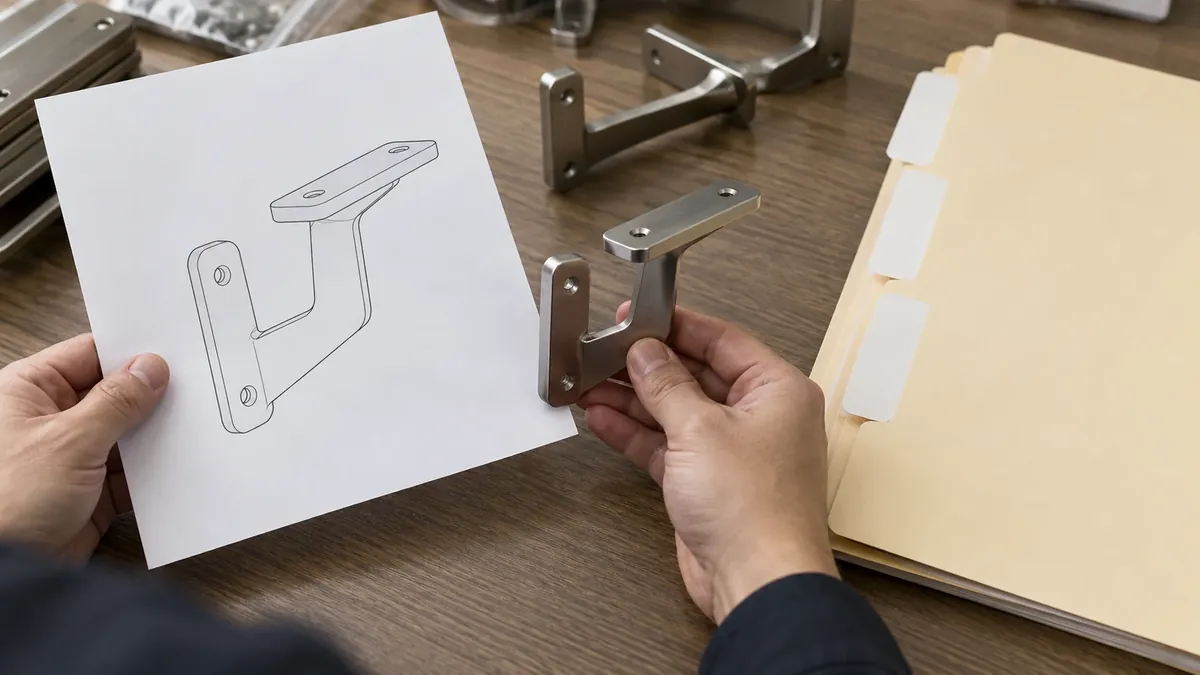
Define what product and design are under review
Start with the exact product configuration. A product family name is not enough. Identify the body shape, dimensions, visible features, material and finish, accessories, packaging, graphics, logo, and any design changes requested by the buyer. Include drawings, CAD files, reference photos, samples, and revision identifiers. The more closely the decision relates to appearance, the more important it is to preserve views that show the complete design.
Separate the product into elements where helpful: a metal frame, mounting bracket, decorative pattern, handle, hook, surface treatment, logo, packaging artwork, and instruction graphics may raise different questions. Some features may be functional, some ornamental, and some may include another party’s mark or artwork. This article does not determine how any feature is legally protected; that is for counsel in the relevant market.
Record the source of each design element:
- Created by the buyer or its designer.
- Supplied by the manufacturer as an existing model.
- Adapted from a physical reference sample.
- Based on public product images or a competitor example.
- Designed jointly by multiple parties.
- Purchased or licensed from another source.
Do not assume a design is free to use because it appears in a catalog, online marketplace, or public database. Public visibility is not the same as permission to manufacture or sell. Likewise, do not assume every similar-looking product infringes a right. Similarity, scope, status, ownership, territory, and other legal issues require professional analysis.
Identify the markets and commercial roles
Rights are territorial and the relevant questions may differ between the manufacturing location, import destination, and sales markets. List every country or region where the product may be made, imported, distributed, advertised, or sold. Include marketplaces and intended private-label channels if known. A supplier’s experience in one country does not establish clearance in another.
Clarify who is responsible for which part of the project:
- Who provides the design and reference?
- Who creates or modifies drawings and CAD?
- Who selects materials, finishes, and components?
- Who owns or controls the tooling and production files?
- Who will apply the brand and packaging?
- Who imports and sells in each market?
- Who will obtain professional advice and make the release decision?
These are project facts for counsel to review, not conclusions about legal liability. A contract or supplier statement may describe responsibilities, but it should be assessed by the buyer’s legal adviser in context. Do not rely on an informal assurance such as “we have sold this before” as a substitute for a documented rights review.
Ask the supplier for evidence and a clear statement
If a supplier proposes an existing design, ask for its model identifier, product history, and any documents it is authorized to share about design ownership or permission. If the supplier says it has a license, request the license scope and the markets, products, uses, and period it covers. The buyer should not assume that permission for one brand, product, or territory extends to another.
If the design is said to be buyer-created, preserve the dated design files, author and agency records, development instructions, invoices, and communications showing how the design was created and transferred. If a third-party designer or agency participated, ask counsel what documents are needed to establish the buyer’s rights to use and modify the work. The article does not prescribe a contract clause or guarantee that a particular record is sufficient.
If the supplier modifies a reference design, document what changed and who requested or created those changes. A small visual modification should not be treated as a safe harbor. There is no percentage-change rule in this guide, and buyers should not rely on a casual claim that changing a certain feature makes a product safe.
Useful supplier questions include:
- Is this an existing supplier model, a buyer-provided design, or a joint development?
- Which drawings, samples, CAD files, or catalog images define the quoted version?
- Does the supplier claim permission to manufacture and sell this product in the proposed markets?
- Is any license, authorization, or ownership document available for counsel to review?
- Are any components, patterns, graphics, or accessories provided by another party?
- What changes have been made from the reference and by whom?
- Will the supplier notify the buyer before substituting a design or component?
Record the answer as a supplier statement and attach the supporting document. Do not rewrite an unverified statement as a confirmed legal fact.
Prepare a focused search and evidence dossier
Public search tools can help counsel identify potentially relevant records and owners, but a preliminary search has limits. The USPTO Patent Public Search tool provides access to U.S. patents and published patent applications. WIPO’s Global Design Database covers international designs and participating national or regional collections. WIPO notes that its database may not include every relevant register and that users may need to search national or regional offices as well. Its terms also state that search results do not express a legal opinion about conflicts between designs.
These tools can support a research handoff, not a clearance conclusion. A search with no obvious match does not prove that no relevant right exists. A search result that looks similar does not by itself establish infringement. Records can be incomplete, status can require interpretation, and design representations can be difficult to compare. Counsel may need to review other right types, official records, ownership, status, territories, and product details.
For a professional review, assemble:
- Product drawings and a dated sample or photographs from all relevant angles.
- The exact product and packaging revision.
- The supplier’s model number and description.
- The buyer’s requested modifications and design history.
- Names of designers, agencies, manufacturers, and other contributors.
- Supplier statements, licenses, authorizations, and ownership documents.
- Intended manufacturing, import, advertising, and sales markets.
- Any potentially relevant records or search results already found.
- Commercial timing, planned tooling, and whether a launch is pending.
Keep the search notes factual: search tool, date, terms, filters, markets or collections, and records reviewed. Do not label the product “cleared” because a search returned no results. The scope and legal significance of a search should be determined by qualified counsel.

Review more than design patents
A buyer’s phrase “design patent check” may be shorthand for broader questions. Depending on the product and market, a professional may need to consider design rights or registrations, utility patents, trademarks, copyright, trade dress, contracts, licenses, and other rights. Which categories matter depends on the product’s features and the commercial activity. This article does not provide a complete list for every jurisdiction.
For hardware, the review may need to distinguish the product’s ornamental appearance from functional features, a brand logo from a product shape, and supplier-created artwork from buyer-provided graphics. Packaging and product names can raise questions separate from the physical metal item. Ask counsel to define the scope rather than assuming that one patent database answers every issue.
If a buyer is inspired by a competitor’s product, preserve the source material and document which functions or requirements matter. Ask an independent designer or qualified professional to assess the brief before directing a factory to copy a recognizable appearance. Do not send a competitor’s design and request “the same but with our logo” without a review of rights and project risk.
Keep tooling and samples inside the decision gate
Tooling, samples, and production commitments can create commercial pressure to proceed. Treat a rights review as an explicit project gate before irreversible spending or launch decisions. Confirm who can pause work, what happens to a sample or tooling already created, and how design revisions are controlled. The exact contractual language should be prepared or reviewed by counsel.
Paying for tooling does not automatically settle every third-party rights question. Tooling ownership and permission to use a design are related but distinct project issues. A buyer should maintain separate records for tooling ownership, CAD access, design authorship, supplier authorization, and market review.
A sample can help counsel understand the design, but it is not a legal determination. Label each sample with its revision, date, source, and changes. If the supplier substitutes a component or alters the appearance after review, update the dossier and ask counsel whether another review is needed.
Maintain change control after approval
A rights review is based on a defined product and set of facts. Later changes may affect the review: a new handle, ornamental opening, logo, decorative edge, packaging illustration, component, supplier, or sales market. Establish a change-control process that routes relevant modifications to the responsible buyer and counsel before production or launch.
Maintain a revision log with:
- Old and new design revisions.
- Description and reason for the change.
- Person or organization requesting and creating it.
- Sample, drawing, and packaging affected.
- Markets or channels affected.
- Whether professional review was requested and completed.
- Release decision and responsible owner.
Do not assume that a previous review automatically covers an altered design or a new country. The buyer should ask counsel what changes require reassessment.
Specify how the design patent check before importing sample will be measured, installed, and approved before production release.
A responsibility and evidence table
| Topic | Buyer or project team prepares | Supplier can provide | Qualified professional assesses |
|---|---|---|---|
| Product identity | Drawing, sample, revision, markets | Model number, production configuration | Relevant legal questions and scope |
| Design history | Design files, authors, instructions | Existing model and modification records | Ownership, permissions, and rights implications |
| Supplier statement | Questions and required markets | Written role, authorization documents available | Whether evidence is sufficient |
| Public search | Search notes and records found | Product details or identifiers | Meaning, status, conflicts, and further searches |
| Tooling and production | Spend timing and release gate | Tooling ownership and process facts | Contract and rights issues as needed |
| Change control | Revision log and launch plans | Notice of proposed substitutions | Whether a change needs further review |
This table organizes a handoff; it does not assign legal responsibility or replace a contract.
Questions to take to counsel
The buyer can make a professional review more efficient by asking focused questions:
- Which rights categories and territories should be assessed for this product and activity?
- Is the current information adequate to review the exact design and supplier role?
- What additional searches or official records are appropriate?
- Do supplier documents cover the proposed manufacturing and sales markets?
- Should the design, logo, packaging, or reference use change before tooling?
- What changes after approval should trigger another review?
- What should be documented before production, import, advertising, and sale?
The professional may need more facts before answering. A search tool or supplier statement alone should not be treated as the final decision.
Sourcing takeaway
Before importing a private-label hardware design, identify the exact product and markets, document who created or supplied each design element, request relevant supplier evidence, and assemble a dated dossier for qualified IP counsel. Public databases are useful research tools, but no search result in this guide is a clearance opinion. Keep tooling, production, and launch decisions within a defined review and change-control process.
For metal product development context, see Koitor’s OEM home-storage hardware information. Share only the manufacturing facts the factory can confirm; have a qualified professional assess the legal questions.
Discuss Your Before Importing a Private-Label Hardware Design Specification
OEM / العلامة التجارية الخاصة
حوّل دليل التوريد هذا إلى موجز منتج
يرجى إطلاعنا على المنتج المستهدف، والحجم، والتشطيب، وكمية الطلب، ومتطلبات التغليف. وسيتلقى فريقك تقييمًا عمليًّا لإمكانية التصنيع قبل تقديم عرض الأسعار.

 English
 Español
 Português
 Français
 Deutsch
 العربية