

A bathroom medicine cabinet organizer should be approved against a defined cabinet interior, not just the cabinet’s advertised outside width or a broad “fits most” phrase. Importers need to record the clear opening, usable width and depth, shelf position, door and hinge sweep, insert envelope, access path, and the sample configuration used for approval. A cabinet insert that fits one measured model does not automatically fit every model in the same retail category. This guide covers bathroom storage inserts for toiletries and personal-care products; it does not cover medication handling, healthcare storage, or a claim that Koitor manufactures medicine cabinets.
What Does “Fits a Medicine Cabinet” Mean?
The phrase can describe several different assemblies. A buyer may be sourcing a removable shelf insert, a freestanding tray, a wire basket that rests on a shelf, a door-mounted pocket, a modular caddy, or a cabinet with its own internal organizer. Each design has a different envelope and a different path into the cabinet. A product page that lists a width and depth may not explain whether the unit must be tilted through the opening, positioned around a hinge, or installed after a shelf is removed.
Separate three decisions:
- Cabinet fit: Can the insert pass through the opening, occupy the intended shelf or mounting location, and remain clear of the door and surrounding parts?
- Product access: Can the user reach and remove the intended toiletry items without lifting or dismantling the cabinet insert in an unplanned way?
- SKU compatibility: Which named cabinet models, interior dimensions, door configurations, shelf arrangements, or measured ranges has the buyer actually reviewed?
The importer’s job is to turn those decisions into a controlled product brief. The cabinet’s retail name or nominal width is not a sufficient datum. Two cabinets with similar exterior dimensions may use different interior frames, door thicknesses, shelf positions, hinge arms, or mounting arrangements. A recessed cabinet and a surface-mounted cabinet can also differ in wall opening and room projection even if the visible mirror face looks similar.
Koitor’s existing recessed versus surface-mount cabinet guide addresses the outer cabinet-format decision. This article focuses on the insert inside the cabinet. Keeping the two questions separate helps an assortment team avoid using cabinet installation data as evidence that an organizer fits the interior.
Search results for “medicine cabinet organizer” can also mix bathroom cabinet accessories with pill cases and other medication organizers. State the intended product clearly in the title, image, SKU description, packaging and listing. For this article, “medicine cabinet” means the bathroom furniture or mirrored cabinet; it does not mean a pill organizer or a healthcare product. Public category pages can establish the broader assortment context without proving that a specific insert fits. For example, KB Kitchen & Bath Wholesalers lists bathroom organizers in its cabinet-organizer range; each insert still needs SKU-level interior and door-clearance evidence.
Which Dimensions Should Importers Measure?
Measure the usable cabinet at the exact location where the insert will sit. Do not rely on one front-facing width measurement. A simple, reproducible method is to identify the cabinet model or sample, mark the measurement datums, record units, and take measurements at the shelf height and door position that matter to the proposed insert.
| Cabinet or insert input | What to record | Why it matters |
|---|---|---|
| Clear opening width | Narrowest opening and location of the measurement | The insert must pass through the opening, not merely fit somewhere inside the cavity |
| Usable internal width | Clear span at the intended shelf or mounting position | Frames, hinge arms, screws and trim can reduce the usable span |
| Usable depth | Front-to-back clear space with door hardware considered | A shelf may be deep enough while the door or mirror back still contacts the insert |
| Vertical clearance | Shelf-to-ceiling space and any adjustable shelf positions | A tall container or tiered insert can block closure or require an impossible insertion angle |
| Door sweep and hardware | Hinge-side intrusion, door thickness, magnet or latch position, and open/close path | The insert should not bind, collide, prevent latching or make the door difficult to use |
| Shelf and support details | Shelf thickness, lip, support pins, fixed or adjustable status, and surface | These determine the insert’s resting interface and available adjustment |
| Insert envelope | Maximum outside width, depth, height, protrusions and required installation path | The product’s nominal dimensions may not capture handles, clips, feet or removable parts |
| Access and removal | Reach path, hand clearance, item extraction and cleaning access | A product may fit geometrically yet make normal use inconvenient |
Record both product dimensions و minimum cabinet clearances if the design needs a larger cavity than the object itself occupies. One manufacturer’s current cabinet-caddy page, for example, distinguishes its listed product size from the minimum cabinet height and depth it asks buyers to provide. Those values apply only to that product’s geometry and mechanism; they are not universal dimensions for medicine-cabinet inserts. The useful lesson is to state the fit envelope separately from the product envelope and explain the reason for any additional clearance. A buyer can review that example on the maker’s Cabinet Caddy SNAP product page.
Take measurements with the cabinet door in both relevant positions. The closed position helps reveal contact and closure problems; the open position can reveal how hinge arms, door-mounted features or a mirrored panel sweep through the interior. If shelves are adjustable, record the selected shelf height and whether the insert depends on that shelf being moved. If the insert must be tilted or rotated to install, record that path and verify it with the sample. Do not assume the owner will remove a shelf or alter a cabinet unless that is part of the product instructions and buyer approval.
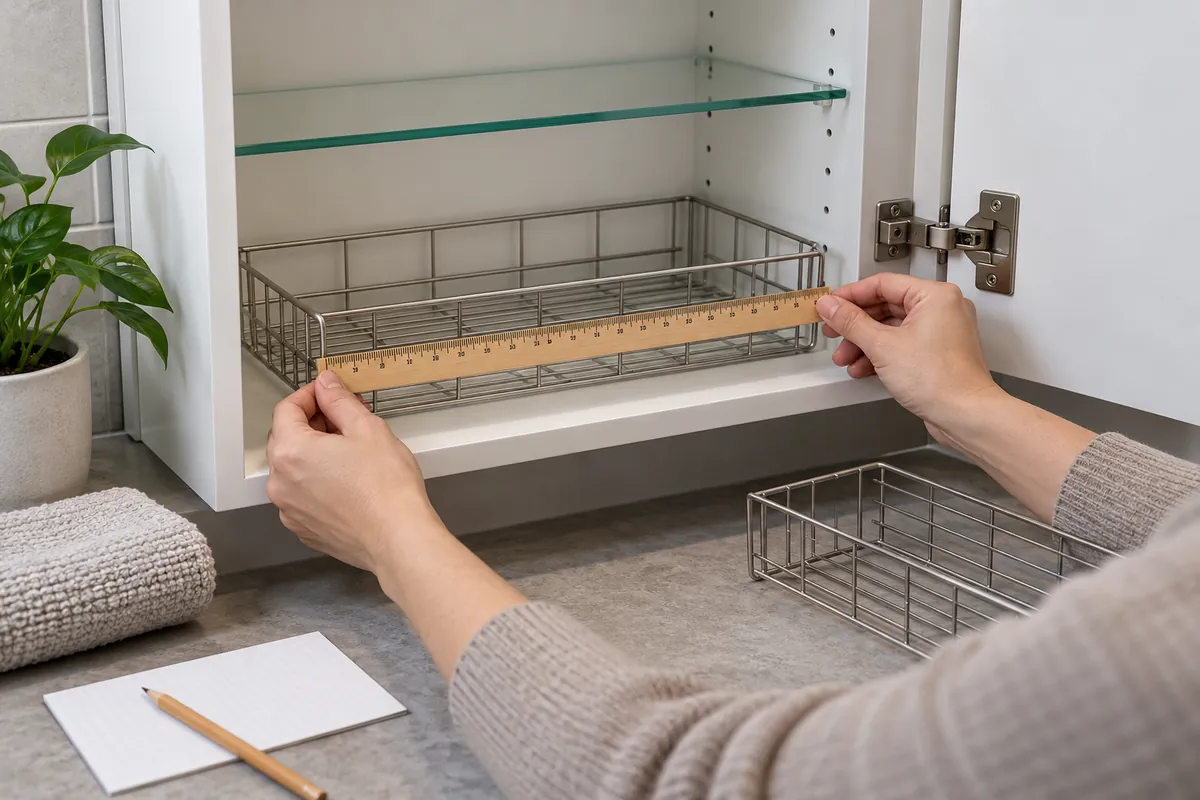
Use a drawing, sample, or scale-referenced photographs to preserve the measurement context. A list of numbers without a datum can be hard to reproduce: “depth” might mean the shelf surface, the cabinet box, the clear distance to the closed mirror, or the space available after hinge intrusion. Note the point from which each dimension starts and ends. When a cabinet varies by product revision or production lot, identify the source and date of the measurement.
There is no single clearance allowance that should be copied across every organizer. Required space depends on the insert shape, cabinet geometry, tolerances, finish, protective feet or liners, and how the product is installed or removed. Ask the design owner to define which dimensions are critical, how the buyer should check them, and what variation is acceptable for the approved cabinet family.
How Do Insert Design and Access Affect SKU Fit?
A fit review should cover how the organizer holds and exposes its intended items. A simple tray, an open wire basket, a divider, a hanging pocket and a multi-level insert do not create the same access or contact conditions. The buyer should identify which items define the use case—such as narrow cosmetic bottles, tubes, jars or grooming tools—and provide representative dimensions rather than writing only “bathroom products.”
For each compartment, check the usable opening, base support, height under a shelf or door, and the direction in which an item is removed. A divider that looks efficient on a plan can leave too little finger space around a container. A high side rail may help keep small items within a tray but can obstruct a taller bottle or cover a label. A wire base can make small caps or narrow containers unstable unless the product design addresses their footprint. These are sample-review questions; they do not prove a universal design rule for every item.
Consider the cabinet’s user routine as well as the static geometry. Does the user take the insert out to clean it? Does it need to be repositioned to reach a cabinet shelf? Are several people sharing a cabinet with different container sizes? Does the buyer want identical organizer modules or separate widths? The answers influence whether the SKU should use fixed compartments, removable dividers, one tray, stacked modules, or no insert at all. Do not add complexity simply to create more sellable variants; each variant needs a clear fit or access reason.
The material and finish brief should reflect the bathroom environment and the intended cleaning routine. Ask which surfaces are visible, which surfaces touch the cabinet, whether a protective foot or liner is part of the approved design, and how the sample is checked for sharp edges or finish damage. If the organizer is metal, forming, weld placement, polishing access, coating thickness and packaging protection may affect fit and appearance. Koitor’s approved expertise supports discussion of metal storage baskets, wire racks, and sample-based OEM review; it does not establish a particular medicine-cabinet insert, test result, or finish life. Any material, finish, edge treatment or fit requirement must be confirmed for the selected project.
The buyer can also review whether the product is meant to sit freely, attach to a shelf, hang over a door or use a permanent fastening method. Each approach changes installation and clearance questions. A free-standing insert must be stable on the specified shelf surface; a hanging design needs the target door thickness and its closing envelope; a fixed design introduces fastener, cabinet-material and installation ownership. Do not combine these mounting systems in one compatibility claim.
How Should Buyers Build and Approve the SKU Matrix?
Build the matrix around cabinet configurations and user requirements, not around an arbitrary set of insert widths. Start with the cabinet models or measured interior families that the buyer can support with actual data. Use a separate row when a hinge location, depth, shelf position, door type, or insertion path changes enough to affect fit.
| SKU field | Example of the record to keep |
|---|---|
| Cabinet reference | Buyer model, internal cabinet ID, revision or measured sample |
| Measurement basis | Drawing, physical cabinet, scale-referenced photos, or supplier drawing |
| Fit envelope | Clear opening, usable width/depth/height, shelf position and door sweep |
| Insert definition | Outside dimensions, compartment layout, rails, dividers, feet and removable parts |
| Intended contents | Container dimensions or representative range and access requirements |
| Approval sample | Sample ID, product revision, cabinet configuration and reviewer |
| Decision and limits | Approved fit cases, excluded variants, open issues and allowed listing wording |
| Packaging and identification | SKU/revision label, protective method and carton distinction |
For a bathroom medicine cabinet organizer assortment, the matrix should make it possible for customer service, receiving and the end user to identify the cabinet family that each insert fits. A broad “universal” label is not a substitute for the compatibility list. If the buyer cannot define cabinet models, the listing can instead describe measured dimensions and make the user’s measurement responsibility clear, provided the fit information is precise and approved.
A sample-approval sequence can be kept short but controlled:
- Select a representative cabinet or cabinet mock-up and identify its revision.
- Measure the opening, usable interior, shelf position, hinge intrusion and closing path.
- Check the insert’s maximum envelope and installation/removal path.
- Load representative containers and confirm access, contact and shelf clearance.
- Record deviations, confirm the correct insert revision, and photograph the approved configuration.
- Decide which other cabinet variants can use the same SKU only after their critical fit points are compared.
- Lock the drawing, sample ID, SKU label, packaging reference and listing language before bulk release.
An existing Koitor guide for mapping pull-out basket widths to a SKU assortment discusses assortment structure in a different cabinet application. Here the product is a shallow bathroom cabinet insert; the useful connection is the discipline of linking a SKU to measured cabinet conditions, not transferring kitchen dimensions or rail specifications.
What Evidence Should Be Captured at Sample Approval?
Keep the sample record specific enough that another reviewer can reproduce it. At minimum, record the insert revision, cabinet reference, measurement datums, intended contents, door and shelf configuration, fit observations, reviewer, date, and approval decision. Add close photographs of hinge-side clearance, the shelf interface, the front opening, and the installed insert. Images support the record but do not replace written measurements.
If the sample does not fit, classify the cause before revising the drawing. A narrow opening may require a smaller outside width; a hinge collision may require a different insertion path or geometry; poor access may call for compartment changes; a protruding liner may change usable depth; and a door that fails to close may indicate an incorrect height, shelf position or compatibility assumption. Change one controlled feature at a time where practical and identify whether the revision changes only the sample or also the target SKU range.
The buyer should separate fit evidence from shipping and product-quality evidence. A carton drop or transit check concerns packaging under its defined conditions; it does not establish that an insert fits a cabinet. A finish check concerns the specified surfaces and method; it does not prove compatibility. A product sample that fits one cabinet does not prove it fits every model with the same nominal outside width. State what each record demonstrates and what remains unknown.
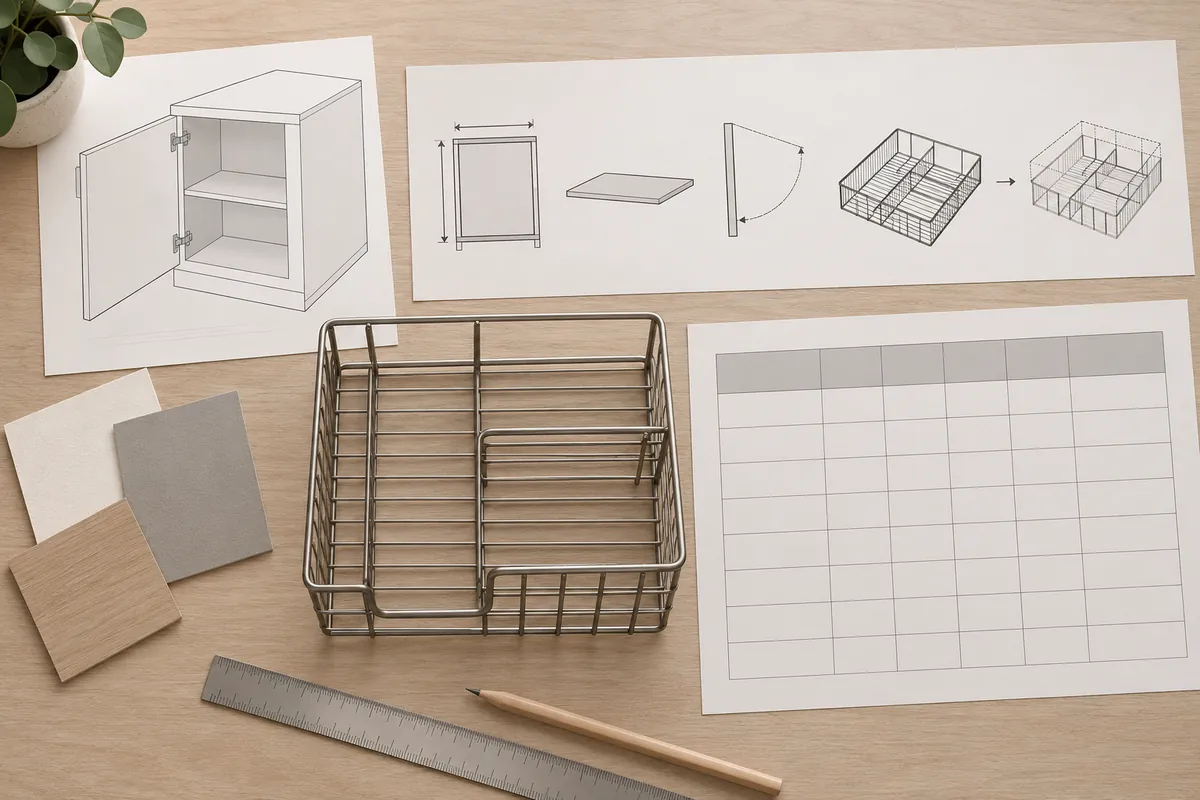
When the product comes from a supplier, ask for a controlled drawing and a clear revision reference. If the supplier cannot see the buyer’s cabinet, the importer should provide measurements or a physical sample and specify which side owns cabinet compatibility. Do not ask a manufacturer to guarantee fit to a cabinet model it has not reviewed. Instead, document the test sample and the boundary of the compatibility statement.
Which Mistakes Cause Fit or Listing Problems?
Using nominal cabinet width as usable insert width. Exterior width may include the cabinet frame, trim or installation structure. Measure the actual interior at the intended shelf position and record the opening separately.
Checking only whether the door closes. A cabinet can close while the insert blocks a shelf adjustment, limits access to small items, or makes removal impractical. Check the use and service path as well as closure.
Copying one product’s dimensions into a new SKU. A current product page may show both product dimensions and a larger required cabinet envelope because of its specific design. Those measurements cannot be transferred to a different insert shape, mechanism or cabinet family.
Using “fits most” without a compatibility basis. The phrase can create a broad promise without explaining which models, sizes or revisions were checked. Prefer a measured range or named configuration list with a documented basis.
Confusing cabinet inserts with under-sink storage. Under-sink organizers must account for pipes, valves, traps and plumbing access. A medicine-cabinet insert has different depth, door, shelf and reach questions. Do not reuse an under-sink fit checklist as if it covered the cabinet above the sink.
Treating a product photograph as a measurement. Perspective, lens angle and hidden obstructions can conceal the usable envelope. Use a drawing, a marked scale reference, or a physical sample when dimensions control purchase approval.
Claiming supplier capability beyond verified facts. Koitor’s company profile confirms metal storage baskets, custom wire racks, and drawing/sample review. It does not confirm current production of medicine cabinets, every type of insert, cabinet hinges, or medical products. A buyer may share a drawing or physical sample for a project-specific discussion, but capability and final fit must be confirmed before a product promise is made.
الأسئلة الشائعة
What should be measured before ordering a bathroom medicine cabinet organizer?
Measure the narrowest clear opening, usable internal width and depth, vertical space, shelf location, hinge and door sweep, and the path required to insert or remove the product. Also check the organizer envelope and the intended containers against the target cabinet.
Are organizer dimensions the same as the cabinet space required?
Not always. A design may need extra space for a door, hinge, installation motion, clearance or an extending component. A supplier should state product dimensions and any separate minimum cabinet envelope; buyers should not assume one is implied by the other.
Can one organizer fit every medicine cabinet?
A broad compatibility claim needs supporting fit evidence across the named models or a clear, buyer-approved measurement range. Cabinet interiors, shelves, hinges and door construction vary. Without that basis, list the conditions the buyer can verify rather than promising universal fit.
Is this article about pill organizers or medication storage?
No. It addresses bathroom furniture inserts used to organize general toiletries and personal-care products. Medication handling, child safety and healthcare storage are outside the article’s scope.
Should an importer approve the sample before finalizing the SKU matrix?
Yes. The sample should be reviewed in the representative cabinet configuration, with the intended shelf and door setup. Keep the approved sample ID and drawing revision with each SKU record so a later change is not treated as automatically equivalent.
What should the manufacturer receive for a quotation?
Send the target cabinet drawing or sample, measured opening and interior dimensions, shelf and hinge details, intended organizer layout, finish, packaging needs, quantities, and target market. Identify any dimensions or compatibility claims that need explicit approval.
اعمل مع شركة «كويتور» للأدوات
A useful RFQ identifies the cabinet, the clear interior, the intended insert interface, sample requirements and the exact fit statement the buyer wants to support. Koitor can discuss drawings and samples for metal storage concepts within its confirmed manufacturing range; the selected product, cabinet compatibility and any performance claim must be confirmed for the individual project.
Review a Bathroom Storage Insert Concept
Share the cabinet drawing or sample, measured clearances, proposed insert layout, finish and target quantity. Koitor can discuss supplier-side feasibility within confirmed metal-storage capabilities; fit and product scope need project-specific confirmation.
OEM / العلامة التجارية الخاصة
حوّل دليل التوريد هذا إلى موجز منتج
يرجى إطلاعنا على المنتج المستهدف، والحجم، والتشطيب، وكمية الطلب، ومتطلبات التغليف. وسيتلقى فريقك تقييمًا عمليًّا لإمكانية التصنيع قبل تقديم عرض الأسعار.


 English
 Español
 Português
 Français
 Deutsch
 العربية