
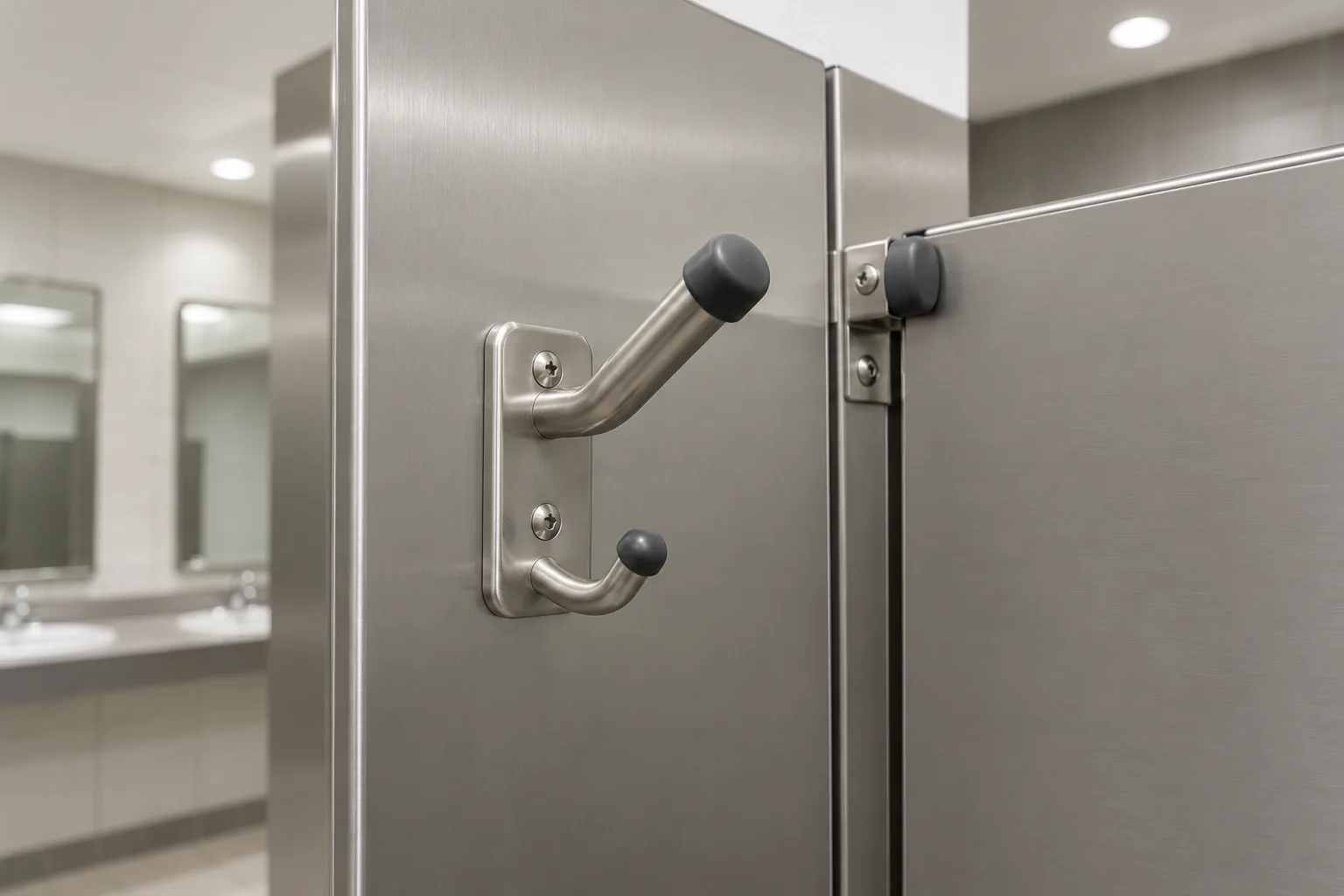
A toilet partition coat hook bumper is a coordinated part: the hook must hold the intended item, the bumper must contact the intended surface, and the mounting must match the named partition or door. Buyers should verify projection, hole pattern, panel construction, door swing, bumper position and replacement-part responsibility before specifying a model. A catalog image does not show the actual contact point or establish impact protection, accessibility compliance or compatibility with every partition. Approve the exact hardware on a representative panel and door configuration.
Why Specify the Hook and Bumper as One Assembly?
A dual-purpose fitting can perform two separate jobs. Buyers comparing a toilet partition coat hook bumper should therefore record the door and panel references together. Its hook presents a place to hang a garment or bag; its bumper may provide a contact surface where a door or panel reaches its intended stop position. Whether those functions occur in the planned location depends on the installation geometry. If the bumper is offset from the strike area, the door may contact another surface. If the hook projects too far, it may interfere with movement or adjacent fixtures.
For the toilet partition coat hook bumper, the project definition must include both the hanging point and the strike point. Commercial partition catalogs and technical sheets show hook/bumper variants with different dimensions and mounting details. Treat those documents as model-specific information, not as a universal design rule. The buyer should state which door or panel the bumper is intended to meet and whether the hook will be installed on the door, partition return or another surface. A general phrase such as “coat hook with bumper” does not establish the assembly’s orientation.
This is not the same decision as selecting a robe hook for towel retention or a floor-mounted stop that contacts the bottom of a door. K1315 focuses on the partition-mounted combined fitting and its actual strike surface. The project schedule should identify the product location and function so the installer does not infer the intended orientation from a generic symbol.
Which Dimensions and Site Details Should the RFQ Include?
Start with the partition system: supplier, model, panel material, thickness, edge or core construction, and any available installation drawing. Note the door width, hinge side and swing direction. Mark the hook/bumper location on an elevation or plan and identify the intended contact target. Where the target is a door, show its closed position and the adjacent surface it is expected to meet.
Record the fitting’s overall projection, mounting footprint and hole spacing from the supplier’s drawing. Add the bumper’s material description and replaceability if the manufacturer provides those details. The project team should not assume that a supplied fastener is appropriate for an unverified panel. Have the partition manufacturer or installer confirm the mounting condition for the actual system.
| RFQ field | Buyer evidence | Decision it supports |
|---|---|---|
| Partition system | Supplier, model, panel material and thickness | Establishes the substrate being reviewed |
| Door geometry | Width, hinge, swing and closed position | Locates the bumper contact target |
| Fitting dimensions | Projection, hole spacing and mounting outline | Checks installation fit and reach |
| Hook use | Intended garment or bag context | Clarifies the required usable shape |
| Bumper detail | Position, material and replacement basis | Identifies contact and service questions |
| Fixing responsibility | Supplied hardware and installer review | Prevents site assumptions being hidden |
| Finish and pack | Finish reference, code and packaging unit | Aligns sample, quotation and reorder |
If the project has several partition models or handed door layouts, create one row for each condition. Do not assume that a single fitting placement works across all stalls. A model can be standardized only after the intended panel and contact geometry have been defined for the range.
How Should Buyers Review Contact and Door Swing?
Use the actual door or a dimensionally controlled mock-up. Open and close it through its planned path and note where the bumper lands. Confirm whether the fitting, hook or bumper touches the intended surface first. Look for a projection that causes contact with a latch, wall return, adjacent fixture or the wrong part of the door. A static photo of the closed configuration cannot show the full movement path.
The trial should be documented as an observation, not as an impact test. Note the panel, door, mounting setup, fitting revision and contact point. If the project requires a particular impact, noise or durability performance, define the requirement and test method with the responsible supplier and design team. Do not infer a force rating from a rubber or plastic bumper appearing soft, or assume that the presence of a bumper prevents damage under every condition.
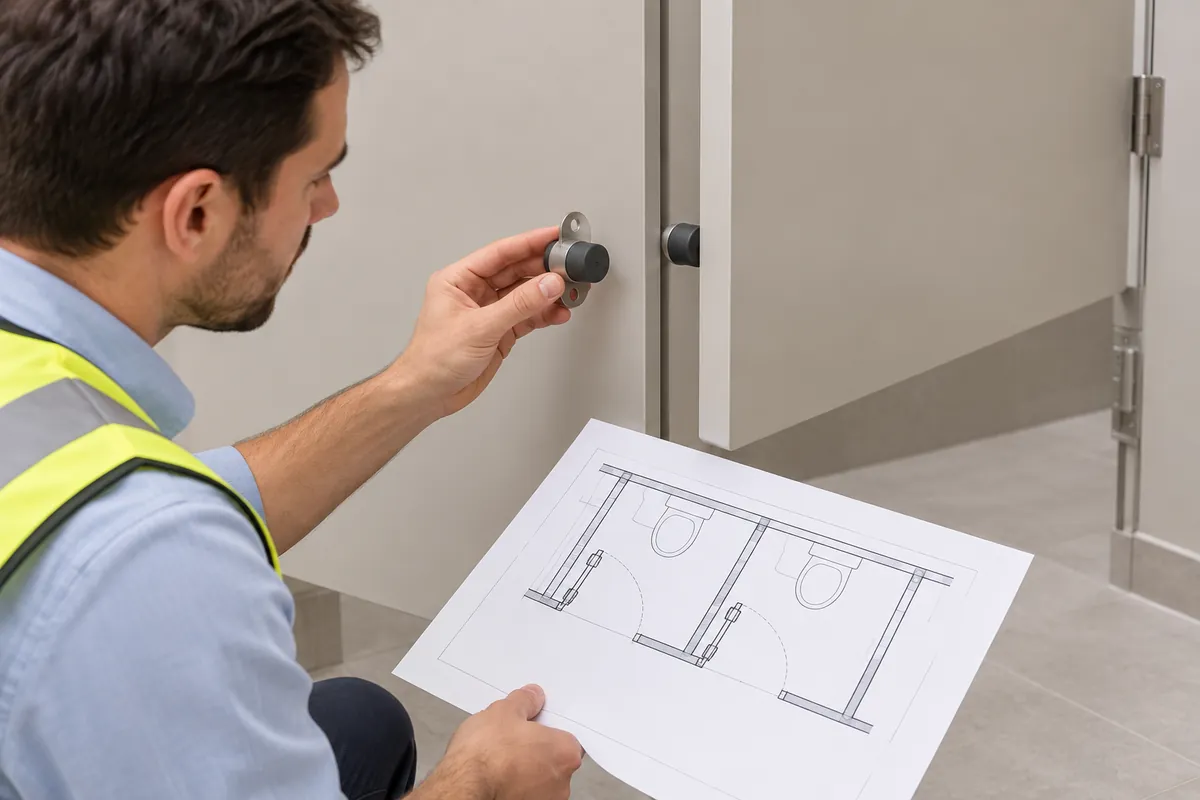
Inspect the bumper-to-surface relationship after mounting. A gap may mean the fitting does not touch as intended, while constant pressure may affect the door or adjacent panel; what is acceptable depends on the specified product and installation. Record whether the bumper is adjustable, fixed or replaceable only when supplier documentation supports that description. Never modify the installation in the field without approval from the responsible project parties.
What Should the Physical Sample Establish?
The sample should confirm that the fitting’s mounting pattern aligns with the specified panel and that the hook and bumper occupy the intended positions. It should also reveal finish, edge, assembly and component details on the exact model. It does not establish compatibility with all panels, a certified mounting method, a quantified impact result or long-term durability.
Use the controlled panel or door assembly, with fasteners and backing identified. Record the product code and drawing revision. Check that the fitting can be mounted in the documented orientation, that the hook is accessible in the intended location, and that the bumper meets the designated surface during the normal door swing. Ask the partition supplier or installer to confirm the panel-side fixing assumptions.
Review replacement needs before approving the component. If the bumper pad is a separate part, record its part number and whether it can be replaced under the supplier’s instructions. If it is integrated, clarify whether the assembly must be replaced when the bumper wears or is damaged. Do not assume parts will remain available unless the supplier confirms the service program. A buyer can request identification photos and a replacement part listing as part of the submittal.
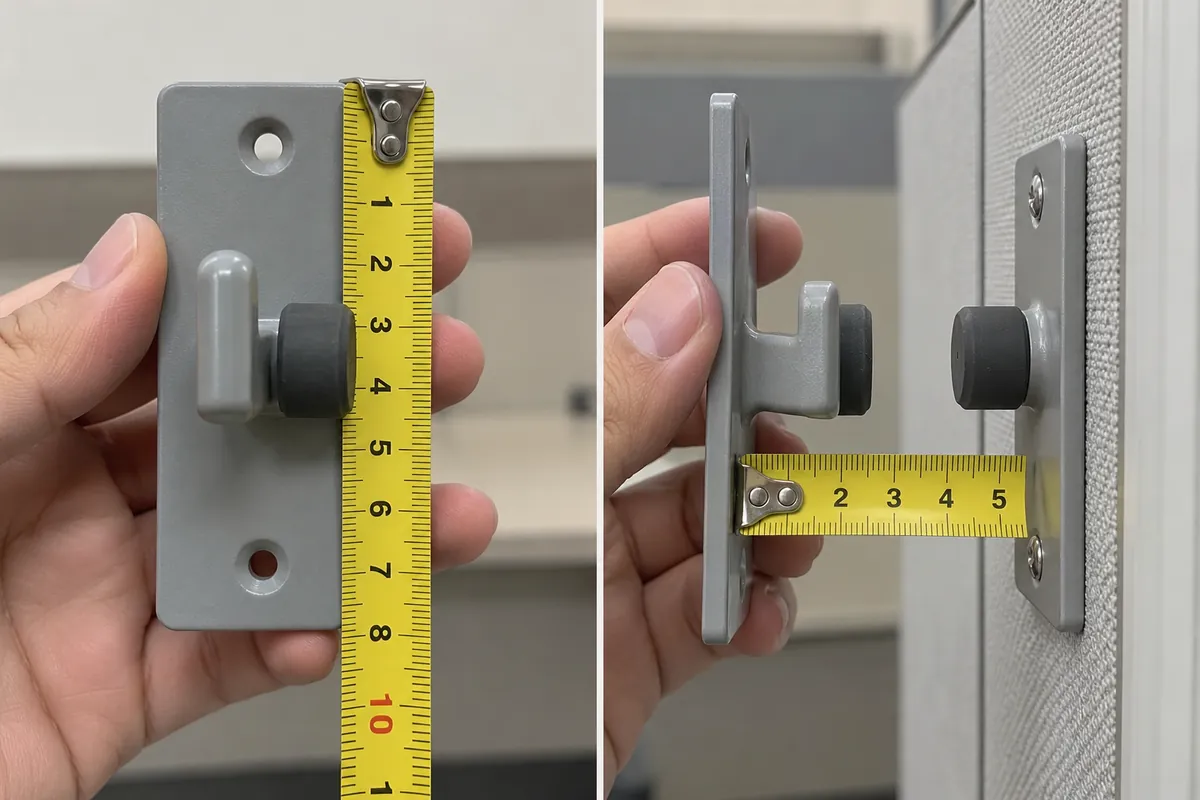
The approval record should include: partition and door references; hook/bumper model; overall and mounting dimensions; finish; sample panel and fixing setup; observed door contact; deviations and unresolved evidence; bumper spare or replacement item; and the person approving each project assumption. Tie the record to the purchase code and revision so later substitutions are visible.
How Do Buyers Compare Quotations and Replacements?
Normalize the quote scope. Ask each supplier to state whether the price covers one combined fitting, a hook and separate bumper, fasteners, backplates, replacement pads, instructions and packaging. Compare material and finish descriptions on the same basis. If one supplier offers a surface-mounted item and another a different mounting arrangement, the products are not like-for-like.
Request a dimensioned drawing, product sheet and sample policy. Any claim about impact reduction, vandal resistance, load, accessibility or durability should be tied to a defined model and supporting evidence. If evidence is absent, record the feature as an unverified claim and do not use it as a project acceptance criterion. A photograph may explain a design but cannot confirm material, performance or mounting.
For replacement planning, identify the assembly code and any separate bumper component code. Clarify how a replacement pad is ordered, how finish or color variants are distinguished and whether the distributor maintains compatible stock. If the entire item is replaced, plan the correct pack quantity and ensure the substitute is reviewed against the same panel and door. A local replacement that changes the projection or contact point may affect the installation.
#Before a project closes, include maintenance staff in the review. Ask how the bumper is identified for replacement, whether cleaning access reaches the contact surface, and which product code belongs on a spare-parts request. If the partition supplier changes panel thickness or the door hardware changes its closing position, the strike point may move; define those as review triggers. This is a coordination safeguard, not a guarantee that a specific bumper prevents impact damage. Keep maintenance observations and installation sign-off with the project record so that a later replacement can be matched to the original geometry.
What Common Specification Errors Should Be Avoided?
Only listing the product name. Add the panel, door, mounting position and contact target.
Using the closed-door photo as the only fit check. Examine the full opening and closing path.
Treating the bumper as a tested safeguard. A component’s presence is not an impact rating or damage-prevention guarantee.
Ignoring hole pattern and substrate. Confirm the actual panel system and fixing responsibility.
Leaving hook use undefined. Specify the intended hanging function without making an unsupported load claim.
Failing to ask about replacement. Identify whether the bumper is a separate service part or part of a complete assembly.
Applying one detail to unlike stalls. Use a matrix when partitions, doors or handedness vary.
How Does Koitor’s Capability Boundary Apply?
Koitor is a family-owned custom metal hardware factory with established bathroom and home-storage hardware work, drawing and sample review, metal forming and joining, finishing, assembly and packaging experience. That background supports general buyer education about preparing an accurate hardware specification. It does not confirm current manufacture of partition hook/bumper assemblies, rubber bumpers, specialist mechanisms, impact testing or accessibility approvals.
For an adjacent product inquiry, provide the fitting drawing or sample, panel system, door geometry, material and finish expectations, project quantity and required evidence. The proposed product scope must be checked against current factory capability before a quotation is made. Do not treat a product category link or factory background as proof that this exact fitting is available.
For broader washroom schedules, see the commercial washroom submittal checklist and the custom bathroom hardware overview. They support related sourcing work but do not claim current manufacture of this assembly. Send a drawing or sample using the project contact page for a scope review.
Buyer Checklist Before Specifying
- Identify the partition manufacturer, system, panel thickness and edge construction.
- Record the door width, hinge side, swing and intended contact surface.
- Add a plan/elevation mark for the fitting location and orientation.
- Obtain the product drawing with overall projection, hole spacing and mounting outline.
- State the intended hook use and any project-specific requirement.
- Confirm bumper location, material description, replaceability and part code.
- Review on a representative panel and door or controlled mock-up.
- Observe contact during the normal swing and record the exact sample revision.
- Assign substrate and fastener approval to the correct project party.
- Request evidence for any performance or compliance claim.
- Normalize supplier quote scope and included hardware.
- Define spare parts, packaging identification and change-control triggers.
الأسئلة الشائعة
Is a coat hook with a bumper suitable for every toilet partition door?
No. Partition thickness, mounting construction, door swing and strike location vary. Check the exact model against the project’s panel and door layout.
Does the bumper mean the door cannot damage the partition?
No universal damage-prevention claim follows from the presence of a bumper. Any project-specific impact or durability requirement needs relevant evidence tied to the selected assembly and installation.
Can a project buyer use the fitting’s supplied screws?
Only if the instructions cover the actual panel and the responsible installer confirms suitability. A fastener supplied with a product is not automatically right for every partition.
Should the bumper be replaceable?
That depends on the product and maintenance plan. Buyers should ask whether it is a separate service part, how it is ordered and whether a replacement preserves the reviewed geometry.
Does a sample prove accessibility compliance?
No. A sample supports product fit review. The design professional must verify applicable requirements for the project and jurisdiction.
What should be submitted with a quotation request?
Send the partition system, door details, contact target, fitting location, dimensions, finish, quantity, sample expectation and any clearly defined evidence requirements.
Discuss a Commercial Bathroom Hardware Project
Share the fitting drawing or sample, partition and door details, finish, replacement requirements and target quantity. Koitor can first confirm whether the product scope fits current capabilities.
OEM / العلامة التجارية الخاصة
حوّل دليل التوريد هذا إلى موجز منتج
يرجى إطلاعنا على المنتج المستهدف، والحجم، والتشطيب، وكمية الطلب، ومتطلبات التغليف. وسيتلقى فريقك تقييمًا عمليًّا لإمكانية التصنيع قبل تقديم عرض الأسعار.
 English
 Español
 Português
 Français
 Deutsch
 العربية