

A kitchen wrap dispenser metal housing specification must describe the roll, refill route, cutter module and enclosure as one controlled assembly. Naming the housing material or giving only an outside size does not confirm that a roll fits, the web follows the intended path, or a separately sourced cutter aligns with its opening. Importers should define who supplies each module and approve the complete sample in its actual refill and use sequence.
Which parts make up the quoted product?
Start with a bill of materials that separates the enclosure from every functional module. A wall-mounted dispenser may combine a housing, paper-roll holder, foil or film compartments, end caps, cutters, covers, mounting components and labels. Some items may be supplied by the housing factory; others may come from a specialist module supplier. The RFQ should state the responsible party for each item, the model or revision, and who confirms the interface between them.
The name “wrap dispenser” can refer to very different offers. A seller might supply a bare housing, a complete appliance, or a multi-compartment holder for paper towels, foil and cling film. The number of compartments, cutter arrangement, opening direction and refill method should be listed rather than inferred from photos. If the product has a separate paper-roll bay and one or more wrap bays, specify which format belongs in each position.
An official Leifheit Parat Royal wall-mounted roll holder page describes a model with a stainless housing, separate storage compartments, opening caps and sliding cutters. It provides an example of a product that combines multiple operations in a defined assembly. It does not establish that another design uses the same material, supplies the same cutters, or accepts the same roll formats. Confirm the current offer and included components before using any comparison in a commercial listing.
For a buyer, the key commercial question is: who owns module compatibility? If the metal-housing supplier selects and installs a cutter, require the module identity and interface to be part of the approved record. If the buyer supplies the cutter, provide the exact drawing or sample and identify the person responsible for confirming fit. A statement that parts are “standard” is not enough when the holder geometry, fastening, blade access or web path is model-specific.
How should refill formats and access be specified?
Identify each consumable roll by material type, brand or approved supplier, core diameter, outside diameter, width, length and revision where those values are available. If the importer is sourcing multiple consumables, list each intended format separately and state whether the dispenser must accept all of them or only a named product. Do not use “standard roll” without naming the standard or providing the physical reference.
Then define how the user reaches the roll. Does the housing open from the front, from a side cap, or by removing an end piece? Is the roll inserted axially or dropped into a cradle? Does a cover need to be lifted while a cutter remains engaged? Each access path should be shown on an assembly drawing with clearance around the hand and the components that move. Refill access is a function of the complete assembly, not just of the compartment width.
Specify the web route from the roll to the dispensing edge. The film may pass through a slot, between a guide and cutter, or around a shaped lip. Record the intended direction and whether the user pulls horizontally or downward. If the module includes an alignment feature, note its relationship to the housing opening. Avoid inferring a cutting result from an attractive product photo; the exact roll, installation and module need to be reviewed together.
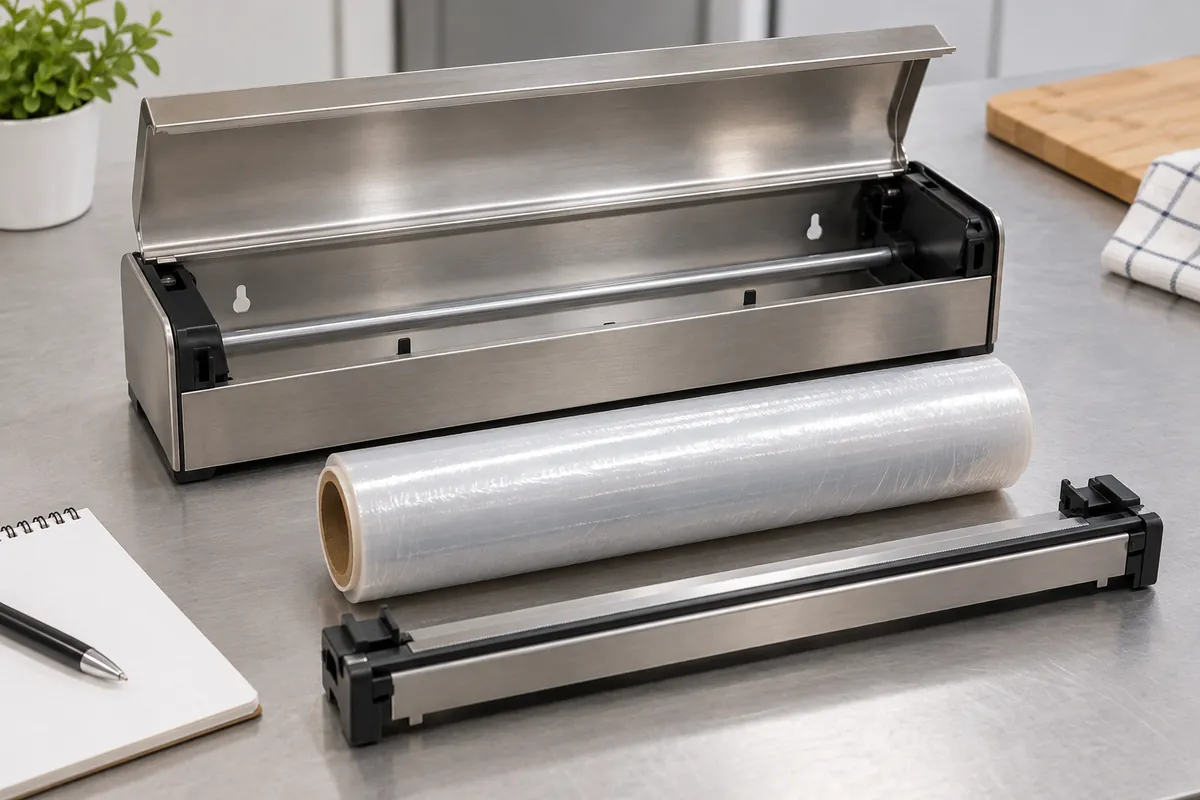
A sample review should reload each roll from the real user access point, route the web and return the cover to its intended position. Repeat for every compartment and each specified roll type. Note if the roll edge is hidden, difficult to locate, or trapped behind a part. The purpose is to identify mismatched interfaces and unclear instructions. It is not a safety certification or a claim about cutting force or injury risk.
The kitchen wrap dispenser metal housing specification should name the source and revision of each cutter and refill module.
Which housing dimensions and interfaces should be controlled?
The drawing should identify the overall envelope, compartment limits, mounting points, door or cap movement, module attachment points and critical openings. Each dimension needs a datum that allows supplier and buyer to refer to the same feature. For example, locate a cutter slot from the housing edge and module mounting plane rather than dimensioning it through a sequence of unrelated rounded values.
Interface dimensions commonly include the roll support width, axial clearance, end-cap position, roll-axis location, web outlet, cutter mounting plane, cover stop and fixing points. The actual critical features depend on the architecture. If a module has adjustment travel or a removable insert, show the usable range and identify any stop or detent. Do not add dimensions from a concept image as though they were production requirements.
A buyer can use this interface matrix:
| Assembly item | Buyer information | Evidence at sample approval |
|---|---|---|
| Roll | Material type, core, width, outside diameter and source | Named roll loaded in the intended bay |
| Refill access | Opening direction and removal sequence | Refill performed with the housing installed as intended |
| Web route | Pull direction and outlet path | Roll is threaded through the approved guides |
| Cutter module | Supplier, model, revision and ownership | Attachment points and alignment reviewed |
| Metal housing | Material, finish and visible faces | Drawing and sample match on controlled features |
| التركيب | Hole pattern, hardware and installation reference | Access to screws and service parts checked |
| التغليف | Contents, dividers, labels and instructions | Packed assembly matches the sold configuration |
If the housing is metal and the functional modules are polymer or another material, define the transition surfaces. A cover can change the outlet clearance; a bracket can shift a cutter; a finish layer can affect a close-fitting insert. These are possible design interactions, not automatic defects. The supplier should identify which interfaces it controls and report any assembly variation that affects the accepted function.
Where surfaces contact a roll or film, state whether the surface is intended to guide, support or simply enclose. A cosmetic edge and a web-contact edge may require different review. The buyer should specify the visible finish, deburring expectation, cleaning instructions and any relevant material restrictions. Do not claim food-contact suitability unless the exact materials, parts and required market evidence have been confirmed by the responsible party.
How can buyers validate refill and dispensing access?
Use a controlled sample set, not a generic roll purchased only for photography. Label each roll reference and keep its dimensions or supplier specification in the review file. Install the dispenser in its intended orientation, refill every compartment, route each web and confirm that the user can reach the end of the material as intended. Record the sequence and identify any orientation-sensitive parts.
Check the assembly with the housing both mounted and unmounted if users may service it in either condition. A dispenser can be easy to refill on a bench but difficult to open when fixed close to a cabinet or backsplash. If the selling package requires wall installation, the sample should be tested at the stated mounting clearance. If buyers may use the unit on a counter, validate that configuration separately rather than assuming a wall-mounted sample represents it.
For the cutter module, confirm physical alignment, fastener access, moving-part clearance and replacement responsibility. If the module is replaced as one unit, define the part number and spare-parts route. If the housing factory purchases it, ensure the procurement spec controls its model and revision. If the buyer provides it, state whether the supplier is responsible for fit-up only or for a broader functional assessment.
Record pass, hold and deviation results. A pass might say that a named roll was loaded through the specified side opening and the web exited through the intended slot without contacting a conflicting edge. A hold might be used when one roll reference has not yet arrived. A deviation should state the part or dimension, the approver and the follow-up drawing revision. Such a record prevents a later replacement module from being treated as identical without review.
Freeze the kitchen wrap dispenser metal housing specification with the roll list, opening dimensions and responsible party for later changes.
What production and packaging questions affect the metal enclosure?
A metal housing may be cut, formed, joined, finished and assembled in stages. The buyer should review the sequence for features that affect fit, such as close openings, return flanges and mounting points. If a coating or other finish is applied, identify the surfaces that must remain free for module attachment or movement. A supplier should respond with a project-specific capability review; the buyer should not assume that a finish name proves fit or durability.
The assembly drawing should distinguish purchased modules from metal components and identify substitutions that require written approval. If the module supplier revises a cutter or cap, check the attachment and outlet interfaces again. If the housing drawing changes, re-evaluate the roll path and access. A change record should connect every approved component revision to the production order.
Packaging must keep loose caps, fasteners, cutters and instructions associated with the correct dispenser version. Separators may be needed to protect visible faces and prevent moving modules from rubbing the housing. The package should indicate whether the unit is supplied assembled or requires user assembly, and the instruction sheet should match the included pieces. Test the real package under the buyer’s distribution protocol if transit evidence is required; no carton description alone guarantees damage-free arrival.
Koitor’s documented product scope includes metal bathroom and home-storage hardware. Its kitchen storage manufacturing page provides that context, but does not confirm a wrap dispenser or cutter-module product. For a new concept, share the housing drawing and specify which specialist parts are buyer-supplied; اتصل بـ «كويتور» to ask whether the metal enclosure and assembly scope are feasible. Any module sourcing or product claim must be agreed separately.
What mistakes should buyers prevent before a launch?
A common mistake is quoting an outside housing size and leaving all internal interfaces until after a metal sample is made. That can produce an enclosure that looks correct but needs a new module bracket, opening or cover clearance. Send module references and a basic assembly layout with the first RFQ.
Another mistake is using roll width as the only refill check. Core, outside diameter, axial movement and direction of insertion can all affect the holder. A sample should include the widest intended roll and any roll with a different core or guide shape.
A third mistake is leaving component ownership unclear. If the quote says “cutter included” but does not name who selects, purchases and replaces it, a later revision may create a fit dispute. List the module provider and responsible approver for each interface.
A fourth is testing the web path once with a fresh roll. The buyer should establish what refill state or operating condition matters and test the unit across the meaningful range without claiming an unverified lifespan. The test record should tell the next reviewer exactly which roll and configuration were used.
A fifth is making a safety, food-contact or cleaning statement from appearance. Metal housing, a concealed edge or a smooth-looking surface does not by itself establish compliance or safe operation. Confirm the relevant part materials and evidence with the responsible suppliers before making market claims.
What should appear in the importer’s approval checklist?
Before quotation, provide the product boundary, drawings, module models, rolls, mounting mode, material and finish requirements, target quantity, labeling and package expectations. Identify which components the seller supplies and which are buyer-provided. State the market claims that need evidence and name the party responsible for that evidence.
Before sample approval, load the real rolls, complete the refill sequence, trace the web route, inspect the cutter-to-housing interface, check covers and caps, confirm mounting clearance, and record each part revision. Resolve every hold and deviation before approving the production reference. At shipment, compare the packed contents, labels and instructions to the approved configuration.
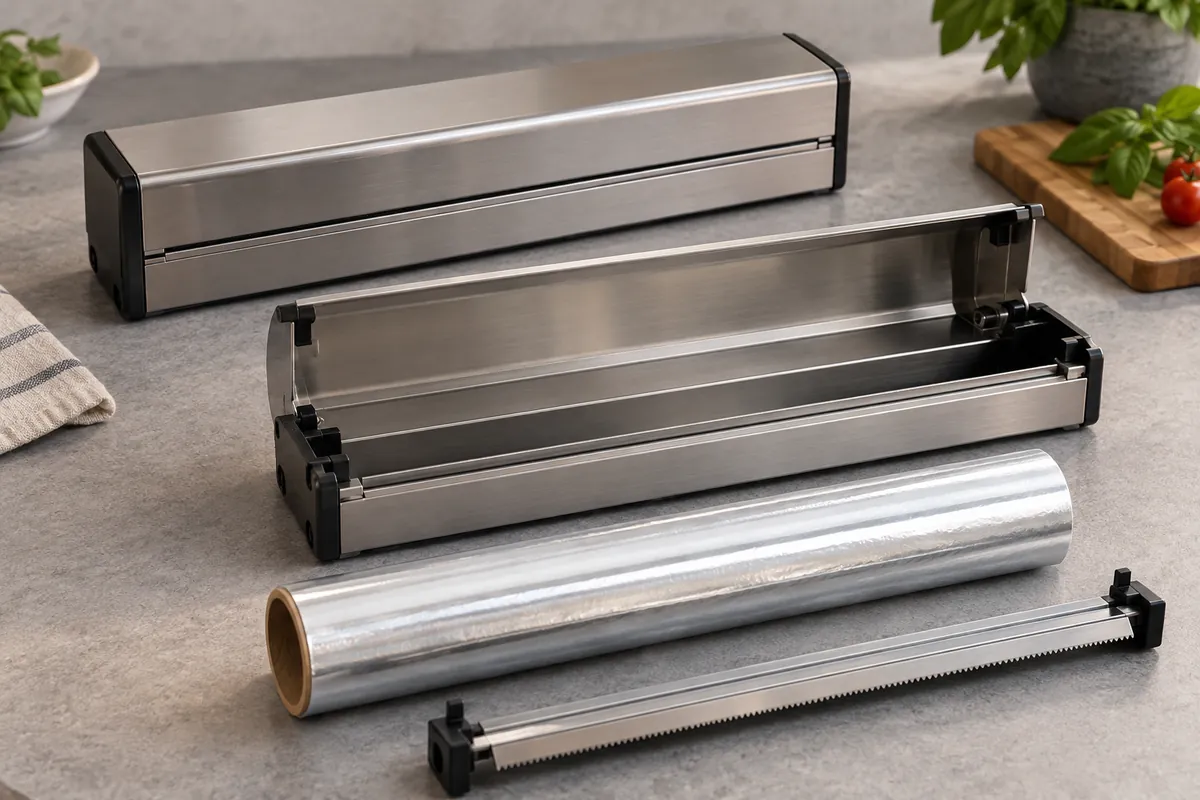
Does a metal housing prove that every dispenser component is metal?
No. The bill of materials must identify the enclosure and each module separately. Verify all materials that matter to the buyer’s specification.
Can a dispenser be approved using only a roll-width measurement?
No. Core, outside diameter, holder support, refill direction and web path also affect the interface.
Who should approve a cutter module supplied by another vendor?
The order should name a responsible party. The buyer, module vendor and housing supplier should agree who confirms fit and who approves changes.
Does a sample establish long-term dispensing performance?
Only if the sample test included a defined method and acceptance criterion for that performance. A basic refill and fit review has a narrower scope.
Reference example: Leifheit Parat Royal wall-mounted roll holder shows one named multi-compartment product arrangement; verify current model components and instructions directly.
Review a metal housing concept with Koitor
Send the housing drawing, roll references and module list. Koitor can assess the proposed metalwork against its documented capabilities before any component or performance scope is assumed.
OEM / العلامة التجارية الخاصة
حوّل دليل التوريد هذا إلى موجز منتج
يرجى إطلاعنا على المنتج المستهدف، والحجم، والتشطيب، وكمية الطلب، ومتطلبات التغليف. وسيتلقى فريقك تقييمًا عمليًّا لإمكانية التصنيع قبل تقديم عرض الأسعار.



 English
 Español
 Português
 Français
 Deutsch
 العربية