
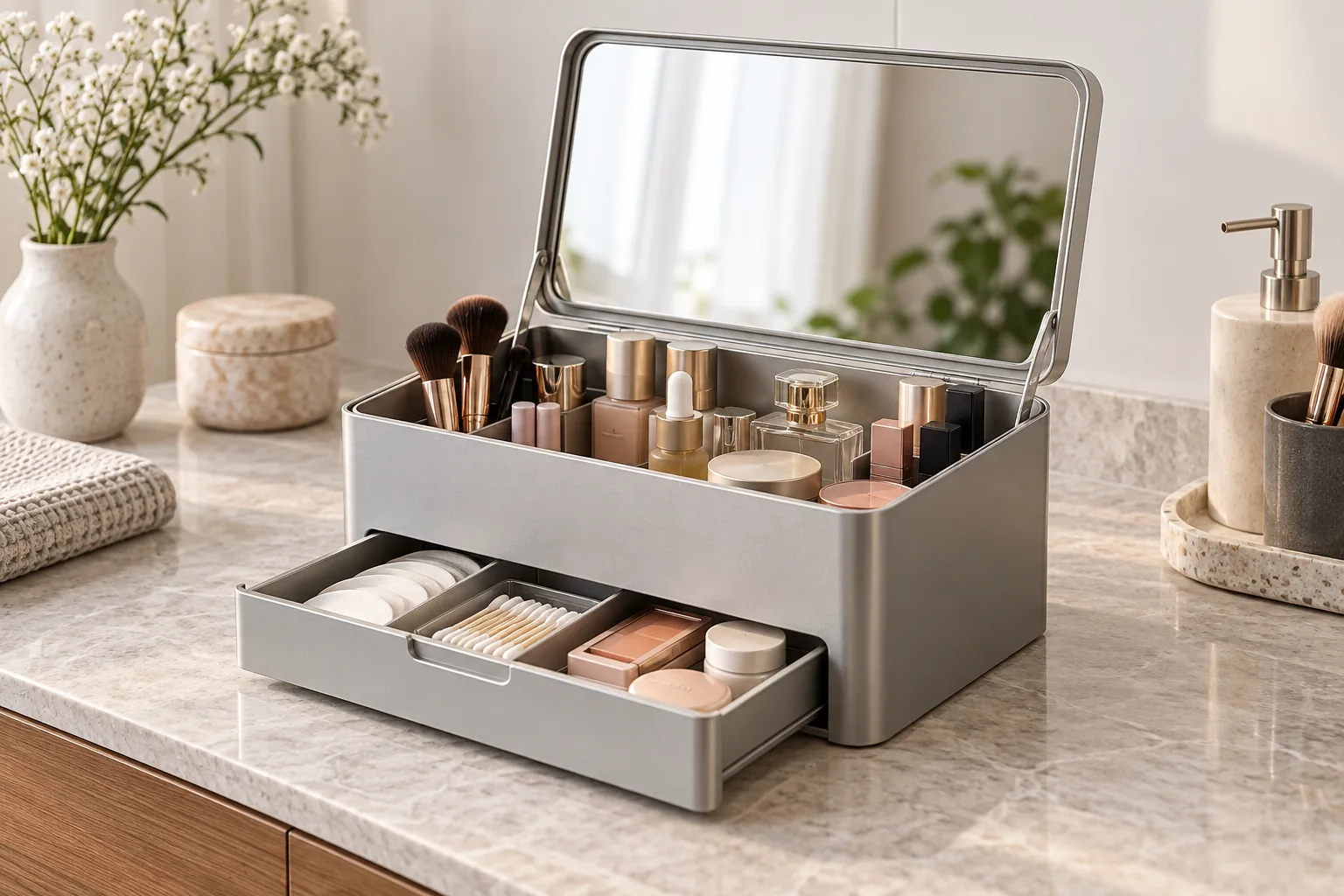
Metal makeup storage box tray fit should be approved across the complete use sequence, not by checking only the closed outside dimensions. Buyers need to confirm the stored-item references, sliding-tray travel, removable mirror-lid position and access to the lower compartment. A stationary metal box may look simple, but every moving or removable part creates an interface that should be shown in the drawing and tested with the intended contents.
What exactly is included in the storage box?
Start with the bill of materials. Separate the metal body from trays, dividers, removable lid, mirror, handle, feet, liners and any purchased components. The word “makeup box” can mean a bare container, a compartmented organizer, a portable case or a vanity unit with a mirror. The quotation and listing should say which one is being sold and whether cosmetics or accessories shown in photographs are included.
Record each part’s material and source only when confirmed. A metal shell may be combined with polymer trays, a wood cover, a mirror or other materials. Treat those as separate components with their own specifications and suppliers. Do not infer that the body, tray and lid share the same construction because they appear in one image. If a material claim matters to a retailer, request the relevant part-specific information and maintain the supplier’s documentation.
A current Yamazaki Home makeup storage box page describes one model-specific arrangement with a steel body, separately identified tray materials and a removable mirrored lid intended to be used in a defined position. It illustrates why a box may have several approved states and material interfaces. It does not establish that every makeup organizer is stationary, uses the same material combination or supports a mirror in the same way. Confirm the live model description and assembly instructions directly.
The buyer should then name the use environment: a dressing table, bathroom vanity, retail gift assortment or another defined location. The environment affects the intended contents, cleaning instructions, placement and customer expectations. Do not make bathroom suitability or moisture claims from a metal body or mirror alone. If the item may be placed near water or cosmetics, describe that context to the supplier and ask for product-specific material and care information.
How should stored-item fit and tray travel be specified?
Build a content set from actual item references rather than generic categories such as lipstick or brush. Record the maximum height, width, base shape and quantity of the products intended for each compartment. Include tubes, compacts, brushes or bottles only if they are part of the buyer’s defined assortment. Product sizes vary; a tray that fits one compact does not automatically accept another.
Map the items into the lower body and each tray. Identify which pieces may be stored upright, which lie flat, and whether a lid or mirror sits above them. A top-down plan helps explain the intended arrangement; a side section shows vertical clearance. The buyer should decide which dimensions are critical and supply physical references when possible. A photograph of cosmetics without scale is insufficient for an acceptance measurement.
For a sliding tray, specify travel direction, usable extension, stop or retention features, and the surfaces that guide movement. Identify whether the tray should be fully removable or only slide to a stop. Check that items remain accessible at the intended extension and do not collide with the lid or lower compartment during movement. If the tray is asymmetric, mark its orientation so it cannot be installed backward without detection.
The sample review should measure clearance in both the retracted and extended positions. Note whether the tray front clears the box edge, whether the hand can reach the contents and whether any stop blocks a second movement. If the design uses runners or tracks, identify those parts and how they attach. Do not claim smooth operation or a cycle life unless a test protocol and result are available for the specific model.
What should the mirror lid do in each state?
Define how the lid is removed, where it is placed, and how it is intended to be supported during use. If the mirror is used while the lid rests in a particular orientation, specify the feet, edge, support point or bracket involved. A removable lid and a hinged lid are different arrangements; do not use the terms interchangeably in a product listing.
Create a state diagram or a simple series of photos: box closed; lid removed; lid in its specified use position; tray retracted; tray extended; and contents accessed. For each state, record which parts remain attached, where the user places the lid and whether the tray can move. This prevents an attractive photo from implying an unsupported arrangement.
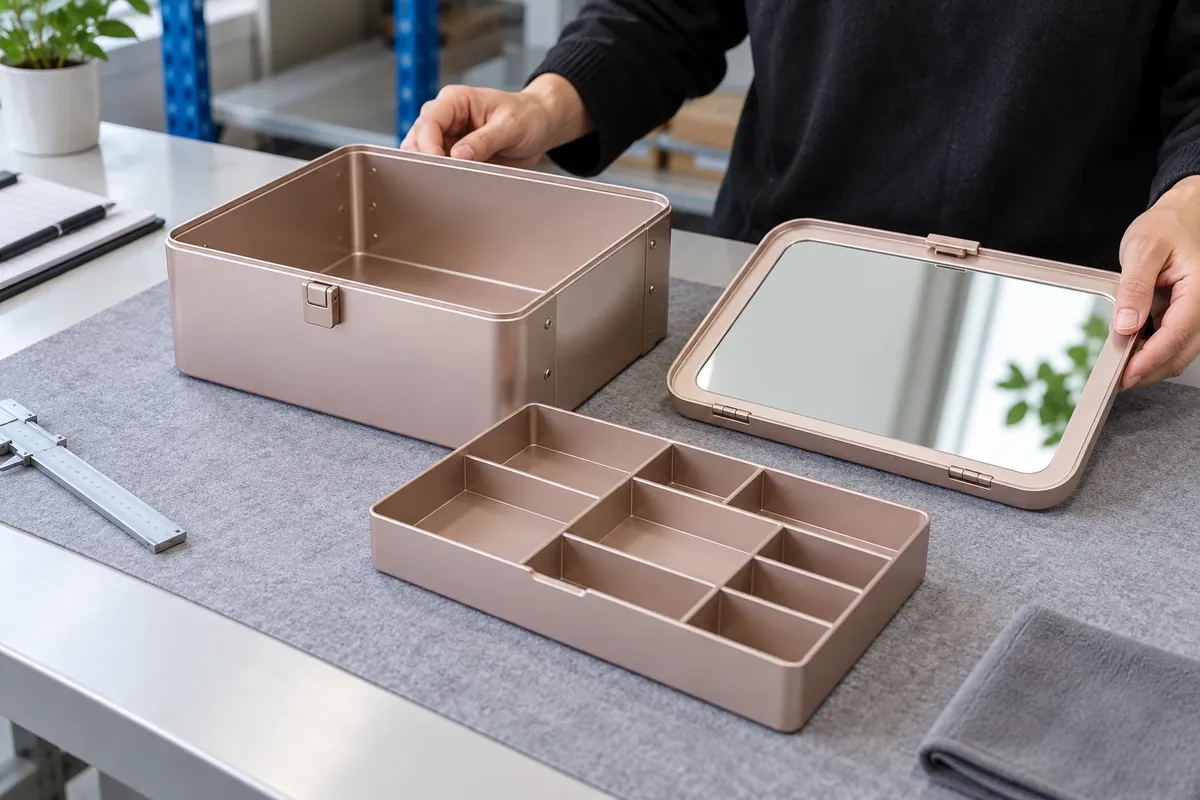
Use the process image to guide inspection of the box body, tray interface and lid contact points. Test with the actual lid and mirror component. Observe whether the removable lid sits at the intended location without rocking or obscuring access; do not convert this observation into a safety statement. If the mirror is fragile or supplied separately, the buyer should also define protective packaging and the responsible party for replacement.
A complete sample record should identify the mirror part and revision, whether it is included in the box set, and how it is protected when closed or shipped. If a buyer changes from one mirror thickness, backing or supplier to another, the interface and packed envelope should be reviewed again. A supplier’s generic “mirror lid” phrase is not enough to control the part.
Which drawing and sample dimensions matter most?
The drawing should define the body envelope, internal clear space, tray dimensions, slide direction, removable travel, stops, lid support points, mirror face orientation and the visible surfaces. Set datums that let supplier and buyer compare the same features. If the tray depends on a close fit, mark the relevant guide and gap dimensions; the actual tolerances must be agreed for the design, not borrowed from a generic organizer.
| Buyer requirement | Reference to provide | Sample evidence |
|---|---|---|
| Stored contents | Named products and maximum envelope | Items placed in planned compartments |
| Lower compartment | Usable depth, width and access | Contents can be inserted and retrieved |
| Sliding tray | Travel, stop and orientation | Tray moves through the specified positions |
| Removable lid | Part ID, support position and storage state | Lid removed and placed as described |
| Mirror | Model, dimensions, backing and supplier | Part matches the approved sample and offer |
| النهاية | Visible face and contact areas | Appearance and edge condition reviewed |
| التغليف | Lid protection, tray restraint and included parts | Packed unit matches the order list |
Review each contact surface. A tray may rub the body, catch at a bent edge or shift if its guide is not located consistently. These are possible interface questions to inspect, not predictions that every metal box has the same problem. Record where normal product movement occurs and which surfaces should remain clear.
How should buyers approve the full assembly?
Ask for a production-intent sample built from the named parts. Check the closed envelope first, then remove and position the lid, operate the tray, access each compartment and return the box to the closed state. Repeat the sequence with the maximum intended content set. If the buyer expects empty storage only, say so; do not claim it accommodates products that were never part of the review.
Record a pass, hold or deviation for each state. A pass should identify the actual tray, lid and contents used. A hold may identify a missing mirror reference. A deviation should state which part or dimension changed, whether the approved listing needs updating and who accepted the difference. Save photographs that show the actual model, revision and orientation rather than only promotional arrangements.
The buyer should also decide how much cosmetic variation is acceptable for a metal enclosure. Identify the viewing distance or lighting if the finish is important, and mark the display faces. The same visual rule should apply to sample approval and receiving inspection. Do not promise that a surface is scratch-proof, tarnish-proof or moisture-proof unless the responsible supplier provides evidence for the exact material, finish and use conditions.
What production changes and packaging details affect repeat orders?
A change to tray depth, guide location or body width can affect the stored-item envelope. A change to the lid or mirror assembly can affect the closed height, support point and pack design. The buyer should require a change notice for any part that controls a named fit decision. Make sure the revision number on the drawing, sample, packing list and product information remains aligned.
The packaging should separate the mirror or lid from surfaces that could mark it. Restrain the tray so it cannot move and rub the body during shipping. Identify small parts, liners and instructions in a labeled bag or compartment. If the item ships partially assembled, include clear orientation information and make sure the buyer’s retailer understands which pieces are removable.
A package sample should be checked in its actual configuration. Confirm that the lid stays protected, the tray cannot escape its intended position, and included content matches the sales offer. If the mirror is a separate purchase, that should be clear in product images and copy. Packaging test requirements should be agreed and performed on the actual package; no generic carton description guarantees an undamaged delivery.
كويتور home storage hardware manufacturing page provides context about its documented category, but does not confirm a makeup storage box SKU, mirror supplier or tray system. Buyers with a new metal enclosure can send drawings and part references through اتصل بـ «كويتور» to request a scope review. Any mirror, tray, finish or complete-product capability needs explicit confirmation rather than inference from the image.
The metal makeup storage box tray fit record should list contents by compartment and show the tray at each approved position.
Which buyer mistakes create preventable fit problems?
A frequent mistake is measuring the outer box while ignoring the items that go inside. The product can meet its outside dimension but fail the actual assortment. Create a reference set and map each item to a compartment before the first quote.
Another mistake is assuming a sliding tray will clear any lid. The tray may rise, tilt or project differently across designs. Review the actual travel and the state where the lid is used.
A third mistake is treating a removable lid as a fixed mirror. The product information should state whether the lid is separate and where it can be placed. Users should not be left to infer an unsupported position from a styled image.
A fourth mistake is approving a sample with substitute parts. A temporary tray, mirror or liner can change fit, feel and packaging. List deviations and do not mark the complete assembly approved until the intended parts arrive.
A fifth mistake is overlooking package contents. The retailer may receive an empty box when the image shows makeup items. State what is included and align the photo, instructions and invoice description.
A revised mirror or tray should reopen the metal makeup storage box tray fit review wherever it changes the closed or use state.
What should the buyer checklist include?
Before RFQ, identify the box format, contents, tray arrangement, lid type, mirror source, intended surface, material/finish expectations, target quantity, label, packaging and market claims. Send actual item references, drawings or a representative assortment. Identify any parts provided by another supplier.
Before sample approval, inspect the closed box, remove and position the lid, extend the tray, load the planned items, access lower storage, and return the assembly to its shipped state. Record each component revision and any deviation. Before shipment, reconcile the product listing, included-parts list, assembly instructions, mirror protection and carton identification.
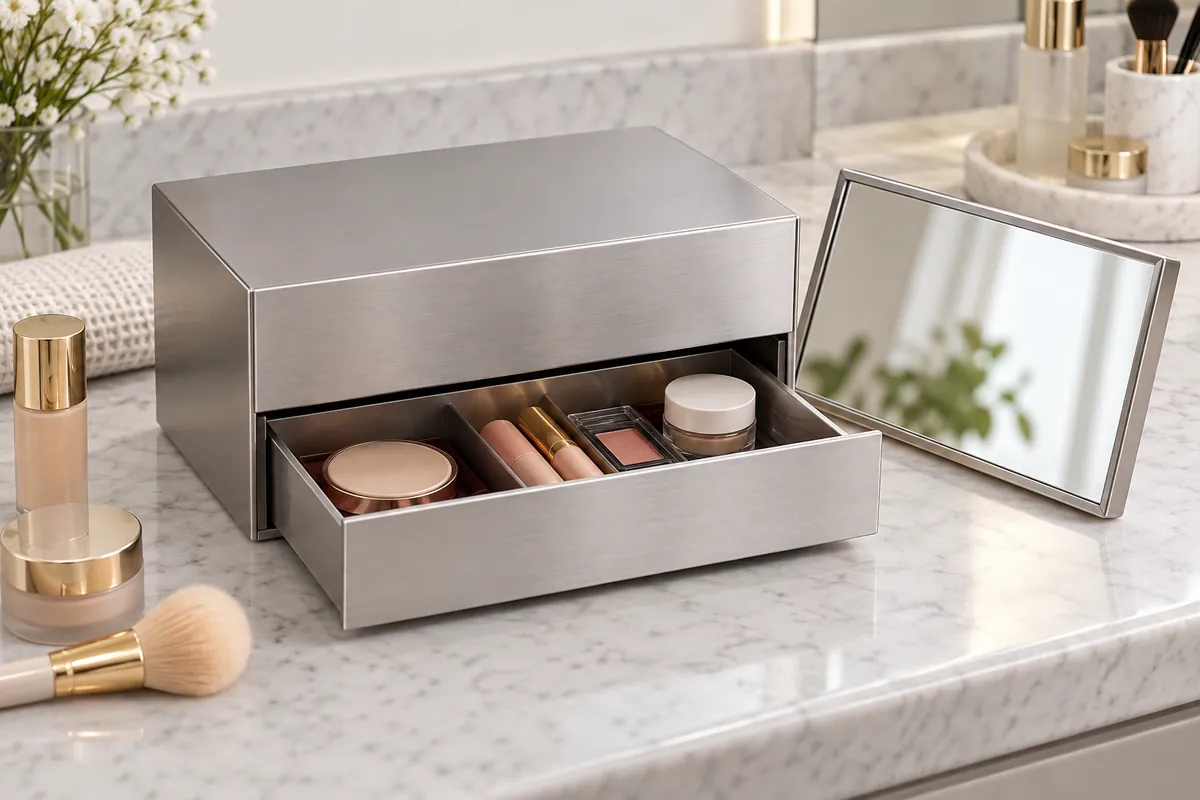
Should the buyer approve a tray using an empty box?
Not if the assortment is known. Use the actual products or controlled dimension references to confirm each compartment and access path.
Does a removable mirror lid work like a hinged lid?
No. The opening, support and storage positions differ. Name the actual architecture and test each intended state.
Does a metal body establish bathroom suitability?
No. Suitability depends on the complete materials, finish, use and maintenance requirements. Obtain product-specific evidence before making environmental claims.
Can a tray or lid be changed after sample approval?
Only through controlled review. Recheck the affected clearances, use positions, contents and packaging, then update the accepted drawing and sample record.
Reference example: Yamazaki Home makeup storage box describes one model-specific body, tray and removable-lid combination; verify the current version directly.
Review a metal storage-box concept with Koitor
Share the body drawing, tray, lid and mirror references, plus the intended contents. Koitor can confirm whether the metalwork fits its documented capabilities before the product scope is assumed.
OEM / العلامة التجارية الخاصة
حوّل دليل التوريد هذا إلى موجز منتج
يرجى إطلاعنا على المنتج المستهدف، والحجم، والتشطيب، وكمية الطلب، ومتطلبات التغليف. وسيتلقى فريقك تقييمًا عمليًّا لإمكانية التصنيع قبل تقديم عرض الأسعار.



 English
 Español
 Português
 Français
 Deutsch
 العربية