

Cloakroom tags numbered pairs must be specified by both number coverage and the physical pieces required for each number. A request for numbers 001 through 050 can mean 50 individual tags, 50 customer-and-hanger pairs, or another arrangement; the total number of printed pieces differs. Before quotation, define the tag roles, ordered unit, exact roster, repeated-number rules, attachments and pack grouping, then inspect the delivered sequence against that approved record.
What sourcing problem does a number roster solve?
A buyer can specify a number range and still leave the order ambiguous. One supplier may interpret each number as one tag; another may assume a matching pair with a customer-side tag and hanger-side tag. An order may include one tag per number but not chains, clips or other attachment parts. These interpretations can produce a shipment with the right number of physical pieces but the wrong role balance.
For a hotel, theatre, club, event venue or commercial cloakroom, numbered tags coordinate items and customer claims. The buyer needs to know which number is associated with which role and how many pieces of each role are supplied. If a venue requests 40 pairs, “40” may refer to 40 unique numbers and 80 physical tags. If it needs 40 single tags, 40 pieces may be correct. The buyer should not expect a supplier to infer that distinction from the word “set.”
This guide focuses on ordering and accepting numbered tag configurations. It does not establish an anti-theft system, guarantee recovery of a garment, prescribe venue procedures or claim that Koitor currently manufactures numbered tags. The buyer must confirm who provides the tags, marking, attachments and packaging for the actual project.
Public supplier product pages demonstrate that the distinction is real: one supplier’s individual tag listing describes single pieces and says paired items or attachments are not included for that SKU, while another supplier’s cloakroom card listing describes corresponding customer and hanger cards. These are product-specific examples, not universal definitions or evidence of Koitor customer demand. The buyer should read the exact product and supplier offer being quoted.

A roster separates unique number values from expected piece counts.
What does “single,” “pair” and “number range” mean?
A single is one physical tag for each ordered number, unless the quote defines a different basis. If numbers 001–050 are requested as singles, the nominal expectation is 50 physical tags, one per unique value.
A matched pair usually means two associated pieces carrying the same number, often intended for two roles such as customer and hanger. The physical forms may be identical or different. The pair could include two cards, two metal tags, or one tag and a corresponding marker. The supplier must state what is included. The term “pair” alone does not define shape, material, attachment or which role receives each piece.
A number range defines the values to be supplied, but should also define formatting, gaps and repetition. For example, the values 1–50 may be displayed as “1” through “50,” or with leading zeros as “001” through “050.” Leading zeros can be meaningful for the venue’s roster and should not be removed without approval.
A replacement range may mean a contiguous block of new values, a replacement of particular missing numbers, or duplicate pieces matching an existing number. The buyer should say which. A request for “replacement 17” could mean one missing tag marked 17, a complete matched pair for 17, or multiple copies for separate zones. The replacement plan belongs to the buyer or venue operator.
| Term in the RFQ | Possible meaning | What to clarify |
|---|---|---|
| 001–050 | 50 unique number values | Whether every value is included and leading zeros are retained |
| 50 singles | 50 physical tags | One role or a particular tag format |
| 50 pairs | 50 matched sets, potentially 100 pieces | Which two roles and whether each piece carries the same number |
| Two copies of 001–050 | 100 pieces across two full runs | Whether numbers repeat intentionally and how each role is identified |
| Replacement 017 | One or more pieces for the existing number 017 | Quantity, role, matching style and attachment |
| Range 001–050 plus spares | A primary sequence plus extra pieces | Which numbers are duplicated and how many of each |
These definitions need to be included in the quotation or purchase order, not left in a buyer’s internal spreadsheet alone. A supplier confirmation should repeat the number range, physical quantity, role count, format and inclusion of attachments.
How should buyers define paired roles?
First name each role in plain language. For a traditional cloakroom workflow, the buyer may call them “customer claim tag” and “hanger/rack tag.” Another venue may use a different arrangement. Do not rely on “A/B” alone unless the legend says which role is which.
Second state the relationship between pieces. Are the two pieces marked with the same number? Is one printed with a letter or prefix? Are there different shapes or colors? Should the pieces stay attached until issuance or be packed separately by role? These choices can affect artwork, marking and sorting.
Third define the ordered unit. If the buyer orders 50 pairs, the commercial line should say “50 matched pairs / 100 physical pieces” if that is the intended count. If the supplier quotes per tag rather than per pair, the unit price must be clear. Quantity and price basis should not be inferred from the number of unique values.
Fourth state what is outside the tag scope. Chains, rings, clips, split rings, lanyards, sleeves or storage boards may be supplied separately or not at all. Do not assume an attachment is included because a product photograph shows one. Ask the supplier to list the physical components included in the quote and sample.
Fifth decide how pieces should be grouped. A carton may contain all tags sorted by number, grouped by pair, separated by role or packed in bundles. The packaging method should support receiving and venue setup. If tags are intended to be issued as pairs, a pair-level grouping could make setup easier, but the buyer should decide based on its workflow and any handling needs.
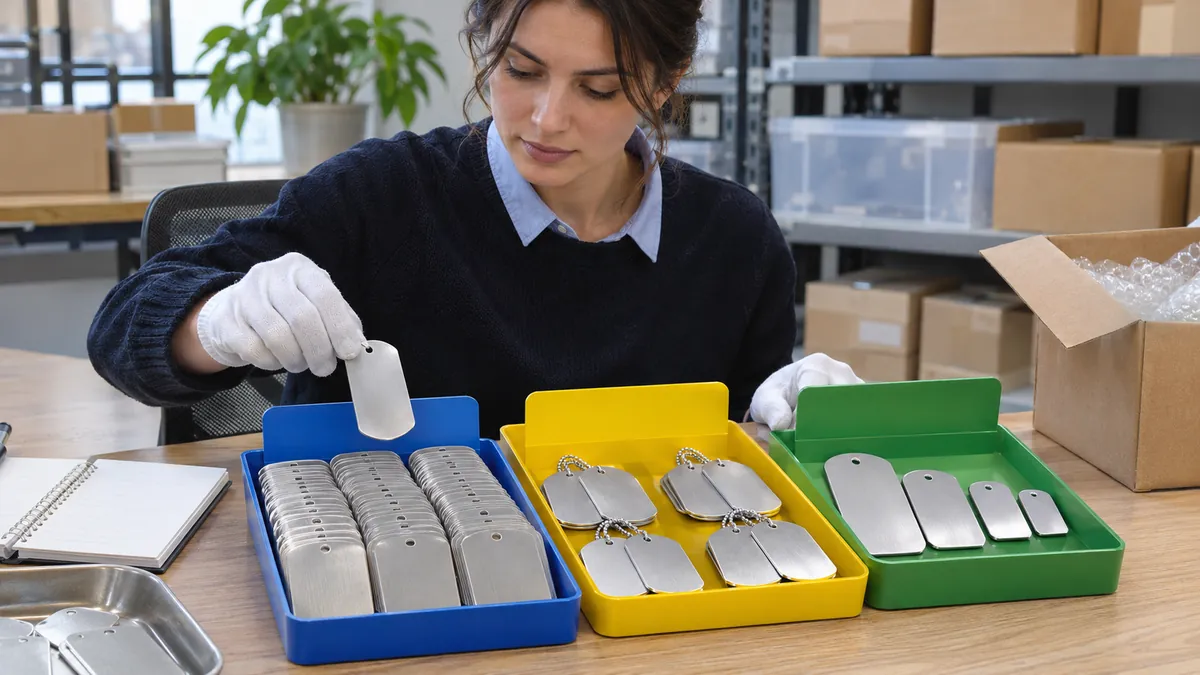
Review the physical sample and roster as separate acceptance checks.
How can buyers check number coverage and multiplicity?
An acceptance check should compare the delivered pieces to a released number roster. The roster should include every intended value, each role, the required number of pieces for that role and the approved formatting. Checking only the total count is insufficient because missing and duplicate values can offset one another.
Suppose a venue orders 50 matched pairs for numbers 001–050. The expected physical total is 100 pieces, assuming two tags per pair. Receiving 100 pieces does not prove completeness. If number 017 is missing one role tag and number 018 has an extra copy, the total still equals 100 but the roster is wrong. The buyer needs to compare value by value and role by role.
A simple acceptance table could look like this:
| Number | Role A expected | Role B expected | Role A received | Role B received | Result / note |
|---|---|---|---|---|---|
| 001 | 1 | 1 | 1 | 1 | Match |
| 002 | 1 | 1 | 1 | 1 | Match |
| 017 | 1 | 1 | 1 | 0 | One Role B piece missing |
| 018 | 1 | 1 | 1 | 2 | Extra Role B piece; check approved roster |
| 050 | 1 | 1 | 1 | 1 | Match |
The table is an illustrative format, not Koitor production data. Adapt it to the actual roles and pack. If each number has one tag only, the second role column can be removed. If some numbers intentionally have additional copies, record the extra count by number rather than treating all duplicates as defects.
Check values systematically. A printed sheet sorted by expected sequence can help a receiving team mark each number, but the actual method depends on the tag size, marking and packaging. If the pieces arrive grouped in packs, reconcile the pack labels to the roster and inspect enough to verify their contents according to the buyer’s plan. Do not claim that a particular sampling method proves every piece is correct; choose an inspection scope proportionate to the purchase and risk.
Preserve leading zeros and any prefix or suffix exactly. “017” and “17” may be treated as the same number mathematically, but they can be different display strings in a venue’s controlled roster. If a range intentionally restarts in a second zone, add the zone identifier so repeated values are not confused during ordering and receipt.
How should replacement ranges be specified?
Replacement orders are often smaller than the original run, which makes ambiguity more likely. The buyer should identify the existing system, the desired replacement values and whether it needs a single tag or a matched set. If the existing tags use a particular font, layout, material, hole position or attachment, provide an approved sample or reference image and state what should match.
Avoid writing “replace missing 17–20” without explaining whether that means four numbers or eight pieces. In a paired system, four unique values may require four pairs, which is eight physical tags. If only the hanger-side tags are missing, ordering full pairs may create unnecessary duplicates. The buyer should decide whether matching one role is acceptable and how the venue will preserve the association.
If numbers are reused across separate zones or service periods, distinguish the context. For example, “North cloakroom 001–050” and “South cloakroom 001–050” may have repeated values intentionally. Use a zone code, color, format or separate pack instruction as chosen by the venue. Repeated numbers are not always errors; the acceptance rule must reflect the approved roster.
A replacement request should state if exact matching to a previous tag is required or if a new design is acceptable. Appearance can change across production lots or suppliers, so the buyer should not promise perfect visual identity unless there is an approved standard and supplier confirmation. For a new supplier, provide a retained sample and define the comparison scope.
What should the sample and quotation confirm?
The sample confirms the physical format and marking for the configuration presented. Check the tag shape, size, material reference if specified, edge condition, number layout, legibility, hole or attachment interface, role distinction and pack grouping. The sample should be linked to a specific number and role, or clearly marked as a blank format sample where actual numbers are not yet released.
The quote should confirm whether the price is per physical tag, per pair, per number set, or per pack. It should state the quantity of unique values, total piece count, number of pairs, attachments included and any setup or artwork assumptions. If a buyer provides a long roster, attach it as a controlled file with a revision and date.
If engraving, stamping, printing or another marking method is requested, confirm the actual supplier’s process and approved sample. This article does not claim that Koitor engraves, anodizes or produces numbered tags. For a metal-tag concept, the responsible supplier must confirm material, marking method, attachment, finish, MOQ, timing and quality evidence. A product page for another supplier does not prove the same process is available from a different factory.
For the hanger or rack interface, specify the intended attachment and fit. The separate hotel hanger-ring compatibility guide addresses related hanger hardware fit, but it does not define number-roster or tag-pair requirements. Keep those questions separate.
What should buyers include in a number-roster release?
A controlled roster can be a spreadsheet or another record, as long as it defines the expected values, roles and quantity. Include:
- Venue, location, project or zone name.
- Exact number string as it should appear, including leading zeros.
- Every unique number to be supplied or the exact continuous range.
- Role A and Role B definitions, if tags are paired.
- Required physical pieces per role for each value.
- Whether any values repeat intentionally and why.
- Whether any ranges are skipped or reserved.
- Attachment type and whether the attachment is included.
- Pack grouping and label method.
- Sample or artwork revision.
- Replacement requirement, if the request is a replacement order.
- Buyer approver and release date.
- Supplier confirmation of unit basis and total physical quantity.
Do not include unnecessary guest names or personal information in a manufacturing roster. The supplier ordinarily needs the number strings and role distinction, not the venue’s customer records. Keep operational or security-sensitive venue procedures under the venue’s own control.
The buyer should retain the approved roster and compare it to the sample and delivery. If the roster changes after production starts, document the new revision and identify whether the earlier version remains in use. A verbal change such as “add a few tags” can lead to duplicate or missing values if the supplier does not receive a controlled update.
What are common ordering mistakes?
Mistake 1: specifying only a number range. A range does not state singles or pairs, nor which role gets each piece.
Mistake 2: confusing unique values with physical pieces. Fifty pairs can mean 50 numbers but 100 physical tags.
Mistake 3: assuming attachments are included. Product pages and quotes can exclude rings, clips, chains or other accessories.
Mistake 4: checking only total quantity. Missing and extra numbers can offset and leave the total correct.
Mistake 5: dropping leading zeros. A spreadsheet may reformat values unless the column is treated as text. Release the exact display string.
Mistake 6: using “duplicate” without context. A duplicate can be intentional within a pair, planned for two zones or an unintended extra. Record the rule by role and location.
Mistake 7: assuming a replacement is a complete pair. State whether the buyer needs one replacement piece, both roles or a full set.
Mistake 8: using the product image as the complete specification. A photo may not show pack quantity, marking method, material, attachment or order basis.
Mistake 9: attributing another supplier’s features to a proposed OEM source. A product listing proves what that specific supplier describes, not what Koitor or any other factory currently makes.
How does the number-tag order connect to a venue’s hardware assortment?
Numbered tags are adjacent to hangers, coat rails, cloakroom counters and other garment-storage arrangements. Their commercial relevance comes from the buyer’s need to source and coordinate pieces used within a venue operation. That relationship does not mean every bathroom hardware importer buys cloakroom tags or that Koitor currently manufactures them.
If a distributor is evaluating a wider hospitality assortment, keep the physical hanger or hook specification distinct from the numbering system. Hanger dimensions, ring compatibility and rail interface are product-fit questions. Tag sequence, role count and replacement policy are identification and roster questions. The same purchase may contain both, but each needs its own acceptance basis.
When reviewing order units and case packs, use the separate buyer guide to MOQ, order multiples and case packs. That guide addresses quantity units generally; here, the extra issue is how unique number values multiply into physical pieces and paired roles.
How should sample review and pack labeling reduce receiving errors?
A sample review should confirm the physical tag format and the way a number is represented, while a roster review confirms the values and counts. These checks answer different questions. A tag may have the right shape and attachment but carry the wrong number. A roster may contain the correct values while the physical sample does not suit the intended rack or handout process. Approve both the form and the numbering logic before production or pack release.
For a first order, select representative samples for every role and any format difference. If Role A and Role B tags have distinct shapes, colors or attachment holes, review one of each. If the range uses a leading zero or a prefix, approve a proof that shows it. If only the tag shape is being sampled before number artwork is ready, mark the sample as a blank-format sample so no one mistakes it for a released numbered example.
Pack labels can help the receiving team separate ranges, zones and roles. A pack label might identify the range and role count, but it should not replace checking the contents against the roster. If one package contains numbers 001–025 and another contains 026–050, state those divisions in the purchase order or packing instruction. If roles are packed separately, each package should say which role it contains and how it maps back to the same number range.
Keep corrections controlled. If a proof shows 017 but the venue needs 017A, the buyer should revise the source roster and resend an approved file rather than ask for an informal correction that may not reach every production copy. Mark superseded rosters clearly. When the order is packed, the supplier should reference the released roster version and the buyer should compare the delivery against that same version.
The scope of inspection should reflect the buyer’s process and risk. A venue may choose to count every piece for a small, uniquely numbered run because each value matters. Another buyer may use a defined receiving check with documented exceptions. This article does not prescribe an AQL, sampling percentage or universal acceptance level. The buyer should define the inspection method, and the supplier should confirm what verification can be included in the quoted scope.
If a shortage, duplicate or incorrect marking is found, record the number, role, pack and evidence. Avoid reporting only that “the set is short,” because the supplier cannot tell whether a piece, pair or number is missing. Preserve the packaging and roster reference where useful, and route the commercial remedy through the buyer’s agreed claim process.
Buyer checklist before quotation and receipt
- State whether the request is for individual tags or matched pairs.
- Name the intended role for every piece in a pair.
- Provide an exact roster or range and preserve leading zeros.
- Translate unique number count into total physical piece count.
- Identify intentionally repeated values, zone ranges and reserved gaps.
- Confirm the attachment and marking scope with the actual supplier.
- Clarify quote unit: per piece, pair, number or pack.
- Approve a physical sample or controlled artwork proof for the format.
- Define how pieces are sorted or grouped for receiving.
- Compare delivered values and role counts to the released roster.
- Use the venue’s policy for replacements and any lost-item procedure.
- Keep personal or security-sensitive information out of the production roster.
الأسئلة الشائعة
Does a request for numbers 001–050 mean 50 pairs?
No. It defines 50 unique displayed values if the range is inclusive, but does not define how many physical pieces accompany each value. State singles or pairs and the role count.
Does “matched pair” always mean two identical tags?
No. It usually means two related pieces, but their shapes, roles, attachment and marking can differ by supplier or application. Specify what each piece is and confirm it in the quote.
Is receiving the correct total quantity enough?
No. The buyer must verify number coverage and multiplicity. A missing tag and an extra duplicate can leave the total count correct while the roster is incomplete.
Can a replacement order reuse an existing number?
The venue or buyer must define whether number reuse is allowed and how it is distinguished by zone or period. Do not infer the venue’s tracking policy from a supplier’s product range.
Are chains, clips or rings included with numbered tags?
Not automatically. Check the actual product specification and quote. A photo or category name does not establish included components.
Does this article confirm that Koitor supplies numbered tags?
No. It is a buyer specification guide. Any proposed tag, marking or attachment capability must be confirmed directly for the actual project before it is described as available.
اعمل مع شركة «كويتور» للأدوات
Use cloakroom tags numbered pairs as a defined comparison in the buyer record, and keep its assumptions visible when the specification changes.
Define the Metal Part and Pack Before Requesting a Quote
If your project includes custom metal storage hardware, send a controlled drawing or sample, dimensions, finish and pack requirements. Any numbered-tag or marking request needs separate quote-specific capability confirmation.
For a useful cloakroom tags numbered pairs review, record the product identity and the decision the measure is meant to support.
OEM / العلامة التجارية الخاصة
حوّل دليل التوريد هذا إلى موجز منتج
يرجى إطلاعنا على المنتج المستهدف، والحجم، والتشطيب، وكمية الطلب، ومتطلبات التغليف. وسيتلقى فريقك تقييمًا عمليًّا لإمكانية التصنيع قبل تقديم عرض الأسعار.



 English
 Español
 Português
 Français
 Deutsch
 العربية