
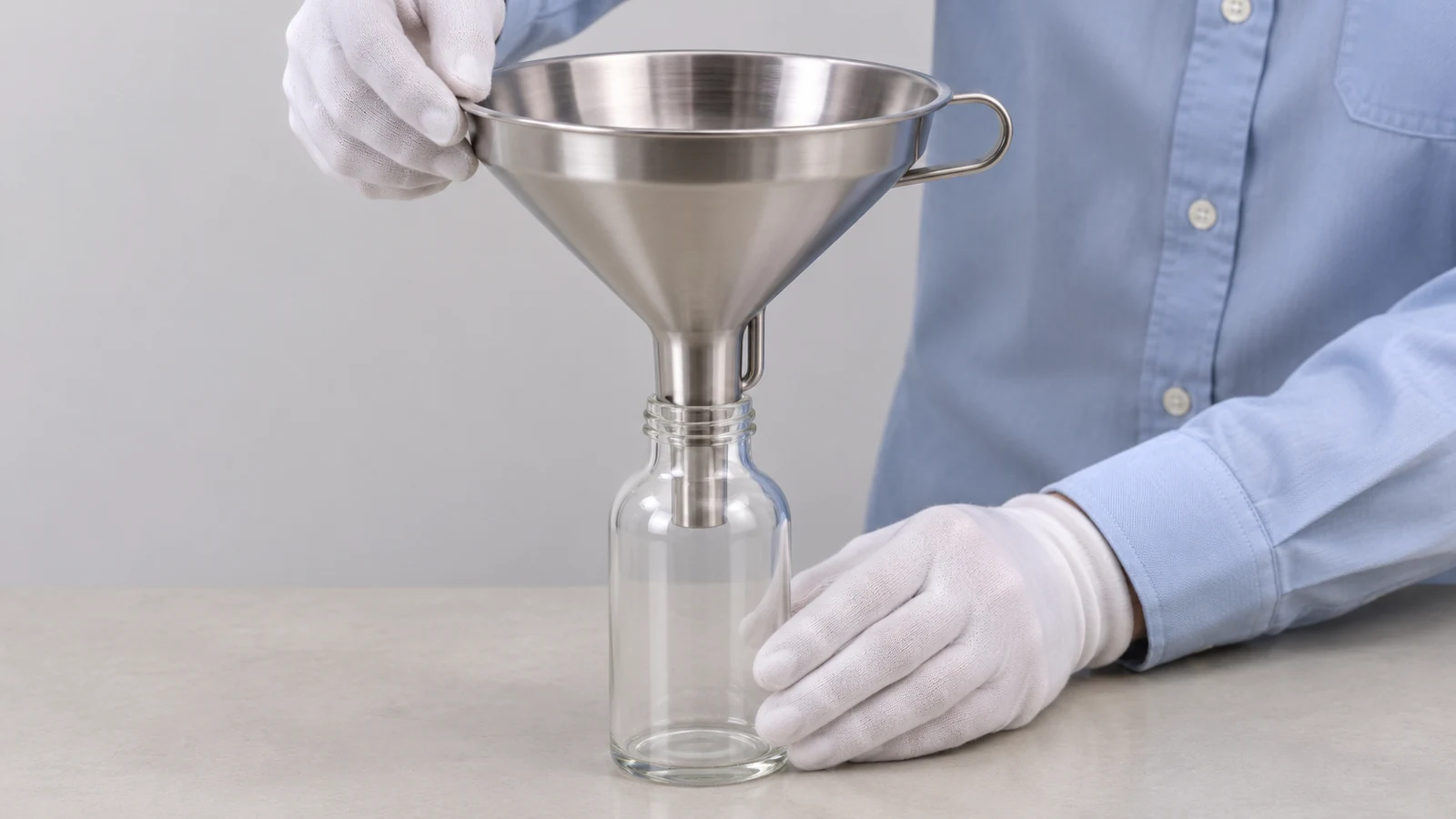
A stainless steel funnel air vent is a product-configuration question, not a single diameter choice. Importers should record the receiving bottle’s reference opening, the funnel’s external nozzle dimensions and inserted length, and the intended air-return route as separate requirements, then compare the same named sample and current supplier drawing. A nominal funnel diameter does not establish how far the nozzle enters, whether the mouth supports it, or whether liquid can displace air while filling.
For this procurement question, stainless steel funnel air vent describes a model feature that still needs exact neck and sample evidence.
This guide is for kitchenware and catering-supplies buyers who need comparable quotations for an ordinary kitchen filling application. It does not provide laboratory, chemical-transfer, pressure, fire, food-contact, or sanitation advice. The referenced manufacturer examples show that suppliers can describe outlet dimensions, neck forms, filters, and air-relief features differently; they do not establish a universal design or performance level. Koitor’s confirmed scope is bathroom and home-storage metal hardware. Kitchen funnels and food-contact product qualification are not confirmed Koitor capabilities, so this is a buyer-side specification guide rather than an offer for a finished funnel.
Decision summary: what makes funnel quotations comparable
Compare a funnel by the specific interface and configuration the buyer needs, not by its top opening alone. At minimum, the product brief should identify the funnel body, outlet geometry, receiving container, method of support, filter inclusion, and any intended air path. If one supplier quotes a plain straight nozzle and another quotes a grooved or otherwise vented outlet, the two offers are not equivalent simply because their bowl diameters match.
A useful quotation comparison separates three questions:
| سؤال من المشتري | Record in the specification | Why it matters |
|---|---|---|
| What container must receive the outlet? | Reference bottle or vessel, opening profile, usable neck depth, and sample or drawing revision | A nominal mouth size does not describe the full insertion interface |
| What dimensions does the funnel supplier define? | Bowl diameter, outlet outside diameter at a named point, outlet length, and any taper or local feature | Different datum points can produce numbers that appear comparable but describe different surfaces |
| How does the configuration accommodate air? | Plain outlet, named groove or channel, spacing, or other supplier-described feature | A feature visible on one model must not be assumed on the entire product family |
| What is included in the offer? | Filter, removable insert, handle, cap, packaging, and included accessories | A component can change the bill of materials, cleaning responsibility, and quotation scope |
| Which evidence governs? | Exact model code, drawing revision, product page or controlled specification, sample identity, and date | The sample, quotation, and published dimensions need to refer to the same configuration |
The comparison should make unknowns visible. If the supplier page does not state insertion length or the dimensional datum, record “not stated” and request clarification. Do not fill gaps by estimating from a photograph or by assuming a rounded number describes every part of the nozzle. The result should be a buyer-approved requirement that both suppliers can quote against.
Which bottle-neck dimensions should buyers define first?
Start with the receiving vessel, because “fits a bottle” is not a measurable requirement. Identify the actual container family, model, or sample that the funnel is expected to serve. A bottle mouth may include a lip, external thread, bead, taper, shoulder, or other transition. A single opening measurement may not describe the surface on which the funnel rests or the length available for insertion.
The buyer should define the mouth reference without asking a funnel vendor to infer a universal bottle standard. If the brand owner supplies a bottle drawing, record its revision and the critical mouth dimensions. If only a physical sample exists, label it with the customer’s model or sample code, photograph the opening with a scale reference, and make clear that the reference sample—not a generic category name—controls the review. The buyer should not claim that the sample represents every bottle sold under a brand unless the brand owner confirms that.
Then define what “fit” means for the application. The funnel might rest on the opening, enter it a short distance, or need to be held in a particular orientation by the user. Those are different support arrangements. A funnel that enters a neck can have a different effective engagement from one that simply sits on the lip. A top opening that looks generous in a catalogue image does not answer the contact geometry at the receiving vessel.
Ask the supplier to identify each outlet dimension by its measurement location. For a tapered nozzle, the diameter near the tip may differ from the diameter closer to the funnel bowl. A drawing should mark whether a figure is an outside diameter, an inside diameter, a maximum envelope, or a measurement at the end face. It should also show the reference plane and any local transition. The buyer should not infer the point from which a catalogue value was measured.
The manufacturer Contacto’s current funnel-series page, for example, describes a listed nozzle diameter as the outside diameter at the bottom of the nozzle and distinguishes a straight-tube form. That is useful evidence of how one manufacturer defines a particular dimension, not a universal convention for all funnel suppliers or models. See the Contacto funnel series. For procurement, copy the named supplier’s definition alongside the model and revision instead of converting it into an assumed industry standard.
Insertion depth deserves its own field. A funnel may have the right tip diameter but still enter too far, bottom against an internal shoulder, rock on the opening, or fail to rest as the buyer intended. The buyer should state the maximum and minimum engagement required only when the project has a substantiated need and a clear measurement basis. Otherwise, request the supplier’s available nozzle length and approve the named sample in the actual receiving container. Do not prescribe a tolerance without the bottle drawing, supplier process capability, and a responsible engineering review.
Use the physical sample as a controlled interface reference
A sample review should begin by identifying both parts. Record the bottle model or sample ID and the funnel supplier’s model, material description as supplied, and revision. Keep those identities in the same review record. If a substitute bottle is used during evaluation, label it as a substitute and do not carry the result across to the intended vessel without confirming the interface.
The review can record straightforward observations: whether the funnel sits where intended, whether the nozzle contacts the opening, whether it rocks under the agreed handling condition, whether the user can hold it in the expected orientation, and whether the parts can be separated without an unplanned obstruction. These are descriptive checks. They do not establish a universal fit rating, flow rate, spill resistance, sanitation, material grade, or safe performance in an application that has not been evaluated.
If a dimensional inspection is required, agree who performs it, which datum is used, what instrument and method apply, and what acceptance limits are appropriate. A caliper reading on a formed or tapered outlet can change with location and instrument placement. One number without a measurement location is poor evidence. For instance, “the nozzle measures 18 mm” is ambiguous unless the reviewer states where along the nozzle, whether the measurement is outside or inside, and which sample was measured.
The buyer should keep three records distinct: the supplier’s drawing dimensions, the buyer’s incoming or sample measurement, and the fit observation with the reference bottle. A measured sample can reveal a discrepancy or a question; it does not revise the supplier’s drawing automatically. If the sample differs from its approved drawing, pause the comparison and ask the supplier to identify the current controlled version before approving an order.
For this buyer guide, stainless steel funnel air vent is a comparison phrase; it does not replace exact model, evidence, and acceptance criteria.

How should buyers specify the air-return path?
Liquid entering a vessel displaces air. In some funnel-and-container arrangements, the outlet can occupy much of the receiving opening, leaving the buyer to consider how air returns through the interface during filling. This is a configuration question. The article does not claim a particular groove, gap, or nozzle guarantees a stated flow rate, prevents spills, or works with every bottle.
Ask the supplier whether the named model has a specific feature intended to provide an air path. If the supplier describes a groove, side channel, flat, interruption, or other geometry, request a current drawing or close-up view that identifies the feature and shows its location relative to the nozzle. Ask whether the detail belongs to the quoted model or only to another variant in the same series. Catalogue pages often cover multiple product forms, and a line in one product description should not be generalized to every item in the family.
A professional supplier’s description of one stainless funnel sold by Stellinox explains a deformation at the conical outlet as a way to let air escape. That is a named supplier’s description of a particular product configuration. It is not a controlled comparative test, a guarantee against blockage, or proof that every funnel needs the same geometry. See the Stellinox stainless funnel description. Buyers should preserve that distinction when translating marketing language into a sourcing brief.
The specification should describe the physical requirement, not an unverified result. For example, it may say that the quotation must identify the outlet configuration and show any supplier-described air-return feature. If the buyer has a defined target bottle and filling process, the appropriate product owner can establish how the feature should be assessed. A catalogue claim should not be converted into an assumed performance threshold without that review.
Do not treat a visible side detail in a photograph as proof of an internal passage or continuous open channel. Perspective, reflections, shadows, and cropping can make a feature appear larger, smaller, or continuous when it is not. Ask for a drawing or an explicit written response identifying the feature. If the supplier cannot confirm it, record the point as unresolved and decide whether the offer is still comparable.
Separate air return from other outlet features
A filter or removable insert is not the same thing as an air-return feature. The components may be offered together, but they address different questions. A buyer who wants to retain particles should record the intended filter scope and the exact included component. A buyer who needs a particular bottle interface should define the nozzle geometry independently. One feature should not be presumed to solve the other.
Rösle’s product assortment, for example, lists filter options on particular funnel products. That establishes that a named configuration can include a filter; it does not show that a filter changes bottle-neck compatibility or produces a particular filling result. See the Rösle funnel product information. Verify the exact model page or current supplier document because product-family pages can change and may list several variants.
The same separation applies to handles, removable strainers, caps, and adapters. A removable part may add a cleaning or replacement requirement. It may also alter the assembled envelope. Record whether it is included, optional, supplied separately, or absent from the quoted configuration. Do not compare the price of a funnel set with a plain funnel without noting that the bill of materials differs.
How can importers run a meaningful sample review?
Build a short sample protocol around the buyer’s actual decision. Identify the receiving bottle, the funnel configuration, the orientation, and the observation to record. The purpose is to determine whether the supplier’s offered sample represents the requested configuration, not to conduct an improvised product-safety or food-contact test.
A practical review sequence is:
- Match identities. Record supplier, model, quotation line, drawing revision, and sample code for the funnel. Record the intended bottle model or buyer sample in the same document.
- Confirm the dimensional basis. Ask the supplier where each stated diameter is measured and whether it is inside, outside, maximum, or local to a particular point.
- Check the support arrangement. Place the funnel in or on the intended bottle as agreed. Note the contact location, visible insertion, and whether the funnel sits in the intended position.
- Identify air-return geometry. If the supplier claims a particular outlet feature, match it to the drawing or have the supplier identify it on the exact sample. Do not infer a hidden path from a product photograph.
- Record included parts. Confirm any filter, insert, cap, or removable accessory and ensure the same parts are present on each compared offer.
- Document unresolved items. Mark any dimension, model, or configuration that is not confirmed. State who must answer and whether the issue blocks the buyer’s approval.
- Control changes. If the supplier adjusts the nozzle, bowl, or accessory after review, assign a new sample or drawing revision and repeat the relevant checks.
The review record should include photographs of the actual funnel and bottle together, plus a close-up of the outlet from the side and end. Photographs supplement the written record; they do not replace the dimensional drawing or prove product performance. Keep notes factual: “the sample rests on the bottle rim” is an observation. “the funnel fits all bottles in the market” is a broad claim that cannot be supported by a single sample.
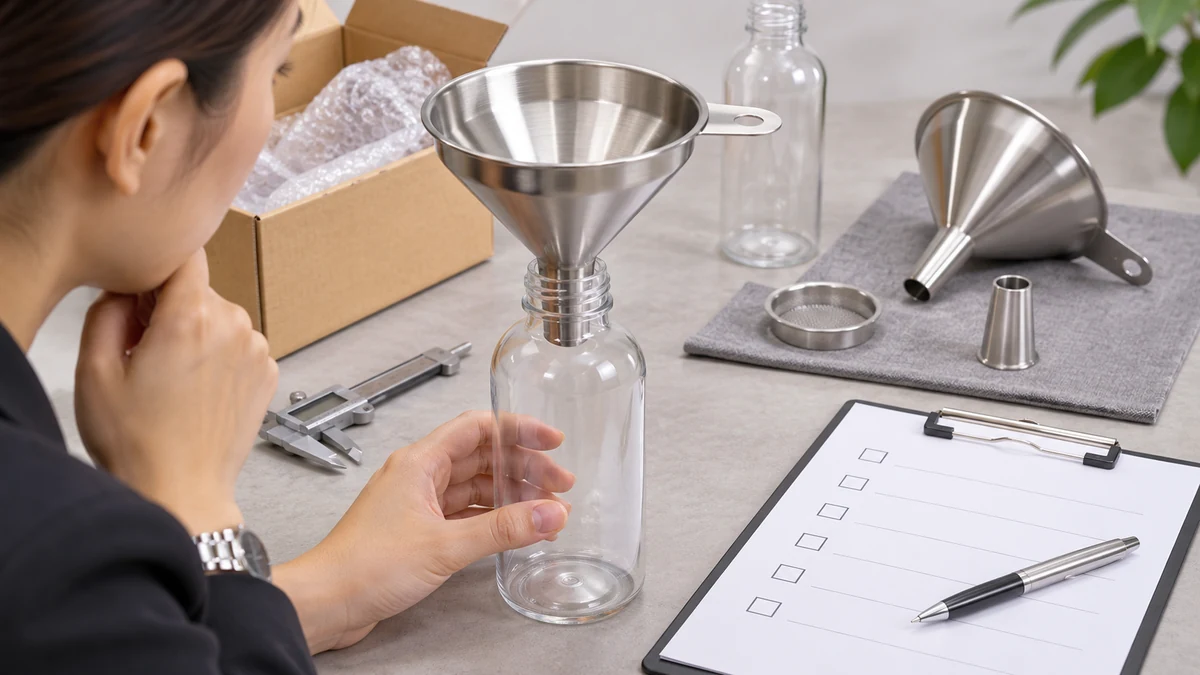
If two suppliers provide different data, do not average their dimensions or choose the smaller number without checking the intended interface. Normalize the model, datum, and configuration first. A quoted nozzle size may refer to the outside diameter at the tip in one source and an inside opening or a point nearer the bowl in another. The appropriate outcome may be a request for clarification, a revised drawing, a different product model, or a controlled sample comparison.
Buyer approval and sourcing controls
Which quotation and packaging details affect the landed offer?
A funnel quotation should state the exact product and included scope. “Stainless funnel” is too broad for a reliable purchase order when the offer may differ by bowl diameter, nozzle geometry, filter, handle, packaging, or finish. The buyer should identify which details are critical to fit and which are preferences that can vary.
Packaging needs to protect the product and preserve component identity through distribution. Buyers can ask whether funnels nest, whether an included filter is packed inside the bowl or separately, and how individual models are distinguished in the carton. These are questions for the actual supplier and pack configuration. They are not claims that a particular package will prevent scratches or transit damage. If several nozzle sizes look similar, request labels or a pack list that lets the receiving team reconcile each model to the purchase order.
The purchase order should refer to the approved drawing and sample. If the product is custom, record the buyer-approved change to the shape, dimensions, or included components. Avoid a purchase-order note such as “same as sample” unless the sample has an identifier, revision, date, and clear custody record. A retained sample, if used, should be stored and labelled under an agreed process so it can be compared with later production. Do not assume the supplier retains it indefinitely.
Ask the supplier to itemize quantities by model and kit scope. If a funnel is sold with a removable insert or filter, state whether the buyer requires each unit, a separate spare quantity, or only the base funnel. If packaging is private label, confirm the artwork and product configuration separately. A package image can depict an accessory that is not included unless the bill of materials and approved artwork agree.
For landed-cost comparisons, keep product unit price, included components, unit packaging, master carton, and any custom development work in separate lines where the supplier can provide them. Buyers should not infer a price premium or cost saving from a feature photograph. Different offers may include different parts, quantities, packaging, or documentation. Use a like-for-like comparison before ranking the quotation.
What sourcing mistakes create avoidable uncertainty?
Several mistakes make a funnel comparison look simpler than it is:
- Comparing only the bowl diameter. The bowl opening does not establish the bottle-neck fit, outlet length, or support method.
- Treating a catalogue size as an exact fit claim. A listed dimension needs a measurement location and a named model.
- Assuming a product-family feature applies to every model. Confirm grooves, removable filters, and handles on the exact quoted configuration.
- Conflating air return with filtration. A filter and an outlet geometry are distinct requirements.
- Using an unlabelled substitute bottle. A result from another neck profile should not be transferred without confirmation.
- Approving from a cropped image. A photograph does not provide the complete outlet dimensions or hidden interface.
- Combining documents from different dates or regions. Record which current model and specification govern the offer.
- Turning a visual observation into a performance guarantee. A sample review is not a measured flow test or a broad claim about spills.
- Leaving accessory scope vague. A set with a filter is not identical to a funnel sold without one.
- Failing to control sample changes. A revised nozzle or insert needs its own model or revision record.
The corrective action is often modest: a drawing note, a dimensional datum, a current model code, or a paired sample review. Buyers do not need a complicated specification for every kitchen accessory. They need enough detail to ensure that suppliers are quoting the same product and that the approval evidence corresponds to what will actually be ordered.
How do home-storage OEM capabilities relate to this buyer brief?
Koitor Hardware is a family-owned bathroom and home-storage hardware factory and a custom metal hardware manufacturer. Its established buyer discussions center on metal storage products, product drawings or physical samples, finishing, assemblies, packaging, and small-batch OEM development. The company’s current product and manufacturing facts do not confirm stainless kitchen funnels, funnel drawing or forming, filter production, food-contact compliance, flow testing, or a complete kitchenware funnel line.
That boundary should remain explicit. A buyer can use this article to write a better funnel brief without assuming that Koitor can manufacture the finished funnel. If the product need involves a metal component or a storage product that fits Koitor’s confirmed scope, the buyer can share the actual drawing or sample for feasibility review. The factory must confirm whether the material, geometry, process, finish, tooling, quantity, and packaging are feasible before a quotation becomes an offer.
For any custom metal project, provide the controlled drawing, material and finish requirements, critical dimensions, cosmetic faces, joining details, packing needs, target order range, and sample approval plan. Koitor can discuss confirmed metal hardware requirements and small-batch customization within its actual capabilities. That manufacturing insight does not replace the funnel supplier’s responsibilities for the finished food-contact product or its claims.
If a product falls outside the confirmed range, classify it as an adjacent opportunity requiring a capability check. Do not imply that a factory’s experience with wire baskets automatically establishes experience with drawn funnel bodies, woven filters, or food-contact qualification. The relevant supplier should provide the exact model information and evidence for those features. The buyer owns the final requirement, the named product supplier owns its product-specific claims, and any applicable regulatory reviewer owns the interpretation of market rules.
Buyer checklist before requesting a quotation
Use this checklist to make the request comparable while keeping open items visible:
- Name the target bottle or vessel model, drawing revision, or physical reference sample.
- State whether the funnel rests on the mouth or inserts into the opening.
- Request outlet outside and inside dimensions with measurement locations and definitions.
- Record outlet length, taper, and any local geometry shown on the supplier’s current drawing.
- Ask the supplier to identify any air-return feature on the exact quoted model.
- Separate filter, insert, handle, cap, and accessory requirements from the base funnel.
- Identify which dimensional or visual features are critical to fit and which are preferences.
- Specify the sample identity and who will review it against the receiving vessel.
- Define how a changed drawing or sample will be reapproved.
- Record packaging by model and included accessories.
- Ask the supplier to identify the current controlling specification and date.
- Mark unknowns as open items instead of making assumptions from photographs.
- Keep food-contact, sanitation, or safety requirements with the responsible supplier and qualified reviewer.
- Confirm whether the product is within the selected supplier’s actual capabilities before requesting a firm quotation.
الأسئلة الشائعة
Does a larger funnel nozzle always fit a bottle better?
No. A larger outside diameter may prevent the nozzle from entering the opening or may cause it to rest differently. Fit depends on the bottle profile, the nozzle’s measurement location, the insertion length, and the intended support arrangement. Compare the named sample and bottle rather than choosing by a single nominal number.
Is the nozzle diameter always measured at the tip?
No universal measurement point should be assumed. A supplier may define a dimension at the bottom of a nozzle, at the mouth, or at another location. Ask for the measurement basis on the exact current model and record whether the figure is inside or outside diameter.
Does an air-return groove guarantee faster filling?
No. A supplier-described groove or channel is a design feature, not by itself a controlled flow-rate result. Its effect depends on the funnel, container opening, liquid, orientation, and supplier’s stated application. Buyers should confirm the exact configuration and avoid converting a product description into an unsupported performance guarantee.
Is a removable filter included with every funnel?
No. Filters and inserts may be model-specific or optional. Confirm the bill of materials, sample, packaging, and quotation for the exact product. A product-family page that lists a filter variant does not prove it is included in every funnel offer.
Can Koitor quote a finished stainless kitchen funnel?
Current approved Koitor facts do not confirm a finished funnel product, funnel-forming process, filter production, or food-contact qualification. Koitor can review metal hardware requirements within its confirmed scope, but a finished funnel order should be directed to a supplier that confirms its product capability and applicable evidence.
What should be approved before a private-label order?
Approve the exact model, controlled drawing, reference bottle, outlet dimensions and datums, air-return configuration, included accessories, packaging, artwork, and sample revision. Keep any unresolved product or regulatory claims with the responsible supplier and qualified reviewer before releasing the order.
المصادر
- Contacto funnel series — named series and supplier dimensional description.
- Stellinox stainless funnel — named supplier description of an outlet deformation associated with air escape.
- Rösle funnels and strainers — examples of model-specific funnel and filter configurations.
- Koitor custom bathroom hardware manufacturing — confirmed metal-hardware scope and project contact route.
اعمل مع شركة «كويتور» للأدوات
Discuss a confirmed metal hardware scope
Share the drawing or physical sample, target application, metal-component requirements, and intended order range. Koitor will first confirm whether the product fits its established bathroom and home-storage manufacturing capabilities.
OEM / العلامة التجارية الخاصة
حوّل دليل التوريد هذا إلى موجز منتج
يرجى إطلاعنا على المنتج المستهدف، والحجم، والتشطيب، وكمية الطلب، ومتطلبات التغليف. وسيتلقى فريقك تقييمًا عمليًّا لإمكانية التصنيع قبل تقديم عرض الأسعار.


 English
 Español
 Português
 Français
 Deutsch
 العربية