
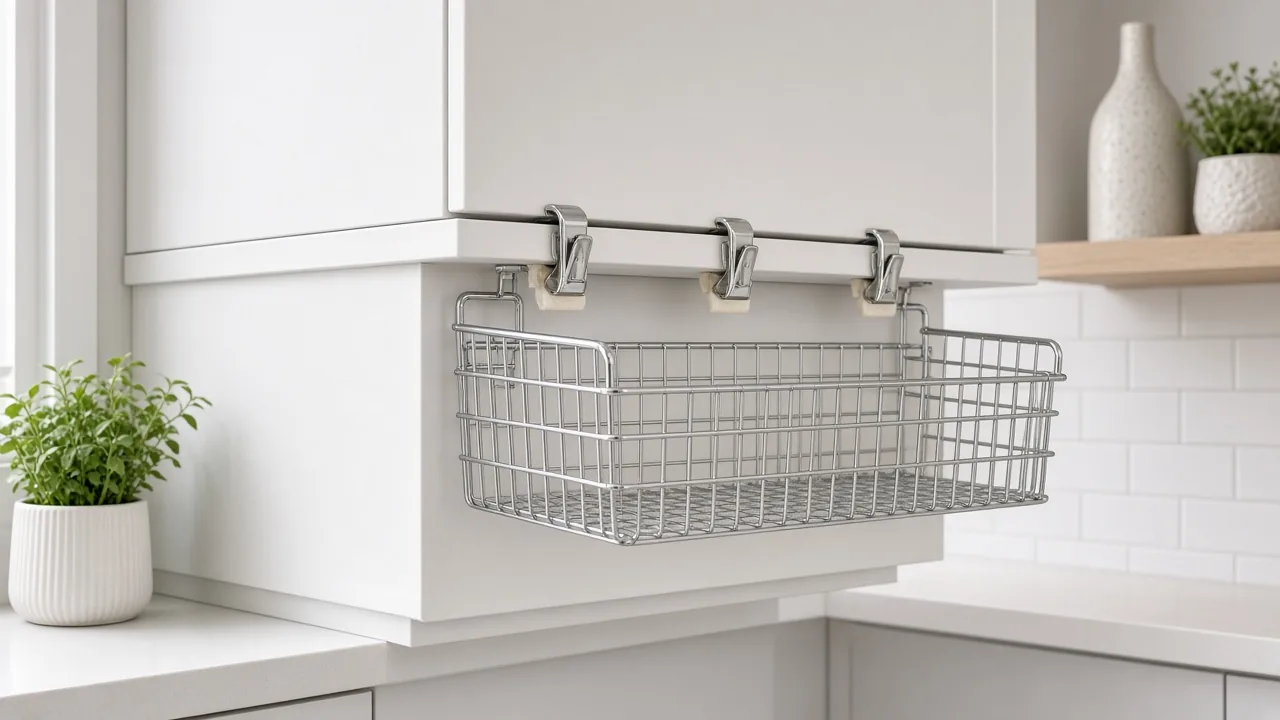
Under cabinet basket clip fit is the match between the cabinet-panel or shelf-front thickness and the clip throat that must clamp it without crushing the paint or falling off in ordinary use. Importers and private-label teams should freeze that thickness window, the clip geometry, and any paint-protection pad before a “fits most cabinets” listing is approved.
A clip that seats on a showroom 18 mm shelf can still scuff a painted 16 mm face or drop from a thicker framed panel. Door swing and soft-close hardware add a second clearance problem that a bench photo of the basket alone will not reveal.
This guide keeps the decision on underside clips for wire baskets. It does not cover slide-out baskets on drawer rails, over-door organizers, or suction mounts, and it does not invent a single thickness that fits every kitchen.
What clip families should buyers name before they talk about thickness?
Name the clip family first. Formed spring-steel or stainless clips, folded wire hooks, and two-piece clamps that tighten with a screw do not share one throat drawing. If the RFQ only says “clip-on under-cabinet basket,” the factory can sample a throat that was never intended for the buyer’s cabinet range.
Spring clips rely on elastic opening and a defined hook or pad at the back of the shelf. Folded wire hooks are simpler, but they often have a narrower useful thickness band and can polish a painted edge. Screw-tightened clamps can cover a wider range, yet they introduce a tool step and a loose-part risk that must be written into the kit list.
Count the clips and show their spacing on the basket rim. Two clips on a short basket may twist if a shopper loads one end. Three clips on a longer basket need a rim stiff enough that the middle clip still meets the shelf when the basket is loaded. The clip is not a decoration; it is a structural path from the shelf to the wire mass.
Write whether the clip is integral to the rim or is a replaceable part. A replaceable clip helps aftersales, but only if the replacement has the same throat, the same pad, and a positive lock to the rim. A clip that slides along the rim in use will leave new paint marks even if the first installation looked clean.
Custom metal storage basket programs often share wire diameters and rim details across several SKUs. That is useful, but it does not let a buyer reuse one clip drawing on every basket width. State the clip and the basket together.
Do not borrow fit language from over-cabinet door organizers or from pull-out wire baskets on cabinet rails. Those products hang over a door or ride on slides. This page’s product hangs from underside clips on a shelf or panel front. Mixing those mounting stories in a listing is how a clip-on basket is returned as “did not fit my cabinet.”
How should buyers freeze the cabinet-panel thickness window?
Define the window on the actual part the clip will clamp. For many kitchens that is the finished front edge of a shelf or the bottom rail of a wall cabinet. The finished thickness includes paint, foil, or laminate. A raw board thickness from a cabinet drawing is not the same number.
Ask the buyer or the retailer’s cabinet source for a range, not a single “standard.” Residential ranges often sit in a band that includes thinner laminated shelves and thicker framed rails. If the program will also be sold into offices or utility rooms, add those constructions as separate rows rather than assuming the kitchen number covers them.
Measure the clip throat on a finished sample the same way the factory will measure it in production: from the inner clamp face to the opposite inner face, after any pad is installed. If a pad is optional in the kit, measure both conditions or forbid the optional path.
The useful window is narrower than the theoretical throat. A clip needs some spring or clamp travel to stay on, and it needs to stop before it bites through paint. Write a minimum thickness that still retains the basket under the agreed load direction, and a maximum thickness that still allows the clip to open and seat without a hammer.
Do not publish a single millimeter as a Koitor universal standard. Published cabinet-component data and supplier catalogs often discuss common shelf or panel constructions, but those figures are examples from third-party specifications, not a mandate for every private-label basket. The controlling number is the range in the buyer’s file, verified on the cabinets or sample panels that the retailer actually sells against.
Record the instrument and the datum once. A caliper is common when the jaws can seat on the finished faces of a panel sample and on the inner faces of the clip. Keep any sampling frequency for incoming lots in a separate inspection agreement. The measurement method and the sampling plan are not the same decision.
A practical way to write the window is to list two physical gauge panels in the sampling kit: one at the minimum finished thickness and one at the maximum. Both panels should use the same face finish as the selling cabinet, or a close stand-in that the buyer has accepted as the paint-trial surface.
The first-article basket must open onto the thick panel without tools. It must stay on the thin panel when the basket is loaded as agreed and given a modest side nudge.
If only one “average” panel is used, the sample can pass and the first retail complaint still arrives from the thickest or thinnest cabinet in the range. That is why under cabinet basket clip fit should be proven at the ends of the window, not only at a comfortable mid point.
| Check | What to freeze in the RFQ | How to verify on sample | Typical fail signal |
|---|---|---|---|
| Clamp target | Which cabinet part is clamped: shelf front, bottom rail, or a named panel range | Offer a physical panel or a cut sample of the finished construction | Clip aimed at a door or a mid-shelf the buyer never intended |
| Thickness window | Minimum and maximum finished thickness, including paint or laminate | Measure the panel and the clip throat after pads are in place | Basket rocks, drops, or will not open onto the thickest panel |
| Clip throat geometry | Inner opening, hook or heel shape, and whether the clip is sprung or screw-clamped | Section drawing plus a finished clip off the first samples | Throat drawn on an unfinished clip that later receives a thick pad |
| Paint protection | Pad material, thickness, and whether it is bonded or replaceable | Install and remove the basket on a painted panel of the approved color | Paint crush, shiny rub, or a pad that walks out of the clip |
| Loaded retention | Basket load direction and a project load figure if the parties agree one | Load the sample on the agreed panel and check creep or walk | Clip opens slowly or the rim twists and unhooks one end |
| Door and soft-close clearance | Open door position, soft-close hardware envelope, and any mid-rail obstruction | Dry-fit in a cabinet box or a mock-up with the actual door hardware | Door hits the basket or the clip heel hits a hinge or closer |
How do pads and paint protection change the throat?
A felt, TPE, or plastic pad protects the painted face, and it also steals throat space. A clip that was tight on a bare metal trial can become loose after pads are added, or it can refuse a thick panel that it accepted without pads. Freeze the pad as part of the clip, not as a late cosmetic add-on.
Name the pad material family and whether it is bonded, clipped, or heat-staked. A pad that falls out in the first month leaves a bare metal heel on a painted cabinet, which is often a return even if the basket still hangs. If the pad is a spare, the spare must match the thickness used to set the throat window.
Color and chemistry are secondary but real. A black pad that marks a white cabinet is a complaint. A pad that swells in kitchen cleaners can tighten the clip after installation. Keep chemical-care claims conditional, and do not invent a Koitor hardness or swell value as proof. If a hardness method is used, name the method family as a project test, and keep the acceptance number in the project file.
Installation direction matters. Some clips must be pushed straight up and then back; others hook the front edge first. If the pad shears during that motion, the first showroom install already damages the cabinet. Watch a first-time installer, not only a factory technician who already knows the motion.
Pad edges should not stand proud of the clip heel in a way that leaves a striped polish on the cabinet face. If the pad is wider than the metal, check that the overhang cannot fold back and leave a glue line. If the pad is narrower, the bare metal corners become the first paint-contact points and should be radiused or covered.
Replacement pads, if offered, need a simple field method. A pad that can only be installed with a factory fixture will not be replaced correctly in a distributor warehouse. Write whether the pad peels, slides into a pocket, or is discarded with the clip as a single spare.

What clearance checks sit beyond the clip itself?
A clip can be perfect on a loose panel and still fail in a cabinet. The basket projects down and often slightly forward. A door with soft-close hardware, a thick decorative rail, or a light valance can hit the front wire or the clip heel.
Dry-fit at least one cabinet box that represents the tightest door condition in the range. Include the hinge and closer if they sit near the underside. Record the remaining gap at the door’s closest point, and decide whether the basket depth or the clip stand-off must change.
Inside the cabinet, tall items already stored on the under-shelf zone may no longer fit. That is a merchandising issue as well as a fit issue. If the retailer photographs the basket under an empty shelf, the listing should not imply that existing shelf contents remain unchanged.
Loaded deflection of the shelf also changes clip attitude. A thin shelf that bends under a loaded basket can reduce heel engagement. If the program will be sold against modest furniture shelves rather than boxed kitchen cabinets, include a weaker panel in the trial set.
Do not ignore adjacent appliances. In some kitchens an under-cabinet basket sits near a range hood, a wine cooler vent, or a corner post. Those are project checks, not universal rules, but they belong on the sample form when the retailer has a known cabinet family.
Height under the shelf is also a user-clearance issue. A deep basket that hangs into the work zone can hit a kettle, a stand mixer, or a person’s hands at the counter.
That depth does not change the clip throat, but it can change the SKU once clip fit is solved. Record hanging depth from the underside of the shelf to the lowest wire after the clip is seated, because pad thickness and clip stand-off both move that number.
If the assortment includes more than one basket length, repeat the door-swing dry-fit on the longest SKU. The longest basket is the one most likely to meet a hinge, a closer body, or a corner post. Approving only the short sample and then scaling the rim later is a common way to discover a clash after artwork is already printed.
What should the factory control, and what stays a project agreement?
The factory can control clip throat consistency on a given tool, pad attachment, rim stiffness, and how the clips are located on the basket. It can pack the basket so clips are not bent in the carton, and it can supply a nominated spare-clip kit when the file asks for one.
The factory cannot honestly claim that one clip fits every cabinet, that paint will never mark, or that a published “standard kitchen thickness” covers every market. Those statements should not appear in a listing unless the buyer has defined the cabinet range and the wording is authorized in the program file.
Incoming inspection can check throat dimensions, pad presence, and a fit trial on agreed panel gauges. Keep that measurement work separate from any agreed sampling plan. A gauge set that represents the minimum and maximum finished thicknesses is more useful than a single go/no-go block in the middle of the window.
If the clip is a purchased component, write the supplier, the part number, and the finish of the clip in the bill of materials so a later lot cannot silently change the throat or the pad. A cheaper clip with a slightly different heel radius is a common source of “the new lot scratches cabinets.”
Change control should follow the same logic. A new clip supplier, a new pad thickness, a change in wire rim stiffness, or a change in clip location is a fit change. It deserves a new trial on the same gauge panels before leftover baskets and new baskets are mixed in one warehouse location. Do not treat a “same-looking” clip from a new source as automatically interchangeable.
When first bulk arrives, keep a small set of the approved gauge panels at the buyer’s inspection site or at the designated inspection provider. A photo of a basket hanging on an unknown shelf in a showroom does not prove the window. The same panels used at sampling should be used to settle a later dispute about whether a lot is tight, loose, or marking paint.
For quotation, send a kitchen storage rack or basket inquiry with the cabinet thickness range, a photo or drawing of the clamp target, and whether spare clips and pads are required. MOQ, sample timing, and production lead time remain project-specific and should use only the careful wording already approved for Koitor programs.
Buyer checklist for under cabinet basket clip fit
Complete this list before a clip-on under-cabinet basket is approved for listing claims or first bulk.
- Name the product as an underside clip-on wire basket, and exclude slides, over-door hangers, and suction in the same SKU story.
- Identify the clamp target: shelf front, cabinet bottom rail, or another named panel, including the finish of that face.
- Write a minimum and maximum finished thickness, including paint, foil, or laminate, and state the unit system once.
- Freeze clip family, clip count, spacing, and whether the clip is integral or replaceable.
- Freeze pad material, thickness, attachment method, and spare-pad policy, and re-measure the throat with the pad installed.
- Trial the opening motion on the thickest approved panel and the retention on the thinnest approved panel, with the basket loaded as agreed.
- Dry-fit door swing, soft-close hardware, and any valance or mid-rail that can hit the basket or the clip heel.
- Check loaded shelf deflection on the weakest panel the retailer will sell against, if that construction is in scope.
- Agree carton packing that protects clip geometry and pad adhesion during transit.
- Keep the measurement method and any incoming sampling plan in separate clauses of the inspection file.
- Prepare listing language that names the cabinet thickness window instead of “fits most cabinets.”
- Note hanging depth after seating, and confirm the longest SKU in the assortment has been dry-fitted, not only the short sample.
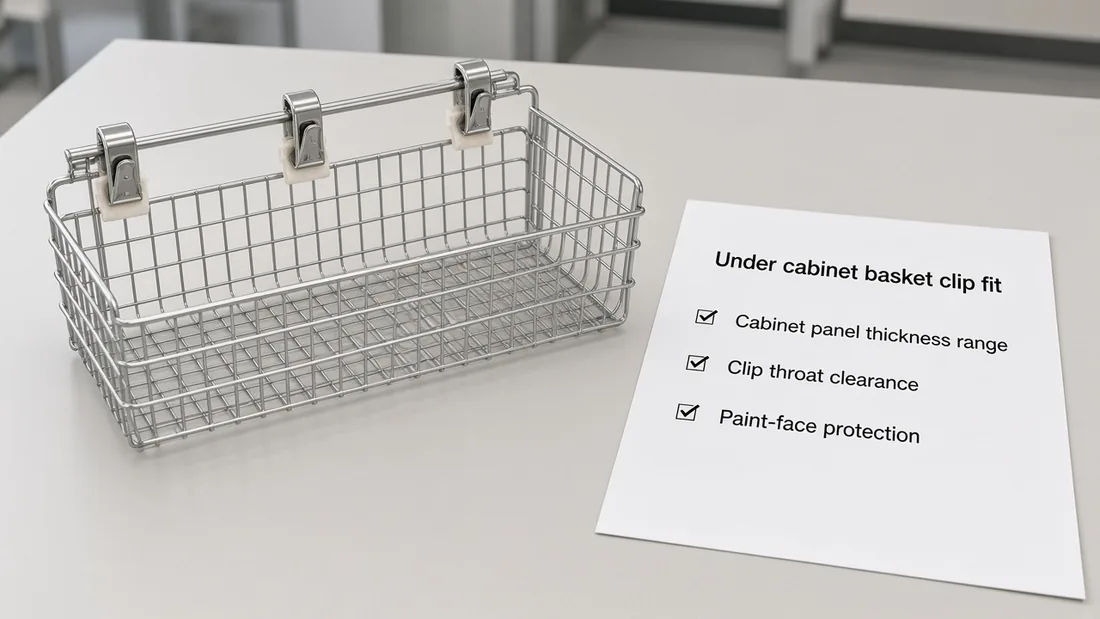
A short written window, two gauge panels, and a painted-face trial will prevent most clip-fit disputes later. If those items are missing from the file, wait to approve the listing claim and the first bulk release.
الأسئلة الشائعة
Can one clip design cover every kitchen in a catalog?
Usually not. If the retailer serves more than one cabinet construction, either narrow the claim to a stated thickness window or offer more than one clip or SKU. Under cabinet basket clip fit is a range decision, not a single universal throat.
Should buyers specify the clip before the basket width?
Specify them together. Width, rim stiffness, and clip count change how evenly the throat meets the shelf. A clip that works on a short basket can twist on a longer one.
Are paint marks always a clip-geometry problem?
No. Missing pads, a pad that has walked out, a rough clip heel, or a forced installation motion can mark paint even when the thickness is inside the window. Inspect the pad and the motion before redesigning the throat.
How should a “fits most cabinets” claim be handled?
Treat it as incomplete until the thickness window and the clamp target are written. If the listing must stay short, point to the specification sheet that states the range, and keep the claim inside that range.
Do soft-close doors always need a special basket?
Not always, but they always need a dry-fit. Some closer bodies occupy the underside zone that a clip heel wants. Record the gap; do not assume a standard door clearance.
Can spare clips be shipped in the same finish later?
Yes, if the spare is tied to the same throat, pad, and rim interface. A later spare with a different heel or pad thickness is a new fit part and should be re-approved.
اعمل مع شركة «كويتور» للأدوات
Need an under-cabinet clip basket reviewed for thickness and throat fit?
Send Koitor the cabinet-panel thickness range, a photo or drawing of the clamp target, and whether spare clips and pads are required. Our team can review the clip throat, paint protection, and small-batch OEM options before quotation.
OEM / العلامة التجارية الخاصة
حوّل دليل التوريد هذا إلى موجز منتج
يرجى إطلاعنا على المنتج المستهدف، والحجم، والتشطيب، وكمية الطلب، ومتطلبات التغليف. وسيتلقى فريقك تقييمًا عمليًّا لإمكانية التصنيع قبل تقديم عرض الأسعار.


 English
 Español
 Português
 Français
 Deutsch
 العربية