

Choose the architecture first, then freeze the opening. An open towel ring is useful when a shopper wants to hang a hand towel without threading it through a closed loop, but the same opening can let the towel drop.
A closed ring is safer against drop and slower to hang. Write the finished C-gap, a named hand-towel SKU, and a hang-versus-drop trial before the assortment is split and photographed. A lifestyle photo of an empty ring is not a gap file.
This guide is for importers and private-label teams building a screw-mounted towel-ring SKU. It does not measure the clear inner diameter of a closed loop, and it does not set a pivot stop or wall-clearance swing. Koitor Hardware, a family-owned China OEM manufacturer of bathroom hardware, can review a ring brief with a drawing or a sample; the buyer still has to choose the architecture and the towel trial.
When is an open C-ring the right SKU, and when is a closed ring safer?
An open C-ring is the right SKU when the program values one-handed hang and removal, and when a modest drop risk is acceptable after a named towel trial. A closed ring is safer when the program would rather accept a slower hang than a towel on the floor, or when the shopper is expected to leave a towel on the ring for a long time.
Do not treat the two as the same SKU with a styling tweak. The opening is a functional split. If a collection needs both, give them distinct identities, distinct photos, and distinct claim lines. A color suffix on a closed ring should not be used to sneak in an open ring.
Custom bathroom towel-rack manufacturing و تصنيع تجهيزات الحمامات حسب الطلب can quote either architecture, but only if the inquiry says which one you want and how the opening will be checked. A request that only says “modern towel ring” is not yet a split.
Worked example: a brand photographs a closed ring with a folded hand towel, then ships an open C-ring in the same listing because it looked similar in chrome. Shoppers complain that towels slip out. The architecture was never frozen, so the listing is now two products with one URL.
Worked example: an open ring is chosen for convenience, but the C-gap is so tight after plating that a thick hand towel must be forced through. The convenience benefit disappears, and the tips chip. The gap was never measured on the finished part.
Opening orientation matters. A gap at the top, at the side, or at the front changes both hang convenience and drop. Write the orientation on the drawing, and keep it consistent in the sample and the photo. A side gap that faces a shower spray may also wet the towel end; that is a use note, not a reason to skip the gap method.
Return lips or slight inward hooks at the tips can reduce drop without turning the ring into a closed loop. If a lip exists, measure the useful opening after the lip, not only the wide mouth. If there is no lip, do not imply one in a rendering.
How should the finished C-gap be measured?
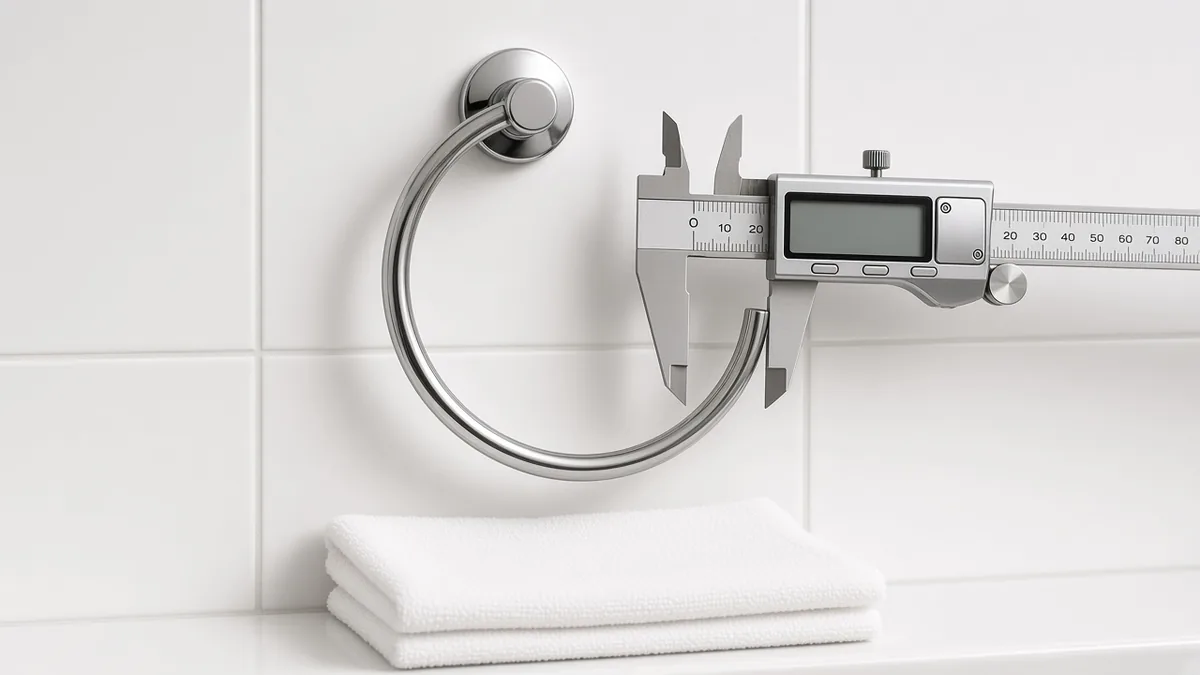
Measure the finished opening on the coated or plated ring, at the narrowest useful gap the towel must pass, with a stated datum. Finish thickness shrinks a gap. A drawing gap on a bare casting or a bare bent tube is not the gap the shopper will use.
Write whether you measure tip to tip, tip to inner return, or both. A ring with a return lip needs both notes. Use a caliper or a simple go gauge, and keep the method out of any sampling-plan sentence. If a project needs a numeric gap, agree it on the sample as a project figure. Do not invent a Koitor default C-gap here.
Check more than one ring from the first article, because bending and polishing can move the tips. If the program later adds a second finish, measure the gap again. A thicker powder or a different polish can close a gap that was acceptable in chrome.
Tip quality belongs beside the gap. Sharp or thin tips chip, catch loops, and look unfinished. A gap that is dimensionally correct can still fail if the tips are knife-edged. Photograph the tips and write a visual accept for finish at the ends.
If the ring is pivoting, measure the gap in the hanging position you will sell, not only on a bench fixture that holds the ring in a convenient attitude. Movement and wall clearance remain a different file; this file only needs the gap in the use position so the towel trial is honest.
Do not confuse this measurement with the clear inner diameter of a closed loop. A closed-ring ID asks whether a folded towel can pass through the loop. An open C-gap asks whether a towel can enter or leave the opening, and whether it then stays. Keep the two methods on their own pages, even when both rings appear in one assortment.
What hang-versus-drop trials belong on the sample?
Name the hand-towel SKU or SKUs: size, fabric family, and typical fold. A thin guest towel and a thick terry hand towel will not behave the same way in the same gap. If the listing says “fits hand towels,” write which ones you tried. Do not invent a universal towel.
Run a hang trial and a drop trial as two looks at the same sample. The hang trial asks whether the named towel can be placed on the ring in the intended way without forcing the tips.
The drop trial asks whether that towel stays after a normal bump, a door close, or a stated tug, as you agree in the project file. Keep the actions modest and written. Do not invent a laboratory drop height or a Koitor pass number.
If the ring will be used with a washcloth or a lightweight decorative towel, add that SKU or exclude it. Lightweight towels slip out of an open ring more easily than heavy terry. A claim that is silent on towel type will be tested by the lightest towel a shopper owns.
Repeat the trial after a wet towel if the product will sit in a steamy bath. Wet fabric hangs differently and can slide. A dry studio trial alone is a weak basis for a no-drop line.
Record the fold. A towel hung by a single corner is not the same as a towel folded in half over the ring. The photo, the instruction, and the trial should use the same fold, or the claim should say so.
If both an open and a closed SKU will be sold, run the same towel on both so the assortment story is honest. The closed ring is the drop-safer reference, not an excuse to skip the open-ring trial.
| Decision | What to freeze | What a sample should show | What to keep off artwork until then |
|---|---|---|---|
| Architecture | Open C-ring, closed ring, or both as distinct SKUs | Each SKU matches its identity; a color suffix does not hide an opening change | One listing that mixes both rings as if they were the same product |
| Finished C-gap | Datum on the finished part, including any return lip, by a written method | The gap still allows the named hang after coating or plating | A drawing gap taken from a bare prototype |
| Opening orientation | Top, side, or front, as designed | The sample and the photo show the same orientation | A rendering that flips the gap for styling |
| Named towel | Size, fabric family, fold, and wet or dry condition | The hang and drop trials use that towel | “Fits all hand towels” or “towels cannot slip out” |
| Tip quality | Visual accept for the ends, and whether a lip is present | Tips are not knife-edged or chipped after the trial | A glamour shot that hides the tips |
| Neighbor files | Closed-loop clear ID and pivot or wall clearance stay on their own pages | This file does not reprint those methods | A gap number used as if it were a clear ID, or a swing used as if it were a drop trial |
What claims should stay off artwork, and what belongs on other ring pages?
Keep “towels cannot slip out,” “fits all hand towels,” and “never drops” off the listing until the named towel trials exist. The U.S. FTC Policy Statement Regarding Advertising Substantiation is a useful reminder that those lines need a reasonable basis, not a Koitor test certificate. If the trials are incomplete, say which towels were checked, or stay quiet.
Clear inner diameter of a closed ring is a different decision: it asks whether a folded towel can pass through a closed loop. Pivot stop and wall clearance are a different decision: they ask how far a swinging ring may travel and whether it knocks the wall. Do not reprint those methods here. Point readers to those files when they go live in your own link set, and keep this page on architecture and C-gap.
Photography should show the opening clearly on the open SKU and the continuous loop clearly on the closed SKU. A cropped hero that hides the gap will train shoppers to expect a closed ring. Pack diagrams should not redraw the opening when a language version is added.
If a finish family will share the same ring design, overlay the gap on each new finish. A shared post or flange does not automatically preserve the C-gap after a different coating build.
Buyer checklist for an open towel ring versus a closed ring
Use this list before an open-versus-closed split is tooled or photographed.
- Choose open C-ring, closed ring, or both as distinct SKUs, and do not hide an opening change inside a color suffix.
- Write the opening orientation and whether a return lip is present.
- Measure the finished C-gap on the coated or plated sample, at the narrowest useful opening, with a stated datum and a method kept separate from any sampling plan.
- Name the hand-towel SKU, the fold, and whether the trial is dry, wet, or both.
- Run a hang trial and a drop trial on that towel, and write what a fail looks like, without inventing a laboratory height.
- Inspect tip quality after the trial, and photograph the tips and the gap.
- Keep cannot-slip-out and fits-all-towels language off artwork until those trials exist.
- Do not use a closed-loop clear-ID method or a pivot-and-wall-clearance method as a substitute for this file.
- Re-measure the gap when a new finish or a new bender is introduced.
- If both architectures are sold, trial the same named towel on both so the assortment story stays honest.
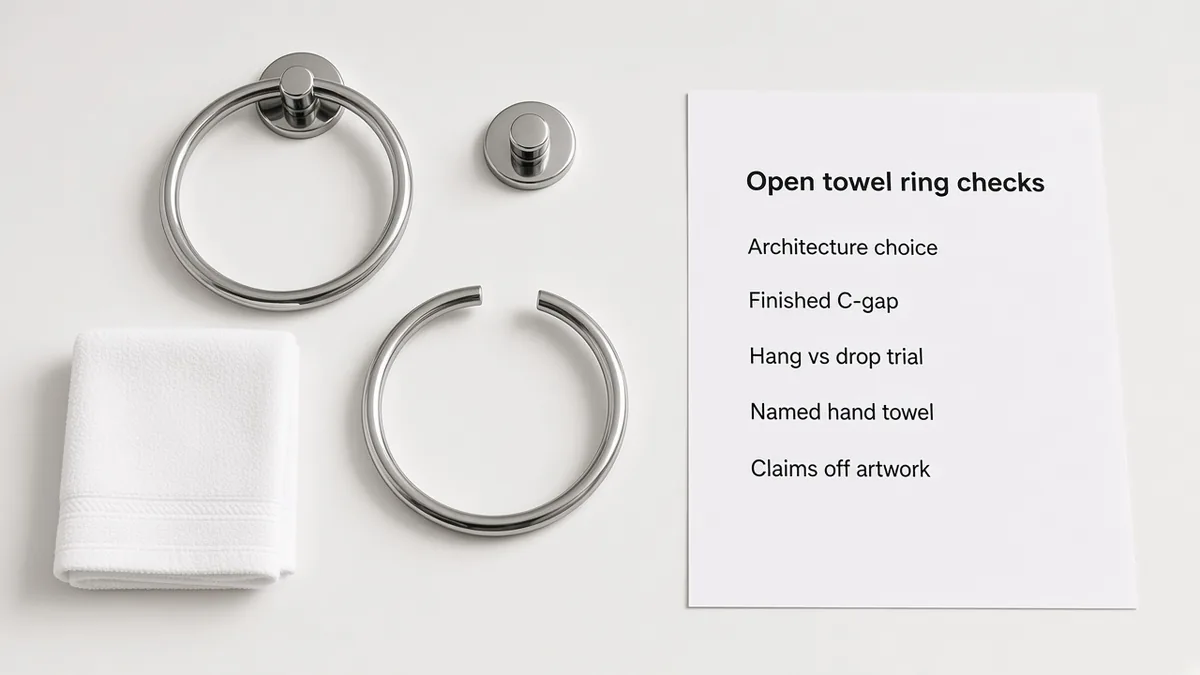
Koitor can review a ring brief as part of custom bathroom towel-rack manufacturing أو تصنيع تجهيزات الحمامات حسب الطلب. Send the drawing or the sample, the intended architecture, the gap callout, and the towel you want used in the trial.
Small-batch customization is possible depending on the product. MOQ can start from 100 pcs depending on the product, samples usually take 5–7 working days after details are confirmed, and bulk production usually takes 4–6 weeks depending on the project. A new opening tool or a second finish can change that discussion under careful approved wording.
A family-owned factory can hold a bending fixture and a retained ring, but it cannot honestly promise that every hand towel in a shopper’s cupboard will stay on an unwritten gap. The buyer still owns the towel list and the claim.
Incoming lots should include a gap check on the finished open ring, not only a finish check on the face. A later polish, a later plate thickness, or a later operator at the bender can reopen the opening. Tick the gap against the retained ring or a simple go gauge.
If a distributor asks to “just open” a closed ring already in the assortment, treat it as a new SKU. Cutting or opening a closed loop changes the tips, the gap, and the claim, and it may weaken the section at the cut.
Retail sets that box an open ring with a closed bar or hook should still show the opening honestly on the ring. A set photo that only shows the bar will not warn a shopper about towel drop.
Instruction cards should show the intended fold and hang. A card that shows threading a closed loop cannot be reused blindly on an open C-ring. Make a version for each architecture.
Warehouse nicks on tips are functional, not only cosmetic, on an open ring. A bent tip changes the gap. Inspect tips on incoming, not only after a finish audit.
When the architecture, the finished gap, the named towel, and the hang-versus-drop trials are written, the SKU split can be photographed. If the file only says “open style available,” the opening is still an untested claim.
A second plant should not inherit the gap by a chrome photo. Re-measure the finished opening and rerun the towel trial on the actual finish.
Do not use a field “towel fell once” story as the only design method, and do not ignore it either. Ask which towel, which fold, and whether the ring was the open SKU. Then go back to the frozen gap and the trial, rather than opening or closing the ring by taste.
Projection from the wall can change how a thick towel hangs in an open ring, but projection is not a substitute for the gap. If a long projection lets a towel slide sideways into the opening, note it in the trial. Detailed swing and knock remain on the clearance file when you use that file.
Children’s rooms and guest baths often use lighter towels. If those channels are in the sales plan, include a lightweight towel in the trial or exclude that use on the artwork. A silent claim will be tested by the lightest textile in the house.
Finish families should carry the architecture code in the SKU stem. A black open ring that shares only a color suffix with a chrome closed ring will create spare-part and instruction errors later.
If a designer adds a decorative crystal or a square profile, remeasure the useful opening. Decoration that sits at the gap is a new datum, not a styling note only.
Sales walls that mix open and closed rings should label them. A shopper who handles a closed ring and buys an open ring from a nearby hook will describe the drop as a defect, not as an architecture choice.
Hotel-looking photography is not a reason to drift the reader into hospitality punch lists. The same architecture choice still belongs to importers and private-label teams. If a catalog mood shot uses a closed ring, do not let that shot stand in for an open towel ring SKU in the same collection page.
A later “improved” tip that shortens the opening after the first season is a change, not a polish note. Re-run the hang trial on the named towel. An open towel ring that suddenly feels “more secure” may have lost the convenience the listing still promises.
Spare-part packs should state the architecture. A spare open ring sent against a closed-ring complaint will not satisfy the shopper, and a spare closed ring sent against an open-ring order will look like a packing error. Put the opening type on the spare label and on the carton end.
If e-commerce filters only offer “towel ring” as one attribute, use the title and the first image to show the opening. Filters will not save a mixed-architecture catalog. The file still has to keep the SKUs distinct before those images are shot.
Installer videos should not be left to a generic closed-ring clip. If the open SKU is the one being sold, the video should show the gap and the intended fold.
A closed-loop threading clip used on an open SKU page will train the wrong hang and then generate drop complaints that look like product defects. Keep the clip and the sample file on the same architecture.
الأسئلة الشائعة
Is an open C-ring just a closed ring with a gap cut in later?
It should not be treated that way. The opening, the tips, and the towel behavior are a new architecture. Tool and check it as its own SKU.
Can I skip a drop trial if the gap looks small?
No. A small-looking gap can still drop a lightweight or wet towel, and a tight gap can defeat the hang benefit. Name a towel and run both trials.
Does clear inner diameter replace the C-gap?
No. Clear ID is for a closed loop and a folded towel passing through. C-gap is for an open ring and the opening the towel uses to enter or leave.
What if I also have a pivoting ring?
Measure the C-gap in the hanging use position, and leave swing, stop, and wall knock on the clearance file. Do not use a swing test as a drop test.
Can I claim that towels cannot slip out?
Only after a named-towel drop trial supports that sentence, and even then you should be careful. If the trial is limited, limit the wording.
What should a first sample include?
The finished open or closed ring, a gap callout or a closed-loop note, the named hand towel, and photos of the opening and the tips. An empty lifestyle shot is not an architecture sample.
اعمل مع شركة «كويتور» للأدوات
Need an open-versus-closed towel-ring brief reviewed?
Send Koitor the drawing or sample, the intended architecture, and the hand towel you want used in the trial. Our team can review the opening, the tips, and small-batch OEM options before quotation.
OEM / العلامة التجارية الخاصة
حوّل دليل التوريد هذا إلى موجز منتج
يرجى إطلاعنا على المنتج المستهدف، والحجم، والتشطيب، وكمية الطلب، ومتطلبات التغليف. وسيتلقى فريقك تقييمًا عمليًّا لإمكانية التصنيع قبل تقديم عرض الأسعار.

 English
 Español
 Português
 Français
 Deutsch
 العربية