
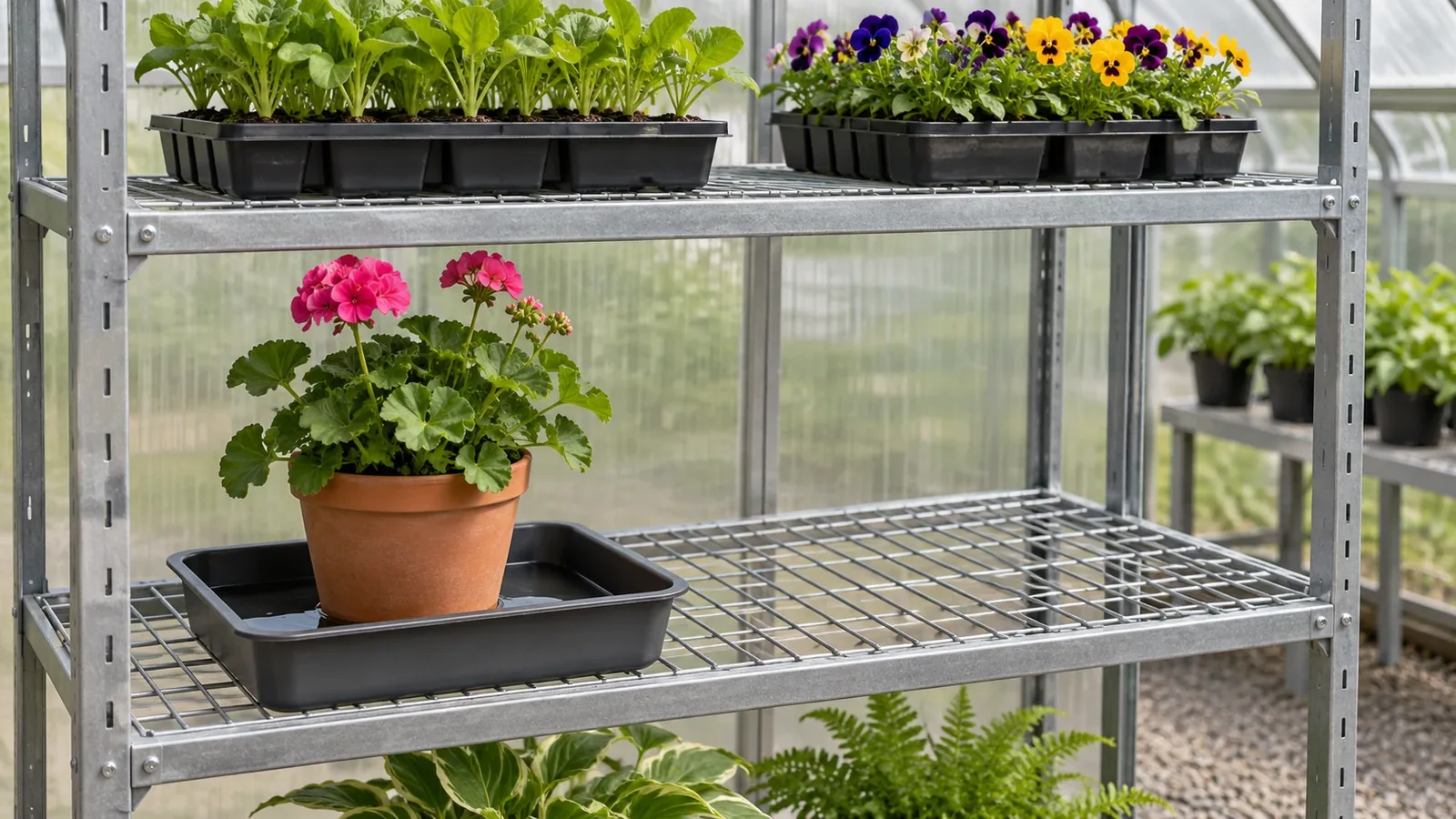
Greenhouse shelving should be specified by its intended water function and by identifying which component performs that function. A shelf described for bottom-watering is not automatically a drainage surface, and a metal carrier is not automatically the water-containing component. Before comparing products, state whether the proposed system supports a deliberate watering arrangement or a runoff task, then name the shelf, tray, insert, or other part responsible for containing or releasing water.
This is a procurement guide for product architecture and supplier scope, not a plant-care article. It does not set a watering schedule, recommend a horticultural outcome, specify a sealed construction, or provide a leak test or installation procedure.
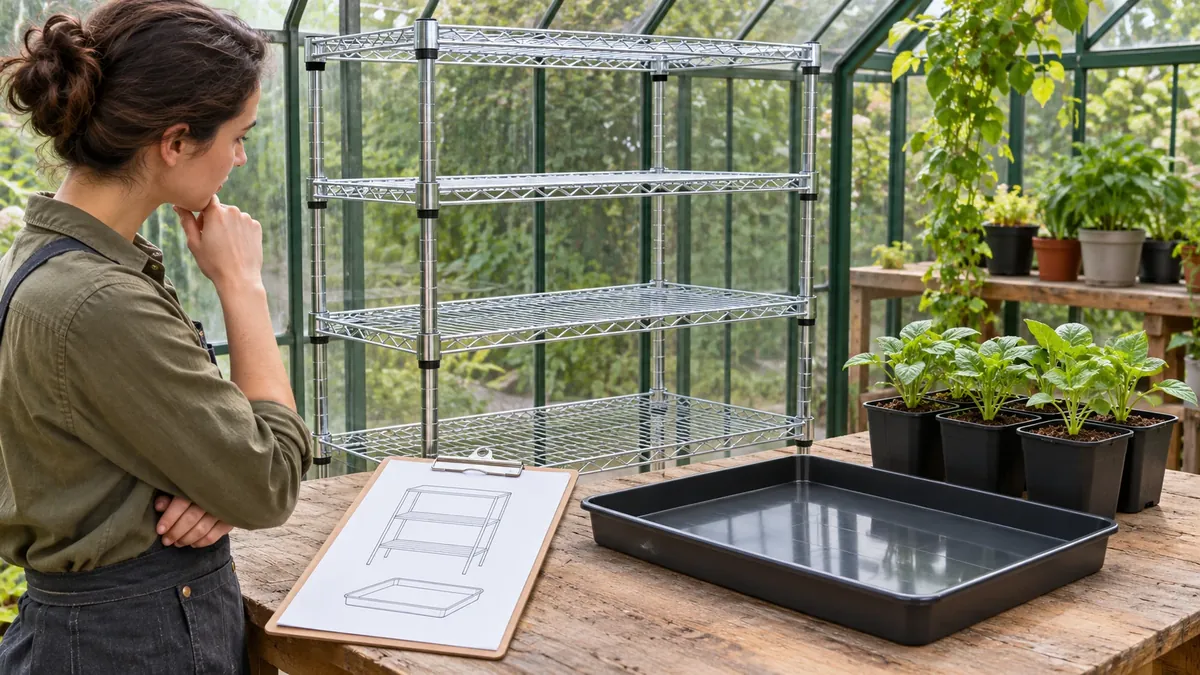
What problem does greenhouse shelving solve for a buyer?
The buyer must define what water is intended to do in the complete arrangement before selecting a shelf blank, tray, or metal support. A system designed around bottom-watering presents a different use brief from a work surface intended to let rinse or spill water drain away.
Product names can make those roles sound simpler than they are. “Greenhouse shelf,” “staging shelf,” “watering shelf,” and “drainage tray” may describe a product category, a desired use, or a component in a larger configuration. They do not automatically identify whether the metal part supports a water-containing component, whether a separate tray is supplied, or which path the water is meant to follow.
Juliana’s current product page for its Integrated Shelf, model F04571, explicitly describes the named product as designed for bottom-watering. It also states that the shelf fits directly into greenhouse profiles and is supplied unassembled. This is evidence of a particular maker’s declared use and configuration. It does not establish a universal construction, leakage limit, water path, or plant-growth outcome for other products.
The sourcing decision should distinguish four things: the intended operation, the component that contacts or contains water, the metal shelf or frame that supports components, and the current instructions for the exact product. If one of those items is missing from the quote, the buyer should mark it unresolved rather than infer that the metal surface itself is a reservoir.
This matters during private-label development because the product title, parts list, assembly instructions, and package contents may be prepared by different teams. If the marketing brief says “bottom-watering” while the purchase order covers only a generic shelf, the supply scope does not yet establish how the intended function is achieved. A clear function record helps product, sourcing, quality, and supplier teams work from the same requirement.
What should buyers define before selecting a shelf or tray?
Start with the desired water task, then identify the component responsible for it. Do not begin with a finish or a photograph and assume that the visible shelf geometry reveals the system function.
Use a water-function matrix before issuing an RFQ:
- Selected system: record the manufacturer, model, revision, greenhouse or frame family, and configuration.
- Intended operation: state whether the brief concerns bottom-watering, drainage/runoff, or another defined task.
- Water-contact component: identify which part is meant to contain, carry, or release water. If unknown, write “not established.”
- Carrier/support component: identify the shelf, frame, or metal part that supports the tray, plants, or another item.
- Documented water path: record what the maker’s current instructions actually say about water movement.
- Bought-in parts: list inserts, trays, accessories, seals, or other parts only when they are named in the supplier’s current documentation.
- Evidence owner: identify who confirms the complete arrangement and any project-specific performance requirement.
- Open questions: list missing geometry, materials, containment details, or acceptance evidence for the responsible product maker.
| سؤال من المشتري | Bottom-watering configuration | Drainage/runoff configuration |
|---|---|---|
| What is the intended task? | A maker documents the selected product for a defined bottom-watering purpose | The buyer defines where runoff should go and which component handles it |
| What part manages water? | Identify the exact component from current product documentation | Identify the surface, tray, or receiving component responsible for the water path |
| What does the metal shelf do? | It may support part of the arrangement; do not assume it is the reservoir | It may be a carrier, shelf, or part of a system; do not infer the drainage design |
| What must be confirmed? | Current model instructions and full included-part scope | Current model instructions and project-specific water-management scope |
| What is not proved by a coating name? | Water containment or a sealed construction | A predictable drainage path or absence of pooling |
The table is a way to define responsibility, not a universal design chart. A particular product may combine several roles, but the supplier should identify that combination for its exact model. A buyer should not create an overflow, seal, groove, slope, or water-depth specification without the proper technical source.
How should a bottom-watering shelf be evaluated as a product brief?
Treat bottom-watering as a documented use of a named product, not as a conclusion that any solid shelf will hold water. The maker’s current description should identify the product model and intended configuration, and the buyer should confirm what parts are included.
Juliana’s page identifies model F04571 and describes its intended use as bottom-watering. The same page states that the shelf is fitted into Juliana greenhouse profiles, comes in two- and three-section versions, and is supplied unassembled. Those details help define that particular product and its product context. They do not provide a universal rule for other greenhouse profiles or prove that the metal carrier is a watertight tray.
For a buyer evaluating a different supplier, ask for the current model number and a parts list. Clarify whether the quote covers the shelf alone, an integrated component, an accessory tray, or a system assembled with other parts. If the maker provides instructions, record their revision and the configuration they cover. If a separate insert or water container is part of the intended function, its supplier and responsibility should be explicit.
Do not transfer plant-care language into a technical sourcing claim. The Juliana page includes product-specific marketing about plants absorbing water and watering frequency. This article uses only its stated product purpose as an example. It does not make a general gardening recommendation or promise any plant outcome for a different system.
The buyer should also separate availability from engineering scope. A product page can show a specific configuration or a set of options, but the order still needs the exact current model, selected variant, and package contents. Do not assume a dimension, material, number of segments, profile fit, or assembly detail beyond the selected product documentation.
How does drainage differ from water containment?
Drainage describes a desired route for water to leave a surface or system; containment describes a part intended to hold water. Neither role should be inferred from the word “shelf.”
A metal shelf may be solid, perforated, open, or paired with another component, but this guide does not rank those constructions or say which is universally suitable. A bathroom storage article about water leaving a shower shelf addresses a different application from a greenhouse product documented for bottom-watering. The product context and requested function matter; shared words such as shelf, tray, or water do not establish the same buyer decision.
Likewise, a potting bench listing may describe a removable tray and separately ordered add-ons. That is useful adjacent context for supply-scope questions, but it does not prove a bottom-watering system or a universal greenhouse drainage configuration. Buyers should use the exact manufacturer instructions for their selected system.

For a real project, the supplier should identify which part is expected to contain or redirect water and what documentation supports that function. If the answer depends on an unread drawing or a proprietary profile, request the current source directly. Do not fill the gap with a presumed seal, end cap, groove, or surface treatment.
How should supplier responsibility be recorded?
Assign the water function to the supplier or designer who owns the relevant component and complete system evidence. A metal shelf fabricator may control a carrier or support while another manufacturer supplies a tray or greenhouse profile.
The RFQ should identify the proposed scope in plain terms. For example, one quote may cover a metal shelf or support frame; a second may cover the component expected to contain water; a third may supply the greenhouse profile or accessory. Listing those parts separately prevents a buyer from assuming that the manufacturer of one component has approved the completed system.
Use a responsibility schedule:
| Responsibility | Record | If the information is not available |
|---|---|---|
| Product configuration | Exact model and current revision | Request current maker documentation |
| Water-contact part | Supplier, component identity, and stated function | Mark the component and function unconfirmed |
| Metal shelf/carrier | Drawing owner, material and finish scope, and quantity | Keep outside claims about water containment |
| Mating greenhouse profile | Model/family and interface owner | Do not infer compatibility from appearance |
| Instructions | Document title, revision, and supplied status | Hold the relevant claim until instructions are provided |
| Performance evidence | Claim, configuration, evidence, and approver | Do not make a universal claim from a sample or finish name |
This schedule helps prevent gaps at handoff. The quotation should state deviations from the drawing and identify buyer-supplied parts. Sample approval should reference the same model and configuration. Packaging and online descriptions should not claim functions that the supplier has not documented.
How should buyers define evidence for a water-function claim?
The buyer should state the claim that needs support and ask the responsible maker what documentation applies to the exact model and configuration. This article does not prescribe a test method or pass limit, because the available primary evidence documents a named product purpose rather than a performance test.
For a purchasing review, separate three statements: the maker’s description of intended use, the parts included in the quoted configuration, and any performance claim the buyer wants to make. A page that describes a product for bottom-watering may support the intended-use statement for that model. It does not automatically establish a leak limit, a seal design, or a tested duration. A parts list may establish what is included without proving how the complete arrangement manages water. Any additional performance claim needs its own appropriate evidence.
| Statement under review | Evidence to request | Decision if evidence is missing |
|---|---|---|
| “Designed for bottom-watering” | Current maker description for the selected model and configuration | Limit the wording to the exact documented product or hold the claim |
| “This part contains water” | Product-specific documentation identifying that component and scope | Do not assign containment to the shelf or carrier by assumption |
| “Water drains through this surface” | Current product documentation for the intended water path | Leave the drainage statement unconfirmed |
| “This assembly is watertight” | Evidence for the complete identified configuration and project use | Do not use a finish name or sample appearance as proof |
| “This metal part is suitable for the greenhouse environment” | Material/finish scope reviewed for the actual exposure | Keep the environmental claim with the responsible supplier |
The matrix is a claim-control aid, not a test protocol. If the buyer needs a project-specific evaluation, the product maker and qualified reviewer should agree the conditions and evidence before sampling or release. Keep the requirements separate from this article’s conceptual framework; no test duration, water quantity, load, service life, or pass/fail threshold is supplied here.
What assumptions should buyers avoid?
Avoid turning a product label or appearance into a water-performance claim. The research evidence supports a named maker’s declared bottom-watering purpose and a separate water-function decision framework; it does not support a universal construction or test result.
Do not assume a greenhouse shelf is a drainage shelf. Ask the manufacturer what function it documents and where water is expected to go in that exact configuration.
Do not assume a solid shelf is the water container. A shelf may support another component. Identify which part is expected to hold water and who supplies it.
Do not assume openings are always desirable or undesirable. The correct water behavior depends on the defined application and the selected system. This article does not prescribe slot geometry or a drainage pattern.
Do not assume a powder-coated finish establishes containment. A finish name does not by itself prove that an assembly holds water or has no leak path. Request relevant evidence from the responsible maker.
Do not infer a seal or end-cap design from an unread drawing. The linked Juliana guide was not accessible for visual review in the research process. No gasket, groove, fastener, seal, or water-depth claim is made here.
Do not claim that a coating prevents corrosion in every greenhouse condition. The research pack provides no project-specific exposure, test, or life data for this topic. Material and finish questions should be specified and reviewed for the actual use environment.
Do not turn bottom-watering into a horticultural promise. A manufacturer’s intended-use statement for one product does not establish watering frequency or plant health for all crops and climates.
Do not treat a sample or finish label as a containment test. Any performance evaluation should be specified by the responsible system maker and project reviewer. This article does not set a duration, volume, load, or pass limit.
Do not imply Koitor currently manufactures a greenhouse system. The approved company facts support metal fabrication and related component discussions, not a current greenhouse shelf, irrigation, or watertight-product range.
Buyer handoff and next steps
How can Koitor support a related metal-component inquiry?
Koitor Hardware can discuss metal forming, joining, finishing, basic assembly, packaging, and drawing or sample review within its approved bathroom and home-storage hardware scope. This does not establish a greenhouse product line, irrigation expertise, extrusion/profile capability, or a sealed watering-shelf product.
For an adjacent inquiry, identify whether the requested part is a metal shelf, tray carrier, frame, or another component. State separately which part is intended to contain or release water and name the supplier responsible for that function. Provide the drawing or physical sample, mating profile reference, requested finish, quantity, and packaging needs so Koitor can confirm whether the exact metal scope fits its capabilities.
If a water-contact component is bought in, keep its supplier and model visible in the quotation. Ask the responsible product maker to confirm its function and current instructions. A metal fabricator’s drawing review can discuss the defined metal part but does not establish containment, corrosion life, plant suitability, or full-system performance.
Small-batch OEM development can support a buyer evaluating a defined metal storage component. Feasibility and timing depend on the exact drawing, material, finish, quantity, assembly, and packaging. Confirm current project details with Koitor rather than treating general manufacturing experience as proof that the cited Juliana shelf or any greenhouse system is available.
الـ OEM home-storage hardware scope is the relevant company context for a bounded metal-component inquiry.
Buyer checklist before requesting a quotation
Include the information that makes the intended water function and supply boundary clear:
- Greenhouse or frame maker, model, and current revision.
- Exact shelf or staging component and whether the quote is for the shelf alone or a complete set.
- Intended operation: bottom-watering, drainage/runoff, or another defined task.
- The exact component expected to contain or release water.
- Current maker documentation that describes the selected configuration.
- Mating profile, interface owner, and current drawing reference.
- Bought-in tray, insert, accessory, or other component identity and responsible supplier.
- Metal part drawing or sample, requested material and finish, quantity, and packaging scope.
- Any open evidence required for a water-containment or drainage claim.
- The reviewer responsible for approving the completed configuration.
Ask suppliers to state what their quote excludes and which assumptions it uses. If the water function is not documented, do not describe the offer as a confirmed bottom-watering or drainage system. Keep the claim open until the responsible maker supplies current evidence for the exact arrangement.
A buyer can translate the intended water function into a short evidence record without inventing a test plan. Name the product model and revision, quote the maker’s stated purpose accurately, identify the part expected to contain or route water, and record which supplier owns that claim. Add the source document and date checked. If the maker’s description only says “bottom-watering,” keep the record at that level; do not expand it into a quantified water capacity, leak-free claim or drainage behavior.
If the project brief asks for both plant-tray support and water management, list those as separate requirements. Ask the product maker to identify which components belong to each function and whether the exact configuration has current documentation. A shelf, tray, insert or frame can be sold separately, and a photograph may show a combination that is not the quoted supply scope. Use a parts list that names included, optional and buyer-supplied items.
When a metal component is sourced independently, the metal drawing review can cover only the defined metal part and its documented interfaces. The water-contact supplier remains responsible for confirming containment, routing or other system behavior. Keep open requirements visible in the quote comparison and do not convert a lack of information into an implied pass.
The same boundary should carry into product listings, packaging and service documents. State a maker-supported intended use and identify the selected model; avoid broad language such as “waterproof greenhouse shelf” unless that exact claim is supported for the complete configuration. This communication step helps the buyer compare offers while leaving technical acceptance criteria to the system maker and project reviewer.
For greenhouse shelving, record the selected model and the exact water function stated by its maker before comparing a metal carrier with a separate tray.
الأسئلة الشائعة
Does “greenhouse shelf” mean that it is a drainage shelf?
No. The category name does not specify a water path. The buyer should review the selected model’s current documentation and state whether the project requires drainage, bottom-watering, or another function.
Does a solid tray automatically hold water as required?
No. Appearance alone does not establish containment, sealing, or a water limit. Identify which part the maker intends to manage water and request its current configuration documentation.
Does powder coating establish water containment?
No. A finish label does not prove that a completed product holds water. The responsible system maker must provide evidence for the selected product and intended use.
Can one shelf specification be used for watering and runoff tasks?
Do not assume so. Those are different product briefs. Compare the named configurations and ask the maker which water function each one is documented to support.
اعمل مع شركة «كويتور» للأدوات
Define the Shelf and Water-Contact Part Separately
Share the selected greenhouse or frame reference, metal component drawing, intended water function, bought-in part list, quantity, finish, and packaging. Koitor can confirm whether a defined metal component fits its current scope; the responsible system supplier must confirm water-management performance.
OEM / العلامة التجارية الخاصة
حوّل دليل التوريد هذا إلى موجز منتج
يرجى إطلاعنا على المنتج المستهدف، والحجم، والتشطيب، وكمية الطلب، ومتطلبات التغليف. وسيتلقى فريقك تقييمًا عمليًّا لإمكانية التصنيع قبل تقديم عرض الأسعار.

 English
 Español
 Português
 Français
 Deutsch
 العربية