
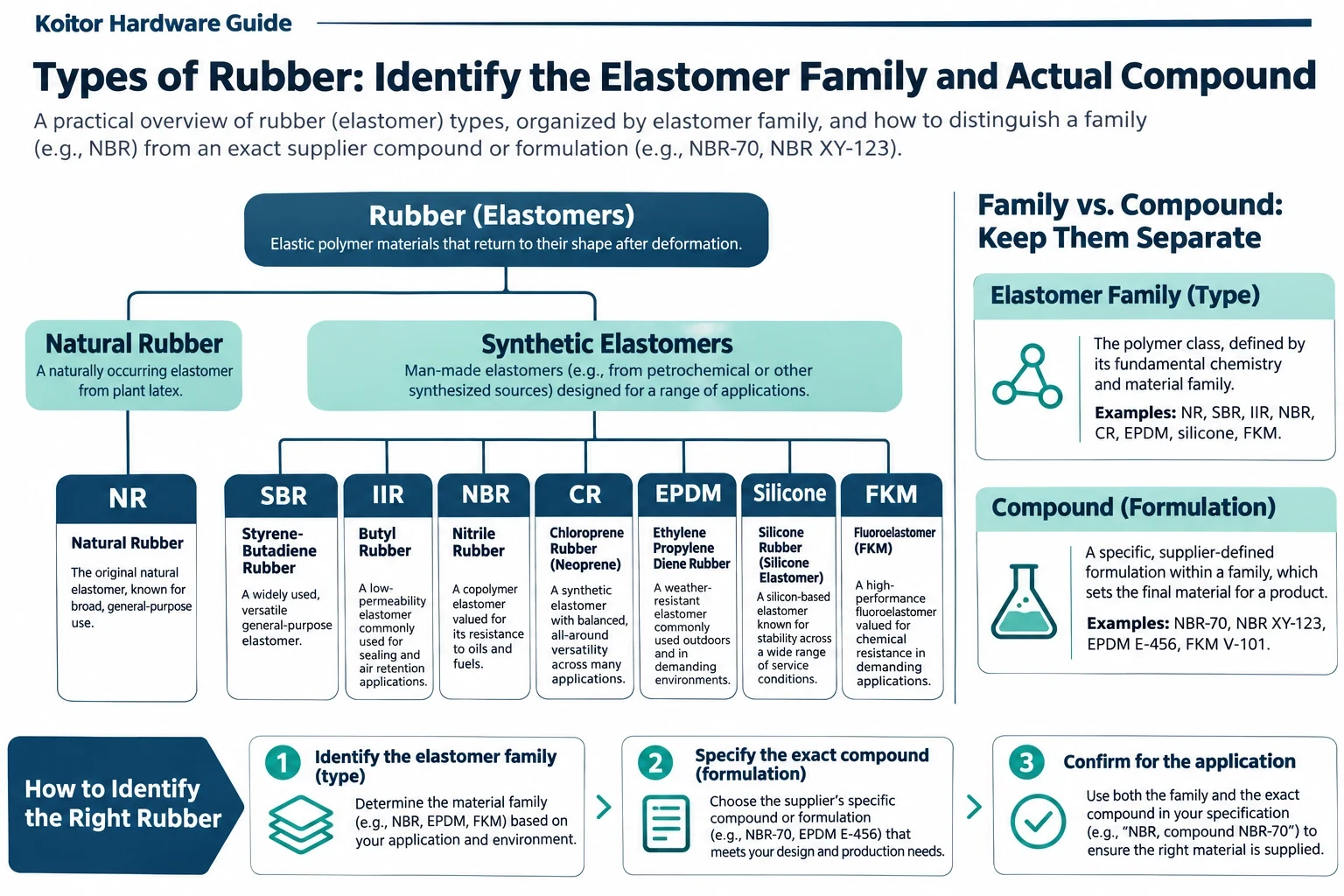
Types of rubber are best understood as families of elastomer materials, not as one interchangeable specification. Common names include natural rubber (NR), styrene-butadiene rubber (SBR), butyl rubber (IIR), nitrile rubber (NBR), chloroprene rubber (CR), EPDM, silicone rubber, and fluoroelastomer (FKM). Each family name helps identify a broad material identity, but it does not by itself identify a supplier’s exact compound, hardness, construction, or suitability for a particular assembled product. Buyers should separate those questions before comparing samples or approving a drawing.
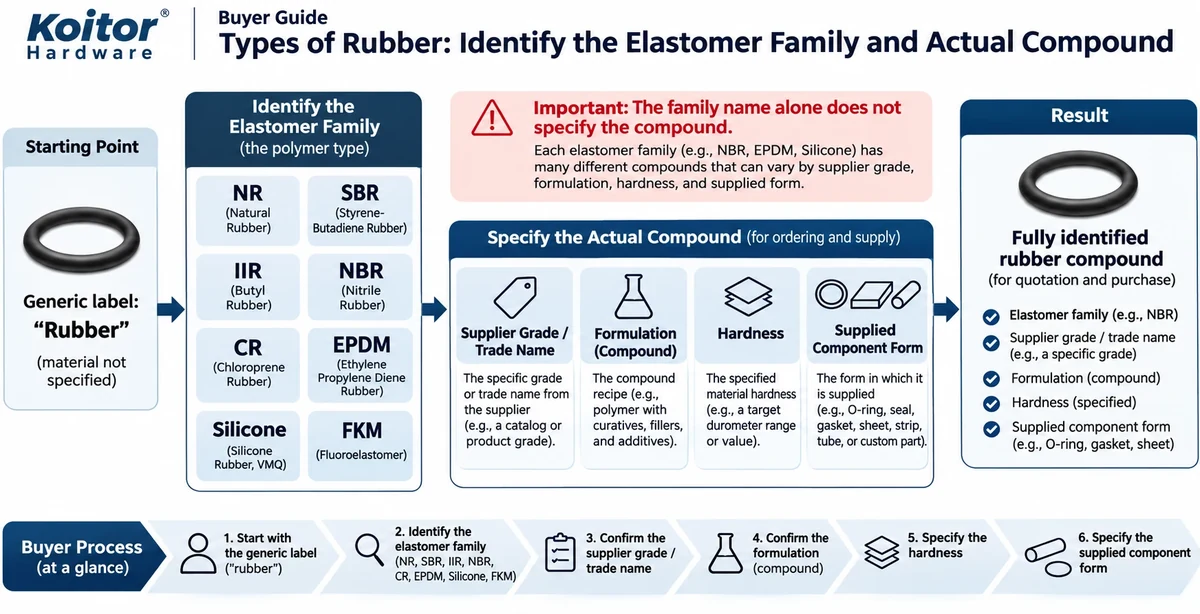
What problem do rubber material types help a buyer solve?
A buyer researching types of rubber may be trying to interpret a supplier description, compare an existing component with a proposed replacement, or prepare a drawing note for a protective foot, buffer, pad, gasket, or other bought-in part. The words on a quotation can be too broad to support a meaningful comparison. “Rubber” may describe a broad class; a family abbreviation narrows the identity, while a trade name may refer to a supplier’s particular material range. Neither guarantees that two parts have the same formulation or finished behavior.
This guide maps common family names and shows what additional information should be requested. It does not rank the families from best to worst. A material that is suitable in one geometry, load, exposure, and assembly may be unsuitable in another. The measured search expression is broad and informational, so the answer begins with the family taxonomy itself. A hypothetical hardware example is used only to explain the buyer’s specification task; it is not a claim that Koitor manufactures rubber compounds or molded elastomer products.
The practical problem is often one of traceability. If a product drawing says only “rubber pad,” a later buyer may not know whether the replacement matches the original. If a supplier changes a trade name, a procurement team may not know whether the family, formulation, color, hardness, or form also changed. The buyer needs enough identity and change-control information to compare proposals and decide what evidence is appropriate.
What are the main types of rubber?
The names below identify common elastomer families or material groupings. They are not all defined at the same classification level, and the short names do not specify every grade or compound sold under them.
| Family or name | Common abbreviation | What the name helps identify | What remains unspecified |
|---|---|---|---|
| Natural rubber | NR | Natural-rubber family identity | Grade, additives, hardness, cure system, geometry, and finished-part behavior |
| Styrene-butadiene rubber | SBR | Synthetic rubber based on styrene and butadiene | Exact recipe, grade, reinforcement, cure, and intended application |
| Butyl rubber | IIR | Isobutylene-based family, commonly identified as butyl | Exact compound, permeability data, hardness, dimensions, and acceptance limits |
| Nitrile rubber | NBR | Acrylonitrile-butadiene family identity | Acrylonitrile content, formulation, temperature range, hardness, and compatibility |
| Chloroprene rubber | CR | Chloroprene family, also commonly called neoprene | Supplier grade, formulation, construction, and application-specific limits |
| EPDM | EPDM | Ethylene-propylene-diene elastomer family | Grade, cure system, hardness, additives, and tested exposure conditions |
| Silicone rubber | VMQ or silicone | Silicone elastomer family or supplier description | Exact grade, cure, hardness, color, reinforcement, and end-use evidence |
| Fluoroelastomer | FKM | Fluorinated elastomer family designation | Exact grade, formulation, cure, supplier identity, and verified operating limits |
This list is a practical introductory map, not an exhaustive inventory of every elastomer or commercial designation. Naming conventions vary between standards, suppliers, and markets. Buyers should confirm the designation used in the actual quotation or technical data sheet, especially when the supplier uses a brand or trade name. A trade name does not automatically tell the buyer the complete chemical composition or prove that a proposed replacement is equivalent.
How should a buyer distinguish a family, grade, trade name, and compound?
These terms answer different questions. A family name groups materials at a broad level. A grade or supplier designation identifies a more specific material offering, often within the family. A trade name identifies a branded product range. A compound is the formulated material used to make the part, which may include a polymer plus additives, fillers, pigments, reinforcement, and a curing system. A part specification then adds the geometry, tolerances, construction, and acceptance criteria for the finished component.
A useful RFQ or drawing review therefore asks for several linked items rather than a single word:
- Family or material designation. State the recognized family and the supplier’s exact designation where available. If the supplier uses a trade name, ask for the underlying family or technical description needed for comparison.
- Supplier and product identity. Record the manufacturer, grade, product code, and revision or document date. A generic name can cover more than one supplier formulation.
- Physical form. Clarify whether the component is solid, cellular, sheet, extruded, molded, cut, bonded, or supplied as another construction. Form is part of the component identity.
- Geometry and interface. Identify thickness, diameter, contact area, attachment method, and any features that affect compression, fit, or retention. The material label alone cannot define these details.
- Properties that matter to the application. Select only the needed requirements, such as hardness or a specified exposure condition. Define the method, specimen, tolerance, and evidence expected instead of relying on an unexplained shorthand.
- Change control. State whether a change of family, grade, trade name, formulation, color, supplier, or manufacturing route requires prior notice and approval.
This structure helps buyers compare like with like. Two quotations that both say “EPDM” may still refer to different grades or compounds. Conversely, two different trade names may refer to materials that a supplier says are comparable, but equivalence should be supported with identifying documents and any required sample evaluation. A buyer should not infer equivalence from color, appearance, or a single broad family name.
Why is “rubber” too broad for a purchase specification?
“Rubber” can be useful in early concept discussions, but it leaves too many variables open for a controlled repeat order. The word does not identify the polymer family, grade, compound, shape, hardness, or acceptance method. It may also conceal whether the part is a solid elastomer, cellular foam, coated fabric, or a composite construction. If these details affect fit or product function, the purchasing document should make them explicit.
A supplier may quote an available standard component using a general material description. That can be appropriate for an initial feasibility check, but the buyer should ask which technical information is available before approving a production sample. The objective is not to request every possible property. It is to identify the few variables that matter to the product interface and future replacement decision.
For example, imagine a hypothetical protective foot fitted to a metal home-storage frame. The buyer may need to distinguish the contact surface and attachment interface, confirm the outside dimensions and internal engagement, and determine whether the part remains in place during the intended handling. That scenario does not establish a universal rubber hardness, friction level, load capacity, or service life. Those values depend on the component design and should come from project-specific requirements or evidence.
A specification that only says “black rubber” is even less informative. Pigment does not reliably identify the family or grade. A visual sample can show color, surface, and approximate form, but it cannot independently establish the composition or prove every performance characteristic. If material identity is critical, request the supplier’s technical data and define whether a declaration, certificate, test report, or independent analysis is needed. The appropriate evidence depends on the risk and buyer’s requirement.
What should buyers compare when reviewing a rubber component?
Start with the intended function and the interface, then compare material information. A family-only comparison can mislead buyers because the part’s behavior also depends on formulation, shape, dimensions, manufacturing method, and the way it is assembled. A disciplined review separates observable features from properties requiring documentation or testing.
Define the part’s job
Write down what the component is expected to do in the assembly: protect a surface, reduce direct metal contact, cover an edge, locate a part, provide a spacer, seal an interface, or perform another defined role. Avoid using a broad material term as a substitute for the functional requirement. If one part has several functions, list them separately so that the supplier can identify trade-offs and the buyer can approve the relevant evidence.
Identify the physical construction
A solid pad, a cellular foam insert, a hollow profile, a bonded laminate, and an overmolded part are not interchangeable merely because each may be described informally as rubber. Record the supplied form and the critical dimensions. For a fitted part, specify the mating component and the dimensions that control retention or alignment. If assembly includes adhesive or a mechanical capture feature, identify that interface separately from the elastomer family.
Decide which material properties are relevant
Do not copy a property table from a general article into a product specification without checking whether the conditions match. A hardness number without a test method and tolerance can be ambiguous. A chemical-resistance statement without a defined chemical, concentration, temperature, duration, and exposure method may be too broad for an acceptance decision. The same is true for abrasion, compression, weathering, and temperature claims.
Choose evidence that corresponds to the real application. If the part contacts a cleaning chemical, define the agent and exposure conditions that matter. If the buyer is concerned about compression or recovery, specify the type of loading and the period or method to evaluate. If the part is purely a spacer in a protected assembly, these requirements may be unnecessary. A focused specification is easier to quote and verify than a list of unrelated properties.
How can rubber affect a metal hardware assembly?
An elastomer component may influence fit, protection, assembly, and the buyer’s inspection plan. The effect is a property of the complete design, not of a material abbreviation in isolation. A supplier should understand where the component sits, what it contacts, and how it is retained before proposing a substitute.
| Buyer requirement | What to check | Why it matters |
|---|---|---|
| Part fit | Overall dimensions, engagement depth, mating geometry, and tolerance | The correct family name does not ensure that the component fits the metal part |
| Surface contact | Contact area, edge condition, and assembly position | A pad can be displaced or misaligned if the interface is not defined |
| Material identity | Family, grade, product code, and supplier document | Helps preserve traceability when a component is reordered |
| Appearance | Color, texture, visible flash, and cosmetic criteria | Visual acceptance should be separated from composition or performance claims |
| Replacement control | Approved sample, drawing revision, and change-notice rule | Reduces ambiguity when a supplier or product code changes |
| Functional evidence | Defined test conditions and acceptance criteria | A material family label cannot stand in for a product-level verification |
These checks are relevant to metal storage products because bought-in nonmetal components can sit at an interface with a frame, bracket, shelf, or packaged product. The buyer should avoid implying that a rubber component improves corrosion resistance, load capacity, grip, or noise performance unless the exact design and supporting evidence establish that result. A carefully written requirement says what the part must accomplish and how approval will be judged.
For suppliers, the clearest request includes a drawing or sample, a marked interface, and a short list of critical requirements. A family name can be included when it is genuinely important, but the buyer should identify whether a supplier may propose an alternative. If alternatives are allowed, require a comparison package and sample approval rather than relying on a verbal statement that materials are “equivalent.”
What mistakes should buyers avoid?
Treating family names as rankings
The family list is not a best-to-worst chart. Material suitability depends on the actual compound and conditions. A buyer who chooses a family because a generic comparison describes it as “stronger” or “more resistant” may be using a claim outside the conditions that matter to the part.
Assuming a trade name is a complete specification
A trade name may identify a supplier range, but it is not necessarily a full component specification. Record the producer, exact product code, document revision, and any relevant product form. If the source of the material changes, ask whether the technical identity and approved requirements are unchanged.
Identifying material by color or touch
Color and feel can help describe a sample but do not establish the polymer family. Pigments, fillers, surface texture, age, and production variations can make visual comparison unreliable. Use documents or a defined verification method when material identity needs to be proven.
Copying generic property numbers into an RFQ
A property value without a method, test conditions, sample geometry, and tolerance can lead to false confidence. Use a requirement that is necessary for the product and identify how the supplier should demonstrate it. A generic chart is not a substitute for project-specific acceptance.
Skipping sample and revision control
If an initial sample is approved but the drawing, supplier grade, or formulation changes without a record, later comparisons become difficult. Mark the approved sample or drawing revision, record the material identification, and define which changes require buyer approval.
Over-specifying unrelated characteristics
Requesting every possible property can add cost and slow quotation while leaving the key interface unclear. A short, prioritized list of material identity, geometry, appearance, and functional requirements is usually more useful than a broad checklist copied from unrelated applications.
How can a small-batch OEM factory support the project?
Koitor Hardware is a family-owned custom metal hardware factory specializing in bathroom and home-storage hardware. In an OEM project, a buyer can share the drawing, sample, product image, and assembly context so that the metal product requirements and any bought-in component interface can be discussed together. This supports clearer communication about the metal assembly, finish, fit, packaging, and the approval information needed from suppliers.
That role should be described accurately. Koitor’s approved capabilities include custom metal hardware production and packaging preparation; they do not establish rubber compounding, elastomer molding, chemical analysis, or a certified material-testing laboratory. If an elastomer is supplied by another party, the buyer should identify who is responsible for the material specification, purchase, traceability, and verification. Koitor can only discuss coordination within a confirmed product scope and should not be presented as the manufacturer of an unverified component.
Small-batch customization can be useful when a buyer is developing or revising a product and needs to review the metal part’s dimensions, mounting, finish, or packaging. Depending on the product and confirmed details, sample development and order requirements vary. A drawing or physical sample can make a quotation discussion more concrete, but it does not replace a material declaration or test evidence when the buyer requires those documents.
For a broader view of the company’s product scope, see OEM home storage hardware. The link describes Koitor’s metal-hardware context; it should not be read as a claim that every elastomer component in a product is manufactured by Koitor.
Buyer checklist before requesting a quotation
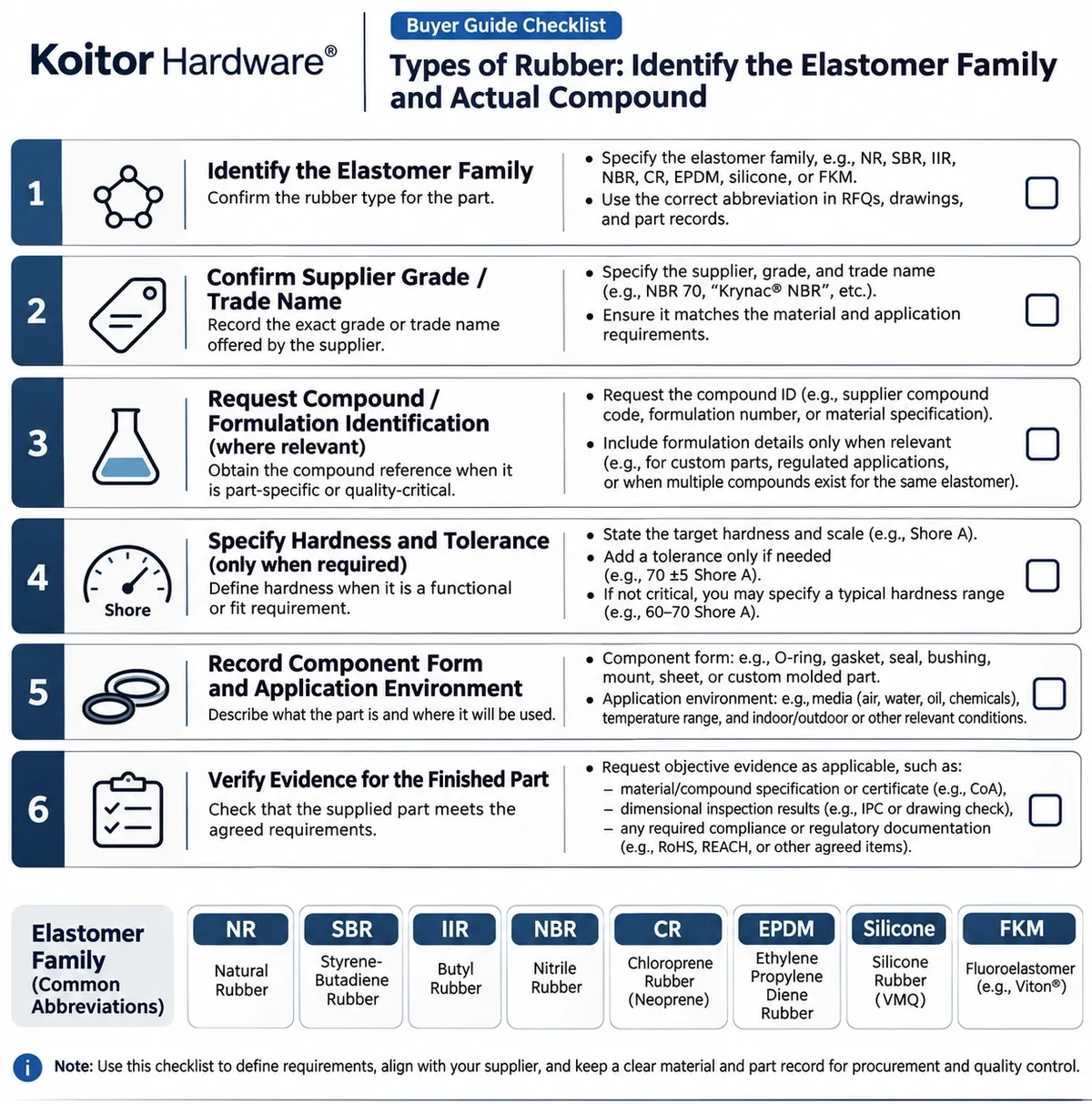
- Identify the specific product and the component’s function in the assembly.
- Provide a drawing, marked photograph, or physical sample showing the mating interface.
- State whether the required family or exact supplier designation is mandatory, preferred, or open to alternatives.
- Ask for the supplier, grade or product code, and current technical document when material identity matters.
- Specify the component form, key dimensions, and tolerances needed for fit.
- Define only the functional or exposure requirements relevant to the actual application.
- Identify required evidence, test method, conditions, and acceptance limits where applicable.
- Confirm color and cosmetic criteria separately from composition or performance.
- Record sample approval, drawing revision, and changes that require advance notice.
- Clarify which supplier is responsible for buying, identifying, and verifying a supplied component.
- Confirm packaging, target quantity, sample requirements, and delivery assumptions for the overall metal product.
- Avoid treating a generic family chart as evidence that one material is right for every application.
How does a sample narrow a rubber specification?
A sample can show a component’s dimensions, appearance, and fit in the condition received, but it does not automatically reveal the exact elastomer formulation. For procurement, record the sample’s part number, supplier, date, drawing revision, and any available material label. Ask whether the material designation describes a polymer family, a supplier grade, a trade name, or a compound code. These descriptions answer different questions and should not be substituted for one another.
If the project depends on hardness, request the specified scale and method, and identify whether a value is a target or a supplier’s typical description. If the component is already molded, a hardness reading or visual comparison still may not establish the full formulation or environmental suitability. The buyer should obtain the material evidence appropriate to the requirement from the responsible component supplier.
The term types of rubber is useful for exploring broad families, but it is too broad by itself for a purchase order. A controlled material line can identify the family, supplier grade or approved trade name, compound reference when needed, component form, and agreed evidence. The types of rubber comparison in this guide helps separate these fields before a quotation is approved; it does not select a compound for a specific chemical, temperature, or service-life requirement. Ask the design owner to define those conditions and the acceptance criterion.
Martins Rubber و Rubber Mill provide additional terminology references.
الأسئلة الشائعة
Does a rubber family name specify the compound?
No. A family name identifies a broad material group, but a compound may differ by grade, ingredients, cure, pigment, reinforcement, and supplier formulation. Buyers should request the designation and product documentation needed for their comparison.
Is silicone outside the rubber family?
Silicone rubber is commonly discussed as an elastomer family, but terminology can vary by technical context and supplier. The important purchasing step is to state the actual designation and intended part, rather than assume that every supplier uses “rubber” in precisely the same way.
Can color identify NR, NBR, or EPDM?
Color alone is not a dependable material identification method. Different families can be pigmented similarly, and the same family can appear in several colors. Use supplier documentation or a defined verification method when identity matters.
Does a material-family chart prove that a part is suitable?
No. A chart can help organize names, but suitability depends on the actual compound, geometry, assembly, operating conditions, and the buyer’s acceptance criteria. Any required performance should be tied to evidence under defined conditions.
Should buyers always specify the most chemically resistant family?
No universal family choice follows from a general chart. First identify the actual exposure and the component’s role, then ask suppliers for relevant evidence. Avoid selecting a material solely from an unspecific ranking.
Review Your Metal Hardware Component Interface
Share the drawing or sample for a project-specific discussion of the metal product, component fit, finish, and packaging requirements. Material manufacture and specialized testing must be confirmed with the responsible supplier.
OEM / العلامة التجارية الخاصة
حوّل دليل التوريد هذا إلى موجز منتج
يرجى إطلاعنا على المنتج المستهدف، والحجم، والتشطيب، وكمية الطلب، ومتطلبات التغليف. وسيتلقى فريقك تقييمًا عمليًّا لإمكانية التصنيع قبل تقديم عرض الأسعار.


 English
 Español
 Português
 Français
 Deutsch
 العربية