

Types of foam for packaging are easiest to compare on three separate axes: polymer family, cellular construction or processing description, and the physical form supplied for the package. Common families include polyethylene (PE), polyurethane (PU), polystyrene (PS), and polypropylene (PP), while labels such as EPE, XLPE, EPS, EPP, and XPS add information about expansion, crosslinking, or processing. These terms do not all describe the same kind of property, and none alone proves how a complete package will protect a particular product. Buyers should identify the material and form, then evaluate the package under conditions relevant to the actual shipment.
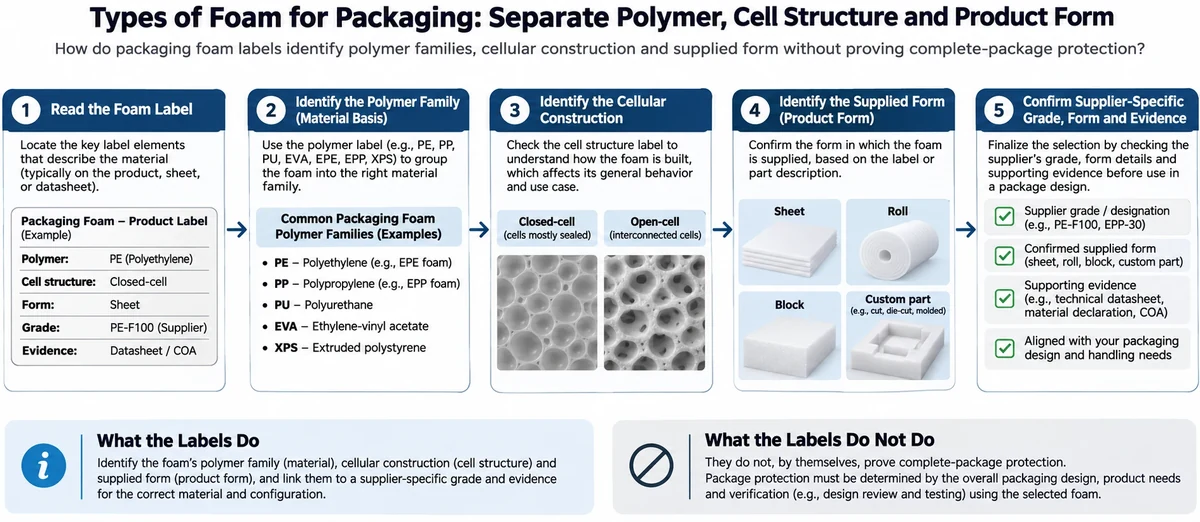
What packaging decision does this foam guide support?
An importer may encounter “foam insert,” “EPE,” “PE foam,” or another short label on a quotation, packaging drawing, sample, or product specification. These labels can appear interchangeable when they are not. One may name a polymer family, another a processing route, and another a shape or commercial product. If the buyer treats all labels as a single list of competing foam types, the quotation comparison may omit the actual differences that matter.
This guide answers the measured broad taxonomy question first. It gives buyers a way to record family, construction, and form separately. A hypothetical metal organizer packed with a protective insert illustrates how to use the map, but it is not evidence that one foam is universally best or that a particular package has passed a test. Product geometry, mass, finish, movement inside the carton, stacking, shipping route, and handling can all affect package performance.
The scope is also deliberately limited. A family name does not determine cushioning at a specific load, resistance to repeated compression, surface marking, chemical compatibility, or damage rate. Those questions require the actual package and a defined requirement. Koitor Hardware can discuss packaging preparation and communication in a confirmed metal-hardware project. Foam manufacture, foam-converting machinery, a packaging laboratory, or a specialized cushioning-design service are not established company capabilities and should not be implied.
How should a buyer classify packaging foam?
A useful classification separates material identity, construction, and supplied form. The axes can overlap: an item may be made from one polymer, processed into a particular cellular structure, and supplied as a die-cut insert. A single label may communicate only part of that description.
| Classification axis | Examples of information | سؤال من المشتري |
|---|---|---|
| Polymer family | PE, PU, PS, PP, or another identified material | What polymer family does the supplier mean, and what exact grade or product designation is supplied? |
| Cellular or processing description | Expanded, crosslinked, extruded, molded, or another process-related term | Does the label describe a material family, a structure, a process, or a commercial form? |
| Supplied geometry | Sheet, roll, block, cut insert, formed cavity, strip, or other shape | What shape, thickness, cut pattern, and interface arrive with the shipment? |
| Package role | Separation, edge protection, surface contact, blocking, bracing, or void fill | What does this piece do within the complete pack-out? |
| Evidence and acceptance | Sample, drawing, inspection criteria, or package-level test | How will the buyer decide whether this package is acceptable? |
The table is a buyer’s communication framework, not a universal industry standard. Suppliers may use additional product names and classifications. Ask for the source manufacturer’s actual designation and a product data sheet where available. When terms are unclear, request that the supplier annotate the package drawing or provide a sample with the material and form identified.
What do common packaging foam names mean?
Polyethylene family and PE forms
Polyethylene foam products can be supplied in different structures and forms. EPE is commonly used for expanded polyethylene, while XLPE indicates crosslinked polyethylene. Those labels should not be presented as different base polymer families simply because the prefixes differ. They indicate additional distinctions that a buyer should confirm with the specific supplier.
A purchase record can state “polyethylene-based foam” as a broad family and then identify the exact designation, density or grade only if supplied and relevant, thickness, and geometry. The buyer should not infer a cushioning curve or impact response from the word PE. Nor should a general source’s description be applied as a guarantee for a specific insert.
Polyurethane family
Polyurethane foam appears in multiple forms and applications. “PU foam” does not, by itself, specify whether a product is flexible, rigid, molded, sheet-like, or produced for a particular package. The actual product form and supplier designation should be requested. Broad softness comparisons are not enough to establish suitability because the package geometry and the object being protected also matter.
If a supplier proposes PU as a substitute for another foam, ask what exact product is being offered and what basis supports the substitution. A material-family label does not establish the same compression behavior, surface contact, dimensions, or package-level performance as the existing design.
Polystyrene family and EPS/XPS
EPS and XPS are terms associated with different polystyrene foam products and manufacturing routes. A buyer should record which one the supplier is offering rather than write only “PS foam.” The terms do not automatically establish whether the item is a formed insert, sheet, panel, or another shape; that information belongs in the package drawing or quotation.
Do not infer that every EPS product is foam-in-place packaging. A specific packaging method must be confirmed from the actual supplier proposal. Similarly, a general comparison should not be converted into universal cost, impact, moisture, or protection rankings.
Polypropylene family and EPP
Expanded polypropylene (EPP) is a product term that connects a polymer family with an expanded foam form. The buyer still needs the actual grade or product designation, component geometry, and package role. A label does not prove the number of reuse cycles, impact performance, cleanliness, recyclability route, or suitability for contact with a particular finish.
Why labels are not a flat list
A list containing PE, EPE, XLPE, PS, EPS, XPS, and EPP mixes broad polymer names with more specific product or process descriptions. That makes a simple “which type is best?” comparison misleading. Instead, normalize each supplier proposal into a row with the base family, exact designation, process or structure, supplied form, package role, and evidence.
For example, one supplier could describe a cut insert by family and form, while another uses a branded designation and does not immediately state the polymer. The first proposal is not automatically better. The buyer should ask enough questions to understand what each offer means and whether the package design meets the agreed requirements.
How do foam form and package geometry affect the comparison?
The material is only one part of an insert. A sheet cut into slots, a formed cavity, a corner protector, a block, a wrap, or a shaped cradle can position the product differently. The package designer or supplier needs the product dimensions, exposed cosmetic surfaces, contact locations, and the movement or compression concerns that the package is meant to address.
For a hypothetical metal storage rack, the insert may separate metal components, keep a finished surface away from a carton wall, or prevent a detachable part from shifting. Each role implies a different geometry and contact pattern. It does not follow that a particular foam family or thickness will achieve those outcomes. A package review should check the actual fit and restraint of the product in the carton.
A useful sample review can proceed in stages:
- Identify each foam piece by a label or part number.
- Record its family or supplier designation and physical form.
- Compare the insert geometry with the product and carton drawing.
- Check where the foam contacts the product and whether that contact is acceptable for the finish.
- Confirm the pack-out sequence and orientation.
- Decide whether a sample evaluation or package test is required for the buyer’s distribution conditions.
- Record revisions and approvals so later orders use the same identified configuration.
The sample review verifies a specific arrangement. It does not establish that all foam of a named family behaves the same, or that a package protects products under every transport route. If transit damage is a concern, define the product configuration, carton, conditioning, handling scenario, and acceptance criteria before selecting a test. Do not use an unspecified “drop-tested” statement as a substitute for a documented method and result.
What should a supplier quotation say?
A quotation should make the supplied item understandable without forcing the buyer to infer the construction from a short material word. The requested level of detail depends on the project. For a simple spacer, a drawing and sample may be sufficient. For a package with cosmetic surfaces, multiple components, or specific transit risks, more detail may be needed.
| Quotation field | Useful detail | Why it matters |
|---|---|---|
| Material identity | Family, supplier, product code, and document reference when available | Allows the buyer to distinguish broad names from a specific product |
| Physical form | Sheet, roll, block, molded cavity, cut insert, or other supplied shape | Prevents a family label from obscuring the geometry |
| الأبعاد | Thickness, cut profile, cavity positions, and relevant tolerances | Supports a fit review against the product and carton |
| Package role | Separation, blocking, bracing, or surface protection | Connects each piece to the function in the pack-out |
| Contact surfaces | Product areas touching the foam and any cosmetic restrictions | Helps the buyer identify marking or contamination questions |
| Revision control | Drawing number, sample date, and change notification expectation | Keeps later orders aligned with the approved package |
| Verification | Sample review or a specified package test if required | Ties evidence to a clear acceptance decision |
Avoid adding unnecessary material claims to the RFQ. If no density, thickness, or performance requirement has been established, do not invent a number just to make the specification appear technical. Ask the supplier what information they can provide, compare proposals on the same basis, and define any project-specific acceptance limits with the responsible engineering or packaging reviewer.
What are common mistakes when choosing packaging foam?
Using one label to represent the whole construction
“Foam insert” does not identify a polymer or exact product. “EPE” does not show the cavity geometry. “Crosslinked” does not state how the insert fits the carton. Keep material, process, form, and package role distinct.
Borrowing a broader keyword’s properties
A packaging-specific foam query should not inherit unrelated claims from a general “types of foam” discussion. Similarly, one supplier’s commercial page may describe its own material range, not every product in a family. Use the data sheet for the proposed item, not a generic label, when making a project decision.
Treating a foam name as a protection guarantee
No family name proves that a finished package will prevent scratches, deformation, breakage, or other transit damage. The complete package and its handling conditions are relevant. If the buyer needs evidence, define the test and acceptance criteria for the package being shipped.
Ignoring contact with finishes
A metal product may have a cosmetic coating, polished surface, or another finish that needs a defined packaging review. Do not assume that a foam is non-staining or universally compatible. Ask what contacts the surface and evaluate the actual packaging materials and conditions.
Comparing only unit price
A quotation that lists only a price and foam name may omit shape, quantity, assembly, and protection requirements. Request comparable geometry and a representative sample before drawing conclusions from price alone.
Changing the insert without updating the pack-out
A new cut pattern or material designation can change how the product sits in the carton. Record approved revisions and communicate them to whoever prepares packaging. A material substitution without a fit and pack-out review can make the drawing and delivered configuration diverge.
How can a small-batch OEM factory help with pack-out communication?
Koitor Hardware is a family-owned custom metal hardware factory specializing in bathroom and home storage hardware. For a confirmed OEM product, a buyer can share product drawings or samples and discuss the metal item, detachable components, finish, and packaging preparation together. That can help clarify which product surfaces need protection, which parts require separation, and how the approved pack-out should be described.
This collaboration should not be confused with foam manufacturing or specialized package engineering. Koitor’s approved scope includes packaging preparation and communication about the metal product. It does not establish foam production, foam converting, material testing, a packaging laboratory, or a certified transit-test service. The source and qualification of a supplied protective insert should be confirmed with the responsible packaging supplier.
A clear request can include a marked image showing contact points, a product and carton drawing, the intended arrangement, and a sample approval requirement. For project-specific metal-product scope, buyers can review OEM home storage hardware and share the relevant drawing or sample through the contact route. These pages describe the metal-hardware relationship; they do not promise a particular foam material or package test result.
Buyer checklist before approving a foam insert

- Record the supplier and exact material designation, not just the word “foam.”
- Separate polymer family from construction or processing terms.
- Identify whether the component is a sheet, roll, block, cut piece, or formed geometry.
- Mark the insert’s role in the package and its orientation.
- Compare the geometry with the actual product and carton drawing.
- Identify product surfaces that touch the packaging.
- Confirm the sample matches the drawing revision.
- Specify any project-specific performance requirement and test method.
- Keep test conditions and acceptance criteria with the package record.
- Clarify who supplies, converts, assembles, and verifies each packaging component.
- Record approved substitutions and changes before repeat orders.
- Do not infer protection, recyclability, cleanliness, or compliance from a family label alone.
How can buyers document a packaging change without overclaiming?
A packaging change record should identify the approved baseline and the proposed difference. The baseline can include a dated sample, drawing revision, item description, supplier designation, and the position of each insert in the carton. The change request should state whether the polymer family, product code, geometry, thickness, cut pattern, supplier, or assembly sequence has changed. This makes the review specific: the buyer can determine whether the change affects fit, contact, pack-out labor, or an identified performance requirement.
Do not describe a change as “same foam” when the source or product code differs unless the responsible supplier has supplied a basis for that statement and the buyer has accepted it. If the material designation is unchanged but the insert outline has changed, the geometry still needs review. If the drawing is unchanged but a supplier substituted a different grade, the identity review remains necessary. A simple change log can show the old description, new description, reason, supporting document, sample status, approver, and effective order.
This control does not require a buyer to demand laboratory tests for every revision. The evidence should match the risk. A minor label correction may need a document update; a change that alters product restraint or contact with a delicate finish may justify sample review or a defined test. Record what was checked and what remains unverified. That distinction protects the buyer from treating a packaging description as proof of transport performance.
For repeat orders, include the approved packaging configuration in the purchase-order or product specification record. If packaging components are sourced separately, identify the party responsible for the insert and the party responsible for the final pack-out. Where several suppliers contribute, a marked assembly image can help prevent the same material name from being applied to different pieces. The goal is a reproducible, reviewable arrangement, not a universal foam taxonomy imposed on every product.
How should a foam label be checked against the actual pack-out?
A foam descriptor is only one input to the packaging decision. Before comparing supplier quotations, identify the product configuration the foam is intended to hold: the number of pieces, orientation, contact points, separation between surfaces, and the outer package around the insert. A sheet, roll, die-cut insert, or molded piece can use the same polymer family yet occupy a different role in the pack-out. Describe the supplied form and the geometry separately so the quotation does not hide a design change inside a familiar material name.
A sample insert can help teams review fit, assembly sequence, and whether the product is placed consistently. It does not alone prove that the complete package protects the product through a particular distribution route. That conclusion would require a defined package configuration, evaluation method, conditioning and handling context, and acceptance criteria. A supplier’s foam datasheet also applies only to its identified product and scope; it should not be treated as a test result for a finished carton containing a metal rack or accessory.
When a packaging foam specification changes, compare the old and new polymer designation, cell structure, density or grade only where specified, supplied form, dimensions, and package layout. Identify which drawing or pack-out revision controls. This keeps a material substitution distinct from an insert redesign and helps the buyer determine whether the sample and any package-level evaluation need renewed review. The types of foam for packaging should therefore be compared at both the material-label level and the finished-pack level, with evidence matched to each decision.
For the types of foam for packaging, compare each label with the real insert geometry and the test evidence for the complete pack-out.
Foam Industries و SmartShield Packaging provide additional packaging-foam terminology references.
الأسئلة الشائعة
Is EPE a different polymer from PE?
EPE is commonly used for expanded polyethylene. It is more specific than the broad PE family name, but the exact commercial product, grade, and form should still be confirmed with the supplier.
Does a foam label prove cushioning performance?
No. A label can help identify a family or product form, but package behavior depends on the material specification, geometry, product, carton, and handling conditions. A project claim requires evidence tied to defined conditions.
Can polymer family and insert shape be specified separately?
Yes. A buyer can record the family or supplier designation in one field and the insert geometry in a drawing or separate description. Keeping those attributes separate makes substitutions and revisions easier to review.
Is the softest foam always the safest choice?
No general softness ranking can select a package for every product. The product, contact surfaces, package geometry, and handling conditions all matter. Compare representative proposals against a defined requirement.
Does a foam family guarantee that it will not mark a coated metal part?
No. A broad family name does not establish the behavior of the exact material against a specific finish. Identify the contact material and evaluate the proposed pack-out when surface marking is a concern.
Review Packaging for Your Metal Hardware Product
Share the drawing or sample to discuss product interfaces, finish protection, and packaging preparation for a confirmed OEM scope.
OEM / العلامة التجارية الخاصة
حوّل دليل التوريد هذا إلى موجز منتج
يرجى إطلاعنا على المنتج المستهدف، والحجم، والتشطيب، وكمية الطلب، ومتطلبات التغليف. وسيتلقى فريقك تقييمًا عمليًّا لإمكانية التصنيع قبل تقديم عرض الأسعار.

 English
 Español
 Português
 Français
 Deutsch
 العربية