
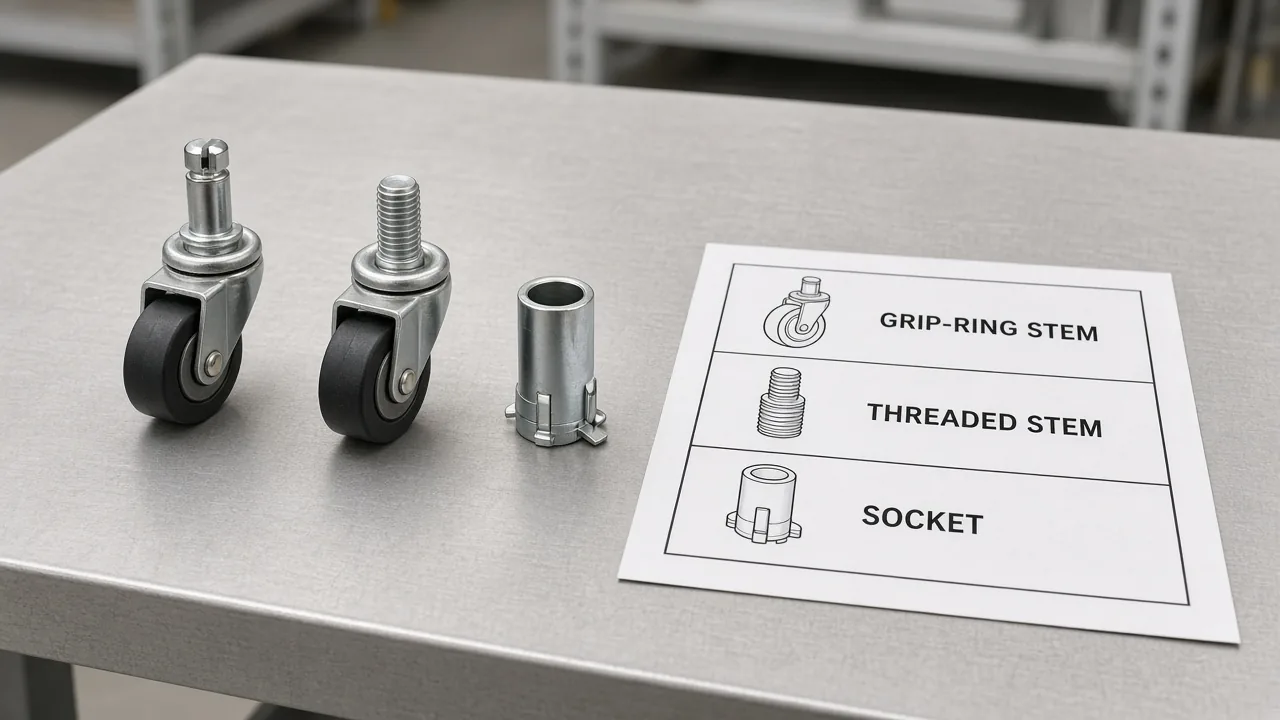
An install sheet can tell a buyer how to install stem casters only after the stem family and the packed socket or leg interface are named. The family is a grip-ring stem, a threaded stem, or an expanding or socket-stem. The interface is the packed socket, the leg or tube condition that socket assumes, and the instructions that belong to that pair.
Stem-to-socket and socket-to-tube identification belong on the live caster-socket interface file. Plate-mount casters, wheel or brake or tread selection, and office-chair caster replacement are different jobs. None of those decisions is this stem-family first-hang sentence, and none should be rewritten as one.
This guide is for importers, distributors, and private-label teams approving first-install wording and kit scope for stem casters already in the live OEM library. That scope includes casters used on storage racks and carts as an adjacent line.
Koitor Hardware is a family-owned China OEM manufacturer of custom metal bathroom and home storage hardware. Adjacent caster and storage OEM pages already sit in that published library. That fact is not a claim that Koitor currently manufactures a named caster SKU or a complete rack.
Send the stem family, the socket or leg interface, the rack or cart drawing, and the market. We can review the wording and the kit scope. We will not issue an insertion-force chart, a load rating, an interchange claim, or a universal install sequence.
What does a how to install stem casters file actually freeze?
It freezes the stem family and the packed socket or leg interface that a first-hang sentence can support. It does not freeze dual-interface identification, plate-mount first hang, wheel or brake selection, or office-chair stem replacement.
Searchers often ask how to install stem casters because they have a socketed leg and a loose stem, or because a furniture blog mixed plate-mount and stem-mount into one sequence. That demand is real. For an importer, the usable decision is whether a listing or an install sheet may say the casters are easy to install, and which stem family and packed interface are being promised.
A grip-ring stem, a threaded stem, and an expanding or socket-stem do not share a kit, even when the wheel looks similar. If the sheet does not say which family shipped, an easy-install line will be applied to the wrong socket. This file is not a consumer furniture tutorial, and it is not a product listing.
Informal expanding-stem or threaded-stem install phrasing belongs to the same “name the family first” decision. It does not open a second page. How to replace chair casters is an office-chair leak and is not this target. How to install casters on furniture, and what size casters a job needs, are also not this first-hang sentence, and their volume must not be borrowed.
و OEM home storage hardware manufacturer can review whether a kit list and an install-sheet sentence stay together. Matching a wheel color or a fork finish to a collection is not the same as inventing a default stem, a default socket, or a timed insertion method. If you are screening this adjacent line, bring the intended stem family and the packed interface with the drawing.
A published “includes everything” or “easy to install” claim is only as complete as the named family and the named interface. If the photograph shows a socket and the bag does not, the sheet has already failed, even if the wheel looks familiar. The same is true of a grip ring, a threaded nut, or a set of instructions that belong to a different family.
This file can precede an RFQ. It should not be turned into a catalog page, a plate-mount manual, a chair-replacement guide, or a load chart. Those jobs already have, or should keep, their own files.
Which stem family and packed interface must be named first?
Name the stem family first: grip-ring, threaded, or expanding or socket-stem. Then name the packed socket or leg interface, or mark that interface as sold separately or not applicable. Do not start with an insertion sequence, and do not start with a plate-mount method.
A grip-ring stem uses a ring or groove that engages a matching socket. The sheet should say so, and it should say whether the matching socket is packed, sold separately, or assumed as already in the leg. “It just pushes in” is not a complete family line if the socket condition is left unnamed, and it is not a license to invent an insertion force.
A threaded stem is a different family, even when the wheel and fork match a grip-ring SKU. The packed nut, washer, or threaded socket is part of the first-hang promise. A grip-ring leaflet copied onto a threaded carton is already the wrong kit, regardless of wheel diameter.
An expanding or socket-stem family is not “a grip-ring with a tighter fit.” It is a different interface, often used when a tube or leg is prepared for an expanding socket or a matching stem. Name it in plain language and pack the socket or expander that belongs to it, or mark those parts sold separately. Do not hide it under a generic stem-caster photograph.
The packed socket or leg interface must be named honestly. A socket that ships in the carton, a socket already in the buyer’s tube, and a socket sold separately are three different kit states. A mixed photograph that shows a packed socket and a bare stem in the same easy-install panel is how the wrong bag is packed for the wrong SKU.

Plate-mount casters stay off this sentence. A top plate and a stem are different mounts. If a program also sells plate-mount casters, keep a separate install sheet for that family. Do not let a “how to install casters” umbrella merge the two kits.
Office-chair replacement stays off this sentence as well. A chair base and a storage-rack or cart leg are different interfaces, even when both can accept a stem. This file may exclude chair bases in one clear line. It should not become a chair-caster replacement tutorial, and it should not use twin-wheel office-chair imagery as the product form for this kit.
A custom metal storage rack manufacturer review is useful when the casters are being specified as part of a rack or cart program. Rack construction is not a substitute for the stem-family line. A familiar rack finish does not name the stem or the socket.
What belongs in the first-hang kit, and what stays out?
The kit should include every part the install sentence assumes. For a first hang, that usually means the stem casters in the named family, the packed sockets if the interface requires them, any nuts or expanders that family uses, the instructions, and an honest sold-separately or not-applicable mark when a part is not in the carton.
A hardware kit packing inspection checklist is a useful neighbor when you are comparing the bag to the sheet. That checklist does not invent an insertion force or a load. It only asks whether the named parts were packed. Use it as a completeness check, not as a substitute for the family line.
| Family or claim | What must be named | What belongs in the kit | What this row is not |
|---|---|---|---|
| Grip-ring stem | Grip-ring family, and whether the matching socket is packed, sold separately, or already in the leg | The stem casters, packed sockets if they ship, and matching instructions | A threaded-stem leaflet, a plate-mount hang, or an invented insertion-force chart |
| Threaded stem | Threaded family, and the nut, washer, or threaded socket the interface uses | The stem casters, packed nuts or threaded sockets, and matching instructions | A grip-ring “push in” sentence, or a torque chart presented as a Koitor standard |
| Expanding or socket-stem | Expanding or socket-stem family, and the expander or socket that actually ships | The stem, the packed expander or socket, and matching instructions, or an explicit sold-separately mark | A grip-ring kit with one part described as “tighter,” or a chair-base replacement |
| Packed socket or leg interface | The interface condition: packed, already in the tube, sold separately, or not applicable | Only the interface parts that are actually in the carton | The live dual-interface identification file rewritten as a first-hang sequence |
| Plate-mount or chair replacement | That those jobs are out of scope on this stem-family file | Nothing on this carton unless a separate, honestly named program is packed | A mixed “install casters” leaflet that treats plates, stems, and chair bases as one kit |
Keep wheel, tread, brake, and floor-marking selection off this table. This first-hang file may name a wheel or brake that is actually packed. It should not reprint those selection files, and it should not invent a load or hardness chart.
Do not fill a blank insertion-force, torque, or interchange field with a plant default. If a later buyer file names a required value and cites a source, the sheet may repeat that requirement. Until such a source exists, keep the field named and leave the value blank.
Why are specialist install guides not a factory insertion-force standard?
They are demand evidence and third-party examples. Many search results walk a press-in or thread-on sequence as if that were the only stem-caster method. Quote those pages only as proof that the family and the packed interface must be named. Do not copy an insertion-force table, a torque chart, or an interchange list as a Koitor standard.
A third-party video may be cited as a named-model example if you have checked that the packed family still matches. Label it as a third-party example. It is not a factory standard, not a timed method, and not a substitute for the family line. If the packed socket has changed and the video has not, the citation is already stale.
Brand-navigational phrases, including phrases built around another company’s caster model, are not this page’s target. Describe the hardware in family and interface terms. Do not borrow a competitor’s install video, or that video’s search volume, as a Koitor standard.
Size queries, including what size casters a rack needs, stay off this first-hang sentence. This kit file may name the stem and wheel that are actually packed. It should not invent a size chart, and it should not treat a nominal tube diameter as a factory interchange rule.
Which neighboring caster files should stay out of this sentence?
Stem-to-socket and socket-to-tube identification stay on the live caster-socket interface file. That href is not in the official lock-copy list used for this draft, so the file is named here in prose only. Do not invent an address for it, and do not reprint its dual-interface identification as a first-hang sequence.
Storage-rack caster specifications, casters versus wheels, and wheel-brake versus total-lock files are also neighbors, named in prose only when they are missing from the lock copy. This first-hang file may point to them. It should not absorb those selection decisions.
A live neighbor that is in the lock copy is the Floor Lock Versus Caster Brake: Define the Stationary Function Before Specifying a Mobile Rack file. That page defines a stationary function. It is not a stem-family first hang, and this article should not rewrite it as one. A floor lock is also not a reason to skip the stem-family line.
Plate-mount first hang, if it is ever written, must stay a separate file. Office-chair replacement must stay off both files unless it is separately validated, which it was not for this page. Underbed rolling-basket clearance and tread or hair-guard files are further neighbors, not this kit sentence.
What should be checked before a listing says the stem casters are easy to install?
Check the family line, the packed socket or leg interface, the packed list, and the exclusions before any easy-install sentence is printed. If any of those four is missing, the sentence is not ready, even if the wheel photographs well.

- Name the stem family in plain language: grip-ring, threaded, or expanding or socket-stem, before any install sentence is printed.
- Name the packed socket or leg interface, and mark the socket as included, already in the tube, sold separately, or not applicable.
- Name every part the ready-to-install sentence assumes: casters, sockets or expanders or nuts, and matching instructions.
- Pack instructions that belong to the named family, not a mixed leaflet that treats grip-ring, threaded, and expanding stems as one sequence.
- Exclude plate-mount casters from this sheet, or give that family its own install file; do not merge the kits.
- Exclude office-chair replacement; do not borrow that volume, and do not use a chair-base sequence on a rack or cart carton.
- Keep dual-interface identification on the live caster-socket file, named in prose when the lock copy omits that href.
- Keep wheel, tread, brake, and floor-lock selection on their neighboring files, including the live floor-lock versus caster-brake page.
- Do not print an insertion-force, torque, load, or interchange chart as a Koitor standard, and do not invent a current named caster SKU.
- Do not print a brand video as a timed install method or as a substitute for the family line.
- Revise the ready-to-install line whenever the packed list, the family, or the packed instructions change.
Translations on a bilingual carton should follow the same named fields. A socket-sold-separately note that appears only in one language is not an exclusion in the other market. Review both languages against the same packed interface before the ready-to-install line is translated.
Incoming sample checks can use a simple bag-to-sheet comparison: open the box, lay out the stems and any sockets, and tick the named family and interface. That check is not an insertion-force study, and it is not a load trial. It only asks whether the carton can be believed.
If a later order adds a threaded SKU beside a grip-ring SKU in the same wheel finish, treat that as a new kit, not as a sticker change on the same bag. The sockets, the nuts, and the instructions may all change. A grip-ring ready-to-install sentence left on a threaded carton will be believed, and it will be wrong.
The same discipline applies when a hardware-only caster program later adds a complete rack offering, or the reverse. The stem may look familiar. The packed list is a new list. Reprint the family and interface fields before the carton reuses an old ready-to-install line.
Twin-wheel or chair-like silhouettes should not be used on this artwork if the packed program is a single-wheel rack or cart stem. Product form is part of the honest kit. A familiar office-chair picture will send the wrong buyer to the wrong interface, even when the stem family is correctly named in small type.
Leg material and tube condition can change without changing the stem family, and the stem family can change without changing the tube finish. Treat those as separate fields. A new powder color on the rack is not, by itself, a license to reuse an old socket sentence, and a new stem family is not a license to keep last year’s leaflet just because the wheel looks familiar.
How to install stem casters on a rack or cart remains this same first-hang file, not a furniture-caster umbrella and not a size chart. If the carton serves a storage rack, name the stem family and the packed interface, then leave rack-level specification on the neighboring rack or caster-specification files. A rack job does not authorize an invented interchange or load figure.
Sample photographs should not show a plate-mount caster next to a stem caster in one easy-install frame. Incoming inspection can tick the packed stem and socket against the named family without turning the bench into an insertion-force trial. The check is still a completeness check, not a floor test and not a chair-base fit.
If a project later names a required stem diameter or a required socket standard and cites a source, the install sheet may repeat that requirement and cite the same source. Until such a source exists, keep the field named and leave the value blank. A blank field is safer than a borrowed chart that does not match the packed interface.
الأسئلة الشائعة
Can the listing say the stem casters are easy to install?
Only after the stem family and the packed socket or leg interface are named, and only if the sentence does not go beyond that kit. An easy-install line is not a substitute for a missing socket, an unnamed family, or a mixed plate-mount leaflet. This article does not supply a minute-count, an insertion-force chart, or a load rating.
Do expanding-stem or threaded-stem searches need their own first-hang files?
No. Those phrases are coverage of the same name-the-family-first decision. Name the family and the packed interface, then pack the kit that belongs to that pair. Do not open a second page for each informal phrase.
Should this sheet also tell buyers how to identify a socket already in a tube?
No. Dual-interface identification sits on the live caster-socket interface file. This first-hang file may name the packed interface, or point to that file. It should not reprint the identification RFQ.
Can this sheet be used for plate-mount casters or office-chair replacement?
No. Plate-mount is a different mount, and office-chair replacement is a different interface and was not validated as this target. Keep those jobs off this stem-family carton.
Should this sheet also choose a brake, a tread, or a floor lock?
No. Those selection questions sit on neighboring files, including the live floor-lock versus caster-brake page. This first-hang file may name a brake or wheel that is actually packed. It should not reprint those decisions.
Does Koitor currently offer a named stem-caster catalog SKU?
This article does not assert a current named production SKU, and it does not claim that Koitor supplies a complete rack or cart. Adjacent caster and storage OEM pages already sit in the published library. If you are screening this line, send the intended stem family, packed interface, and kit list for review of wording and kit scope.
اعمل مع شركة «كويتور» للأدوات
Need a stem-caster first-hang kit reviewed?
Send Koitor the caster stem family, the socket or leg interface, the rack or cart drawing, and the market. Our team can review the wording and the kit scope, without issuing an insertion-force chart, a load rating, or a universal sequence. MOQ can start from about 100 pcs depending on the product; samples usually take 5-7 working days after details are confirmed; bulk production usually takes 4-6 weeks depending on the project.
OEM / العلامة التجارية الخاصة
حوّل دليل التوريد هذا إلى موجز منتج
يرجى إطلاعنا على المنتج المستهدف، والحجم، والتشطيب، وكمية الطلب، ومتطلبات التغليف. وسيتلقى فريقك تقييمًا عمليًّا لإمكانية التصنيع قبل تقديم عرض الأسعار.

 English
 Español
 Português
 Français
 Deutsch
 العربية