

A brass vs zinc decision should compare two defined alternatives rather than broad color names.
Brass vs zinc is not a reliable purchasing comparison until “zinc” is identified as a specific zinc-based alloy and the actual part and production route are known. Brass is a copper-zinc alloy family; zinc hardware is commonly a zinc alloy component made by a defined route such as die casting. Neither label alone proves strength, corrosion performance, finish quality, cost or service life. Buyers should compare the complete proposed part: alloy designation, form, geometry, threaded or assembled features, finish, environment and approval evidence.
What does “brass vs zinc” mean for a buyer?
The word brass describes a family of copper-zinc alloys, not one fixed composition or one manufacturing method. Zinc in a hardware quotation often means a zinc-based alloy component, but the buyer should confirm the actual alloy and process rather than assuming the part is pure zinc. Those distinctions matter because the material family, shape and production route all affect what a supplier can make and what the buyer needs to inspect.
The useful first question is not “Which metal is better?” It is “Which two defined components are being compared for the same product function?” A brass fitting made by one process and a zinc-alloy casting made by another can differ in geometry, wall sections, interfaces, machining or finishing operations. A fair selection compares the proposed part to the part it must replace or work with. A broad alloy name cannot settle that question.
For bathroom or home-storage hardware, brass or zinc-based parts may appear in decorative fittings, knobs, brackets, connectors or purchased interfaces. These are examples of buyer contexts, not a claim that every such component is part of Koitor’s product range. A buyer should identify whether a component is structural, decorative, threaded, exposed to moisture, hidden in an assembly or supplied as part of a kit. The intended function establishes which requirements matter.
The current search results include material explainers, product sellers and comparisons. The International Zinc Association’s die-casting material comparison provides zinc-industry context for alloy properties and casting. It is not neutral proof that zinc wins every application. The Copper Development Association’s brass resources describe copper alloy families and help show why brass must be specified more precisely than a color name. Supplier advocacy should be read within its scope and checked against the actual part requirement.
Why can a brass-colored part still be zinc alloy?
Color and finish do not reliably identify the substrate. A zinc-alloy component can receive a brass-colored plating, coating or other surface treatment. A brass part can also be plated, lacquered, polished, brushed or otherwise changed in appearance. A photograph or showroom sample may tell a buyer what the exposed surface looks like, but it does not prove the material underneath.
This distinction affects RFQs, replacement parts and product listings. “Antique brass finish” may describe an appearance rather than a solid-brass substrate. “Brass hardware” may refer to a product family, a finish name or an actual material, depending on the seller’s language. If the buyer needs a specific substrate, spell it out with the applicable supplier designation or material evidence. If only appearance is controlled, state the visual reference and keep material identity as a separate field.
A sample can help compare shape, color and fit. It cannot establish hidden composition by sight alone. If substrate identity is contractually important, request suitable supplier records or an agreed material verification method. Do not claim that a magnet, weight, color chart or casual visual inspection definitively identifies every alloy. The appropriate evidence depends on the part and on what the buyer is trying to prove.
Separate the purchase record into at least four attributes:
- Substrate: named alloy or supplier-controlled material designation.
- Part form and process: casting, machining, forming or another stated route as applicable.
- Surface: coating or finish description, including any color or visual sample reference.
- Component identity: drawing, part number and revision that tie the above fields to the supplied item.
When a finish supplier or component maker is responsible for a purchased part, name that responsibility explicitly. A finished photograph does not transfer material documentation responsibility to the factory assembling the wider product. The purchase record should say which supplier controls each requirement and who approves a proposed change.
How do the material and manufacturing route affect the comparison?
Brass and zinc-alloy parts are not interchangeable manufacturing recipes. Brass can be supplied in different product forms and alloy grades. Zinc alloys are used in cast components with process-specific design limits. Some parts may require machining or secondary finishing. The production route influences feasible geometry, interfaces, tooling, cosmetic surfaces and how a revision is managed. A buyer should ask what route is proposed instead of assuming that two parts with similar outlines were made the same way.
An actual zinc die-cast design is evaluated with its alloy, tooling, wall transitions, draft, gates, ejection, machining requirements and finishing plan. Those details belong to the casting supplier and approved product design. A brass alternative may instead depend on a selected stock form, forming or machining operations, joining and surface treatment. This comparison is conditional and must be confirmed for the actual component; it is not a universal list of advantages or disadvantages for all brass and zinc products.
When a supplier proposes a new route, ask whether the external geometry, internal features, thread system, assembly interface or visible face changes. A part that looks similar from the front can have different mounting depth, hidden ribs, bosses, wall thickness or access for a mating component. Compare the drawing and sample rather than a catalog image. If the new process requires tooling, identify who owns it, which revision it supports and how changes will be approved.
| Comparison field | What the buyer should identify | Why a family name is insufficient |
|---|---|---|
| Material identity | Exact alloy or controlled supplier designation | Brass and zinc-based materials each contain multiple grades |
| Manufacturing route | Casting, machining, forming, joining or other agreed operations | Route affects geometry, tooling, secondary work and supplier responsibility |
| Part geometry | Drawing, revision, critical interfaces and cosmetic faces | Similar outside appearance can hide a different internal construction |
| Thread and mating parts | Thread callout, inserts, screws or connected components | A material substitution may require a different interface solution |
| النهاية | Process description, appearance reference and covered surfaces | Brass-colored appearance does not prove a brass substrate |
| Application | Exposure, cleaning, contact and actual component duty | Suitability depends on the complete requirement, not a metal label |
| دليل الموافقة | Supplier records, representative sample and acceptance criteria | Evidence must match the claim and the exact component under review |
Do not convert an alloy comparison page into a numeric design instruction. No universal wall thickness, load capacity, corrosion life, plating thickness or unit cost follows from the broad words brass and zinc. Those values require an actual design, supplier specification and relevant verification. If a claimed value matters to the buyer, put its definition and evidence requirement in the RFQ before quotations are compared.
Which part characteristics should be compared side by side?
Start with the component’s role. A decorative escutcheon, a threaded insert, a mounting block and a load-bearing connector do not have the same acceptance criteria. List the function, mating parts and visible faces. Then compare the alternatives against the same drawing envelope and use conditions. This keeps a materials discussion from turning into an abstract debate detached from the part.
For each proposal, collect the supplier name and part number, alloy designation, process route, drawing revision, dimensional callouts, surface treatment and sample reference. Confirm which dimensions are important to assembly: hole positions, bosses, threads, seating faces, wall interfaces and clearances. If the component mates with a screw or another metal, name that interface and ask the technical owner to assess compatibility. Don’t assume a general material chart covers every assembled pair.
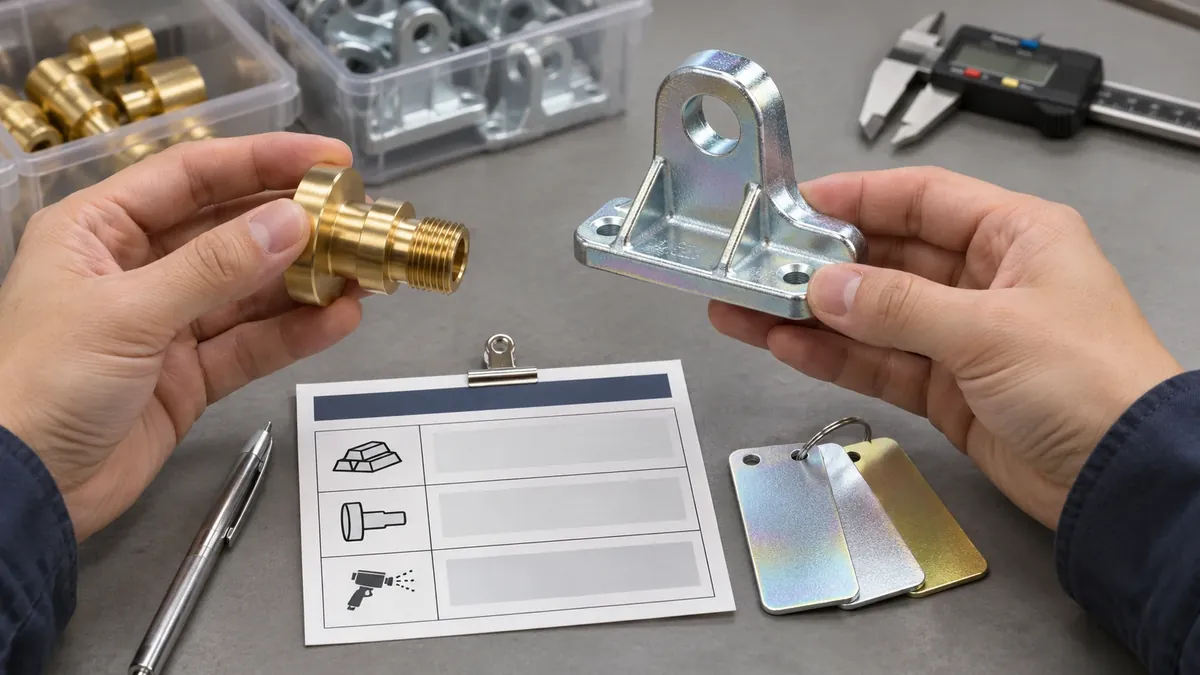
Finish approval should be made against the actual product and its finish process. A color chip is a reference for appearance under agreed review conditions; it does not establish coating adhesion or substrate identity. A plated or coated surface may cover edges, recesses or concealed areas differently from the visible face. If uniform appearance or coverage matters, specify where and how the finished part will be inspected. Avoid saying that one substrate or finish is “rustproof” or maintenance-free without evidence for the exact product and environment.
The intended environment also needs a concrete description. “Bathroom use” can refer to a dry vanity, a damp room, a shower area or a coastal property. Cleaning agents, moisture, ventilation, contact with other materials and usage frequency may vary. Ask which exposures apply and what acceptance evidence the product team expects. A broad comparison between material families cannot stand in for a test of a finished component in its actual environment.
For cost, compare complete quotations with the same scope. Material price is only one element; tooling, machining, finishing, assembly, scrap, inspection, packaging and order quantity may change the delivered cost. Do not claim zinc is always cheaper or brass always more expensive. Ask suppliers to itemize known route or tooling differences, identify assumptions and state what is excluded so a quote can be compared on a common basis.
What should buyers verify before a substitution?
Treat a brass-to-zinc or zinc-to-brass change as an engineering and sourcing change. A new material family may require a different part geometry, supplier, tooling or surface route. Check the complete product assembly and the accepted evidence before a substitute is approved. A similar color or a lower quote is not enough.
- Freeze the current item by drawing, part number, supplier and revision.
- Identify the actual substrate and surface finish of the approved sample.
- Request the proposed alternative’s material designation and process route.
- Compare all critical dimensions, threads, mating surfaces and assembled clearances.
- Review visible appearance and any concealed faces that matter to function or maintenance.
- Name the intended environment, use and cleaning assumptions relevant to the part.
- Identify which supplier supplies material records and which party verifies the sample.
- Record any tooling ownership, production revision and change-notification requirement.
- Agree what the sample review proves and what it does not prove.
- Obtain approval from the product or engineering owner before production release.
This record should preserve unknowns rather than silently resolving them. If the proposed zinc alloy is not specified, note that material identity is unconfirmed. If the brass finish is known only by its appearance, do not claim a solid-brass substrate. If the alternative drawing is incomplete, keep it in review rather than assuming the missing dimensions match the old part.
Sample approval has a bounded meaning. It can document that a particular part and finish were reviewed against specified questions. It does not automatically establish lot consistency, hidden material identity, environmental durability or load capacity. Those claims need their own agreed criteria and supporting evidence. A buyer should state which checks apply before the sample arrives, so the supplier and reviewer do not treat an informal visual check as a broad certification.
What mistakes complicate brass and zinc sourcing?
Treating color as composition. A brass-like appearance does not prove a brass substrate. Identify material and surface separately.
Using “zinc” as a complete material specification. Ask which zinc-based alloy and process are being quoted. Pure zinc and zinc-alloy casting are not interchangeable terms.
Comparing different components. A cast knob and a formed bracket may not serve the same function. Compare alternatives designed for the same interface and requirement.
Assuming the process is invisible to the buyer. Tooling, machining, finish and assembly changes can affect dimensions, supplier responsibility and repeat-order control. Ask the supplier to explain the proposed route.
Accepting a universal durability statement. Neither alloy family automatically ensures a corrosion result or service life. Tie claims to a defined product, environment and relevant evidence.
Approving only the front face. Hidden bosses, threads, mounting depths and contact surfaces can determine whether a part fits. Inspect the full sample and drawing.
Choosing on unit price alone. A quote that excludes tooling or secondary operations may not be comparable. Define the same annual or order quantity, finish, inspection and packaging scope.
Changing a material without revising documentation. The approved sample, listing language, BOM and incoming check should describe the actual selected component. Otherwise the buyer may keep ordering under a misleading label.
What can Koitor contribute to an OEM hardware review?
Koitor Hardware is a family-owned custom metal hardware factory focused on bathroom and home-storage products. In a confirmed OEM project, the factory can discuss how a purchased component relates to the surrounding metal assembly, the drawing, the finish conversation and the sample handoff. The scope should identify which parts are made by Koitor and which are purchased from another supplier. Koitor is not represented here as a brass foundry, zinc die-caster, alloy laboratory or supplier of every component discussed.
For a project discussion, provide the assembly drawing or physical sample, the proposed component designation, mating parts, surface reference, required quantity and open engineering questions. If a third-party supplier controls the material or casting route, identify that supplier’s documentation responsibility. The product owner should establish the required performance evidence; a factory conversation cannot invent a test result or guarantee an outcome not supported by project data.
Small-scale production flexibility can be relevant to trial orders, samples and private-label development where the product scope is suitable. It does not remove the need for controlled revisions. Record a sample against a specific drawing and part identity, then communicate any approved changes before repeat orders. A supplier substitution should be reviewed again if material, finish, geometry or production route changes.
See the Koitor OEM home-storage hardware page for the confirmed manufacturing scope. To discuss a project, use the صفحة الاتصال بـ «كويتور» and include the drawing or sample reference. Any quotation, MOQ, timing or production capability should be confirmed for the actual project rather than inferred from this general material guide.
What should the RFQ and sample checklist contain?
Use a simple record that allows the buyer, component supplier and assembly factory to refer to the same item. The checklist is most useful when it connects a commercial quote to a drawing and a physical sample, rather than collecting disconnected material terms.
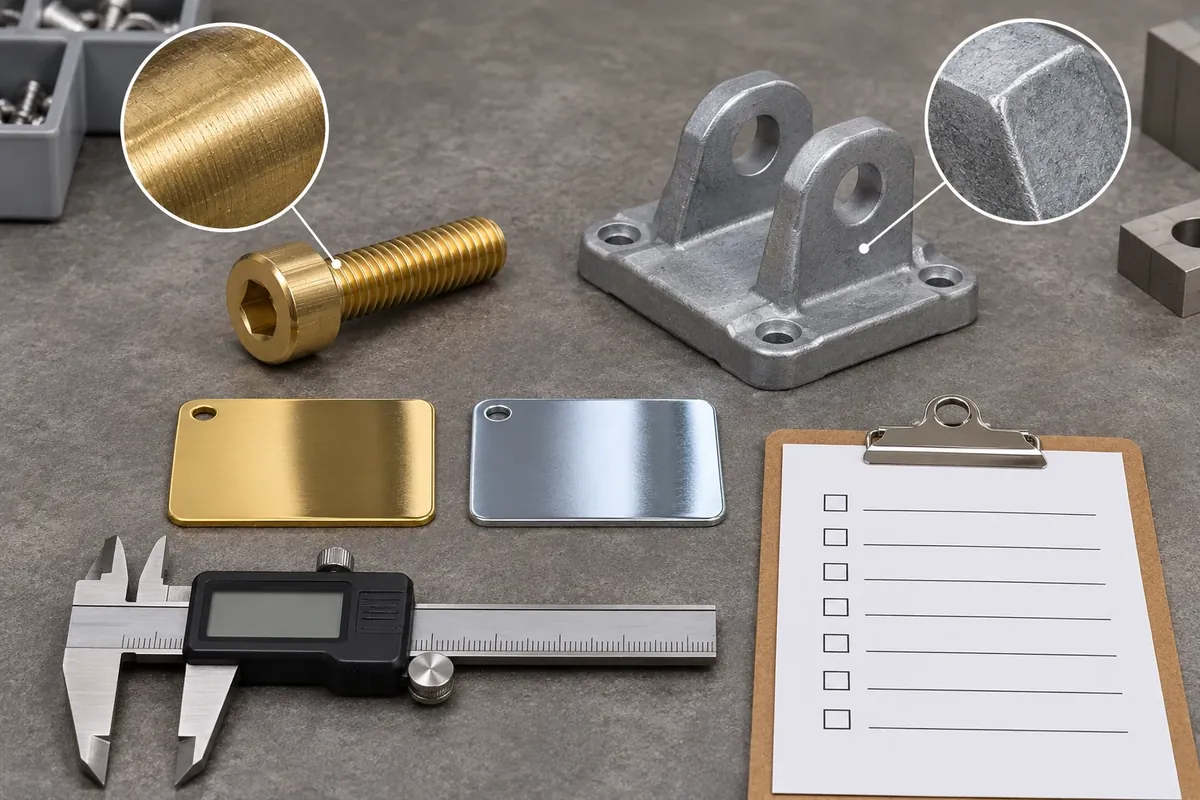
Before quote comparison or sample approval, record:
- The buyer’s target component function and the assembly it enters.
- Existing and proposed part numbers, suppliers and drawing revisions.
- Named material family and exact supplier alloy designation where applicable.
- Manufacturing route, secondary operations and any tooling assumptions.
- Critical dimensions, threads, mating parts, mounting and clearance requirements.
- Finish name, substrate, appearance sample and faces that will be reviewed.
- Intended exposure, cleaning conditions and other application limits.
- Required supplier records and who is responsible for supplying them.
- Sample identity, review date, acceptance criteria and unresolved points.
- Approved change process, production revision and repeat-order expectations.
- Quote basis: quantity, tooling, finishing, assembly, inspection and packaging scope.
Keep commercial and technical assumptions visible. A sample can help resolve appearance and fit, while a supplier declaration or test may be needed for another claim. Assign an owner to each open point. Do not ask a purchasing contact to approve a technical requirement outside the agreed responsibility model, and do not treat the family material comparison as a substitute for specialist design review.
How should the buyer compare quotes for different routes?
Ask suppliers to quote a common part definition and list any assumptions they need to make. One supplier may propose a machined brass item while another proposes a zinc-alloy casting; if so, they may not be quoting the same geometry, tooling or secondary operations. Require each quote to identify the proposed alloy, part number or drawing revision, process steps, finish and excluded work. If the alternative requires a new tool, request the tooling basis separately from the recurring unit price.
Compare landed scope only after clarifying quantity, inspection, packaging and assembly responsibilities. A piece price that omits plating, machining or insert installation cannot be compared directly with a complete finished component. Ask whether sample charges, fixture costs, finishing, protective packaging or quality documents are included. Keep the supplier’s assumptions attached to the quote so the buyer can see why two numbers differ.
Price information also ages. A material-market movement, exchange-rate change, supplier capacity or order quantity can alter a later quotation. This guide does not offer current metal prices or a fixed cost ranking. For a purchasing decision, use dated offers from the actual suppliers and compare the same specification. If the project changes its material or process after sample approval, request a revised quote and review what changed instead of assuming that the previous price still applies.
الأسئلة الشائعة
Is brass the same material as zinc alloy?
No. Brass is a copper-zinc alloy family. “Zinc alloy” describes a different material family often used for cast components. Ask for the actual supplier designation and process.
Can zinc alloy look like brass?
Yes. A surface treatment can give a component a brass-colored appearance. Color alone does not identify the substrate; specify appearance and material as separate requirements.
Is brass always stronger than zinc alloy?
That cannot be answered from the family names alone. The actual alloy, component geometry, manufacturing route, mating parts and design requirement all matter. Request evidence for the specific part.
Is zinc always less expensive than brass?
No universal price conclusion follows from the material labels. Tooling, process, finish, machining, quantity, assembly and supplier terms affect the quoted cost. Compare equivalent scopes.
Can a buyer approve a material change from a photograph?
A photograph may help review visible appearance but does not prove hidden material identity, dimensions or performance. Use the relevant supplier records, drawing and identified sample.
Does a sample prove production consistency?
A sample documents the reviewed item and criteria. It does not by itself prove that all later production will match or meet every performance claim. Define the production controls and evidence separately.
Sources and further reading
- International Zinc Association: Comparison of alternative materials
- Copper Development Association: Copper alloys
- Brass vs. zinc alloy hardware comparison
- Brass dezincification and bathroom hardware
- Zinc alloy creep in loaded hardware
Work with Koitor Hardware
Compare the actual component before changing its material
Share the assembly drawing or sample, component identity, mating parts and finish reference so the OEM discussion can stay tied to the real project scope.
OEM / العلامة التجارية الخاصة
حوّل دليل التوريد هذا إلى موجز منتج
يرجى إطلاعنا على المنتج المستهدف، والحجم، والتشطيب، وكمية الطلب، ومتطلبات التغليف. وسيتلقى فريقك تقييمًا عمليًّا لإمكانية التصنيع قبل تقديم عرض الأسعار.


 English
 Español
 Português
 Français
 Deutsch
 العربية