
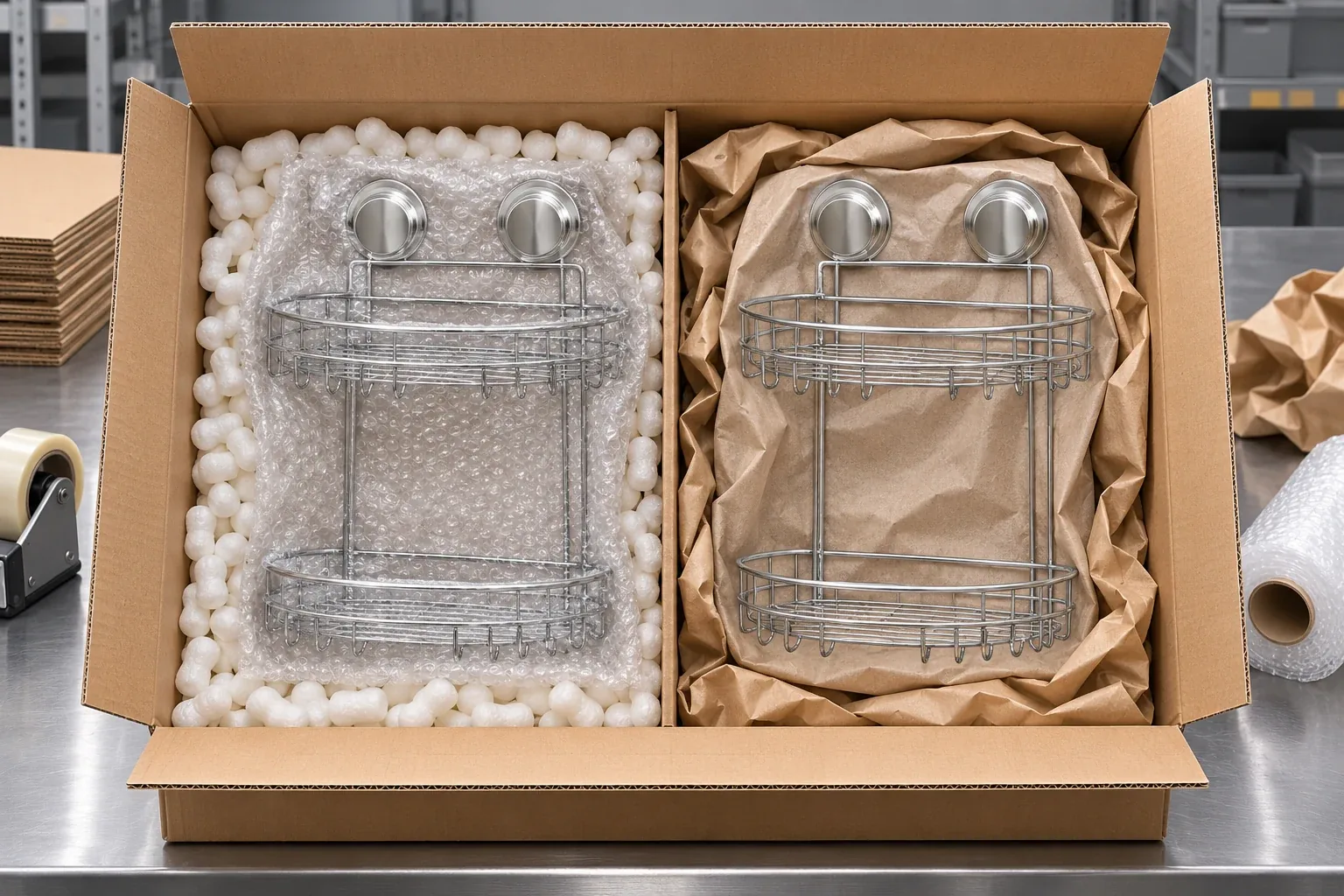
Bubble wrap vs packing paper is best evaluated by the job each material performs inside the package. Bubble-cell wrap is commonly used as a surface wrap or cushioning layer, while paper can wrap a product, fill space or help separate items depending on its form and placement. Neither material alone defines a protective package. For metal hardware, review sharp edges, finish contact, movement, voids, product restraint and the outer carton together, then verify the complete pack under the applicable shipping conditions.

What decision does this comparison answer?
Buyers often compare bubble wrap and paper as if they were competing substitutes for one identical task. In practice, the material may be used to wrap a surface, keep two parts apart, fill an empty space, stabilize an item or create a void-filling structure. One package may need several of those functions. Selecting a material without specifying its role can leave a gap even if the carton contains plenty of cushioning.
For a metal bathroom basket, hook, rail or bracket, packaging must consider both surface appearance and movement inside the box. A polished or coated surface may rub against another component. A wire end or formed edge may contact the carton or adjacent product. Accessories may shift into the finished face. The question is not simply which filler feels softer, but how the product is positioned, restrained and separated through the expected handling path.
Bubble-cell wrap and packing papers also come in different constructions. Bubble wrap varies by format and bubble configuration. Paper can be supplied as flat sheets, crumpled fill, folded wraps or converted structures. The terms therefore do not identify one fixed level of cushioning or one universal packaging result. Compare the actual material, quantity, placement and package geometry rather than relying on a generic material name.
What roles can bubble wrap and paper play?
Bubble wrap is a flexible film with air cells that can be used as a wrap or cushioning material. The supplier’s format and construction matter; a maker’s branded performance claims apply to that specific product and should not be generalized to every bubble wrap. A thin wrap may keep surfaces apart, but that does not necessarily restrain a heavy item from moving inside a carton. The package still needs a way to control the product’s position.
Paper is similarly broad. Flat paper can wrap or interleave parts. Crumpled paper can occupy void space, while folded or engineered paper structures can create a formed protective element. The actual role depends on the material, quantity, shape and packing method. The packaging guide from RAJA distinguishes wrapping and void-fill uses across protective materials. Its generic product descriptions are not performance guarantees for a finished shipment.
These materials can be used together. A wrap may protect the finish from direct contact, while paper fills a gap or helps keep the wrapped item from shifting. Alternatively, a paper partition may separate several products in a carton, with a different cushion or insert controlling movement. A buyer should specify each layer’s job. “Use bubble wrap” is not a complete packaging instruction if the part can still move, contact another item or load a vulnerable edge.
| Packaging job | Bubble wrap may be used for | Paper may be used for | Buyer should verify |
|---|---|---|---|
| Surface separation | Flexible layer around an item or between parts | Sheet, folded wrap or interleaf | Whether direct contact affects coating or appearance |
| Void fill | Limited space filling in a defined arrangement | Crumpled, folded or converted fill | Whether the product remains located after pack-out |
| Product restraint | Part of a designed cushioning arrangement | Formed or tightly positioned blocking | Whether movement is controlled in all relevant directions |
| Edge or corner protection | Wrap around edges when appropriate to the design | Shaped insert or folded protection | Whether the edge can puncture or compress the material |
| Multi-item separation | Individual wraps or layers | Partitions and dividers | Whether products touch during handling |
How should metal hardware packaging be designed?
Start with the product’s actual geometry and finish. Identify protruding wire ends, hooks, bends, weld areas, polished faces, coated surfaces, screw tips and detachable accessories. Mark which surfaces are cosmetic and which interfaces must remain clean or dimensionally controlled. Packaging can then be designed to keep parts from rubbing or pressing against vulnerable areas. Do not infer that a product is scratch-proof from its coating or weight.
Next, map the product’s movement inside the primary package. A buyer can close a sample carton and gently evaluate whether the item shifts, but that informal check is not a transport qualification. The package should be designed for expected handling, stacking and transport conditions. If the shipment has specific compression, vibration or drop concerns, define the appropriate test method, specimen conditioning and acceptance criteria with the responsible packaging or quality owner. A test on a different product or carton does not automatically approve this pack.
Separate wrapping from restraint. A wrap can reduce direct contact, but a loose wrapped product may still move and impact the carton. Void fill can reduce empty space, but it may compress or settle depending on the material and loading. A formed insert can locate the product, but its fit and strength depend on the geometry and material. Consider how the item is placed, how the carton is closed, where load transfers and whether accessories can migrate during transit.
The carton is part of the system. Its dimensions, board construction, closure, internal partitions and pack count affect how the protective materials work. An overfilled carton may press products together; an underfilled carton may allow motion. The same material can perform differently in another box size or with a different product arrangement. The Cargo damage evidence checklist for importers discusses product-specific packaging design considerations, while Corrugated packaging water-absorption specification covers a different cushioning material and its own limits.
How can buyers protect appearance and avoid contact damage?
Surface damage can occur when two products touch, a loose accessory rubs against the finished face, or an edge presses into another component. The buyer should define which parts are individually wrapped, which surfaces need interleaving and where partitions are required. For sets with a basket and several hooks or screws, package those small components so they cannot freely contact a visible surface. The appropriate design is product-specific and should be checked on a pack-out sample.
If materials may transfer residue, mark or react with a finish, ask the packaging and finishing suppliers to confirm compatibility. Do not assume every film or paper is neutral under every temperature, moisture or storage duration. If long storage or a particular environment is expected, state that condition and obtain relevant supplier guidance. This article does not claim that either bubble wrap or paper prevents corrosion or guarantees a scratch-free finish.
Review the unpacking sequence, too. A product may arrive undamaged yet be awkward to remove, or small hardware may be overlooked in a filler. The package should make the product and included accessories identifiable. If instructions or labels are required, specify their placement and revision. This is especially important for retail-ready units, where product protection and presentation are both part of the customer experience.
Compare the actual packing arrangement, not only the filler
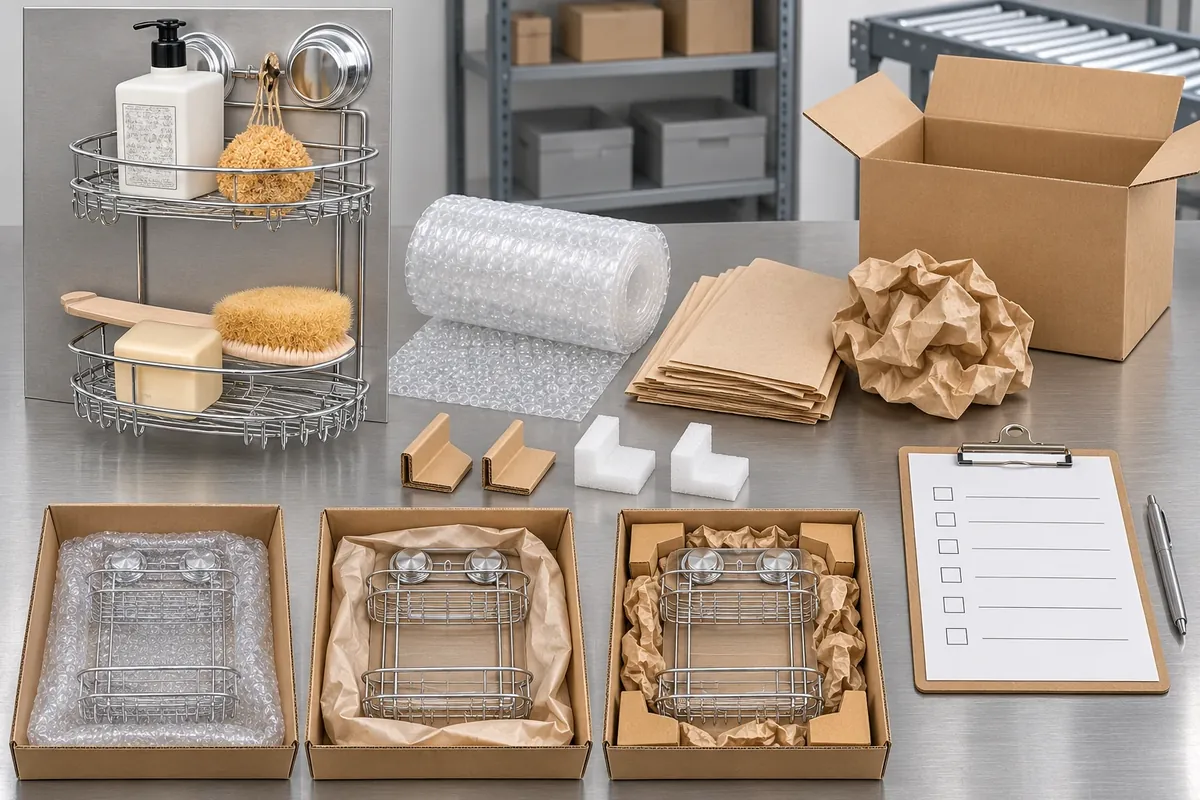
When suppliers quote packaging, request a diagram, photographs or a physical pack-out sample that shows layers and parts. Identify the inner wrap, contact points, void fill, dividers, accessory pouch, carton and closure. Record the number of products per inner and master carton. If one quote uses bubble wrap and another uses paper, ask each supplier to explain what structural role the material performs and how the product is restrained.
A useful review can hold the product and carton constant while comparing the filler arrangement. Does the product remain located? Are the visible surfaces separated? Do sharp corners contact a weak area? Is the accessory pouch secured? Can the carton be closed without excessive pressure? These observations help identify design questions, but a tabletop review does not replace transport testing where required. Define the acceptance method before claiming equivalent protection.
If the packaging material changes after sample approval, treat it as a controlled revision. A change from bubble wrap to paper may affect package volume, pack density, presentation or movement control. A paper wrap may also have a different surface feel and folding pattern. Confirm the revised pack-out on the actual product and update instructions, drawings or packing specifications. Do not rely on a supplier’s statement that a substitute is “the same” without reviewing its role and result.
A worked pack-out review for a wire product
Consider a two-tier wire basket with removable hooks and mounting components. The buyer identifies the polished or coated faces and any wire ends that could touch the carton. The basket is wrapped so that its visible surfaces are separated, while the hooks and screws are placed in a closed accessory pouch. The package designer then decides whether paper or another structure is needed to prevent movement between the basket and the carton wall. Bubble wrap may form a contact layer, but the complete arrangement still needs to locate the basket; paper may fill a void, but loose fill alone may not keep a heavier product from shifting.
The reviewer should inspect the actual assembly orientation and where the accessories sit after the carton is closed. If the pouch can slide into a cosmetic face, it needs a fixed location or partition. If a wire tip can puncture the wrap, the package needs a different local protection strategy. If the basket is nested with another unit, confirm that its load and contact points do not damage the lower unit. These are questions to test on the actual configuration; they do not establish a generic performance ranking between film and paper.
Record the approved pack sequence with photographs or a simple diagram. Identify the product revision, layers, pouch contents, carton and closure. This gives production a repeatable reference and lets the receiving team compare what arrived with what was approved. If the pack is modified, review the changed contact points and movement control instead of assuming that a visually similar arrangement performs the same.
What evidence supports a packaging claim?
Different evidence answers different questions. A material data sheet may describe a packaging material; it does not establish the result for the packed product. A pack-out photo documents placement but does not prove resistance to shipping impacts. A transport test can address a defined configuration under a named method and conditions; it does not automatically predict every route or handling scenario. Keep claims matched to their evidence and state limitations where necessary.
For example, if a buyer needs the carton to protect a finish during a specified distribution cycle, the packaging owner should identify a relevant test plan and acceptance criteria. The specimen should use the intended product, material, carton, pack count and closure. Any change to those elements may make the result less applicable. The procurement record should say who approved the test and which configuration was tested, avoiding a generic statement such as “bubble wrap passed” when the evidence really concerns one completed package design.
Keep the final approved image, packing instruction and sample aligned so that the production team can reproduce the evaluated arrangement without guessing how many layers or where each pouch belongs.
The receiving team can also compare a shipment to that reference. If materials, carton dimensions or accessory placement differ, note the deviation and request confirmation before accepting the change as equivalent.
When cartons are palletized, consider how the package is stacked and handled in the expected distribution path. This does not replace the chosen transport test, but helps the packaging owner ensure that the approved pack configuration matches the shipment plan.
What sustainability and shipping claims require caution?
Buyers may prefer a material based on recyclability, recycled content, disposal instructions or package volume. Those attributes need supplier- and jurisdiction-specific evidence. “Paper” is not automatically a complete environmental claim, and “plastic bubble wrap” is not automatically unsuitable for every program. Material composition, coatings, local collection systems, package design and applicable labeling rules may matter. Confirm the claim and current market requirements before printing environmental language.
The packaging can also affect shipment volume and handling. A wrap-and-fill approach may pack differently from an insert or converted paper structure. Compare the finished carton dimensions and units per carton rather than assuming a material change will reduce freight or damage. The transport packaging and empty-space guide covers additional packaging scope questions. This article does not provide current legal advice or guarantee compliance with a packaging regulation.
Avoid environmental assertions such as “eco-friendly,” “fully recyclable” or a percentage reduction unless they are supported for the actual material and package in the target jurisdiction. If the packaging is part of a private-label program, align supplier documentation, package artwork and disposal guidance before production. Keep the supporting evidence with the approved package revision.
Common packaging mistakes
One mistake is choosing by material name alone. A quote may say “bubble wrap” without identifying the format, how many layers or whether it is meant to wrap or restrain. A paper proposal may omit whether it uses sheets, crumpled fill or formed dividers. Ask for the actual pack construction.
A second mistake is assuming cushioning equals restraint. A wrapped part can still shift inside a carton. A third mistake is focusing on the main product and ignoring small parts that can scratch it. A fourth is approving a photo of a prototype without checking the finished carton, accessory placement or closure. A fifth is transferring a result from a generic cushion test to a different geometry and package. A sixth is changing material after approval without revisiting the pack-out and documentation.
Buyers can also overstate the protection. No generic material description establishes that the package passes a drop, vibration or compression requirement. If a customer asks for performance evidence, agree on the relevant test and criteria with the packaging engineer or quality owner. Record sample configuration, carton and product revision so that the tested package matches the production pack.
Establish a packaging change-control record
A packaging record should identify the product revision, approved pack sequence, materials, carton, unit count and date of approval. Include a photo or diagram that shows where the wrap, paper, accessory pouch and divider belong. State which surfaces require separation and how the product is restrained. If a supplier proposes an alternate film, paper format or carton, mark the proposal as a change and compare it with the approved construction.
Changes that appear small can affect the complete package. A different paper grade may fold or compress differently; a new bubble format may change the thickness of the wrap; a different carton size may change the void and product movement. Adding an accessory can create a new contact point. The change owner should decide whether a pack-out review or transport test is needed. Do not waive review simply because the replacement material has a similar name.
Keep test reports connected to the sample configuration they describe. The record should include the product, packaging, carton, pack count, closure and test method. If any of these items change, note whether the existing evidence still applies and who approved that conclusion. A report for one carton or product cannot be silently reused for another package.
At production, make the instruction practical for the packing operator. Use unambiguous orientation, quantity and layer descriptions, and include a quality check for accessory placement and visible surfaces. If a step is difficult to reproduce, revise the pack design or instruction before volume increases. Clear work guidance is part of the packaging system, even though it does not independently prove shipping performance.
Buyer checklist before approving a package
Keep one approved master carton sample or equivalent pack-out record where practical, so future changes can be checked against the same product and packaging revision.
When reviewing samples, record the carton condition and product orientation after opening. Photograph the layers before removing them so the pack sequence can be reconstructed and compared with the approved packing instruction.
- Identify the product and drawing revision, finish and cosmetic faces.
- Mark protrusions, edges, weld areas and detachable accessories.
- State which material wraps, separates, fills voids or restrains movement.
- Identify the exact bubble-wrap format or paper construction proposed.
- Review product position, package orientation and contact points.
- Confirm accessory pouches, partitions and unit counts.
- Check the carton size, construction, closure and packing sequence.
- Review an actual pack-out sample rather than only a filler sample.
- Define any transport test, specimen and acceptance criterion before shipment.
- Keep packaging claims and disposal instructions tied to supplier evidence.
- Control substitutions and reorders against the approved pack specification.
- Coordinate packaging scope with the factory, packaging supplier and buyer.
الأسئلة الشائعة
Is bubble wrap always better for a fragile metal product?
No. It can serve as a wrap or cushion, but the complete arrangement must also separate and restrain the product. Metal geometry, finish, carton and handling conditions determine what is appropriate.
Can packing paper replace bubble wrap?
Sometimes, depending on the required job and actual paper construction. Compare surface contact, void fill, restraint and package performance for the product. The names alone do not prove equivalence.
Does bubble wrap prevent scratches?
It may be used as a separating layer, but no universal scratch-free outcome follows from the material name. Confirm compatibility and inspect the actual pack-out.
Should buyers test a finished package?
When the purchase requirement calls for transport-performance evidence, the responsible packaging or quality team should select the appropriate method, configuration and acceptance criteria. A generic test result is not automatically transferable.
Work with Koitor Hardware
For a customized metal storage product, share the drawing or sample, finish requirements, accessory list, target pack count and any known shipping constraints. Koitor Hardware is a family-owned custom metal hardware factory and can discuss product configuration, assembly and packaging preparation within confirmed project scope. Packaging materials, tests and environmental claims should be confirmed with the responsible suppliers. Contact Koitor through the OEM home storage hardware page.
In practical sourcing, bubble wrap vs packing paper should frame a defined comparison; the purchase specification still needs the exact material or process, acceptance criteria, and evidence required for the actual part.
المصادر
- Sealed Air: Bubble wrap cushioning
- RAJA: Protective packaging guide
- Cargo damage evidence checklist for importers
Discuss Your bubble wrap vs packing paper Requirements
Share the controlled drawing or sample, intended use and the specific question you are resolving. Koitor can discuss relevant metal hardware manufacturing scope and identify details that need confirmation for your project.
OEM / العلامة التجارية الخاصة
حوّل دليل التوريد هذا إلى موجز منتج
يرجى إطلاعنا على المنتج المستهدف، والحجم، والتشطيب، وكمية الطلب، ومتطلبات التغليف. وسيتلقى فريقك تقييمًا عمليًّا لإمكانية التصنيع قبل تقديم عرض الأسعار.


 English
 Español
 Português
 Français
 Deutsch
 العربية