

A commercial toilet seat cover dispenser should be approved together with the exact paper-cover refill, the service method and the installation envelope. Before procurement, identify the refill format and fold, aperture and retention method, expected replacement process, surface or recessed mounting, and the party responsible for the wall fixing. Product sheets show that capacities, refill styles and mounting configurations vary by model; a product name or stainless appearance does not establish compatibility across suppliers. Treat the sample and its named refill as a controlled pair, and document any acceptable substitute.
Why Must the Refill and Dispenser Be Specified Together?
A dispenser is an interface between the consumable and the facility’s replenishment routine. A paper cover pack may be folded or stacked in a particular way, and the dispenser may present it through a slot or opening designed around a particular refill. If a buyer changes the refill supplier without checking the opening, the replacement pack may not load, feed or present as expected. Conversely, a dispenser with an unfamiliar refill requirement can introduce avoidable complexity for housekeeping or facilities teams.
Commercial catalogs publish product-specific capacity and refill information. That is useful evidence of model variation, not a universal interchangeability rule. “Fits standard covers” is incomplete unless the manufacturer defines what standard means, identifies the refill format or provides a tested cross-reference. A project team should state the exact refill SKU, manufacturer, folded dimensions or pack sample and update procedure in the submittal. If a future alternate is desired, approve it separately against the exact dispenser revision.
For a commercial toilet seat cover dispenser project, tie the equipment decision to the exact refill and the people who will replenish it. Also distinguish consumable supply from durable equipment. The dispenser may remain installed for years while paper-cover packs are reordered from a separate source. The buyer should check whether the chosen refill is available through the intended distribution channel, how substitutions will be controlled and whether the model remains serviceable if the original consumable changes. Do not infer availability, continuity or compatibility from a photograph.
What Should the RFQ and Submittal Specify?
Identify the exact product variant and mounting type. Include a model number or controlled drawing, finish description, body dimensions, overall projection, opening size and the location of the access panel or service door. State whether the dispenser is surface mounted or recessed. For recessed models, identify the wall-cavity depth and construction details that the project team must coordinate. A catalog dimension does not alone verify a particular wall assembly.
The refill entry should name the paper-cover pack and format. Include its manufacturer and SKU where known, stack/fold orientation, package dimensions and whether the product is single- or multi-cover dispensing. If the project has not selected a refill, say so directly and request the supplier’s documented compatibility basis. Ask for a sample refill to be loaded into the production-intent dispenser sample rather than approving only from separately supplied brochures.
Capacity should be recorded as the manufacturer’s stated figure and tied to its refill reference. Do not compare a “capacity” number across two models unless the counting basis is clear: a folded cover, a pack, or another unit may be meant. Ask whether the stated capacity assumes a specific refill and whether the user can see when replenishment is needed. Avoid promising a particular service interval unless usage and occupancy data support it.
| RFQ field | Record or request | Why it matters |
|---|---|---|
| Dispenser model and revision | SKU, drawing, body dimensions, finish | Identifies the reviewed item |
| Refill reference | Brand/SKU or physical sample and fold | Makes compatibility review reproducible |
| Capacity basis | Manufacturer figure and counting unit | Prevents false comparisons |
| Mounting type | Surface or recessed; outline and projection | Supports wall coordination |
| Service access | Door/cover opening, lock or release details | Determines the replenishment task |
| Supplied components | Fixings, keys, labels, instructions | Clarifies quotation scope |
| Project ownership | Buyer, installer, operator and service team | Assigns unresolved decisions |
If the RFQ uses performance language such as “universal,” “jam-free,” “vandal resistant” or “one-hand operation,” ask the supplier to define the claim, test method and covered configurations. Do not repeat marketing language as a project requirement unless it is measurable and supported by appropriate evidence. Where no evidence is available, specify the observed fit or operating requirement for the approved sample and leave the broader claim out.
How Can Buyers Evaluate Loading and Service Access?
Use the actual refill pack and a representative sample. Confirm which surface opens, whether a key or tool is required, how the pack is oriented, and whether the next cover can be retrieved without removing the dispenser from the wall. Follow the intended refill steps and record any component that can be lost, misaligned or damaged during normal service. Do not assume that a door which opens in a catalog photo provides enough access once installed beside a partition, mirror or fixture.
Review the viewing and replenishment cues. A transparent window, label, indicator or opening may help staff judge when to restock, but its presence does not guarantee accurate stock monitoring. Check whether the project wants the replenishment cue, which person uses it and what action follows. Confirm any lock or access control with the facility’s operating requirements; do not assume that a lock is included or that all staff have a key.
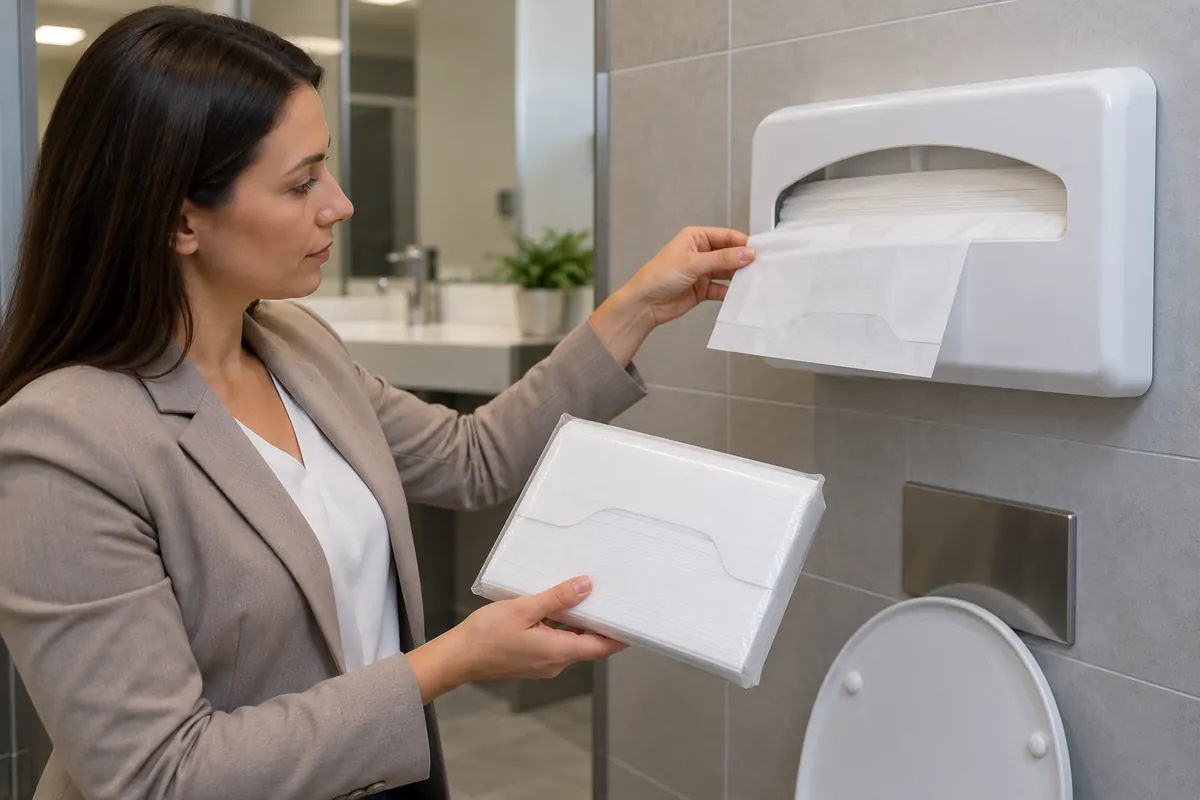
A commercial toilet seat cover dispenser sample should be tested with the identified refill, not merely inspected empty. The buyer should observe loading with the exact refill, then verify that the cover can be withdrawn as the manufacturer intends. Note the sample ID, refill reference, loading direction and any limitation. One successful load establishes only that the tested pair fit in that sample under those conditions; it does not prove every refill brand or long-term operating performance. If the project expects multiple refill suppliers, include each approved product in the sample record.
Service access should also be checked after installation. A door may open freely on a desk but conflict with a nearby grab bar, partition return, mirror or other accessory on the wall. The project drawing should show the opening sweep or service-side clearance where needed. Coordinate with the responsible designer and installer for applicable room and accessibility requirements. This article does not supply universal installation dimensions or compliance conclusions.
What Changes Between Surface and Recessed Models?
A surface-mounted dispenser projects from the finished wall and generally keeps its body outside the wall cavity. Buyers should record the installed projection and access path, then review whether it conflicts with circulation, nearby accessories or cleaning equipment. The exact mounting plate, hole pattern and supplied components should be shown on the submittal.
A recessed model places part of the body within a wall cavity. This can change the wall opening, depth, framing or backing requirements and may affect coordination with other services. Confirm the cutout, rough opening, required depth and service access from the selected model’s technical documents. The construction team must verify that the actual wall can accommodate it. Do not assume a recessed unit can be substituted for a surface-mounted one late in the project without rechecking the wall and finish schedule.
Both mounting types require clear assignment of fixing responsibility. Ask whether hardware is included, which substrates the supplier documentation covers and who selects fixings for the site. The product vendor’s mounting instructions do not replace the project installer’s assessment of the actual wall. If local conditions differ from the documented assumptions, hold approval until the responsible party addresses them.

How Should Distributors Compare Models and Quotes?
Compare scope instead of appearance alone. Normalize material and finish description, surface/recessed style, dimensions, refill reference, stated capacity basis, opening and locking arrangement, supplied hardware, sample policy, packaging and quantities. If one quote includes a key or installation kit and another omits it, the prices do not describe the same package.
Request a response table with three columns: requirement, supplier response and supporting evidence. Mark each line as confirmed, proposed, excluded or open. This exposes assumptions such as “buyer supplies cover packs,” “fasteners not included,” or “capacity based on supplier refill model X.” A question left open is safer than an unsupported “yes.”
For a private-label project, define which details can change without altering compatibility. A logo plate or finish selection may be separate from the refill interface; a revised slot, door or body depth may affect it. Ask how the supplier identifies product revisions, whether replacement parts can be ordered by part number and how a change is communicated to distributors. Do not promise spare-part continuity unless the supplier confirms the program.
Quotation quantities should distinguish dispenser units, refill packs and any installation parts. State sample quantity and whether samples are returnable, charged or representative. The procurement team should also define packaging and carton identification for the separate consumable and durable product. If the dispenser and refill ship from different suppliers, identify the receiving and kitting responsibility.
What Mistakes Lead to Poor Project Handoffs?
Using a generic refill description. “Standard seat covers” may mean different folds and pack dimensions. Specify an SKU or physical reference.
Comparing capacity numbers without a basis. Request the stated refill and counting method before ranking models.
Approving a mounting type without wall coordination. Recessed units affect cavity and opening planning; surface models have a projection and opening sweep.
Reviewing the sample without the refill. A shell-only visual approval does not test the consumable interface.
Treating a lock or window as guaranteed. Record the exact variant and verify any required feature in the sample or drawing.
Assuming supplied fixings suit every site. Confirm wall substrate and installation responsibility with the project team.
Letting substitutes enter silently. A new paper pack or dispenser revision can change loading and service. Use a controlled approved-alternate list.
How Does Koitor’s Capability Boundary Apply?
Koitor is a family-owned custom metal hardware factory with confirmed experience in bathroom and home-storage hardware, drawing and sample review, metal forming and joining discussions, finishing, assembly and packaging. Those facts support a cautious explanation of how buyers can prepare a specification and coordinate a metal-hardware OEM review. They do not confirm that Koitor currently manufactures toilet seat cover dispensers or owns a proprietary dispenser mechanism.
This topic therefore remains buyer education, not a product availability claim. If a buyer requests a dispenser project, the product scope, refill mechanism, project requirements, quantity and needed evidence must first be reviewed against current factory capabilities. No certification, refill compatibility, corrosion performance, cycle testing or mechanism behavior should be claimed without product-specific substantiation.
An importer can make the first feasibility discussion more efficient by supplying the target refill, a dispenser drawing or physical sample, a surface/recessed requirement, finish and label expectations, order size and target market. A custom metal hardware manufacturer can then identify what is known, what needs a sample or drawing clarification, and what falls outside its confirmed scope. For related confirmed categories, see Koitor’s custom bathroom hardware manufacturing overview و home-storage hardware OEM overview. These links are not proof of current dispenser manufacture. Use the project contact page to share a product-specific inquiry.
Buyer Checklist Before Submittal Approval
- Name the exact dispenser model and drawing revision.
- State surface or recessed mounting and provide the selected wall/room detail.
- Name the refill manufacturer, SKU, format and fold direction, or mark refill selection open.
- Provide the physical paper-cover sample for fit and loading review.
- Record stated capacity with the refill and counting basis attached.
- Confirm access panel, lock, key, window and service-side opening details.
- Load and withdraw the named refill in the physical dispenser sample.
- Check access after placement beside nearby fixtures and wall returns.
- Record overall dimensions, projection, cutout and required service clearance.
- Assign responsibility for wall assessment, fixings and installation approval.
- Identify included hardware, labels, instructions, keys and packaging.
- List approved alternate refill SKUs, if substitutes are required.
- Link sample, drawing, finish, refill and product code in the approval record.
- Define which dispenser, refill or packaging changes require another review.
- Keep product claims and testing requirements separate from visual/sample observations.
الأسئلة الشائعة
Can one dispenser accept every toilet seat cover refill?
Do not assume so. Refill folds, pack dimensions, presentation and dispenser openings vary. Check the exact refill reference with the selected model or approve a defined list of alternates.
Is a stated dispenser capacity enough to compare two products?
Not by itself. Record the manufacturer’s stated number and the refill model used to establish it. If the counting basis is not documented, ask the supplier before making a like-for-like comparison.
Does stainless steel confirm the dispenser is suitable for every washroom?
No. Material description alone does not establish construction, finish performance, cleaning compatibility or regulatory suitability. Match the requirement to the project and request the supplier’s evidence for any specific claim.
Should project buyers choose surface or recessed mounting?
Choose based on the wall assembly, room design, projection, service access and installation plan. Recessed products require cavity coordination; surface products require projection and mounting review. The project team should confirm the site-specific decision.
Can a sample approval guarantee consistent production?
A sample records the specific item reviewed. Connect it to an approved drawing and production controls, and define how revisions, refill substitutions and replacement components are managed.
What should a buyer do when the refill has not been chosen?
Keep compatibility open. Set a provisional refill envelope, request candidate samples and avoid approving the final product until the consumable-to-dispenser pair is checked.
Discuss a Custom Metal-Hardware Project
Share a product drawing or sample, refill reference, wall type, finish, packaging scope and target quantity. Koitor can first confirm whether the proposed product fits its current capabilities.
OEM / العلامة التجارية الخاصة
حوّل دليل التوريد هذا إلى موجز منتج
يرجى إطلاعنا على المنتج المستهدف، والحجم، والتشطيب، وكمية الطلب، ومتطلبات التغليف. وسيتلقى فريقك تقييمًا عمليًّا لإمكانية التصنيع قبل تقديم عرض الأسعار.


 English
 Español
 Português
 Français
 Deutsch
 العربية