
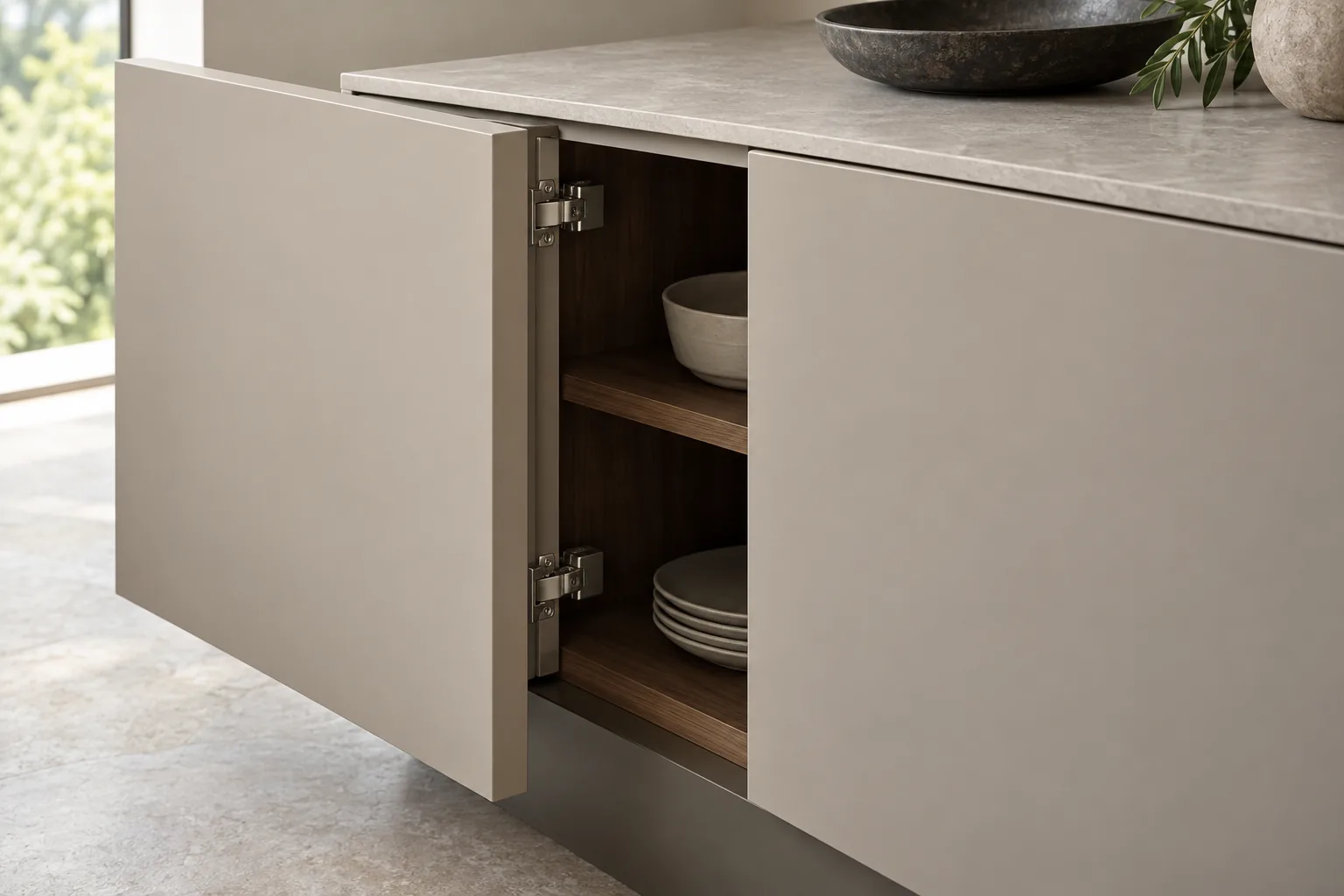
For a coplanar cabinet door opening sequence, document how each panel moves, what clearance it needs, and what users must do before accessing adjacent drawers or storage. “Coplanar” describes a relationship between closed fronts in a product system; it does not tell a buyer the exact opening order, handle operation, travel envelope, or installation sequence. Confirm those points with the selected system supplier’s current drawing and instructions, then review them in a representative cabinet assembly.
What should the buyer clarify about the sequence?
Sliding systems that bring cabinet fronts into a common plane when closed may use a product-specific movement to open and close. A buyer should not infer that sequence from the finished appearance alone. The selected system’s instructions define the operation and any required clearance or sequencing. Different products may move panels differently even when the closed-front look is similar.
The procurement decision is how the door movement interacts with the cabinet layout and the user’s intended access. A panel may need to move before another can travel, or the system may prescribe another order. The buyer should identify the steps exactly as the supplier specifies and show which space must be clear during each step. Adjacent drawers, handles, shelves, or objects in front of the cabinet may affect whether the operation is practical.
The supplier source describes coplanar sliding systems as a product category with defined operation. That is not evidence that every system uses the same mechanism or sequence. For coplanar cabinet door opening sequence approval, use the exact system model, revision, cabinet layout, and instruction set. Mark the sequence on the project drawing rather than rely on a generic label or a short verbal description.
Which cabinet and system inputs belong in the RFQ?
Provide a front elevation and a plan or section view that show the cabinet opening, panels, tracks, adjacent drawers, and nearby obstructions. Identify which fronts are intended to sit in the same plane when closed. Mark panel identities and the user’s viewpoint so that left/right descriptions remain unambiguous. If the cabinet contains internal storage, include the drawer or basket position and its planned extension path.
Ask the sliding-system supplier to identify the correct model, mounting arrangement, panel requirements, operation order, and installation instructions. Request the space needed during movement and the conditions that must remain clear. Do not invent a universal clearance dimension or assume another system’s instructions apply. If the final panel material, dimensions, or cabinet geometry are not settled, label those inputs as provisional and identify who will confirm them.
| RFQ input | What to show or request | Why it matters |
|---|---|---|
| System identity | Supplier, model, revision, and current instruction set | Establishes the rules for the selected product |
| Panel arrangement | Panel IDs, closed positions, viewing direction, and tracks | Defines the configuration being quoted |
| Opening sequence | Supplier-described order of panel operations | Prevents a finished appearance from being mistaken for operation instructions |
| Clearance envelope | Supplier-defined movement space and any restrictions | Allows review against adjacent components and room layout |
| Neighboring storage | Drawers, baskets, handles, shelves, and their travel | Identifies interference between moving parts |
| Approval configuration | Cabinet drawing revision and representative assembly plan | Links the sample to the intended installation |
If a supplier recommends changing the cabinet, record the proposed change and who controls it. The sliding-system supplier should confirm its own requirements; the cabinet maker confirms the cabinet geometry; the buyer approves the combined use case. Do not treat an unmarked sketch as a final installation reference.
How should proposals be compared?
Compare the sequence and the interface, not just the closed-front look. A system may have a prescribed panel order and defined travel. Another supplier’s product may use a different sequence or require a different space. A third proposal may not be coplanar but could still meet a buyer’s access requirement. Those options should be assessed against the actual brief rather than collapsed into one product label.
| Comparison point | سؤال من المشتري | Evidence to retain |
|---|---|---|
| Closed-front relationship | What panel alignment does the supplier’s system define? | System drawing and selected model revision |
| Opening sequence | Which panel moves first and what must happen next? | Current instructions and supplier demonstration |
| Front clearance | What space must be clear during each movement? | Marked travel envelope and cabinet layout |
| Adjacent drawer access | Can drawers open before, during, or only after a door move? | Combined sequence shown on an assembly drawing |
| Installation conditions | What cabinet or panel requirements apply? | Installation manual and written clarification for the chosen configuration |
The comparison should not imply that a specific system is safer, stronger, or better without supported evidence. Buyers should identify the outcomes that matter: appearance when closed, access order, room in front of the cabinet, and operation alongside adjacent storage. If a product feature cannot be confirmed in the documentation, list it as an open question before ordering.
Do not compare one supplier’s fully specified system with another supplier’s generic product image. Request equivalent drawings and clarify what is included in each quote. If the supplier’s system is purchased as a complete kit, identify included components and any separate cabinet or panel requirements. Keep any assumptions visible so a later price or design change does not obscure an unresolved fit condition.
How should the movement and clearance be reviewed?
Review the system in the order prescribed by the supplier. Start with the fronts closed and note their intended relationship. Then operate each panel as instructed, observing where it moves and what area it occupies. Do not force an alternative sequence or assume that two panels can move at once unless the supplier states that this is permitted for the selected model.
Overlay the door movement with the surrounding cabinet components. A drawer that opens into the same space as a sliding panel may need to remain closed until the panel is positioned. A projecting handle, adjacent cabinet, or object in front of the opening may also affect user access. These interactions should be demonstrated in the actual layout; they cannot be resolved by the term “coplanar” alone.
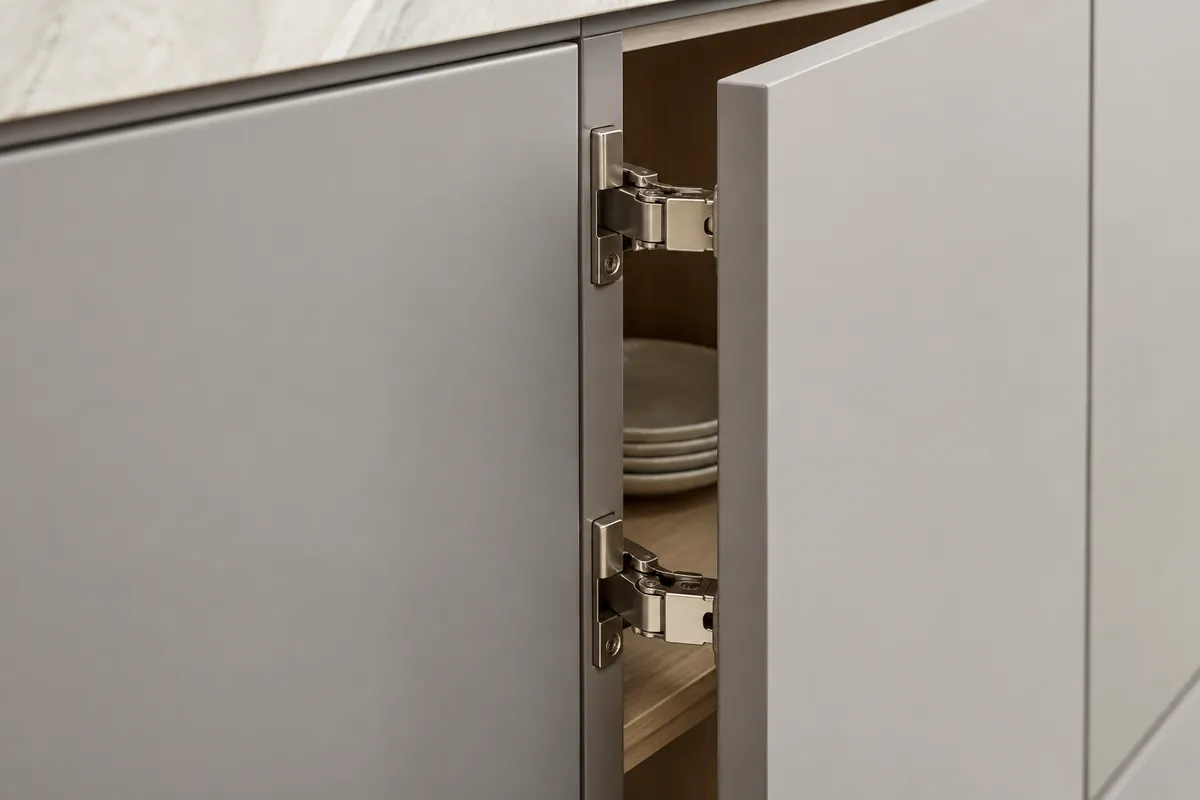
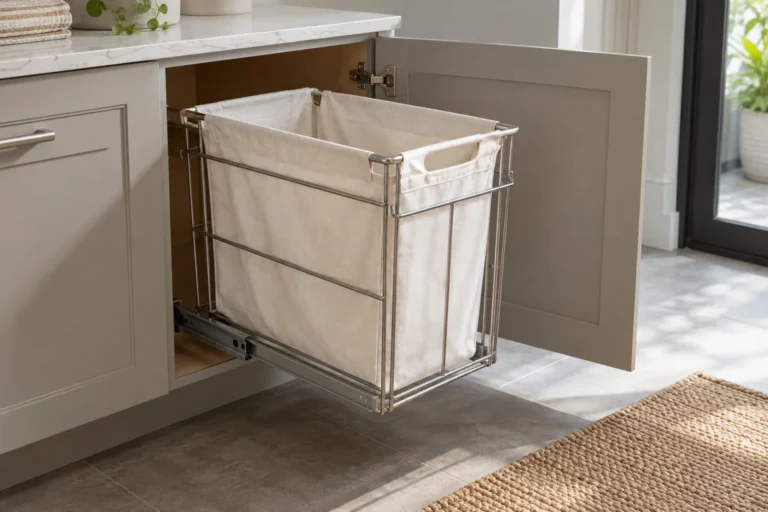
Ask the supplier to identify which clearances are product requirements and which are project-specific planning allowances. Record the dimensions and reference surfaces the supplier uses. If the assembly includes a metal basket or storage rack near the panel path, show that component on the same drawing. The manufacturer responsible for the metal part can confirm its geometry within scope, while the sliding-system specialist confirms its product requirements.
What should a representative sample demonstrate?
The sample should use the system model, panel arrangement, and cabinet conditions stated in the quote. Verify supplier, model, revision, installation instructions, and any specified hardware before assembly. If the demonstration uses reduced-size panels or omits a drawer, note the limitation; a partial setup can show selected motion but may not establish the full interaction.
Operate the panels in the documented sequence. Observe whether the movement matches the instructions and whether the panel clears the cabinet, adjacent drawers, handles, and included storage components. Check the user-access state after each step. If the product requires a drawer to stay closed during part of the sequence, record that operating condition and ensure it appears in the relevant instructions or product documentation.

Record the sample configuration, panel and cabinet identities, sequence observed, interference points, and any accepted deviations. State which parts were not included and which conditions were not evaluated. A sample review establishes observations for the tested assembly; it does not prove long-term durability, load capacity, or universal compatibility. Those claims require separate supplier evidence under stated conditions.
If a conflict appears, stop and ask the responsible supplier to propose a corrected layout or clarify the instructions. Do not resolve the issue by changing the sequence, moving a track, or altering a cabinet without approved design control. Recheck the proposed correction in the assembly and update the drawing revision before release.
How should changes and approvals be controlled?
Keep the approved cabinet drawing, sliding-system identity, panel arrangement, opening instructions, sample photos, observations, and named approver together. Tie these records to the product SKU, quotation, purchase order, and installation documents. If the system is private-labeled, ensure the consumer-facing instructions use the sequence actually approved for the supplied model.
Reassess changes to panel size, track, mounting arrangement, handle, neighboring drawer, cabinet depth, or system revision if they may affect motion or clearance. Ask the system supplier whether the previous approval still applies. A visually similar replacement may use a different sequence, and an unchanged nominal cabinet size does not prove the same front clearance. Preserve the supplier’s written change assessment.
When the buyer proposes an alternate system to address cost or availability, request a sequence comparison and revised drawing. State what changes from the approved configuration and what remains unverified. If the alternate moves the doors differently, review the adjacent storage and access state again. Do not carry over approval solely because the closed fronts look aligned in a photograph.
For a product family with different widths or panel counts, maintain configuration-specific records. Identify which combination has been demonstrated and avoid extending conclusions to layouts not checked. A matrix can help the sales and purchasing teams distinguish approved, conditional, and unreviewed configurations when it is kept current with supplier revisions.
What sourcing assumptions should be avoided?
Do not infer operation order from the word “coplanar.” Do not assume the closed alignment shows the space needed to open. Do not test the panels in an improvised sequence and call the system defective if the selected model requires another order. Do not ignore an adjacent drawer or basket because it is sold by a different supplier. The final buyer experience depends on the combined layout.
Avoid transferring one manufacturer’s instructions to another brand or revision. Avoid changing panel dimensions, tracks, or sequence without review. Avoid stating that the doors and drawers can be operated simultaneously unless the exact system configuration supports that behavior. Avoid turning a sample observation into a broad compatibility or performance guarantee.
These controls are useful for importers and private-label product teams because a clear sequence can be specified, demonstrated, and maintained in order documents. Koitor is not presented as the manufacturer of specialist sliding systems. Where a project includes a separate metal storage component, define that component’s envelope and the interface, then let each supplier confirm its own product scope.
Buyers can review Koitor’s OEM home-storage hardware و إنتاج سلال تخزين معدنية حسب الطلب pages for relevant metal-product sourcing context. Send the cabinet and metal-product drawings through Koitor’s contact page when the metal component itself needs review, while the sliding-system specialist confirms its mechanism and installation sequence.
الأسئلة الشائعة
Does coplanar mean the doors open at the same time?
Not necessarily. The selected supplier’s instructions define the movement. Confirm the actual sequence and model rather than infer operation from the closed-front alignment.
What is a coplanar cabinet door opening sequence?
It is the documented order and movement path used to open and close the specific cabinet door system. It should be verified against the selected product and cabinet configuration.
Should drawers be closed while the doors move?
Follow the system supplier’s instructions and test the combined layout. If a drawer position affects clearance, record the required sequence and user condition.
Can one system’s opening instructions apply to another?
No. Confirm the supplier, model, and revision. Similar appearance does not establish a shared mechanism or procedure.
What should a buyer request before approving a quote?
Request the current system drawing, panel arrangement, opening instructions, movement envelope, cabinet requirements, and clarification for adjacent drawers or storage.
Does a sample prove all cabinet sizes will work?
No. It covers the configuration actually assembled and observed. Record the tested dimensions and any conditions not included.
What if the panel sequence conflicts with a drawer?
Document the interference and ask the system or cabinet supplier for an approved configuration. Do not improvise a new order or modify the cabinet without approval.
When should a sample review be repeated?
Repeat it after changes to the system model, track, panel size, cabinet geometry, or adjacent components that could affect the movement path.
Who confirms system installation requirements?
The sliding-system supplier provides product-specific requirements; the cabinet maker confirms cabinet geometry; the buyer approves the assembled use case.
What should be shown in product instructions?
Show the actual model’s opening order and any required clear space or drawer condition, using the instructions supplied or approved for that system.
Clarify a cabinet movement interface
Share the cabinet elevation, selected system model, opening sequence, and adjacent storage drawing so the review covers the intended assembly.
Clarify the cabinet movement layout
Send the panel sequence and relevant metal storage drawing or sample, with each supplier’s review responsibility identified.
OEM / العلامة التجارية الخاصة
حوّل دليل التوريد هذا إلى موجز منتج
يرجى إطلاعنا على المنتج المستهدف، والحجم، والتشطيب، وكمية الطلب، ومتطلبات التغليف. وسيتلقى فريقك تقييمًا عمليًّا لإمكانية التصنيع قبل تقديم عرض الأسعار.
 English
  Español
  Português
  Français
  Deutsch
  العربية