

The query “country of origin marking product vs packaging USA” points to a real importer decision: must the metal bathroom accessory itself show its country of origin, can an outer container be used in a qualifying case, or does the importer’s actual product configuration change the answer? U.S. law starts with marking the foreign-origin article, subject to exceptions and detailed regulations; a retail box is not a universal substitute. Before artwork is approved, buyers should document the product, origin, packaging level, delivery path, and any exception being relied on, then confirm the proposed treatment with a customs broker or qualified trade adviser.
This article is a sourcing checklist, not a customs ruling or legal opinion. A shower basket, towel rack, bundled mounting kit, replacement part, or product repacked after import may present different facts. The examples below explain what a buyer should verify—not where Koitor or any buyer must place a specific mark.
What is the short answer for a product or its package?
For many imported foreign-origin articles, the general U.S. rule in 19 U.S.C. § 1304 is that the article itself be marked in a conspicuous place, legibly, indelibly, and permanently to indicate the English name of its country of origin, as the nature of the article permits. The law and implementing regulations also provide exceptions. In some circumstances, marking a container may be permitted, but the conditions matter; “put it on the box” is not a stand-alone compliance rule.
The first buyer question is therefore not simply “product or packaging?” It is: which finished article is entering the United States, who is its ultimate purchaser under the applicable rules, how will it be sold or repacked, and is there a specific exception that allows marking the container instead? The importer remains responsible for resolving those facts for the actual entry. A supplier’s past label, another brand’s carton, or a generic artwork template does not establish the answer for a different SKU.

How does the U.S. rule frame an origin-marking decision?
Section 304 of the Tariff Act, codified at 19 U.S.C. § 1304, sets out the general marking principle and exceptions. 19 C.F.R. Part 134 supplies customs regulations on country-of-origin marking, including articles, containers, marking methods, exceptions, and ultimate-purchaser considerations. Buyers should consult the current text rather than rely on a summary copied into an old packaging specification.
At a high level, the distinction is between an article that must be marked and an article for which a recognized exception permits the relevant container to indicate origin. The exception is not triggered merely because the product is small, the carton has a label, or a supplier prefers not to mark a finished metal surface. The product’s nature, marking feasibility, sale configuration, and any other applicable facts need to be evaluated under the regulation.
The word “container” can also be misunderstood. A retail box that reaches the ultimate purchaser, a master carton used only for transport, and a shipping container used by a carrier are not interchangeable concepts for every marking question. Buyers should describe each packaging level and the point at which it is opened, discarded, or replaced. If a package will be removed or the product will be split into separate retail units before sale, that fact may affect the review.
An importer should treat a broker’s or counsel’s conclusion as SKU- and route-specific. If a component kit contains articles with different origins, or if the product is assembled, finished, relabeled, or repacked in another country, origin determination may require a separate analysis. Do not assume that the country where a supplier ships from, the language on the carton, or the factory address alone settles customs origin.
Which facts should a buyer confirm before approving artwork?
Build a short evidence file before final packaging sign-off. It should identify the exact product revision and the path from factory to ultimate purchaser, not just the generic product family. A two-tier wall rack and a bag of mounting screws may be sold together, separately, or as a replacement kit; those configurations can create different questions.
| Decision input | What to record | Why it matters |
|---|---|---|
| Finished article | SKU, drawing or sample revision, included parts, and whether items are sold as a set | Identifies the article and sale configuration under review |
| Origin analysis | Manufacturing and processing facts; origin conclusion and responsible adviser | Ship-from location and supplier address do not automatically determine origin |
| Marking feasibility | Product surfaces, materials, durability, legibility, and feasible methods | A proposed exception or method must fit the actual article and governing rule |
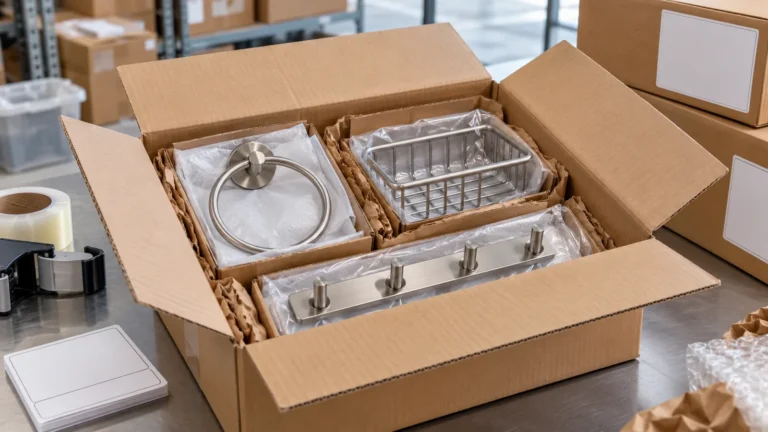
| Packaging path | Retail, grouped, transport, and shipping packaging; who removes or repacks each level | A mark on one level may not answer the question for a different point of sale |
| Ultimate purchaser | Intended sales channel and who receives the article in the relevant transaction | The regulatory analysis can depend on the sale and purchaser context |
| Evidence and approval | Current legal source, broker/adviser confirmation, approved artwork revision, and owner | Creates a traceable decision rather than an undocumented assumption |
The product specification should connect to the exact artwork file. Record the product drawing or sample revision, set contents, fastener origin if relevant, label artwork version, carton level, and shipment configuration together. If packaging artwork changes after the broker review—such as a new retail pack, online-marketplace fulfillment method, or importer repacking step—send the revised facts back for review rather than treating the earlier approval as automatically transferable. For buyers searching “country of origin marking product vs packaging USA,” these SKU and channel details are the starting evidence, not a substitute for the applicable customs analysis.
For private-label programs, keep the compliance decision separate from branding approval. A buyer may approve logo placement, language, barcode, instructions, and color while origin treatment remains unresolved. A signed packaging proof is not, by itself, evidence that the origin analysis was completed. A simple sign-off matrix can name who owns origin determination, who approves the physical marking method, who checks the final proof, and who confirms the production carton matches it.
When might a container-marking exception be relevant?
The statute lists circumstances in which an imported article may be excepted from direct marking, including specified cases involving the nature of the article or when marking its container reasonably indicates origin. The detailed rules in Part 134 determine how exceptions apply. Buyers should not turn the existence of an exception into a general claim that a retail package always satisfies the rule.
For example, a manufacturer may believe that a small chrome fitting cannot be marked without damaging its appearance. That is a useful fact to present to the importer’s adviser, but it is not automatically a legal conclusion. The buyer should ask what evidence supports the exception, what container level is required, whether the package will reach the relevant purchaser, and whether the wording and placement meet applicable requirements. Keep the adviser’s answer with the SKU record and the approved packaging proof.
CBP rulings can illustrate how facts matter, but they are not a substitute for matching the facts of a new product. CBP ruling HQ 733521 discusses marking in a particular metal shelving context; it should not be read as a universal instruction for every bathroom accessory. CBP ruling N352075 addresses a specific metal-shelf origin question and reinforces that production and transaction facts can matter. A buyer or broker should assess whether a ruling is factually comparable and whether it remains relevant to the current transaction.
Where a product is difficult to mark, ask the adviser to identify the exact regulatory route and required evidence rather than writing “box marking approved” in a note. Some products may be exempt for reasons unrelated to their physical size; other articles that seem similar may not qualify. Avoid copying a CBP ruling from a different product class, transformation history, or sales channel into a supplier specification without review.
How should origin and marking be reviewed separately?
Country-of-origin determination and marking method are related but distinct tasks. The origin question asks which country is legally treated as the country of origin for customs purposes under the facts and relevant rules. The marking question asks how that origin must be communicated on the article or, if permitted, the container. A label that clearly says a country does not fix an incorrect origin conclusion; a correct origin conclusion does not automatically prove that a proposed mark is sufficiently conspicuous, legible, indelible, permanent, or correctly placed.
This distinction matters when a bathroom rack contains parts made in different places, when components are assembled or finished after import, or when kits are packed under a private label. Do not assume that minor assembly, polishing, coating, or repacking necessarily changes origin—or that it never can. The applicable origin test depends on the product and circumstances. Ask the customs professional to review the actual bill of materials and process sequence if those facts may affect the conclusion.
Maintain two related approvals in the project file:
- Origin determination: which finished article and manufacturing facts were reviewed, who made the determination, what source or ruling was considered, and for which market and transaction it applies.
- Marking approval: the required English wording, location, method, package level if applicable, final visual proof, and who confirms the production sample matches.
If either part changes, reopen the corresponding review. A new coating can affect the practicality of a permanent mark; a new kit configuration can alter which articles are sold together; and a new U.S. fulfillment arrangement can change which package is encountered by the purchaser. Those changes should trigger a targeted check, not an automatic assumption that the old answer remains valid.

What should the supplier and importer verify on the physical sample?
Once the responsible adviser has specified the approved marking treatment, translate it into inspectable production instructions. The specification can identify the mark’s text, location reference, method, minimum legibility or durability criteria where prescribed, the relevant product or package level, and the artwork revision. The buyer should avoid vague notes such as “Made in China somewhere on package” because they do not tell production or inspection staff which version or location was approved.
Review a physical production-intent sample or packaging proof against the approved specification. Check that the country name matches the approved wording, is visible in the intended orientation, remains legible after normal handling, is not covered by a rail, bracket, tape, or insert, and appears on the correct product or packaging level. Those are practical comparison questions, not a substitute for the legal test. A visual check by itself cannot establish country of origin, determine whether an exception applies, or guarantee CBP acceptance.
For a metal product, the manufacturer and buyer may need to compare marking approaches with the finish and geometry. A removable sticker, printed carton, durable label, laser marking, stamping, or other method may have different practical effects on appearance, corrosion exposure, assembly, cost, and packaging flow. The appropriate method is not selected solely by a supplier’s machinery or a buyer’s preference; it must match the adviser-approved rule and the finished product. Do not request a mark that damages a cosmetic surface or obscures a safety or instruction label without reviewing those consequences.
| Sample check | Pass evidence to retain | What the check does not establish |
|---|---|---|
| Correct revision | Product and packaging revisions match the adviser-reviewed SKU file | It does not prove the origin conclusion is legally correct |
| Wording and location | Physical sample matches the approved proof and location instruction | It does not prove that a container exception applies |
| Legibility and permanence | The mark remains readable and attached under the specified review conditions | It does not create a customs ruling or guarantee entry release |
| Pack-out consistency | Production units use the approved package level and artwork version | It does not verify a different route, marketplace, or repacking scenario |
If the first sample differs from the approved proof, stop artwork release for that SKU and document the discrepancy. Correct the production instruction or obtain updated advice before mass pack-out. Photograph the actual product and relevant package level in context, store the signed proof and date, and record who resolved the mismatch. This gives an importer a clearer chain from legal review to production evidence without claiming that a supplier inspection replaces the importer’s compliance responsibility.
What does a package label not prove, and what should buyers avoid claiming?
A country-of-origin mark is not a certificate of product quality, safety, material grade, factory identity, tariff classification, or a guarantee of preferential duty treatment. It does not establish that the product complies with every rule in the destination market. Those matters may involve separate customs, product, labeling, environmental, or consumer-protection requirements.
Likewise, a supplier cannot establish the importer’s complete legal position merely by printing the wording requested in an artwork file. The buyer should avoid statements such as “the retail carton always replaces product marking,” “assembly in another country automatically changes origin,” “a CBP ruling for a different shelf covers our rack,” or “the sample passed, so all future shipments are compliant.” Each statement skips facts or overstates what a single check demonstrates.
Use precise internal language: “The broker reviewed SKU X, drawing revision Y, the listed production steps and the stated U.S. sales path on [date], and approved the proposed treatment shown in artwork revision Z.” If the evidence is incomplete, mark the decision pending and name the owner. A short, dated record is more useful than an unqualified compliance claim pasted into a supplier purchase order.
What is a practical pre-shipment decision sequence?
Before the next private-label bathroom hardware order, work through this sequence:
- Freeze the SKU and physical configuration: product, included components, kit contents, drawing revision, and origin facts.
- Map the packaging chain from the individual product to the ultimate sales unit, grouped carton, export carton, and any U.S. repacking or fulfillment stage.
- Give the importer’s customs broker or qualified adviser the exact facts, destination, route, and planned sales channel; ask for an origin conclusion and marking instruction separately.
- Record the cited legal provision or ruling and how its facts compare to the actual product. Do not treat a search result or supplier precedent as approval.
- Translate the approved decision into a controlled product/packaging specification and artwork revision. Identify the required marking method and the owner of each check.
- Verify a production-intent sample and pack-out against the approved version. Preserve photos, proof approval, revision identifiers, and discrepancy closure.
- Reopen the review if origin, processing, kit configuration, package level, destination, purchaser, or fulfillment route changes.
This sequence helps the importer communicate the decision to the factory without asking the factory to make the importer’s legal determination. The factory can confirm feasible marking surfaces, package dimensions, material and finish effects, lead-time implications, and whether a controlled artwork revision can be used in production. The importer and adviser decide the applicable rule and approve the treatment.
For buyers developing custom or private-label storage products, a clear origin-marking instruction should travel with the approved drawing and packaging specification—not arrive as a last-minute email after cartons have been printed. Koitor’s إكسسوارات الحمام ذات العلامة التجارية الخاصة و custom metal storage rack manufacturing pages describe the product-development context; they do not replace customs advice. Buyers can send a drawing, sample, finish requirement, packaging concept, and destination-market question through the Koitor contact page for a manufacturing-feasibility discussion.
The practical takeaway is simple: do not choose between product and packaging until the actual article, origin, packaging path, and applicable exception have been reviewed. Keep the legal determination with the importer and qualified adviser, translate the outcome into one controlled supplier instruction, and verify that the production sample matches it. For the question “country of origin marking product vs packaging USA,” the answer is conditional on the imported article and the facts of the sale—not a blanket preference for either a product mark or a box label. That process reduces avoidable artwork changes while keeping manufacturing feasibility separate from customs compliance.
Need a packaging feasibility review for a custom rack?
Send Koitor your drawing, sample, finish requirement, package dimensions and proposed marking location. We can review manufacturing and pack-out feasibility; your importer or customs adviser should confirm the applicable origin-marking rule.
OEM / العلامة التجارية الخاصة
حوّل دليل التوريد هذا إلى موجز منتج
يرجى إطلاعنا على المنتج المستهدف، والحجم، والتشطيب، وكمية الطلب، ومتطلبات التغليف. وسيتلقى فريقك تقييمًا عمليًّا لإمكانية التصنيع قبل تقديم عرض الأسعار.

 English
 Español
 Português
 Français
 Deutsch
 العربية