

Disher size vs volume is a model-identification and product-claim question: a number stamped on a portion scoop should not be treated as a universal capacity unless the maker defines what that number means for the exact model. Buyers should compare the supplier’s model code, stated capacity and unit, filling convention, and approved sample before using a number on packaging or an assortment chart. A portion estimate for a particular food is a separate statement from the scoop’s nominal capacity.
For a private-label product record, disher size vs volume should remain separate until the exact maker and capacity convention are confirmed.
This guide is for kitchenware importers, catering-smallwares distributors, and private-label product teams. It does not establish a universal scoop-number standard, calibrate any utensil, or claim that one scoop produces a fixed food weight or serving count. Manufacturer charts and product pages describe named products and conventions. They are not a substitute for a controlled specification for a different model. Koitor’s confirmed scope is bathroom and home-storage metal hardware; complete portion scoops, scoop mechanisms, food-contact qualification, and capacity calibration are not confirmed Koitor capabilities.
Decision summary: approve the model, unit, and claim together
A buyer should treat the disher number, the supplier-declared volume, and the weight of a particular food as separate pieces of information. They answer different questions:
| Information | What it can identify | What it does not prove by itself |
|---|---|---|
| Disher or scoop number | A maker’s model, size, or portion reference under its own system | A universal volume unless the supplier defines it |
| Declared capacity | A stated nominal volume with a unit and model identity | Actual food mass, exact serving count, or a result for every filling method |
| Approximate servings per container | A planning estimate in a named chart or model context | A guaranteed portion count for every recipe, ingredient, or user |
| Food weight | The mass of a specified food sample under a stated method | The utensil’s nominal volume or the mass of another food |
| Sample appearance | Visible bowl shape, handle and mechanism | Calibration, material grade, durability, or food-contact approval |
Before comparing quotations, record the exact model, supplier definition, stated unit, filling reference, included components, and relevant product claim. If a supplier’s sheet contains a numbered-size chart without an explicit model or method, ask the supplier to identify which products and assumptions it covers. Do not calculate a missing value from the number alone.
What does a disher number actually tell a buyer?
A numbered disher may be used by a manufacturer or food-service supplier as a size or portion reference. Buyers should not assume that every maker uses the same number in an identical way. The exact relationship should be read from the relevant manufacturer’s chart, product page, instructions, or written specification for the quoted model.
A well-structured manufacturer chart may display several columns together, such as a model number, capacity in one or more units, and an approximate servings-per-container estimate. Those fields should be read as separate declarations. Vollrath’s portion-control chart, for example, presents model number and capacity fields alongside approximate servings-per-quart information and includes model-specific notes. Its printed revision and current model selection matter; the chart should not be converted into a timeless universal rule for every product sold as a disher. See the Vollrath portion-control chart page and its linked manufacturer chart PDF.
When evaluating the supplier’s declared number, ask whether it refers to a particular utensil model, a nominal bowl capacity, or a portion convention used by a market or product family. Ask if a number is stamped on the product, printed on packaging, or appears only in a catalogue. Confirm whether the supplier has a current model cross-reference and whether the quoted scoop carries the same identifier as the source document.
A number can be useful to organize a product range without being enough to describe the offered capacity. For a private-label buyer, the item code and the stated volume should appear together in the internal product master and on any proposed specification sheet. If the buyer uses a number in a recipe, assortment grid, or carton label, confirm that the number means the same thing to the manufacturer and intended customer.
Separate serving shorthand from declared capacity
A capacity statement should name a unit and a product. “Number 20” or “size 70” may be meaningful within a named maker’s series, but without the series and current product reference it is ambiguous. A volume statement such as “one tablespoon” is still a declared product convention, not automatically the mass or yield of every food placed in that scoop.
OXO’s small cookie scoop page describes the named product as size 70 and states a one-tablespoon capacity for dough or batter. That is a model-specific manufacturer declaration. It should not be silently replaced with a calculated portion count from a generic chart or repeated as a universal definition of size 70 across all brands. See the OXO small cookie scoop. The maker’s wording applies to that product and application, not to an unverified private-label scoop.
The same care applies to phrases such as “portion size,” “serving,” or “scoopful.” These can describe a recipe convention, a commercial target, or an approximate product use. A buyer should clarify whether the supplier’s capacity refers to a level scoop, a heaped scoop, liquid fill, or another stated method. Do not assume that product imagery defines the filling technique.
Why is volume different from food weight?
Volume describes the space a container or utensil is intended to hold under a stated basis; weight describes mass. For a food product, the mass in a scoop can vary with density, ingredient shape, particle size, moisture, compression, temperature, and the user’s filling technique. A scoop that holds a nominal volume does not guarantee a single weight for flour, dough, rice, ice cream, or another material.
This distinction matters when buyers write product copy or compare a portion tool to a recipe. If the requirement is a utensil with a declared capacity, ask for the nominal capacity and model. If the requirement is a target weight of a named food, the responsible product team must define an appropriate method using that food and the actual tool. Do not turn a nominal volume into a weight claim by assuming one food has the same density as another.
Likewise, a servings-per-quart number in a supplier chart is a planning convention associated with that chart’s stated model and assumptions. It does not automatically predict the actual number of servings produced by every operator, recipe, fill level, or food. If an importer wants a yield statement for a private-label product, the responsible supplier or product owner should substantiate it for the exact model and usage definition.
A buyer can keep these fields distinct in an RFQ:
| Buyer field | Example of what to record | Responsible evidence |
|---|---|---|
| Product identity | Manufacturer and exact model code | Current product page, drawing, or quote |
| Supplier size label | Number, series, and where it appears | Manufacturer definition for that series |
| Nominal capacity | Value, unit, and method | Exact-model product specification |
| Filling convention | Level, heaped, or another defined reference | Instructions or agreed sample method |
| Food-weight claim | Named food and target statement | Evidence from the responsible product owner |
| Serving estimate | Source chart, revision, and assumptions | Current model-specific documentation |
Avoid blending these fields into one large “size” column. When a buyer keeps model, volume, food mass, and yield separate, the team can identify whether a mismatch comes from the utensil, the declaration, or the recipe assumption.
For this buyer guide, disher size vs volume is a comparison phrase; it does not replace exact model, evidence, and acceptance criteria.

How should buyers approve a scoop sample?
A sample review should confirm that the delivered utensil represents the model described by the supplier. Record the model or part number, revision, source document, sample receipt date, and any markings present. Do not assume a visually similar bowl is the same capacity. A minor geometry change can alter the volume, and an apparently identical handle may conceal a different mechanism or model generation.
Before reviewing the sample, agree what the buyer needs to verify. If the purchase decision concerns declared capacity, identify the supplier’s method and the responsible reviewer. If the buyer only needs to match a named market model, request written confirmation of the manufacturer’s cross-reference and preserve the source. If the buyer has a packaging claim, review the wording and evidence for the exact model separately from the physical appearance.
A visual comparison can record bowl shape, handle configuration, scraper or release mechanism, materials as declared by the supplier, and visible markings. It cannot prove an exact volume, a serving weight, mechanism durability, safe operation, dishwasher suitability, or food-contact status. Those require model-specific evidence from the responsible supplier and a suitable qualified review.
If the buyer and supplier agree to a capacity check, write down the method before the test. State which sample is checked, how it is filled, how the capacity is read, what equipment is used, and who records the result. Do not present an improvised water-fill check as a certified calibration or a universal acceptance method. The appropriate method and tolerance depend on the product requirement and the supplier’s substantiation.
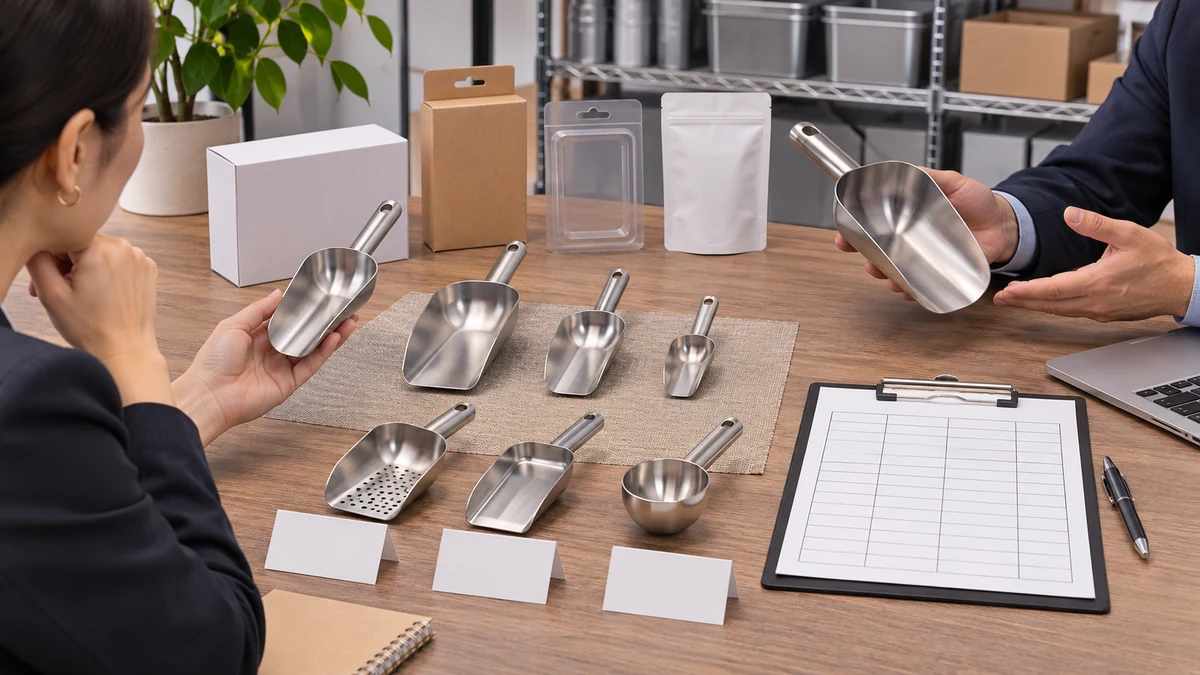
When a sample does not match the approved document, pause the approval and ask the supplier to reconcile the model code, stated capacity, and product marking. Do not correct a label or change a number in the buyer’s product file based only on a verbal explanation. Preserve the discrepancy, responsible owner, and corrective action in the review record.
Buyer approval and sourcing controls
What should importers put in an RFQ and on the product record?
The RFQ should state the buyer’s intended product architecture and the exact declaration that will be used in downstream catalogues. If the importer needs a family of scoop sizes, list each requested model as a separate line with the maker’s number, expected volume unit, handle style, and included mechanism. This helps prevent a supplier from interpreting a range label as permission to substitute any similar scoop.
Ask the supplier to quote the product configuration and included parts. If there is a scraper, spring, gear, trigger, grip, or other moving element, identify whether it is part of the offer and whether a spare or repair component is available. These are supplier questions, not assumptions that Koitor produces those parts. Confirm any model-generation or replacement information against current manufacturer documentation.
Maintain a product record that links the model code, supplier code, image, capacity declaration, package artwork, language version, and revision. If the buyer changes the claim, update the product data and artwork approval together. If the supplier changes the model, require a fresh review of capacity and packaging. The buyer should identify which party owns each information field: utensil maker, importer, retailer, or private-label brand owner.
If multiple markets are served, confirm local recipe and product terminology with the responsible market team. Do not infer that the same everyday word for “tablespoon” always maps to the same product capacity or legal metrology requirement in every destination. This article does not state a legal standard; any regulated measure or market-specific declaration must be checked with a qualified authority for the jurisdiction and product.
How can product changes be controlled?
A change to the bowl, handle, release action, spring, scraper, material, or model marking can alter what the buyer approved. Define which changes require advance notice and whether a new sample, drawing, declaration, or product-data review is needed. A small visual change may affect neither capacity nor buyer use, but that should be confirmed by the responsible manufacturer rather than assumed.
For each change request, ask the supplier to identify the affected model and revision, describe the difference, and state which documents or claims need updating. Keep the approved sample or reference images tied to the order record. If a replacement mechanism is offered, verify it against the exact model generation and assembly; similarity of appearance is not proof of compatibility.
The buyer should also control corrections to catalogue charts. If a model number changes, check that the capacity declaration, product photograph, packaging and internal SKU record change together. A supplier’s updated chart should not automatically overwrite an older customer-facing product page until the brand owner has reviewed the evidence. This is especially important when a model name remains similar while the actual tool or included parts have changed.
How should a buyer resolve conflicting capacity documents?
A supplier may provide a catalogue page, a chart, a quotation, a sample label, and package artwork that were created at different times. The buyer should not choose whichever value looks most plausible. First identify the exact model and revision on each record. Then record the stated capacity, unit, filling convention, and source date side by side. If a model code is missing, ask the supplier to identify the item in writing before treating the document as applicable.
| Documents disagree about | Buyer action before approval | Why the discrepancy matters |
|---|---|---|
| Model number or series | Request the exact model cross-reference and current product record | A capacity chart for a related model may not describe the sample being quoted |
| Capacity value or unit | Ask the responsible maker to confirm the controlling declaration and explain the difference | Rounding, unit conversion, or a model revision can produce apparently conflicting values |
| Level, rounded, or heaped fill | Obtain the maker’s stated convention or leave the basis explicitly unresolved | A different fill method can change the quantity represented without changing the tool |
| Marking versus artwork | Hold artwork approval until it matches the confirmed item and current source | Packaging can preserve an obsolete number after a product change |
| Sample versus written specification | Record the variance and request a corrected document or replacement sample | A photo or verbal assurance does not establish which configuration governs the order |
The buyer can use a simple discrepancy log with six fields: affected model, conflicting records and revision dates, exact conflict, supplier owner, resolution evidence, and approval status. Keep the original documents with the log instead of overwriting them. If the supplier confirms a revised capacity, request a dated replacement specification and identify whether the sample, SKU data, packaging, and any published claim must also change. The importer should then review the update with the responsible product and regulatory teams where applicable.
For instance, if the product page states one tablespoon but a chart associates the model number with a rounded volume, do not assume the numbers contradict or agree until the manufacturer explains its unit and rounding basis. Preserve both source statements, obtain model-specific clarification, and use only wording the responsible owner can substantiate. Do not reverse-engineer a “correct” capacity from a servings estimate, convert a rounded chart into a precision claim, or silently revise package copy. If no authoritative reconciliation is supplied, the buyer can keep the item on hold or remove the capacity claim while the product owner decides whether the tool remains suitable.
What sourcing mistakes should private-label buyers avoid?
Common errors include:
- Treating a numbered disher label as a universal standard without naming the maker and series.
- Using capacity and food weight as if they were the same measure.
- Applying one manufacturer’s chart to another brand’s model.
- Treating an approximate servings-per-container field as a guaranteed yield.
- Comparing a level-fill declaration with a heaped-fill interpretation.
- Approving packaging based only on a generic product photograph.
- Assuming an unmarked sample matches the quoted item code.
- Changing a model or mechanism without rechecking its current instructions and declarations.
- Reprinting an old capacity statement after a supplier revises the item.
- Claiming food-contact or dishwasher performance based only on metal appearance.
These problems are usually prevented by simple product identity control. The buyer does not need to publish every internal check; the goal is to make sure that the quotation, sample, declaration, product record and packaging refer to the same model and same intended use.
How do metal hardware OEM capabilities relate to portion scoops?
Koitor Hardware’s confirmed positioning is as a family-owned custom metal hardware manufacturer for bathroom and home storage products. The company’s approved facts do not confirm complete portion-scoop production, scoop-bowl tooling, release mechanisms, food-contact qualification, or capacity calibration. Importers should not infer those capabilities from general experience with metal products.
The transferable lesson is about a controlled product brief: name the model, state the interface or declared value, identify the sample and revision, and keep claims tied to evidence from the responsible supplier. That sourcing discipline applies across categories, but it does not make the product types or manufacturing processes interchangeable. Woven baskets, wire storage hardware, sheet-metal components, and a portion utensil may require different tooling, forming, assembly, finishing, and product qualification.
If a kitchenware buyer has a separate metal component that may fit Koitor’s established scope, send the controlled drawing or sample for feasibility review. The factory should first confirm the component, material, process, finish, packaging and quantity. A project brief should not present an unconfirmed adjacent product as an existing Koitor line, and a discussion of metal manufacturing does not substitute for the finished utensil maker’s food-contact or capacity evidence.
Buyer checklist before approving a portion scoop
- Record the exact manufacturer, model number, series, and product revision.
- Copy the supplier’s stated capacity and unit from a current exact-model source.
- Ask what the size number means for that manufacturer and product family.
- Define the filling convention if the declaration depends on level, heaped, or another basis.
- Keep nominal volume separate from food mass and servings-per-container estimates.
- Identify the actual bowl, handle, release mechanism, scraper, and included accessories.
- Match the sample, product marking, quote, drawing, and packaging claim.
- Specify who reviews any capacity check and which method is accepted.
- Record the source document, revision date, and any open questions.
- Require a review when the model, mechanism, material, or capacity declaration changes.
- Confirm market-specific claims with the responsible supplier and qualified reviewer.
- Do not assume Koitor produces a finished scoop unless the company confirms that scope.
الأسئلة الشائعة
Does a larger disher number always mean a larger volume?
Do not assume that the numbering convention is identical across manufacturers. Use the exact maker’s chart or product specification for the quoted model and record the declared capacity with its unit.
Is one tablespoon always the same as one scoop number?
No. A named capacity and a numbered product identifier are different fields unless the manufacturer explicitly links them for the exact model. Preserve the source’s wording.
Can scoop capacity predict the weight of a food portion?
Not by itself. Food mass can vary with material density and filling method. Any product or recipe claim about weight should be substantiated for the named food and utensil by the responsible product owner.
Does an approximate servings-per-quart chart guarantee the yield?
No. An estimate in a manufacturer chart belongs to that chart’s model context and assumptions. It does not guarantee yield across different recipes, foods, users, or fill methods.
Can Koitor provide capacity calibration for a private-label scoop?
Current approved Koitor facts do not confirm portion-scoop production or calibration. Buyers should obtain model-specific capacity evidence from the responsible utensil supplier and have claims reviewed by the qualified product owner.
المصادر
- Vollrath portion-control chart — manufacturer chart and model-specific context.
- Vollrath chart PDF — source chart with separate size, capacity, and approximate servings fields.
- OXO small cookie scoop — named product’s size and declared capacity.
- Koitor custom bathroom hardware manufacturer — confirmed company scope.
اعمل مع شركة «كويتور» للأدوات
Discuss a confirmed metal hardware requirement
Share the drawing or sample, metal-component scope, intended application, and order range. Koitor will confirm whether the project fits its established bathroom and home-storage capabilities before discussing a quotation.
OEM / العلامة التجارية الخاصة
حوّل دليل التوريد هذا إلى موجز منتج
يرجى إطلاعنا على المنتج المستهدف، والحجم، والتشطيب، وكمية الطلب، ومتطلبات التغليف. وسيتلقى فريقك تقييمًا عمليًّا لإمكانية التصنيع قبل تقديم عرض الأسعار.


 English
 Español
 Português
 Français
 Deutsch
 العربية