
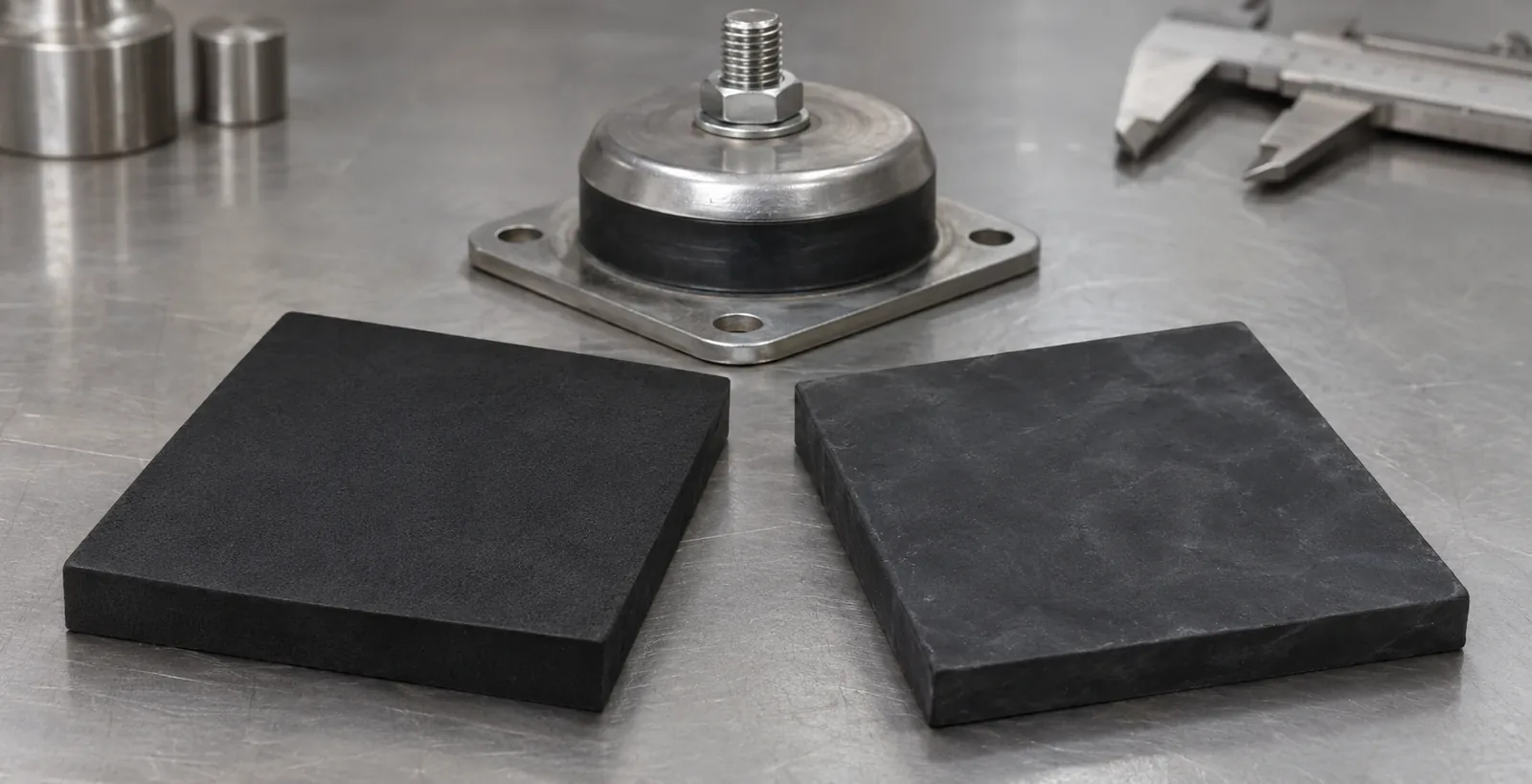
EPDM vs neoprene is not a universal winner-versus-loser decision: the right elastomer depends on the exact compound, part form, contact media, exposure, temperature range, mechanical duty and supplier evidence. Buyers should name the component function first—such as a pad, seal, washer, foot or spacer—then describe its operating conditions and request grade-specific documentation. “EPDM” and “neoprene” identify broad material families, not complete purchase specifications or proof that a finished part will meet a particular requirement.
What buyer decision does an EPDM vs neoprene comparison support?
The comparison helps an importer or product developer decide what to request from a component supplier when an elastomer part must protect, seal, cushion, space or isolate a metal assembly. The first question is not simply which family is “better.” It is what the part must do, what it touches, and which failure would matter to the buyer or end user.
In bathroom and home-storage hardware, elastomers may appear as feet, pads, bumpers, gaskets, washers, adhesive-backed interfaces or purchased accessories. The role changes the relevant requirements. A non-slip foot may need a specified geometry and friction behavior on a defined surface. A gasket may need a compression and sealing requirement. A spacer may need to hold a dimension. An adhesive-backed pad also introduces adhesive, surface-preparation and application variables that are not answered by the polymer-family name.
The sourcing decision should therefore join material identity to part design and use. A supplier should know whether the component sees water, cleaning chemicals, sunlight, oils, intermittent heat, continuous compression, movement, repeated removal or metal contact. A buyer should explain the expected conditions instead of sending an isolated material name and asking for a universal recommendation.
This guide is a comparison framework, not an application approval or a blanket compatibility chart. It does not establish chemical resistance for an unspecified cleaner, a service temperature for an unspecified compound, a fire classification, a waterproof rating, or a guaranteed life. Where those outcomes matter, define the exact compound and test or evidence needed with a qualified component supplier.
What do EPDM and neoprene names mean for a purchasing specification?
EPDM is a family of ethylene-propylene-diene rubber compounds. Neoprene is a common trade name associated with chloroprene rubber (CR). Both families are available in different compounds, hardnesses, colors, cellular or solid forms, manufacturing routes and part constructions. A supplier may quote a molded solid part, a sponge profile, a sheet-cut washer or an adhesive-backed pad; the same material family name does not make these constructions interchangeable.
Ask suppliers to identify the actual material designation and compound information they can disclose. For a molded component, the purchase documentation should specify the part drawing, dimensions, material family or approved compound, hardness scale and tolerance where agreed, color, finish, flash limits, bond or adhesive details and packaging. For a cut part, include sheet type, thickness, die-cut geometry and edge condition. If a property is critical, specify how it is verified rather than relying on a generic brochure statement.
Avoid reading a supplier’s product range as a universal technical guarantee. An engineered-seal manufacturer may describe EPDM and chloroprene choices for a defined application; that supports asking comparable exposure questions. It does not prove that all EPDM compounds suit every outdoor or water-contact part, or that every neoprene product resists every oil, cleaner or temperature. A compound maker’s grade portfolio likewise does not identify which grade a reseller will supply unless the purchase record says so.
In RFQs, distinguish a mandatory requirement from a preference. “Material must be EPDM” is a fixed requirement; “supplier may recommend EPDM or CR if documentation demonstrates suitability” invites a controlled proposal. Buyers should state who approves a change, what comparison evidence is required, and whether the final sample must represent production material and construction.
Useful external reading should be applied only within its stated scope. Cooper Standard’s engineered-seal comparison can prompt buyers to compare exposure priorities, but it does not guarantee performance for an unrelated pad or foot. A component maker’s EPDM and neoprene discussion helps frame gasket and washer questions; neither source replaces documentation for the compound being quoted. Record the source title and access date in the project file, then ask the supplier to reconcile any difference between a public article and its proposed product.
How should buyers compare exposure and component duty?
Compare EPDM and neoprene through the conditions the actual part will experience. The following matrix is a question framework, not a material ranking. Have the supplier map its exact compound and construction to each requirement and identify evidence, assumptions and gaps.
| Decision factor | سؤال من المشتري | What to verify for the offered component |
|---|---|---|
| Water and weather exposure | Is the part exposed to intermittent splash, persistent moisture, sunlight or outdoor weather? | Exact compound guidance and limits; do not transfer general family reputation to a specific product |
| Chemical contact | Which cleaners, oils, soaps, solvents or other fluids may touch it, and for how long? | Compatibility for the named substance, concentration, temperature, contact time and compound |
| Mechanical role | Does the part seal, cushion, grip, space, isolate or protect a cosmetic face? | Geometry, hardness or compressibility requirements, compression behavior and fit |
| Motion and wear | Is there sliding, rubbing, repeated installation, flexing or vibration? | Wear conditions, surface pairing, retention method and representative part evaluation |
| Temperature | What is the actual operating range and duration? | Product-specific data for the exact compound, with test method and conditions |
| Form and process | Is the part molded, cut from sheet, foamed, sponged or bonded? | Construction, density where relevant, tolerances, edge, seam and adhesive details |
| Buyer evidence | What must be documented at approval or reorder? | Datasheet, material declaration, sample identity, inspection record and change-control commitment |
EPDM is often considered when a project prioritizes weathering or water-related exposure, while neoprene may be considered when a different balance of properties or component requirements is relevant. These are screening prompts, not guarantees. Product-specific documents must support any final selection. Avoid claiming a blanket UV, water, chemical, fire or temperature winner from the material family alone.
For chemical contact, “bathroom cleaner” is not a precise exposure description. Name the product or active chemistry where possible, and include dilution, temperature, frequency, contact duration and whether the surface is wiped or immersed. If the cleaner is not yet selected, say so and ask the supplier what additional information is required. Do not treat a generic compatibility chart as approval of an unnamed proprietary compound.
Mechanical function also changes the comparison. A soft pad that prevents metal-to-countertop contact does not have the same duty as a sealing ring compressed between two surfaces. A material with an attractive general description may still be wrong if the part relaxes, slips, tears, takes a permanent set, de-bonds or changes dimensions under the actual assembly conditions. Define the failure mode the part must prevent and agree a suitable evaluation with the component supplier.
How do part form, hardness and assembly affect the choice?
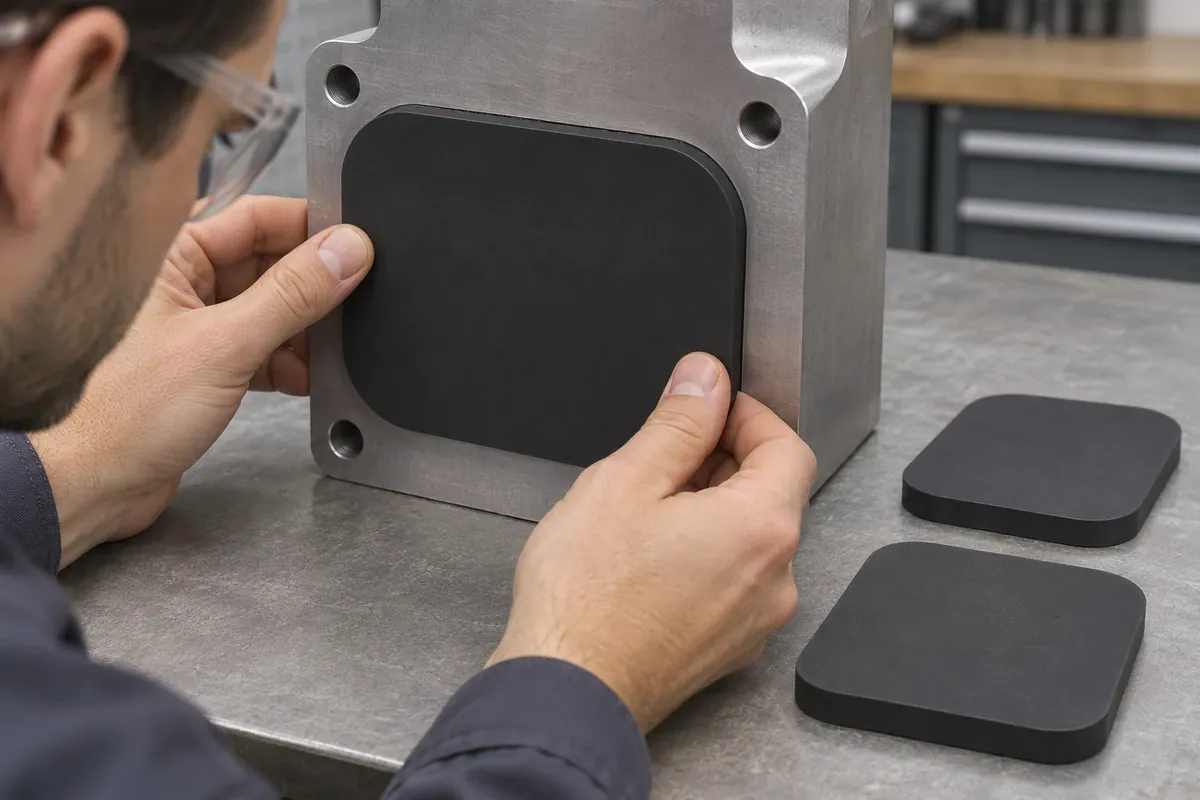
Material selection cannot be separated from shape and assembly. The same nominal family can be supplied as a flat pad, a molded profile, a washer, a hollow seal or a cellular material. Each form changes the part’s compression, contact area, retention, dimensional behavior and method of inspection. A buyer’s drawing should show the part in its assembled condition and identify critical contact surfaces.
Hardness is a useful specification only when the buyer names the scale, test method, specimen conditions and acceptable range. A number without that context can be misunderstood. Hardness alone does not determine sealing, grip, compression set, resilience or lifespan. If the function depends on deflection, sealing force or dimensional recovery, specify or test that function on a representative part instead of assuming that one hardness value proves it.
Assembly details can dominate the result. A pad can shift if its footprint, adhesive or surface preparation is wrong. A washer can extrude if the gap and compression are unsuitable. A foot can rock if the metal part is not flat or the fastener does not retain the elastomer. A seal can leak if the mating geometry is outside tolerance. These are conditional engineering mechanisms to examine; they are not claims about observed Koitor defects or a particular supplier’s product.
Specify how the elastomer attaches to metal or another substrate. If adhesive is involved, identify who supplies it, whether the surface needs cleaning or priming, the application process, cure conditions if applicable, and how the finished assembly will be handled before bond strength develops. The buyer should not assume the rubber compound and adhesive are interchangeable selection decisions. For a bonded part, ask the responsible supplier to confirm the complete material system.
Dimensional tolerances should be based on the functional stack-up and supplier process, not copied from a generic chart. A small variation may have little effect on a loose protective pad but matter in a compressed seal or locating feature. Identify critical dimensions on the drawing and agree inspection method, sampling and acceptance with the supplier before production.
What should buyers put in an EPDM or neoprene RFQ?
A useful RFQ makes the component’s job and exposure clear enough for suppliers to respond consistently. State whether the supplier must quote a specified compound or can recommend an alternative. Attach the drawing, assembly view, sample or interface photo; identify what is confidential and use the project’s approved transfer method for controlled files.
Include these fields where relevant:
- Part name, function and installation location.
- Drawing number, revision, dimensions, critical tolerances and quantity per finished product.
- Proposed material family, exact grade or compound designation, and whether substitutions are permitted.
- Solid, sponge, foam, molded, extruded, die-cut or other construction.
- Hardness scale and range if functionally required, plus any agreed test method.
- Color, visible-face criteria, flash, seams, surface texture and edge requirements.
- Contact media, named cleaners or chemicals, temperature, duration, frequency and cleaning method.
- Load, compression, movement, abrasion, vibration or retention conditions relevant to the part.
- Adhesive type or approved bonding proposal, substrate preparation and assembly responsibility.
- Required declarations, technical data, sample approval and inspection records.
- Packaging that prevents contamination, deformation, adhesive exposure or mix-ups between compounds.
- Lot identification, change notification, traceability and controls for repeat orders.
If the buyer cannot finalize the material, request two controlled proposals. Each should name its compound, part construction, documentation and known limitations. Keep the quote comparison on the same geometry, quantity, packaging and acceptance plan. A supplier’s “equivalent” note should identify what evidence makes it equivalent for this component and who bears responsibility for final application approval.
How should buyers evaluate samples and manage compound changes?
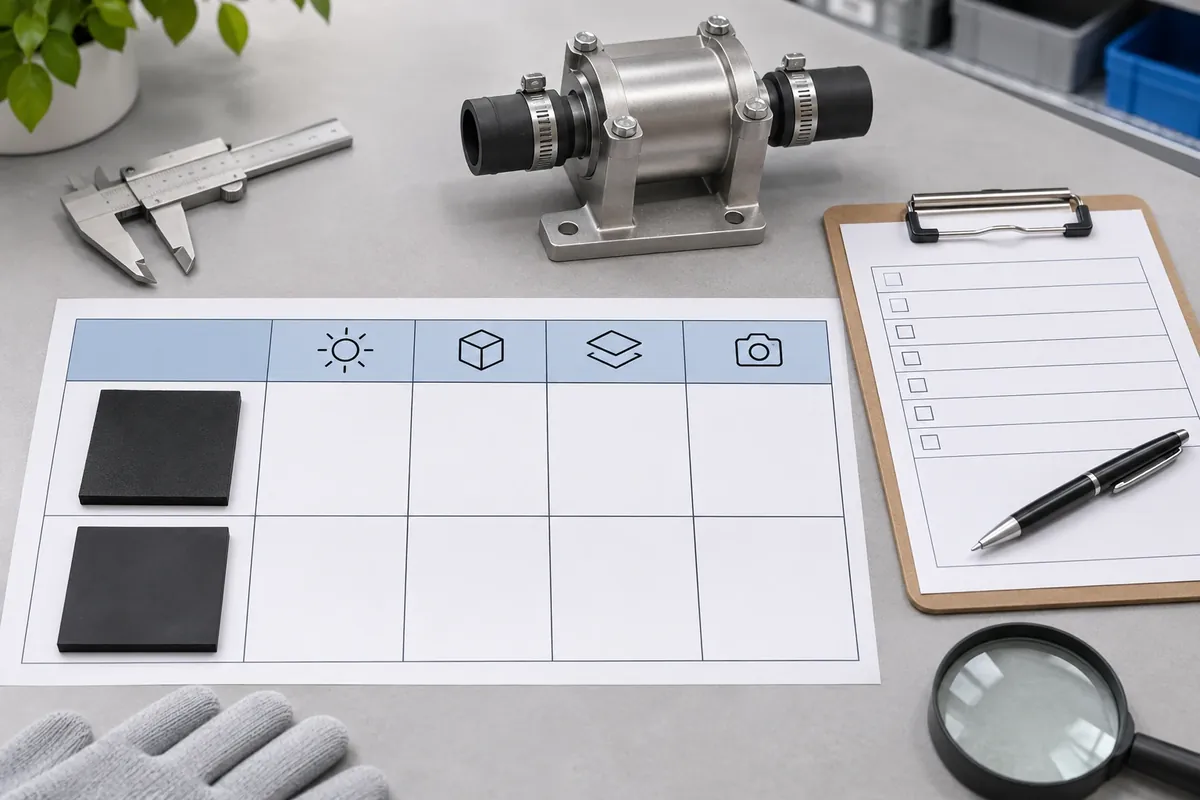
The buyer should approve an identified sample, not an unnamed category of rubber. Record the supplier, compound or grade, part revision, form, color, hardness specification if used, adhesive or bond system, and the date or lot reference. If the sample is hand-finished, cut from a different sheet, or assembled by a non-production process, document that difference and decide whether a production-representative sample is needed.
Inspect the properties that relate to the function. Check the dimensions that control fit, the contact surface, edge quality, flash, seams, bond location and retention. Assemble it using the intended metal parts and fasteners. If the elastomer seals, grips, cushions or compresses, define a representative evaluation that matches the real interface. A simple visual check cannot prove chemical compatibility, long-term compression behavior, adhesion life or a fire classification.
Testing should answer a defined question. For example, a buyer may need to know whether the exact compound changes appearance after exposure to a named cleaner, or whether a pad remains attached after an agreed assembly cycle. State sample preparation, exposure, measurement, duration and acceptance criteria with the responsible technical supplier. Avoid inventing a test duration, force or pass value when the buyer’s product requirements do not provide one.
Changes can enter through a compound reformulation, alternate sub-supplier, color change, adhesive change, mold revision or substitute construction. Require prior notification for changes that may affect function, contact compatibility, appearance, fit or compliance. The supplier should identify which records or samples will be updated. On reorder, compare the current order against the approved material and sample rather than assuming the material family name guarantees the same compound.
If a supplier cannot disclose a proprietary formula, buyers can still request enough controlled identity to manage purchasing: manufacturer or grade code where available, a relevant declaration, the property data used for the decision, batch identity and advance notice of changes. Confidential formula details do not need to appear in a public-facing product specification. The goal is to know which approved product is being purchased and to receive notice if a change could affect use. Agree commercially reasonable records with the responsible supplier before the first order rather than trying to reconstruct them during a complaint.
For a multi-source program, nominate an approved source or establish an equivalence review. Two suppliers can use the same broad polymer family but supply different forms, hardnesses, colors, adhesives or process controls. A second-source approval should compare those differences against the functional brief and a finished-part sample. Record the approved supplier, alternate, part revision and evaluation basis so a later purchasing team does not treat a verbal approval as an unlimited waiver.
What mistakes make an EPDM vs neoprene decision unreliable?
The first mistake is choosing by reputation alone. A buyer may associate one family with weather resistance or another with oil exposure, then treat that shorthand as proof for a finished compound. Use the shorthand only to frame questions. Obtain information for the exact compound and the actual contact conditions before accepting a supplier recommendation.
The second is asking for a chemical-resistance answer without naming the chemical and exposure. Concentration, temperature, contact time and mechanical stress can change the relevance of a data point. If the cleaner or fluid is not known, the supplier cannot confirm compatibility to an undefined requirement. Document the unknown and resolve it before final specification when it affects safety, function or market acceptance.
The third is treating a sample as production approval without recording what it is. An anonymous rubber swatch does not show which compound, hardness, process, adhesive or lot will be used. Label the sample record and connect it to the drawing, purchase order and inspection plan.
The fourth is specifying hardness as a substitute for function. A hardness figure may help define material feel or resist indentation under a test, but it does not alone prove sealing, grip, compression recovery, wear or adhesion. State the functional outcome and ask for fit-for-purpose evidence.
Finally, some buyers overlook packaging and storage. Elastomer parts can be vulnerable to contamination, deformation, adhesive exposure, heat or mix-ups depending on their construction and supplier instructions. Agree packaging and storage conditions with the component maker, label different compounds or revisions clearly, and inspect the goods when received. Do not invent shelf-life limits; obtain them from the exact supplier and product documentation.
How can a China OEM manufacturer support a hardware assembly?
Koitor Hardware is a family-owned factory and specialized OEM manufacturer for bathroom and home-storage metal hardware. In a project that includes purchased EPDM or neoprene parts, the metal factory can review the surrounding assembly drawing, metal contact points, pad or seal location, fastener access, fit and packaging interface within its confirmed scope. It should not be described as a rubber compound producer or as the source of a compatibility certification unless the project verifies those facts.
Share an assembly drawing or physical sample and mark which elastomer part comes from another supplier. Include the part function, intended exposure, approved compound information if already selected, target quantity, sample requirements and the issue the buyer wants to resolve. This helps the metal-product team ask practical interface questions: Is there enough space for the pad? Does the metal edge contact the visible or sealing surface? Can the part be installed without damage? Does the packing method keep it clean and in place?
Small-batch OEM development can be useful when a buyer is evaluating a new private-label product or revising an existing assembly. Early sample review gives the buyer an opportunity to correct fit, placement and packaging before an order is repeated. It does not replace chemical or material evaluation by the elastomer supplier. Keep technical accountability aligned with the supplier that controls the compound and part process.
For broader project context, see Koitor’s OEM home-storage hardware manufacturing information. To discuss an assembly drawing, sample or sourcing requirement, use the صفحة الاتصال بـ «كويتور».
قائمة مراجعة للمشتري والأسئلة الشائعة
Use this checklist before requesting an EPDM or neoprene quotation:
- Identify the component function, geometry and installed location.
- Name the material family or allow a documented supplier proposal.
- State the exact exposure, contact media, temperature and use frequency.
- Define the material form, color, hardness range or functional criteria as needed.
- Share the drawing, revision, tolerance and mating-part details.
- Specify adhesive or bonding responsibility and installation method.
- Request compound-specific documents, sample identity and change controls.
- Agree inspection, acceptance, packaging, identification and storage requirements.
Is EPDM always better for bathroom hardware?
No. A bathroom label does not define the exact moisture, cleaner, temperature, compression or sunlight exposure. A specific EPDM compound may be proposed for a defined use, but the buyer should review product-specific evidence and the installed part requirements. Neoprene or another material could also be considered if its exact compound and evidence meet the defined need.
Is neoprene always better when oils or chemicals are involved?
No. Compatibility depends on the exact substance, compound formulation, concentration, temperature, duration and mechanical conditions. Name the fluid and ask the component supplier for guidance covering that exposure. A broad family-level statement cannot approve an unnamed chemical contact.
Can I use hardness to compare two rubber components?
Only as one data point, with the same hardness scale and comparable test conditions. Hardness alone does not show that two components have equivalent sealing, compression recovery, grip, wear, fit or bonding behavior. Compare the finished part and its required function.
Can a material-family substitution be made without a new sample?
That depends on the buyer’s risk and acceptance plan, but a change in family, compound, form, adhesive or supplier should be reviewed before production. When the change can affect fit, function, appearance or compliance, approve a representative sample and update the controlled specification.
اعمل مع شركة «كويتور» للأدوات
Review Elastomer Interfaces in Your OEM Hardware Project
Share the metal assembly drawing, elastomer part location, sample, target quantity and packaging requirements. Koitor can discuss confirmed hardware development and fit interfaces while the component supplier confirms the compound and exposure evidence.
OEM / العلامة التجارية الخاصة
حوّل دليل التوريد هذا إلى موجز منتج
يرجى إطلاعنا على المنتج المستهدف، والحجم، والتشطيب، وكمية الطلب، ومتطلبات التغليف. وسيتلقى فريقك تقييمًا عمليًّا لإمكانية التصنيع قبل تقديم عرض الأسعار.


 English
 Español
 Português
 Français
 Deutsch
 العربية