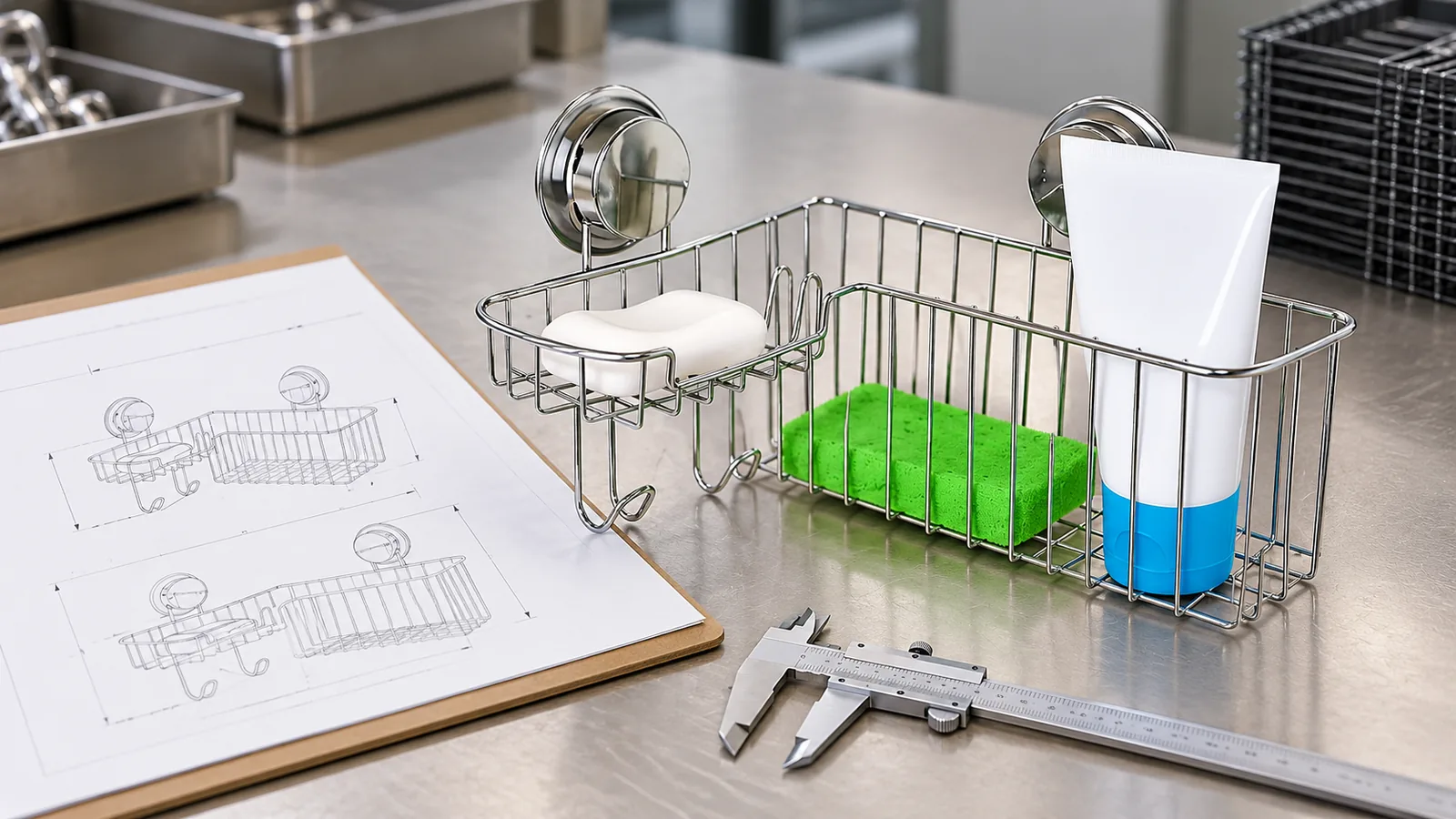
For an importer, a first article inspection for bathroom hardware is a documented check of a production-intent unit before the supplier continues with the bulk run. It should confirm that the approved drawing revision, materials, joining route, finish, assembly and packing definition match the order, with actual evidence for the characteristics that matter. It is not simply a photo of a polished sample, and it does not replace later lot inspection. Agree the scope and release authority before production starts.
What decision does a first article inspection close?
A first article inspection (FAI) answers one narrow question: does the first representative unit made through the intended production route conform closely enough to the released product definition for the buyer to authorize the next production step? For bathroom hardware, the unit might be a shower caddy, towel rack, tissue holder or metal storage basket.
“Production-intent” means the sample is made using the planned material, forming, welding, surface finishing, assembly and packaging approach as far as practical. A hand-finished prototype can help a buyer judge design direction, but it may not reveal whether a repeatable factory route can hold wire spacing, basket width, weld position or finish appearance.
The buyer and supplier should define the release boundary in writing. Depending on the order, release may authorize the remaining quantity, the first production lot, or only a limited pilot run. If approval is pending, the supplier should not assume that silence means release unless the purchase agreement explicitly says so.
FAI scope should be proportional to product risk and order complexity. Ordinary bathroom storage products do not automatically require aerospace or automotive paperwork. IAQG describes AS9102 as a first-article requirement for aviation, space and defense contexts; importers should not treat that sector-specific framework as automatically mandatory for a bathroom basket. See the IAQG 9102 scope and standard overview. The practical principle is to identify the product, revision, relevant characteristics, evidence and approval decision clearly.
How is a first article different from a prototype, master sample or PSI?
These activities occur at different stages and answer different questions. A prototype explores whether a concept is workable; a retained master sample records an approved reference; a first article checks a production-intent unit before continuation; and pre-shipment inspection samples a finished lot before dispatch.
| Activity | Typical timing | Main question | Useful evidence |
|---|---|---|---|
| Prototype or development sample | Design development | Is the concept and general form worth developing? | Sketch, sample comments, fit observations |
| First article inspection | Before bulk continuation or pilot release | Does the production-intent unit match the released definition? | Revision, selected measurements, material/finish identity, deviations and approval |
| Master sample retention | After sample approval | What physical example represents the accepted appearance and assembly? | Labeled sample, revision, date and sign-off |
| Pre-shipment inspection (PSI) | After production, before shipment | Does the completed lot meet the agreed lot-acceptance criteria? | Sampling plan, defect findings, packing and quantity checks |
One sample may serve as both a first article and a retained master if the parties explicitly identify it and record its status. But a saved sample is not automatically proof that every later production unit matches it, and an FAI does not establish that the full lot is acceptable.
For buyers already defining a product from a drawing, the custom bathroom hardware manufacturing service can be discussed alongside sample-development requirements. Keep the FAI checklist focused on release evidence rather than repeating the complete design-approval process.
What should buyers identify before asking for the inspection?
Before the supplier measures anything, the buyer should identify the exact order, part, drawing revision, sample status and inspection scope. Without those anchors, even accurate readings can be attached to the wrong version.
Include these identification details in the purchase order, inspection request or agreed approval sheet:
- – Product name, SKU or project identifier and purchase-order reference.
- – Drawing, specification or approved sample revision, including revision date.
- – Whether the unit is a prototype, production-intent first article, pilot piece or retained master.
- – Planned material and finish description, without assuming unsupported grade or performance claims.
- – Quantity represented by the first article and the production lot it may release.
- – Buyer contact authorized to approve or reject the unit.
- – Required evidence format, submission date and response deadline.
Next, select characteristics that affect fit, function, installation, visual appearance, safe handling, packing or downstream assembly. For a shower caddy these might include basket width and depth, clear opening, spacing between shelves, hanger relationship to the shower fitting, wire-end condition and coating coverage at visible joints. For a towel rack, critical features may include mounting-hole centers, projection from the wall and clearance for the specified towel.
Avoid measuring every feature without purpose. Mark key dimensions or characteristics on a controlled drawing, state the datum or measurement method where ambiguity is possible, and distinguish critical-to-function features from descriptive dimensions. If the buyer needs actual readings, request actual readings—not only a “pass” tick box.
What evidence makes an FAI useful for wire and metal bathroom hardware?
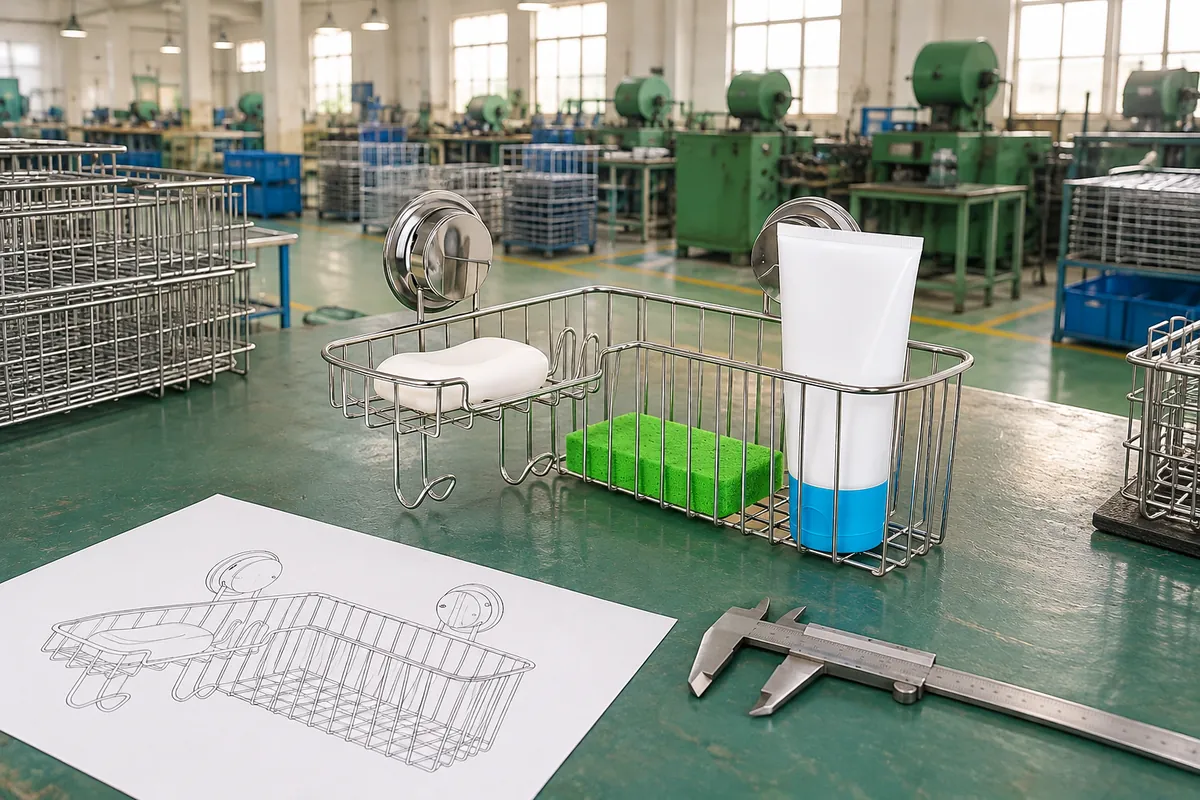
A useful first-article record connects the physical unit to the released definition and shows enough objective evidence to support the release decision. Photographs are useful for identity, layout and finish context, but they do not replace measurement where dimensions or interfaces are critical. A first article inspection for bathroom hardware should state which evidence closes the buyer's specific production-release question.
The evidence pack can be simple and still disciplined:
- 1. Identification: product/SKU, order reference, drawing revision, sample number, date and supplier contact.
- 2. Material and process confirmation: the material and planned forming, joining, finishing and assembly route, stated at the level agreed for the project.
- 3. Selected measurements: the agreed key dimensions with units, instrument or method where useful, actual result and acceptance criterion.
- 4. Assembly and interface review: mounting fit, alignment, shelf spacing, component orientation and any buyer-provided mating part or installation envelope.
- 5. Appearance review: finish color/texture relative to the approved reference, visible weld/grind areas, sharp ends, scratches and coating coverage in defined viewing conditions.
- 6. Packing definition: product protection, included fittings/instructions, inner pack and carton arrangement if packaging is part of release scope.
- 7. Deviation register: any difference from the drawing or specification, its location, proposed disposition and buyer decision.
- 8. Release record: approved, rejected, or approved with specifically bounded deviation; reviewer, date and production quantity covered.
The purpose is not to create paperwork for its own sake. It is to make the decision reproducible if the product is reordered, transferred between teams or challenged after shipment. A photo without revision identity can be ambiguous; a measurement without its acceptance limit can be uninterpretable; and a supplier “pass” without the agreed evidence may not answer the buyer’s actual concern.
How should buyers handle deviations and conditional approvals?
A deviation is any agreed product characteristic that differs from the released drawing, specification or previously approved sample. The supplier should identify it before release, describe the affected scope and wait for an authorized disposition; a verbal “it should be fine” is not a clear concession.
For each deviation, record the characteristic and location, intended quantity or lot, cause if known, product impact considered, proposed correction or use-as-is request, and approval owner. The buyer may reject the unit, request correction and reinspection, accept a bounded concession, or ask for a revised drawing. The chosen disposition should state whether it applies only to the inspected piece, a named lot, or future production.
Conditional approval is easy to misread. If the buyer accepts a slightly different hook orientation on one sample for evaluation, that does not automatically authorize the same change across future orders. Use a clear boundary, for example: “accepted for this identified pilot lot only; revise drawing before repeat production.” Preserve the record with the order and master sample.
If the first article fails, containment and correction should happen before release. A corrected sample may need a focused reinspection of the failed characteristic plus any connected features that could have changed. A cosmetic rework should not be treated as proof that a dimensional or process issue has been resolved.
When should a new first-article review be reopened?
Reopen the review when a change could affect fit, function, appearance, installation, assembly, packaging or repeatability. The buyer and supplier can agree which changes need full FAI and which require only a documented delta check.
Typical triggers include a drawing revision, material substitution, wire or tube size change, revised bend or weld location, new fixture or joining method, finish or color change, supplier/process relocation, altered assembly sequence, changed mounting hardware, or packaging configuration that can damage the product. A change to a non-critical carton label may require a packaging approval rather than repeating all product dimensions; a changed hanger geometry may require checking the entire installation interface.
Set the rule at project launch. For each change, ask: what characteristic could be affected, what evidence would detect the effect, which previous approvals remain valid, and who can release production? This prevents both extremes—repeating every check for an inconsequential edit and overlooking a change that invalidates the approved baseline.
How can Koitor support a proportionate release gate?
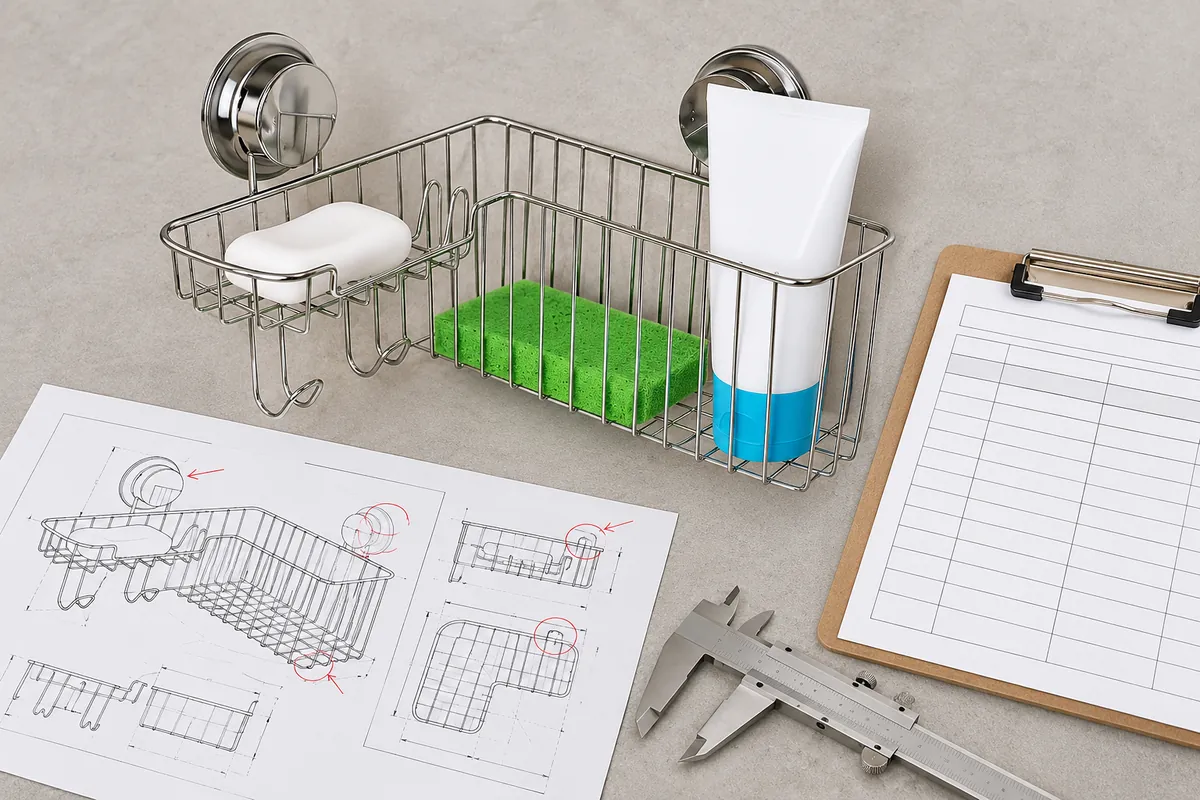
Koitor Hardware is a family-owned custom metal hardware factory serving overseas buyers of bathroom and home storage hardware. For a drawing- or sample-based OEM project, buyers can review the product definition, selected dimensions, joining locations, visible finish areas, assembly and packaging before sample production and agree what evidence is needed before a production release.
That discussion is especially useful for small-batch and trial orders, where the buyer needs meaningful evidence without imposing a paperwork system designed for a different industry. A practical plan can separate development approval, first-article release and later lot checks. Koitor’s manufacturing team can discuss bending, resistance/laser/TIG welding, grinding, polishing, powder coating, assembly and packaging preparation as relevant to the product; suitability remains project-specific and must be confirmed against the buyer’s drawing and sample.
Buyers should provide a controlled drawing or physical reference, intended sales market, acceptance criteria, target order quantity and any packing requirements. MOQ, sample timing and production timing depend on structure, materials, finishing, packaging and capacity at the time of quotation; they should be confirmed for each project rather than assumed from a generic guide.
Buyer checklist before releasing a first production article
Use this checklist to make the review decision explicit. A first article inspection for bathroom hardware becomes more useful when the release quantity and subsequent lot checks are separated in writing. If a line is not relevant to the product, mark it “not applicable” rather than leaving uncertainty.
- – [ ] The part, order, SKU and drawing revision are identified on the unit or record.
- – [ ] The inspected unit represents the planned production material, joining, finishing, assembly and packing route.
- – [ ] Critical dimensions, datums, units and acceptance limits are identified.
- – [ ] Actual readings are recorded for dimensions that require measurement.
- – [ ] Installation interfaces and buyer-provided mating parts or fit envelopes are checked.
- – [ ] Visible finish, weld/grind areas, wire ends and coating coverage are reviewed against the agreed reference.
- – [ ] Deviations are listed with bounded scope and authorized disposition.
- – [ ] Packing components and instructions are checked if included in the release scope.
- – [ ] Approval, rejection or conditional release is dated and names the authorized buyer.
- – [ ] The quantity or lot covered by release is stated; later lot inspection remains separately defined.
- – [ ] Changes that trigger a new FAI or delta review are agreed.
Frequently asked questions
Is a first article inspection the same as a pre-production sample?
Not necessarily. A pre-production sample may be used to approve the design or appearance, while an FAI is specifically tied to a production-intent unit and a defined release decision. The parties can combine them only when the manufacturing route, evidence and approval status are explicit.
Does every bathroom hardware order need a formal FAI document?
No universal formal package is required by this buyer guide. The buyer and supplier should agree a proportionate record based on product risk, complexity, order terms and market needs. A concise checklist may be suitable for a simple reorder; a changed custom structure may justify a broader review.
Can photographs alone approve the first article?
Photographs can document identity, assembly and appearance, but they cannot reliably prove every dimension or hidden interface. If a feature affects installation or fit, request a measurement or physical mating check against an agreed criterion.
What happens when the sample differs slightly from the drawing?
Record the exact deviation and ask an authorized buyer to reject it, request correction or approve a bounded concession. Do not let a verbal exception silently redefine future production. Update the drawing if the design itself is changing.
Does FAI replace pre-shipment inspection?
No. FAI checks a representative production-intent unit before the agreed production release. Pre-shipment inspection evaluates a completed lot against its own sampling, defect and packing criteria.
Plan a Clear First-Article Release for Bathroom Hardware
Send Koitor your drawing revision, physical sample, critical dimensions, finish requirements and intended release quantity. The team can discuss a practical sample and pre-production review scope for your OEM project.
OEM / العلامة التجارية الخاصة
حوّل دليل التوريد هذا إلى موجز منتج
يرجى إطلاعنا على المنتج المستهدف، والحجم، والتشطيب، وكمية الطلب، ومتطلبات التغليف. وسيتلقى فريقك تقييمًا عمليًّا لإمكانية التصنيع قبل تقديم عرض الأسعار.
 English
  Español
  Português
  Français
  Deutsch
  العربية