
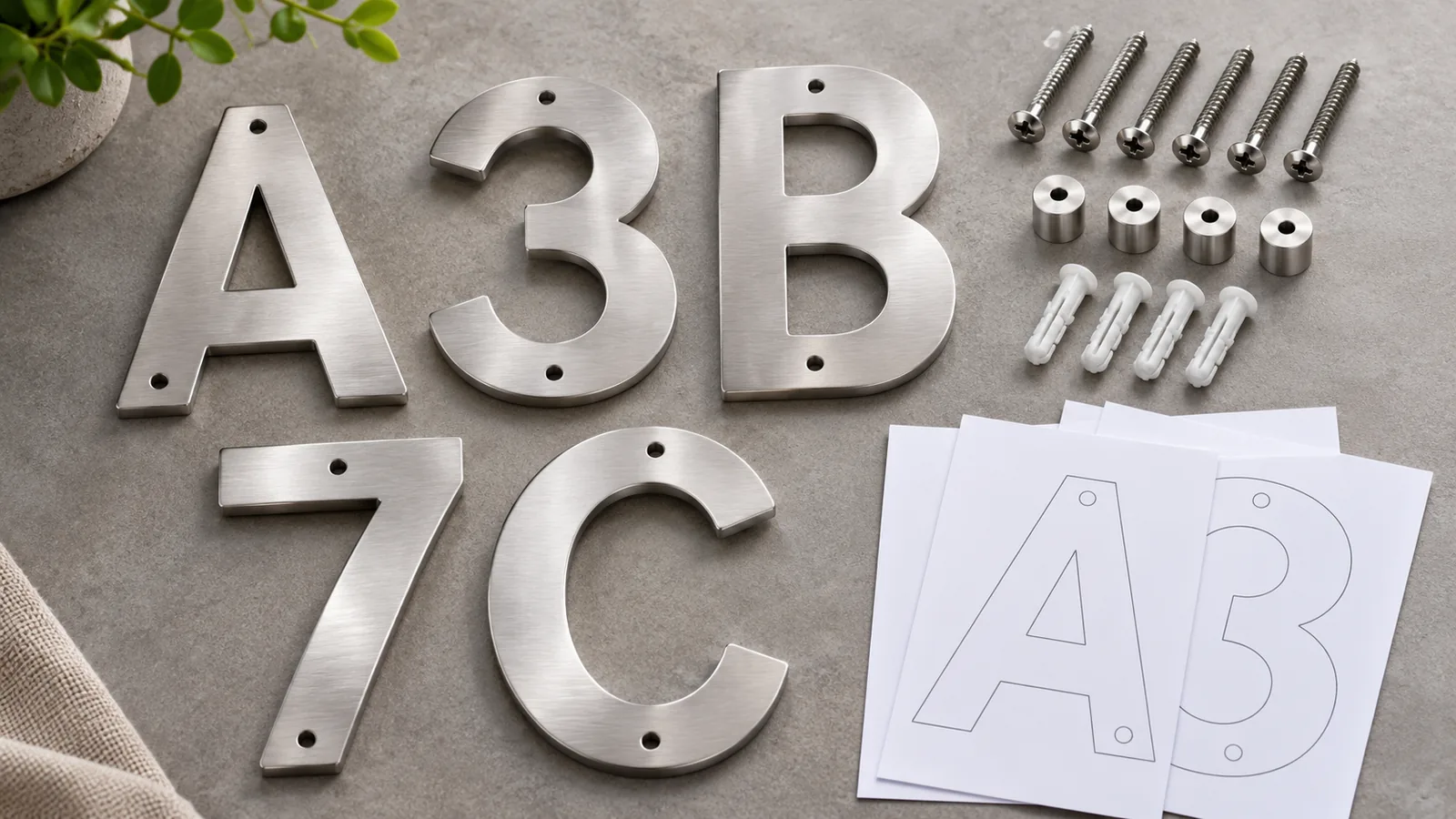
A floating house numbers mounting template must match the exact character, size, mounting kit and instruction revision supplied in the package. Buyers should not assume that a template for one number size fits a larger character, that a letter uses the same hole spacing as a number, or that two brands use the same stand-off hardware. Define each sellable character as a controlled SKU and link its parts and template before approving the sample or retail pack.
What should a floating house numbers mounting template specify?
House numbers and letters can differ by character shape, size, thickness, mounting method and included hardware. Even when two characters share a visual style, their fastener positions can differ. An assortment may also mix flush-mounted and floating designs, or products made in different materials. The buyer should track the character and the kit together rather than using one broad “address number set” label.
Create a variant matrix with character, nominal size, material/finish, mounting style, fastener code, template file, instruction revision and package identifier. Note whether the kit is one character per pack, a multi-character order set or a combination of letters and numbers. The package label, online listing, pick list and instructions should all resolve to the same SKU identity.
The primary manufacturer instructions reviewed for one five-inch house-number family make an important distinction: the actual-size printed template uses hole-center marks, and those marks may differ from the outline of the hand-polished character. That is a model-specific instruction. It shows why a template must be paired with the exact product revision, not that every character uses that layout. See the manufacturer’s five-inch house-number instruction PDF.
Do not reproduce a competitor’s distinctive typeface, character shape or template artwork in a private-label product. Buyers should use their own approved design files and confirm intellectual-property permissions where needed. The information here concerns SKU and document control, not legal advice about brand or design rights.
How do mounting systems differ between products?
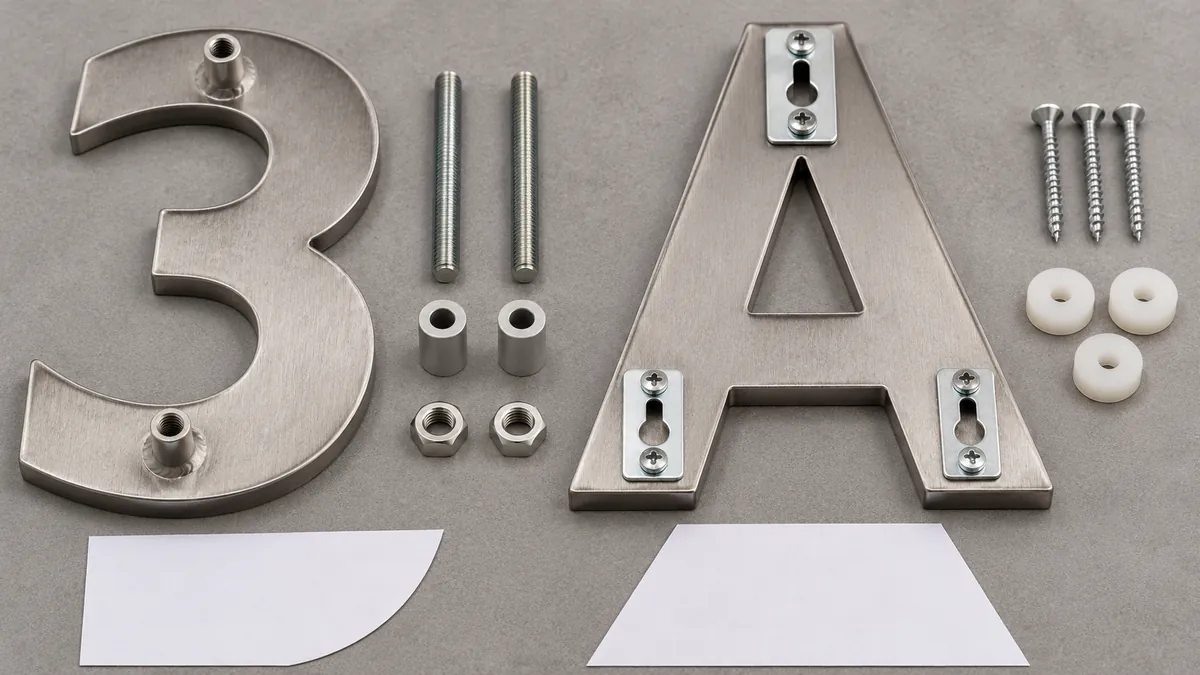
“Floating” commonly describes a visible offset from the wall, but it does not specify the hardware architecture. One product may use rods and spacers; another may use projecting fasteners or a different hidden attachment. The position of the mounting points, the depth of the stand-off and the supplied parts are product-specific. Do not combine instructions or hardware from two systems because both are described as floating.
The reviewed product examples make this distinction clear. Architectural Mailboxes lists a named four-inch house letter with a particular material and its own included hardware and template. Its five-inch number instruction sheet is separate evidence for a different product family. A House Numbers Australia FAQ describes rods and separate spacers for its floating arrangement, which differs from the partly projecting fastener description in the first maker’s sheet. Those sources should not be merged into a universal mounting method. See the four-inch house letter product page و House Numbers Australia floating-mount guidance.
For procurement, capture an exploded view or mounting section that shows the character, hardware, spacer or stand-off, template relationship and package contents. If the supplier proposes a design alternative, require a new drawing and instructions tied to that design. A visual resemblance to another system is not proof of interchangeability.
What must a buyer check on the printed template?
Check the exact template file, product size and print scale before the template is placed in a retail pack. The instructions may require printing at actual size and may mark hole centers separately from the visible outline. A PDF viewer can scale a page to fit, so the buyer should confirm the documented print setting and, where the manufacturer provides a reference dimension, verify that dimension after printing. Do not make a new drilling recommendation from an unverified template.
Use a controlled document checklist:
- Confirm the character family and nominal size stated on the template.
- Match the template revision to the product drawing and mounting kit.
- Identify which marks show hole centers and which lines show a character outline.
- Check any stated actual-size printing requirement in the source instructions.
- Confirm the printed scale using the manufacturer’s own reference where supplied.
- Ensure the file remains legible after printing in the intended pack format.
- Verify that the correct language and regional insert are paired with the SKU.
- Record who approved the artwork and when it entered the production pack.
Do not assume that the character’s outside silhouette is the correct drilling reference. A cast, machined, polished or otherwise finished character can have edges that vary from an ideal outline, while the mounting interface is controlled by the designated hardware positions. The supplier’s approved drawing and the product-specific instructions govern the template relationship.
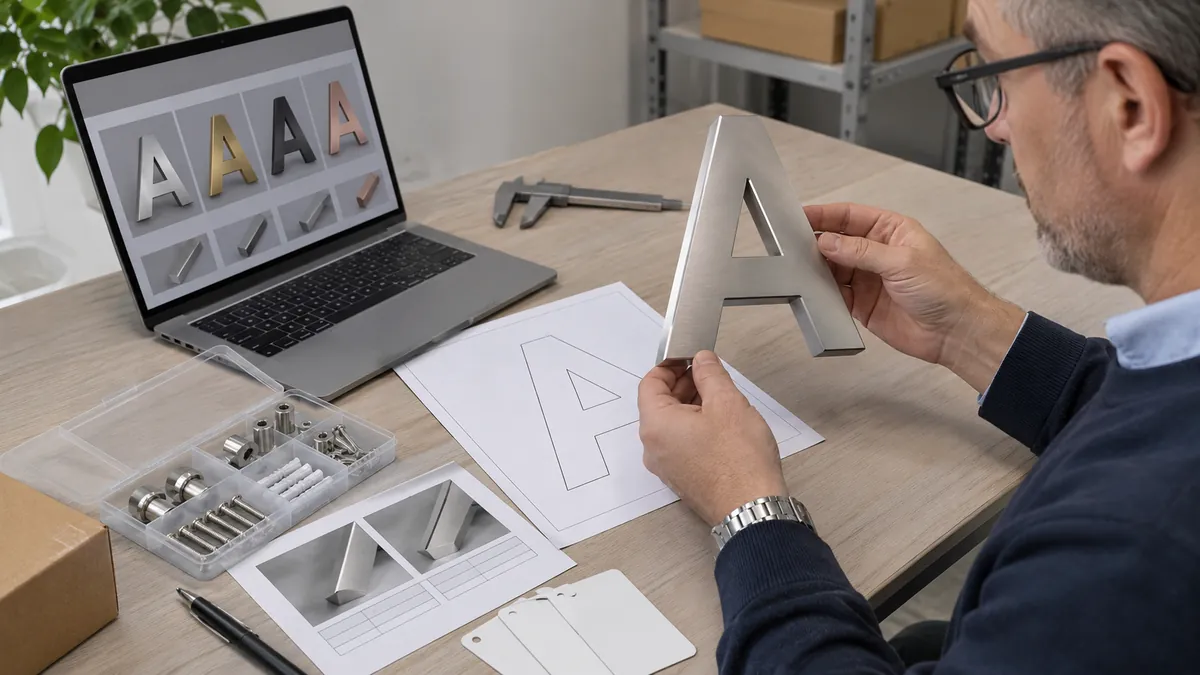
The buyer should also distinguish a production template from a display mockup. A product photograph may show a character against a wall but provide no exact scale or installation reference. Do not trace a photo into an instruction sheet and treat it as a validated template.
How should the SKU matrix prevent kit and character mix-ups?
Build the assortment record at the lowest level that changes the shipped parts or instructions. A separate character, size, finish or mounting kit should have a distinct identity if it changes the package contents or template. Where several characters share a mounting kit, document that commonality and verify it with the product drawings before grouping them.
| Matrix field | Example of the data type | Control purpose |
|---|---|---|
| Character | Number or letter identity | Distinguishes the actual sellable component |
| Family and size | Named series and nominal size | Prevents templates crossing product families |
| Mounting architecture | Flush, floating or other defined arrangement | Keeps claims and instructions aligned |
| Hardware kit | Part list and revision | Confirms what is packed with the character |
| Template file | Filename, revision and print scale note | Prevents obsolete or mismatched documents |
| النهاية | Buyer-approved appearance reference | Keeps visually similar variants controlled |
| Pack label | SKU, character and kit identity | Supports picking and customer identification |
| Approved sample | Physical sample or controlled images | Links a visual reference to the correct record |
For a set with multiple letters or numbers, specify whether each unit is sold separately or as a kit. If a buyer wants a mixed assortment for a project, define the sequence and the corresponding number of each character. Never assume that a pack of mounting parts contains enough pieces for a full address unless the bill of materials states that clearly.
If template revisions change, determine whether existing package inventory must be replaced, relabeled or consumed under a controlled plan. This is a buyer-supplier change-control decision, not something the article can decide universally. Track the effective SKU and revision so that customer service can identify what documentation accompanied each shipment.
What should sample approval cover beyond appearance?
Review the character, mounting kit, template, instruction sheet and pack as a single product experience. A character can look acceptable while the wrong screws or template are included. Conversely, a correct kit can be packed with instructions from an adjacent size. The buyer should make a complete sample and verify every component against the SKU matrix.
The approval should record the product family, character, nominal size, material/finish reference, mounting architecture, hardware contents, template revision, print scale note, instruction version and retail pack. If the buyer has a target wall or substrate requirement, route that to the responsible designer or installer. This article does not provide drilling methods, anchor selection, spacing rules or installation advice; those depend on the exact product and project.
Keep safety and property claims narrow. Do not imply that a template proves a safe installation, that one mounting kit fits every substrate, or that the character will remain attached under unspecified conditions. If the manufacturer makes a product-specific claim, confirm the documentation and scope for the exact SKU before repeating it in packaging or marketing.
How should importers prepare an RFQ for a character range?
Send design files or a reference sample, the character and size matrix, finish references, required mounting architecture, template and instruction expectations, package design and planned order quantities. Include which components can be shared and which are character-specific. Ask the supplier to identify the materials and processes assumed in the quotation and whether each requested variant is within confirmed capability.
Koitor is a family-owned custom metal hardware factory focused on bathroom and home storage hardware. Current company materials do not confirm a house-number or address-letter product range. This is an adjacent-category sourcing guide, not a promise that Koitor manufactures address characters or installation kits. A buyer may send a design to confirm scope via the contact page; the OEM home storage hardware page describes general positioning rather than confirming this specific product.
The manufacturer’s sample and engineering review should not be treated as a substitute for the buyer’s artwork approval or project installation review. Keep the approval responsibilities clear. The factory can quote and produce against confirmed drawings and component lists within its scope; the importer owns the final assortment definition, SKU presentation and market-specific documentation decisions.
The buyer should also plan for order picking and after-sales identification. A customer may contact the retailer with a character code, a photo of an instruction sheet or a missing-spacer question. If the pack uses a generic label with no character or mounting-kit reference, customer support may be unable to identify the correct replacement. Put the SKU or another controlled product identifier on the package and keep the same identifier in the instruction file and purchase records. Where multiple colors or sizes share a carton style, ensure the variant mark remains visible to warehouse staff.
For a launch assortment, pilot the full pack across several characters rather than inspecting only the easiest one. Include a letter with unusual geometry if its hardware or template may differ. Confirm that every package contains the correct quantity of fasteners and that the template is not folded or obscured in a way that affects use. These checks are pack-accuracy reviews, not installation instructions. They help the importer detect document and picking errors before the assortment expands.
Buyer checklist before releasing an address-character order
- Create a SKU for each character, size, finish or kit variation that changes the pack.
- Pair the exact mounting kit with its character and product drawing.
- Keep flush and floating architectures distinct.
- Match the template revision and print instructions to the named product family.
- Distinguish hole-center marks from character outlines where the source does so.
- Verify package inserts, language, hardware count and SKU label together.
- Keep proprietary character artwork and templates under approved rights and control.
- Route substrate and installation questions to the responsible project professional.
- Approve the complete pack, not only the visible metal character.
- Record the exact sample and document revisions used for future orders.
Keep the floating house numbers mounting template paired with the exact character family, kit and revision in every SKU record.
الأسئلة الشائعة
Can one mounting template work for every house number and letter?
Do not assume so. Character shape, size and mounting points can differ. Use a template that the manufacturer has tied to the exact product family and revision.
Does the character outline always show where the holes belong?
No. One reviewed maker instruction distinguishes hole-center marks from the outside character outline. Follow the exact instructions supplied for the product rather than tracing its silhouette.
Are floating number mounting kits interchangeable?
Not by description alone. Rods, spacers, projecting fasteners and other systems differ. Confirm the hardware and template against the named character SKU.
What should be included in a retail pack approval?
Review the character, fasteners, spacers or other kit pieces, template, instructions, labels and packaging against one SKU record. A single-item visual sample is not enough to verify all contents.
Does a printed template provide installation approval?
No. It is a product-specific reference document. Installation requirements and substrate decisions must be handled by the responsible party for the exact product and project.
اعمل مع شركة «كويتور» للأدوات
Discuss a Custom Metal Hardware Range
Share the product drawing, SKU matrix, finish reference and planned pack contents. Koitor can confirm whether the concept fits its current bathroom and home storage hardware scope.
OEM / العلامة التجارية الخاصة
حوّل دليل التوريد هذا إلى موجز منتج
يرجى إطلاعنا على المنتج المستهدف، والحجم، والتشطيب، وكمية الطلب، ومتطلبات التغليف. وسيتلقى فريقك تقييمًا عمليًّا لإمكانية التصنيع قبل تقديم عرض الأسعار.


 English
 Español
 Português
 Français
 Deutsch
 العربية