

For framed vs frameless cabinets, identify the added face frame at the box opening before selecting an organizer or fitting. ## What Does “Framed” Describe on a Cabinet?
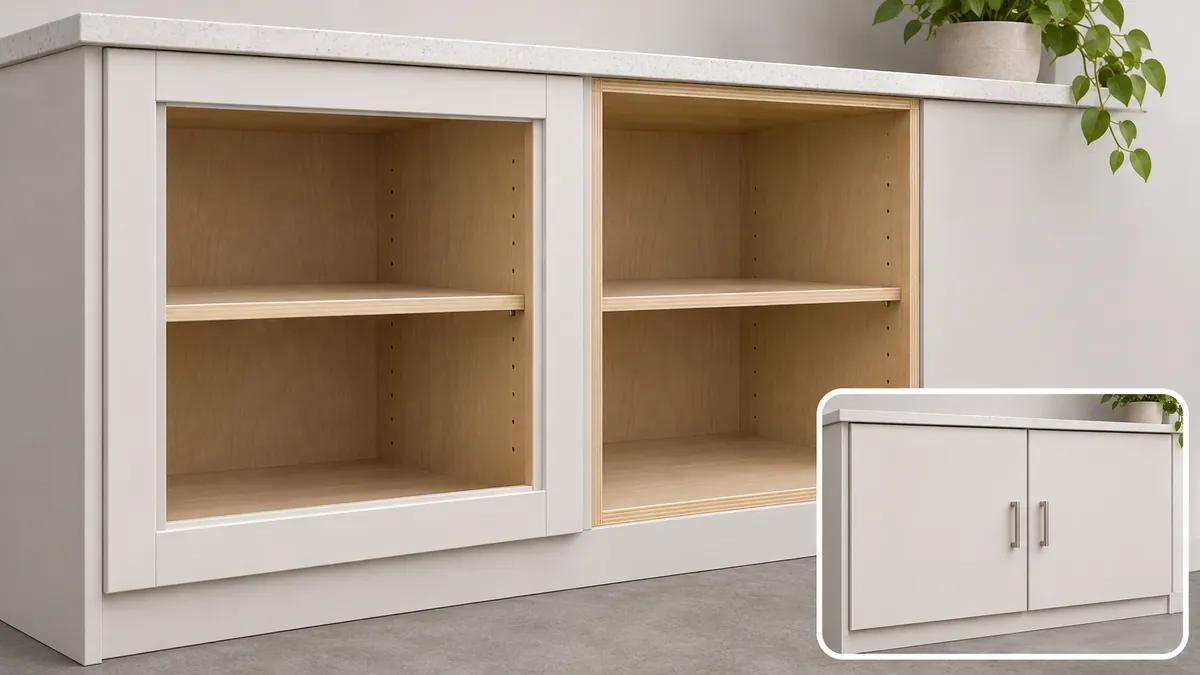
A framed cabinet has an additional structural frame attached to the front of the cabinet box. In a typical face-frame layout, horizontal members are called rails and vertical members are called stiles. The frame surrounds or divides the box opening, creating a front surface beyond the box sides. The exact layout varies by cabinet maker and product. For a buyer, the useful identifying feature is not a style name or a decorative door; it is the additional front frame at the opening.
That added frame changes the surfaces around the opening. A hinge, slide, shelf support or pull-out organizer may refer to the frame, the box side, or both. A fitting designed around one mounting surface cannot be assumed to suit the other just because the cabinet opening looks close in size. The attachment point, fastener position, clearance behind the opening and accessible installation path all depend on the specific cabinet and hardware system.
Do not infer a universal rail or stile width from the word “framed.” Cabinet makers use their own drawings and construction dimensions. If a buyer needs to place a metal basket, slide, insert or bracket, request the cabinet maker’s drawing or a sample measurement rather than applying a generic dimension found in a comparison article. The construction label helps identify what to ask about; it is not a substitute for the dimensions that control the actual interface.
In the sourcing conversation, separate three objects: the cabinet box, the face frame attached at its front, and the door mounted in front of the opening. They are related but not interchangeable terms. A door may cover part or all of a frame, and hardware may attach to a surface that is not visible when the door is closed. The buyer’s first task is to identify the receiving structure before specifying the metal component that must fit it.
Framed Vs Frameless Cabinets: What Does “Frameless” Mean?
A frameless cabinet omits the added face frame at the front of the box. The front edges of the cabinet sides and other box panels define the opening. “Frameless” therefore describes the front construction; it does not mean that the cabinet has no box, sides, top, bottom, back or internal structure.
With no added face frame, the box sides themselves are the most visible front edges when the doors are open. That can make the opening appear broader than a framed opening with the same outside cabinet width, but the actual usable width still depends on panel thickness, hardware, slides, hinges, door position and the interior layout. A label alone does not establish an exact clear opening or guarantee additional storage space. Buyers should compare the relevant drawing dimensions rather than assuming a fixed clearance advantage.
Frameless construction can also present a different mounting surface for a hinge, shelf support or organizer. A component may attach directly to a side panel, use a plate, use an adapter, or follow a manufacturer-specific arrangement. Do not assume every frameless box has the same side thickness, reinforcement, fastener allowance or accessory compatibility. Those are product-specific facts to confirm with the cabinet maker or hardware supplier.
For a metal storage component, the practical question is: which cabinet surface receives the component, and what dimensional reference controls its position? A supplier may need the box side, opening, door and adjacent obstruction dimensions. A buyer should identify whether the requested hardware is intended to connect to the box, the face frame, a separate rail or another support. This avoids quoting one assumed interface while the sample or drawing describes another.
Why Can Closed Doors Make the Two Constructions Look Similar?
The closed-door view does not always reveal the cabinet box construction. A full-overlay door can cover much of the front of a framed cabinet. From the front, that door may create a broad, nearly continuous surface that resembles the appearance of a frameless cabinet. The visual resemblance does not remove the frame behind the door.
The distinction becomes clearer when the door is open. A buyer can inspect whether a separate rail and stile frame sits around the front of the box or whether the cabinet box edges form the opening. A photo taken from an oblique angle may help, but a close-up of the open front or a drawing is more reliable for identifying the construction. If a supplier provides only a closed-front photo, ask for the receiving area with the door open before making a hardware decision.
The door’s overlay is another separate attribute. Overlay describes how the door relates to the cabinet opening or frame. It should not be used as a synonym for framed or frameless. A framed cabinet can use a door that covers a large portion of the frame; a flat or flush-looking front is not enough to classify the box. The cabinet’s structural opening and the door’s position should be recorded as separate fields on a product brief.
| What the buyer sees | What it can tell you | What it cannot establish by itself |
|---|---|---|
| Closed, nearly continuous door fronts | The door style and apparent front coverage | Whether a face frame is behind the door |
| Open front with rails and stiles around the box | The presence of an added face frame | Exact frame dimensions, fastener limits or accessory fit |
| Open front with box edges defining the opening | A frameless front construction | Exact interior width or supported load |
| A hinge or slide visible in a photo | A particular installed hardware example | Compatibility with another cabinet or hardware model |
The article’s central comparison is therefore a front-frame map, not a ranking. If two closed fronts look alike, open them and inspect the box opening. The frame is a structural feature at the front; the door is a movable cover. Keeping these separate lets a buyer explain why two products with similar appearance may need different brackets, slides or organizer interfaces.
Which Dimensions Matter Before You Specify Cabinet Hardware?
The construction type narrows the interface question, but a buyer still needs actual dimensions from the receiving cabinet. A useful drawing or measurement sheet distinguishes outside cabinet width from the opening, inside box width, frame dimensions and door position. It should identify which values are measured from finished surfaces and which are nominal design values.
For an organizer or drawer component, request the dimensions that its mounting system actually uses. This may include inside width between box sides, the front opening width, side panel thickness, frame projection, clear depth, obstruction locations, door swing envelope and the intended mounting surface. The exact list depends on the product. Do not convert one published drawer-width chart into a universal fit rule for all cabinet constructions.
Record how each measurement was taken. For example, “opening width” may mean the distance between the clear edges of the frame, while “box inside width” may mean the distance between inner side panels behind the face frame. A drawing that uses the same informal label for both can cause suppliers to quote incompatible parts. A buyer can avoid ambiguity by labeling a simple front view and side view with arrows that point to the actual reference surfaces.
Check whether the door, hinge, pull, plumbing, neighboring drawer or internal shelf enters the component’s travel path. A metal basket may fit between the box sides but still strike the frame, door hinge or pipe when pulled out. These checks should be based on the intended installed state, including the door and any fixed obstacles. If the cabinet is not yet built, request the current cabinet drawing and confirm revision status before finalizing the metal component.
| Drawing item | Define it explicitly | Why it matters to a hardware quote |
|---|---|---|
| Box inside width | Distance between the inner box sides at the mounting area | Helps determine the available component envelope |
| Front opening | Clear opening at the front, including any frame restriction | Helps check entry, removal and front clearance |
| Face frame | Presence, location and relevant dimensions of rails and stiles | Identifies a possible mounting or clearance surface |
| Side panel | Thickness and available fastening area, when known | Affects the specified attachment interface |
| Door and hinge | Open and closed positions or a verified envelope | Helps identify possible collisions |
| Internal obstructions | Shelves, pipes, brackets or other fixed items | Prevents a fit check from ignoring the installed interior |
| Revision and units | Drawing revision, units and measurement basis | Reduces errors when a buyer and supplier use different documents |
For cabinet basket widths and rail clearances, see the existing pull-out wire basket cabinet rail width guide. That page handles the dimensional interface; this comparison explains why a buyer first needs to identify the cabinet’s front construction. Do not use the two topics interchangeably.
How Does Construction Affect Organizer and Slide Selection?
Framed and frameless cabinets can require different hardware interfaces because the accessible mounting surfaces are different. The correct hardware depends on its actual design and the cabinet maker’s documented dimensions. Neither construction label guarantees that a specific slide, hinge, basket or bracket fits, and neither label alone establishes which option is better.
A buyer evaluating a pull-out organizer should identify whether its rails or brackets attach to the cabinet sides, frame, floor, rear panel or a separate mounting system. Then confirm the dimensions at those exact attachment points. If the product uses a side-mounted slide, the question may be whether the slide has a compatible bracket or fastening arrangement for the receiving cabinet. If it uses a frame-mounted support, the frame’s location and available screw area matter. The article does not prescribe a universal adapter; the specific hardware drawing should name the actual parts included.
For a supplier comparison, ask each supplier to state the cabinet assumptions behind the quote. A quote that says “fits framed and frameless cabinets” should be supported by a list of compatible cabinet dimensions, a defined interface, or separate configurations. Ask whether the quoted component includes the mounting parts shown in the drawing. A verbal compatibility statement cannot replace a drawing or sample fit check.
This also affects sample approval. A sample tested in a frameless cabinet box does not automatically validate a framed cabinet installation. When a project targets both cabinet types, the buyer may need to check each receiving condition or document the exact adapter and clearance that makes them compatible. Preserve the cabinet sample or interface drawing used for approval so later production checks use the same references.
If you are still comparing the slide system itself, use the existing drawer slide installation guide for the separate question of slide architecture and installation. The cabinet construction comparison should stay focused on recognizing the receiving front and documenting the right interface.
Do Door Style and Overlay Tell You Whether a Cabinet Is Framed?
No. Door style and overlay describe the door, while framed versus frameless describes the cabinet box opening. They affect one another during design, but one term cannot substitute for the other. A flat-looking front can still cover a face frame, and a door that covers a large part of the opening does not prove that the box has no frame.
For a specification, record at least two separate questions: “Does the cabinet have an added face frame?” and “How does the door overlap or sit relative to the opening?” If a hinge or storage component depends on a third detail, record that interface too. This makes the product brief more precise than selecting one broad style label.
When evaluating a concealed hinge, the terms inset and overlay refer to the door-to-opening relationship and the hinge configuration. They do not answer whether a face frame is present. See the separate concealed hinge overlay versus inset guide for that terminology. A buyer should not infer hardware compatibility from a cabinet’s appearance alone; confirm the hinge or organizer model and the cabinet surfaces shown in the relevant drawing.
This distinction is especially useful when a retailer’s product page has a styled photo but no construction diagram. Ask for the opened cabinet view, an edge detail or the manufacturer’s specification sheet. If the page uses “frameless” as a marketing or design phrase without showing the box opening, treat it as a claim to verify rather than a complete hardware specification.
What Common Buying Errors Follow from Confusing the Terms?
One common error is to classify the cabinet from a closed door photo. This misses the face frame that may be concealed behind the door. The correction is simple: request an open-front view or drawing that shows the box and front frame.
A second error is to treat overlay as construction. Overlay describes door coverage; it does not determine whether a frame is present. Document door overlay and cabinet construction independently.
A third error is to assume that frameless means a universally wider opening or more usable storage. Cabinet box dimensions, panel thickness, hardware and interior layout still control the available space. Compare the actual clear opening and the required movement envelope.
A fourth error is to send suppliers a single outside width while omitting the mounting surface. Two cabinets with the same outside width may have different internal openings and interface references. Share a dimensioned drawing, identify the face frame and label the exact points where the metal component attaches.
A fifth error is to approve a sample on one construction and apply that approval to another without checking the interface. Sample approval applies to the represented configuration, revision and parts. If the target project includes more than one cabinet type, list each one and confirm which configurations the sample covers.
Finally, do not read quality, cost or strength into the words framed and frameless. The architecture label does not establish cabinet material, joint quality, fastener capacity, finish durability or maker capability. Those require separate evidence and a project-specific review. A neutral comparison helps keep the purchasing decision focused on fit rather than unsupported broad rankings.
How Can a Buyer Compare Supplier Drawings Efficiently?
Use a common interface sheet for each supplier response. It does not need to be a complicated engineering document. It should show a front view of the open cabinet, a side view of the component’s installed envelope, the reference surfaces, the relevant clearances and the drawing revision. If the supplier proposes a frame adapter or side bracket, identify it by part name or drawing callout and show whether it is included.
Ask suppliers to complete the same fields. Record cabinet type, box inside width, front opening, frame presence, side panel thickness when known, installation point, door swing, obstructions, and the product model or configuration being quoted. If an item is unknown, mark it unknown instead of filling the gap with an assumed standard value. That makes quotation differences visible and gives the cabinet maker a concrete question to answer.
Compare the stated assumptions before comparing prices. One supplier may have priced a box-side attachment, while another has allowed for a face-frame bracket. Their totals may look different because they are not quoting the same configuration. Clarify the included rails, clips, screws, brackets and other supplied parts, as well as the information still needed for a fit check.
For a sample, document the receiving cabinet or test fixture used, the component revision and any adjustment made during installation. Note whether the door opens and closes through its intended movement and whether the organizer travels without contacting the frame, hinge or fixed obstruction. Such a fit review does not establish load capacity or long-term performance; those require separate, appropriately defined evaluation. Keep the record narrow: it confirms the observed interface for the specific sample and setup.
What Should the RFQ and Sample Record Include?
An RFQ should let a supplier understand what is being sourced and what cabinet interface is expected. Include the product drawing or a dimensioned sketch, cabinet construction, interface surfaces, material and finish requirements if already defined, annual or trial quantity only when known, packaging needs and target market. Do not substitute “frameless” for all the dimensions needed to quote a metal basket or organizer.
For a custom metal component, a drawing or physical sample can help a family-owned factory review manufacturability, assembly sequence, finish access and packaging discussion. Koitor Hardware is a family-owned custom metal hardware factory focused on bathroom and home storage hardware and supports OEM and custom manufacturing. The company can review the information a buyer supplies for a relevant metal storage part; that does not mean Koitor manufactures the wood cabinet itself or supplies every type of cabinet hinge.
Before sample approval, keep the evidence connected to the actual interface: the cabinet opening or fixture, front frame if present, component mounting points, door path and agreed drawing revision. If the design changes, identify whether the change affects the opening, component width, bracket position, fastener location or door clearance. Do not treat an updated title or a new product photo as proof that the dimensions remain unchanged.
| RFQ or sample record | Include | Leave open when not verified |
|---|---|---|
| Cabinet identification | Framed or frameless, based on an open view or drawing | Do not infer from a closed-front image |
| Interface | The exact box, frame or separate support surface | Do not assume a mounting part is included |
| الأبعاد | Labeled opening, inside width, depth and obstruction references | Do not substitute nominal cabinet width for clear dimensions |
| Door relationship | Door position, hinge envelope and movement path | Do not equate overlay with box construction |
| Component configuration | Drawing, revision, sample or model identifier | Do not mix sample revisions in one approval |
| Commercial scope | Quantity, finish, package and target market where known | Do not present unknown requirements as fixed |
Buyer Checklist Before Requesting a Quotation
- Confirm whether the open cabinet has a separate face frame or whether the box edges define the opening.
- Photograph the open front and the mounting area; include a closed view only as additional context.
- Label box inside width, front opening, relevant depth and the exact points used for measurement.
- Identify whether the metal component attaches to the box side, face frame, floor, rear panel or another support.
- Record door overlay or inset separately from framed or frameless construction.
- Show the hinge, plumbing, shelf or other obstacle that could affect movement.
- Provide the cabinet drawing revision, units and measurement basis.
- Identify the organizer or hardware drawing, model, sample and required configuration.
- Ask suppliers to state included mounting parts and unresolved cabinet assumptions.
- Approve samples against the actual target interface and record any adjustment or exception.
This checklist is for clarifying the receiving structure; it is not a universal cabinet installation instruction. Cabinet makers define their own construction and hardware constraints. The product supplier should confirm the proposed metal component against the actual drawing or sample before the buyer treats fit as established.

The cabinet construction definitions above are bounded to supplier guides from Cabinet Doors’N’More و Holland’s Custom Cabinets. They support the added front-frame distinction, not universal cost or quality rankings.
الأسئلة الشائعة
Is a frameless cabinet the same as a cabinet with no frame at all?
No. In this comparison, frameless means the cabinet omits the additional face frame at the front of its box. The cabinet still has a box or carcass made from its panels. The distinction is about the front opening, not the absence of all structural components.
Can a framed cabinet look like a frameless cabinet when the doors are closed?
Yes. A full-overlay door can cover much of a face frame, making the closed fronts look similar. Open the door or obtain a drawing of the box opening before specifying an organizer or mounting interface.
Does frameless construction always provide more usable storage?
No universal storage gain follows from the label alone. The inside dimensions, side thickness, hardware, door position, organizer envelope and obstructions determine the usable space. Compare measured dimensions for the specific cabinet.
Does framed or frameless tell me which hinge or slide to buy?
It tells you what construction question to investigate, not which product is compatible. Confirm the attachment surface, cabinet dimensions, supplied brackets or adapters, and the hardware maker’s fit information for the exact model.
Is overlay another word for framed or frameless?
No. Overlay describes how a door relates to the opening or frame. Cabinet construction describes whether the added face frame exists. Record both attributes separately when a hinge or organizer depends on them.
What if the supplier only gives a front-view product photo?
Request an open-front photograph, a cabinet section or the maker’s drawing. A front view of a closed door does not reliably show whether a face frame is behind it or which surface will receive the hardware.
Should I send a cabinet sample with my organizer RFQ?
If the fit is uncertain and a physical sample is available, it can clarify the real interface. Label the sample, drawing revision and dimensions. The sample check applies to that represented configuration and does not replace any separate performance or load evaluation required for the project.
اعمل مع شركة «كويتور» للأدوات
If you are developing a metal cabinet organizer or home storage component, send the actual cabinet interface drawing or sample together with the required dimensions, finish and quantity. Koitor Hardware can review the metal component’s manufacturing scope and discuss sample development, customization and small-batch OEM options. The cabinet construction itself remains with its cabinet maker, so include that maker’s interface details when fit matters.
How does framed vs frameless cabinets fit the exact product and buyer decision?
Use the model-specific drawing and evidence described above; this guide does not create a universal specification.
Review a Cabinet Organizer Interface
Share the relevant product drawing or sample, intended use, material or finish requirements, and target quantity. Koitor can review the manufacturing scope for custom bathroom and home-storage hardware based on the information provided.
OEM / العلامة التجارية الخاصة
حوّل دليل التوريد هذا إلى موجز منتج
يرجى إطلاعنا على المنتج المستهدف، والحجم، والتشطيب، وكمية الطلب، ومتطلبات التغليف. وسيتلقى فريقك تقييمًا عمليًّا لإمكانية التصنيع قبل تقديم عرض الأسعار.
 English
 Español
 Português
 Français
 Deutsch
 العربية