
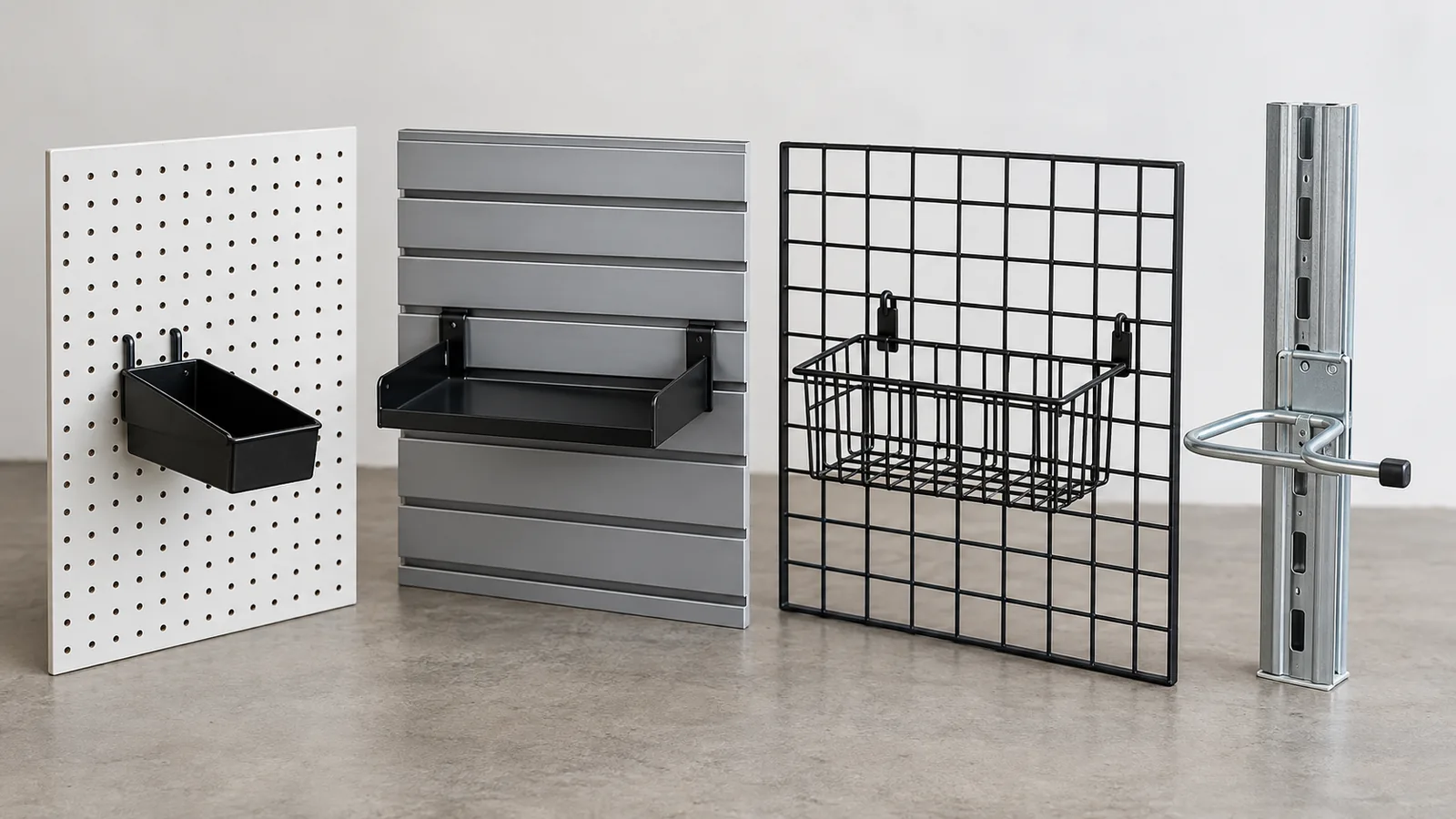
For a B2B importer, garage storage system compatibility should be managed as a named system-and-accessory matrix, not a universal-fit slogan. Pegboard, slatwall, gridwall and track or rail products use different engagement geometries, and even two products with a similar nominal spacing may differ in opening shape, panel thickness, stand-off, retention feature or revision. Before claiming cross-brand fit, identify the exact panel references, test the accessory on them and record the exclusions. This guide treats garage wall storage as a defined buyer decision and ties the review to the specific product, configuration and evidence available.
Why should importers treat each wall system as a separate interface?
Garage organization is sold as a product ecosystem: panels or rails, hooks, baskets, bins, brackets, shelves and specialty holders. A range manager may want to offer accessories across several system families, but the family name alone does not fully define the mating geometry. An accessory can appear to hang in a slot and still sit at the wrong angle, have insufficient engagement or move differently from the intended system. Fit, retention and load are distinct questions.
Buyer discussions show uncertainty about whether accessories from two named slatwall systems interoperate and whether a hook can be found for an inherited panel with an unknown brand. Those are examples of compatibility questions, not proof of widespread incompatibility or a product-failure rate. See the slatwall accessory discussion and the unknown-panel identification discussion.
First-party manufacturer documentation illustrates why buyers should be specific. Proslat states that its slatwall panels are designed for Proslat accessories and that its named panel categories are not made to interlock with one another. Wall Control describes compatibility between specified traditional pegboard-style hooks and its own panel design, while distinguishing its own slotted accessories. Gladiator presents GearWall and GearTrack as named product families. These statements apply to the manufacturers’ products and current instructions; they are not universal claims about every panel sold under similar names. Review the Proslat FAQ, Wall Control guide و Gladiator wall-system overview.
The buyer’s job is to turn a broad assortment idea into a controlled list of interfaces and fit claims. If a specific accessory is designed for a specific panel family, name it. If the importer wants a multi-brand product, define each tested brand/model and part revision. If the reference is unknown, mark the compatibility as unverified instead of using “universal” to fill the gap.
What interface details belong in a compatibility matrix?
Create a separate row for every panel or rail family the buyer intends to name. Record the manufacturer, product line, panel or channel model, revision or current catalogue identifier, material, thickness, profile and the exact reference panel used. Where a system’s design has openings or grooves, note their dimensions and the surfaces the accessory engages. A single nominal pitch or spacing does not capture the whole interface.
Depending on the product, the matrix may include:
- Panel type and material, including whether it is sheet, molded, extruded or a separate track.
- Overall thickness, wall stand-off, edge condition and mounting orientation.
- Opening or slot shape, pitch, groove lip, flange, rear channel or engagement path.
- Accessory hook, tab, pin, flange or bracket dimensions that meet the panel.
- Any retention feature, lock, secondary fastener or intended removal action.
- Finish or coating at contact points and any protective insert or spacer.
- Named compatible model/part, sample source, review date and exclusions.
The purpose is not to create a full engineering drawing for every consumer system. It is to capture the interface dimensions that determine whether the importer may list an accessory as compatible. The product engineering owner should decide which dimensions are critical, what tolerance is required and which measurements need a formal method.
Separate “fits into the opening” from “retains as intended.” A hook may enter a slot but have a different shoulder, bend, backplate or catch. Likewise, a basket might hang on a rail but sit at an unintended angle or interfere with an adjacent accessory. During sample review, observe insertion, seating, removal and any movement that matters to the product’s described use. Do not infer a load rating from a fit check or test an unspecified wall installation.
Wall Control’s own product guide, for example, explains that its combo panels accept named standard pegboard hooks as well as its own slotted style hooks. This is a product-specific compatibility statement that can inform the matrix methodology; it is not permission to assume every metal pegboard panel accepts every hook. The buyer should check the current technical description of each named system before repeating a compatibility claim.

How should the assortment separate pegboard, slatwall, gridwall and rails?
Treat each category as its own starting point. Traditional pegboard uses a panel with holes and hooks designed to engage those openings; variants may change material, thickness, hole dimensions or offset. Slatwall accessories engage grooves, lips or inserts, and the panel’s material and profile can vary by product line. Gridwall accessories engage a wire-grid arrangement. Track or rail systems use channels, slots or hooks shaped for a named rail family. These are broad descriptions, not complete compatibility specifications.
Do not assume that two products with the same category label share an interface. “Slatwall” can include different groove spacing, depth, lip shape and insert construction. “Pegboard” may refer to a panel that differs from another in hole diameter, thickness, material or hook geometry. “Rail” can mean a specific channel or track with its own accessory mechanism. The buyer should inspect the relevant technical page and physical sample for each named product line.
For a broad assortment, use two layers of data. The first is the system family that organizes the category, such as pegboard, slatwall, gridwall or track. The second is the named interface that a product listing can actually claim. A category may help a product manager group development work, but the named panel/model is what the compatibility statement needs.
Panel Processing’s slatwall product page shows how even one supplier’s slatwall range can include different slot orientations, groove options, substrates, finishes and inserts. It also notes that inserts differ in their function. That example reinforces why a buyer should request the panel construction and profile rather than use the category name alone. See Panel Processing’s slatwall specifications. The page describes that supplier’s offerings only; other manufacturers may use different configurations.
When the buyer wants cross-system accessories, decide whether to develop separate accessory variants, interchangeable adapters or one accessory that has evidence for several interfaces. Each choice has consequences for part count, cost, packaging, instructions and inventory. This article does not recommend a particular design. The product team should compare the interface count, production complexity, assembly and customer confusion for its intended range.
How should samples be checked before making a fit claim?
Obtain current reference panels or rails for each named system. Record where each came from, the model or product family, and whether it is a current production item. A photo from a retailer page may help locate a reference, but it cannot establish hidden dimensions or replace a physical check where engagement geometry matters.
Use a production-intent accessory and a clearly identified sample panel. Check the orientation, insertion path, seated position, removal path and interaction with the surface finish. If a basket or bracket is intended to hang at a particular angle, record the observed position on the named sample. If a lock or secondary feature is included, confirm that the mechanism can be reached and operated as intended. The test record should describe what was observed, not generalize to an entire category.
Test each row individually and keep the results separate. Do not use one representative slatwall sample to validate all slatwall brands. Do not combine results for the metal panel with those for the wood-based panel if their profiles differ. If the buyer has an accessory revision, capture it as well: a change to hook offset, bend, tab or coating can affect compatibility even if the panel has not changed.
Where repeatability matters, the buyer and supplier should identify the critical dimensions, reference datums, inspection tools and acceptable range. The sample record may include dimension readings, photos and a disposition. A pass should mean only that the accessory met the agreed fit criteria on the referenced panel sample. It should not imply that a wall installation, building substrate, fastener or load condition has been qualified.
If the sample does not fit, record the exact mismatch: opening too narrow, hook does not reach the engagement feature, accessory rocks, panel finish interferes, or removal is blocked. Then decide whether to adjust the design, create a separate variant, revise the claim or remove the panel from the compatibility list. Do not quietly change the panel sample to make the accessory appear compatible unless that modification is part of the customer’s approved product system.
How should packaging and compatibility claims be controlled?
The compatibility wording on the carton, listing, catalogue and instruction sheet should use the same named panel references and exclusions. Avoid phrases such as “fits most panels,” “universal garage hook” or “works with standard wall systems” unless the buyer has defined what “most” or “standard” means and can support that scope. A safer product statement names the exact tested family and any required panel revision or accessory adapter.
If a product is compatible with only a named set, put that set in a controlled matrix and link the listing to the corresponding SKU. If an adapter is required, include it in the bill of materials and show it in the instruction sheet. Do not display the hook attached to an unknown wall system in marketing imagery if the caption implies broad compatibility.
Packaging should keep visually similar accessories and adapters identifiable. The buyer should specify SKU, compatible system code, included component count, revision and any relevant instruction sheet. For kits with multiple attachment variants, list the parts separately and design the pack-out so the end user can distinguish them. The supplier should not substitute an adapter or fastener without approval because a small component change may alter the interface or claim.
When a panel supplier changes material, groove, insert, finish or revision, review affected compatibility rows before carrying claims forward. Likewise, an accessory supplier change or finish adjustment can affect fit. Keep a record of the sample panel and accessory pair that supports each claim, and define who must approve a change to either side.

What does a compatibility pass not establish?
A physical fit check does not establish a wall system’s load capacity, installation safety, building suitability or resistance to accidental removal. These depend on the full system: accessory, panel, wall substrate, panel fasteners, installation method and intended use. Load claims require product-specific engineering and evidence from the responsible manufacturer or qualified evaluator.
Similarly, a manufacturer’s claim about its own panel and accessories should not be expanded to a competing panel because the parts look similar. The exact source, product line and revision matter. If the official product instructions change, update the buyer’s matrix and any affected listing or label rather than leaving outdated compatibility language in circulation.
Does one shared slot pitch prove two wall systems are compatible?
No. Similar spacing alone does not establish matching profile, depth, panel thickness, engagement path, retention or installed position. Check the complete interface on named samples.
Can a hook fit one slatwall brand and be listed for all slatwall?
No. Slatwall profiles and panel constructions vary. Name and check the specific panel families the buyer intends to include.
Does a sample fit check prove a weight capacity?
No. A sample fit result addresses the interface checked. A load claim requires a defined configuration and appropriate evidence covering the accessory, panel, fasteners, wall and use conditions.
How should “universal” be handled in product copy?
Use it only when the buyer has defined a finite compatibility scope and substantiated the claim. Otherwise list the named verified systems and state exclusions plainly.
Should the importer create one accessory for every system?
That is a product-line decision. Compare separate designs, adapter options and inventory complexity against the verified range and buyer needs; no one architecture suits every assortment.
Keep garage wall storage tied to the named product or order configuration, and record which revision and requirements the supplier actually reviewed.
When comparing garage wall storage, state the open assumptions and approval owner in the project record rather than generalizing beyond the evidence.
اعمل مع شركة «كويتور» للأدوات
| Wall system family | Interface evidence to request | Buyer approval boundary |
|---|---|---|
| Pegboard | Board hole pattern, pitch and hook interface drawing | Confirm the named panel and accessory combination |
| Slatwall | Groove profile, insert or bracket interface and revision | Do not infer fit from the category name alone |
| Gridwall | Wire spacing, orientation and hook engagement details | Review against the actual grid sample or controlled drawing |
| Rail system | Rail profile, mounting direction and accessory mating geometry | Record the exact rail model checked |
Review a Custom Metal Storage Requirement
Share your drawing, panel sample, accessory interface, finish, packaging plan and target quantity. Koitor can discuss metal-storage requirements within its confirmed manufacturing scope; compatibility with named wall systems must be reviewed against the exact reference panels.
OEM / العلامة التجارية الخاصة
حوّل دليل التوريد هذا إلى موجز منتج
يرجى إطلاعنا على المنتج المستهدف، والحجم، والتشطيب، وكمية الطلب، ومتطلبات التغليف. وسيتلقى فريقك تقييمًا عمليًّا لإمكانية التصنيع قبل تقديم عرض الأسعار.


 English
 Español
 Português
 Français
 Deutsch
 العربية