
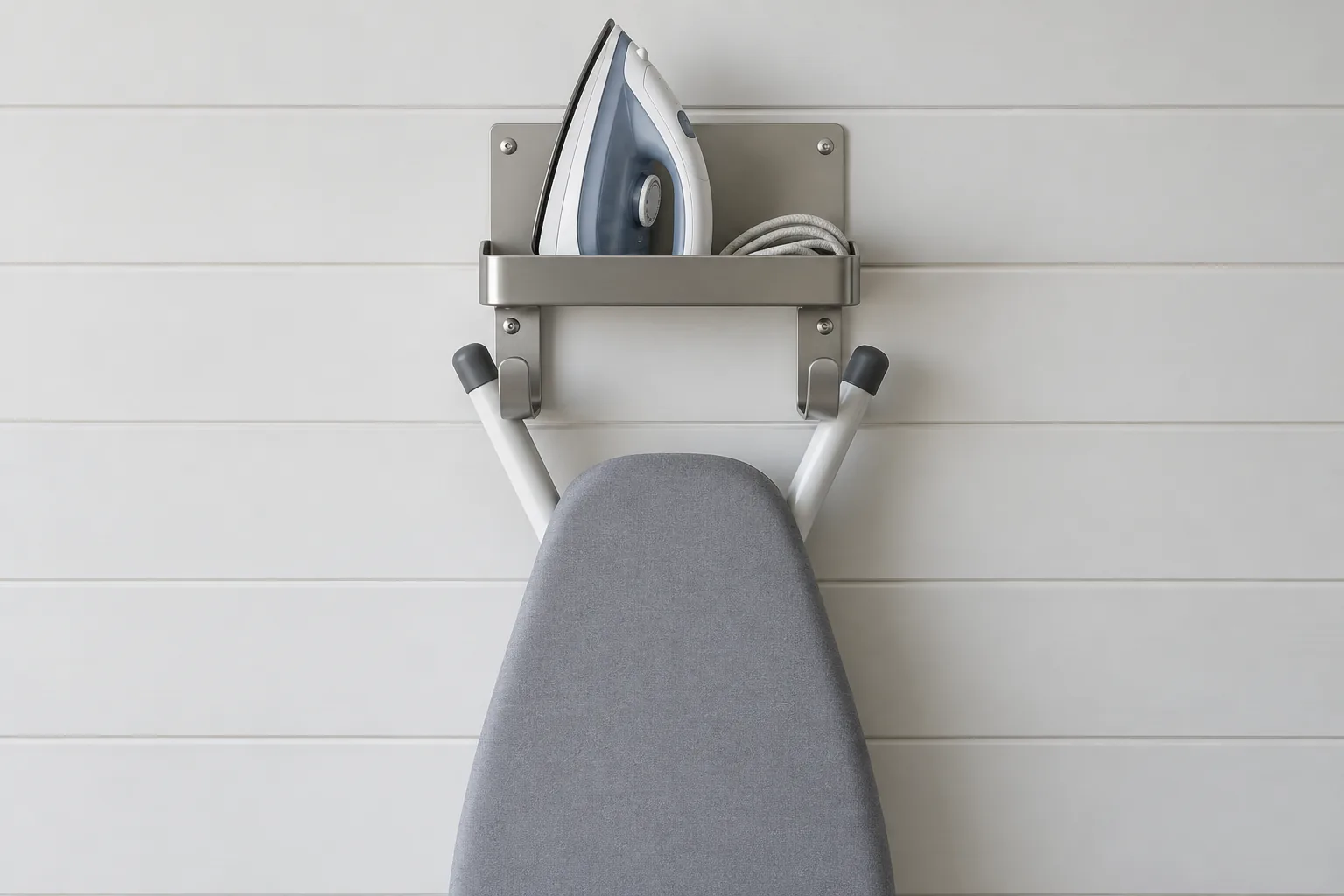
Ironing board hanger compatibility is determined by the actual folded leg frame and how it seats on the hanger—not simply by a product listing that says “T-shaped,” “Y-shaped” or “universal.” Buyers should compare the board’s leg cross-section, spacing, engagement points and removal path with the hook geometry, then test the selected board and hanger together. If the organizer also stores an iron and cord, review those interfaces separately with a cool, unplugged iron.
This is a paired-product specification problem. A wall hanger can fit one board from a category while failing to support another model with a different leg width, brace position or folded profile. A supplier’s compatibility statement should therefore identify which board configurations were checked and what the claim covers.
What does ironing board hanger compatibility mean?
For sourcing, compatibility means the selected folded ironing board can engage the hanger in the intended position, remain seated under the specified static storage condition, and be lifted off without an unexpected snag or unstable tilt. It does not mean every board sharing the same broad leg label will fit.
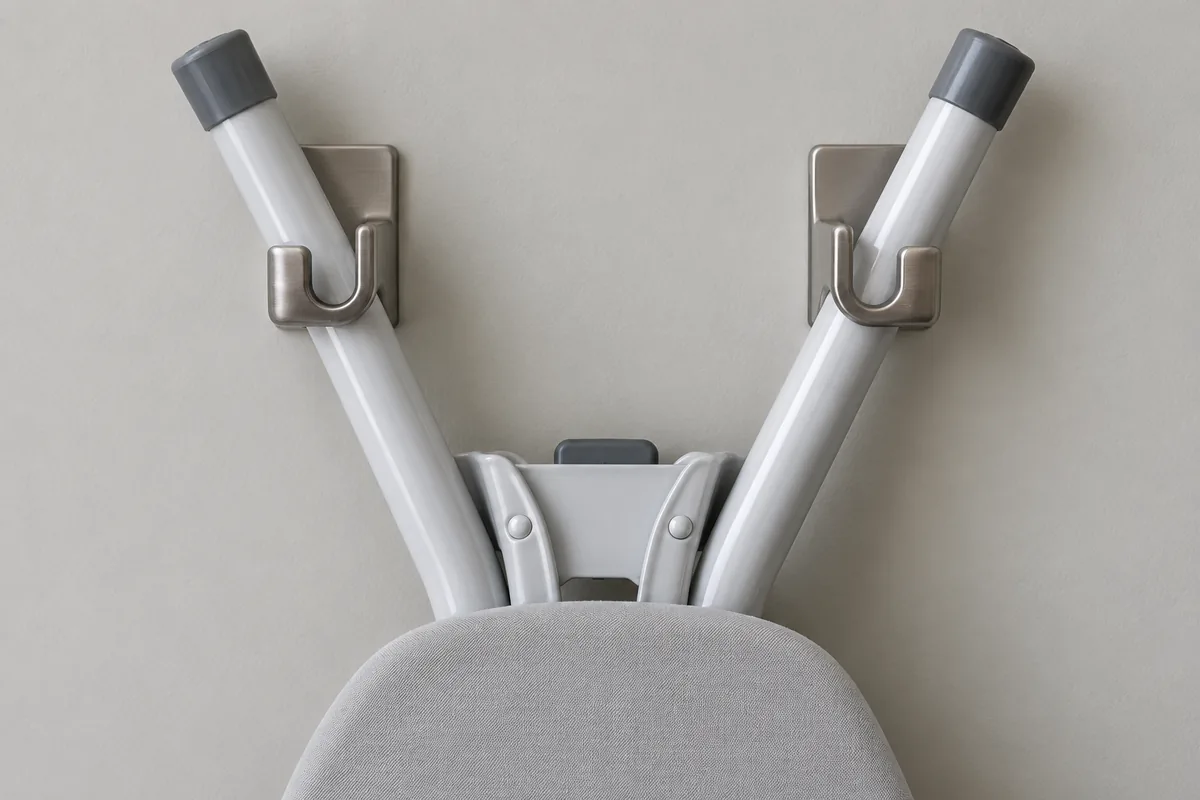
A T-shaped frame and a Y-shaped frame describe a general arrangement, but not every dimension that controls the interface. Buyers may still need to check the width between the legs, tube or brace shape, the point where the frame crosses, and the direction in which the board approaches the hooks. A hanger may have two fixed supports, adjustable hooks, a receiving slot or another interface. Each design needs its own fit check.
The product’s advertised category is only a starting point. For example, Joseph Joseph’s IronHub page names T-shaped and Y-shaped boards plus its own Glide boards as compatible with its hanging hook. The same page gives the distance between that model’s hooks as 4 cm and includes a cable compartment. Those details are specific to that IronHub product; they are not universal dimensional guidance for other hangers. The page’s customer reviews also include an individual report that two boards did not fit. That is a useful compatibility signal, not evidence of a general failure rate. See the manufacturer product and care page.
Which leg and hook dimensions should buyers compare?
Start with the board in its actual storage configuration. Fold it as the user would before hanging it, then identify the metal leg segments that contact the hook. Record the clear spacing, tube or brace cross-section, contact length and any protruding latch, foot, cap or crossbar near the engagement area.
On the hanger side, document hook spacing, opening width, depth, orientation, edge radius and whether the supports can be repositioned. If a product has two independent hooks, record their mounting centers and the permitted adjustment range. If the supports are part of a larger caddy, include the caddy body and wall plate because they may restrict how the board approaches or hangs.
| Fit item | What the buyer should measure or observe | What the supplier should confirm |
|---|---|---|
| Folded board profile | Leg shape, tube/brace section and protrusions | Which board configurations were checked |
| Contact spacing | Distance between the two leg segments at the intended hang point | Hook center spacing and adjustment range |
| Hook engagement | How far each leg sits into or over its support | Required engagement and any end-stop |
| Insertion path | Direction and angle used to place the board | Whether the caddy or wall obstructs that path |
| Removal path | Lift, tilt or slide movement needed to remove it | Whether the board can be removed without dislodging accessories |
| Stored position | Tilt, wall gap and contact with other components | Intended orientation and any support points |
Use the same reference points on the board and hanger drawing. A measurement taken at the feet may not match the width where the hook actually contacts the folded frame. If the folded board has multiple possible positions, specify the one used for the compatibility statement.
How should buyers check insertion, seating and removal?
A board that can be placed on a hook is not necessarily well supported. During sample review, observe whether both sides engage as intended, whether the board sits at a repeatable angle, and whether normal removal requires an awkward twist or contact with adjacent parts. Note any rocking, one-sided engagement, interference or reliance on a flexible component to keep the board in place.
Run the check with the intended board model and a production-representative hanger. A generic diagram or a different board from the same category is insufficient for a model-specific claim. If the buyer’s assortment includes several board styles, select representative samples based on their folded frame geometry rather than only the brand or board length.
Review the complete wall-mounted assembly. The organizer may include an iron shelf, cable channel, accessory compartment or removable hook. Those features can change the available approach path or shift where the board sits. Check that the board can be hung and removed without striking the shelf or catching on the cord compartment. Keep this interface review distinct from a load or durability test.
What should the compatibility claim include?
Avoid broad wording such as “fits all standard boards” unless the supplier has defined “standard,” checked the relevant configurations and documented the boundaries. A useful claim names the compatible leg patterns or exact board models when known, identifies the tested configuration, and states any dimensional limits that matter to fit.
If the supplier has only checked one T-style and one Y-style sample, say so. Do not turn two successful samples into a universal-fit promise. If a particular board family has model revisions, confirm that the tested sample represents the version currently sold in the target market. If the buyer intends to make a broader claim, create a sample matrix that reflects the intended coverage.
A compatibility record should include:
- board brand/model or a clear description of the folded leg configuration;
- sample or drawing revision and date;
- measured hook and leg contact dimensions;
- engagement, stored position and removal observations;
- any interference with the wall caddy or adjacent iron/cable storage;
- approved claim language and models that remain unverified.
This record helps keep product copy, packaging and buyer instructions consistent with the tested samples. It also gives a distributor a concrete basis for deciding whether to list a named model as compatible or request more evidence.
How should buyers assess iron and cable storage?
Treat the iron compartment and board hanger as separate interfaces even when they share one organizer. Check the iron body against the holder, verify that the cord can be routed or stored without blocking access, and make sure any plug or cable does not become trapped by the board legs. If the product includes a separate cable space, confirm its opening and usable volume with the intended iron and cord arrangement.
For safety and use instructions, evaluate storage only after the iron is cool and unplugged. Joseph Joseph’s product instructions explicitly caution users to let the iron cool before storing it in the IronHub caddy. That instruction is product-specific, but it is a clear reminder not to infer hot-iron storage suitability from a metal bracket or a generic “iron holder” label. Do not make heat-resistance or electrical-safety claims without separate evidence for the selected product.
If the buyer’s assortment includes several iron sizes, test the models most relevant to the intended market. Record which body shape and cord arrangement were checked. Avoid treating “fits most irons” as a technical criterion unless the included compatibility range is defined and supported.
What should an OEM sample approval include?
Approve the hanger and board as a pair. Provide the supplier with a folded board sample, clear photos or a controlled drawing of the leg interface, and the intended storage caddy if it has additional compartments. Ask for a dimensioned hook drawing, the proposed mounting arrangement and the method used to check fit.
On the sample, verify the engagement points, spacing, storage angle, insertion and removal path, and clearance from the caddy body. If the hooks are adjustable, record their approved positions and whether any adjustment needs a tool. Repeat the check after any change to hook width, spacing, support height, wall plate, caddy body or the paired board frame.
A fit check is not a load-rating, wall-fastener or product-safety certification. Keep those questions separate and request the relevant model-specific evidence. A short demonstration may confirm that the board can be hung, but it does not establish performance under every installation condition or over time.
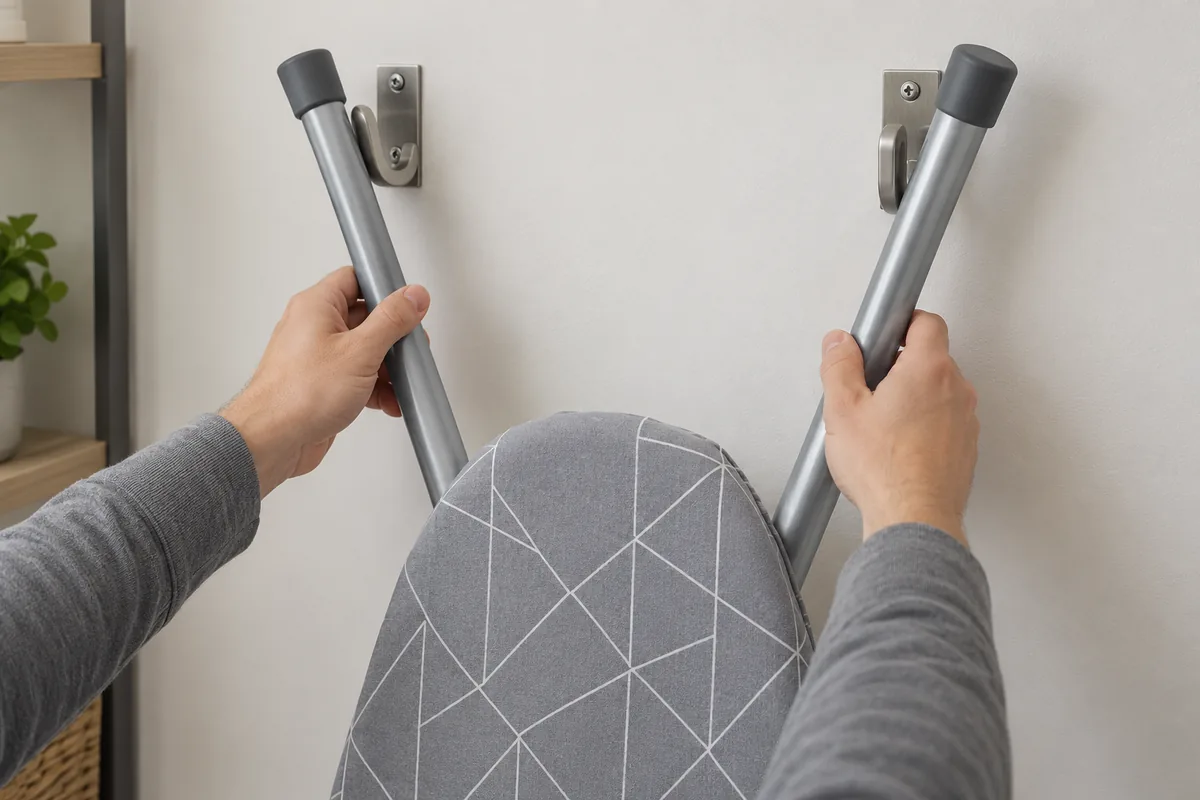
Recheck fit if the board leg frame, support spacing or folded position changes. On the hanger, review any change to hook gap, opening, depth, shape, orientation or mounting offset. A small adjustment can move the actual contact point and alter how the board sits. A new caddy body or accessory shelf can also obstruct the board even if the hooks themselves are unchanged.
For private-label programs, identify the controlled interface dimensions and sample combination in the approval record. If a supplier proposes a substitute hook or changes the mounting plate, request a fit-impact review before accepting the revision. If the board comes from a separate supplier, make clear who owns compatibility sign-off and who must approve a changed leg profile.
Do not require a full development cycle for an unrelated cosmetic change, but confirm that the change does not affect the approved fit. Keep the revised drawing, paired-sample record and product copy aligned.
Treat ironing board hanger compatibility as a controlled pairing, not a permanent property of the hanger alone. Keep the approved board sample or its interface drawing identified with the hanger revision, and record whether the claim covers one named model or a defined family of folded frames. This makes changes easier to assess during repeat orders.
What should buyers ask before placing an order?
Ask the supplier to identify the board styles or sample models used in its compatibility check, provide the relevant hook and leg interface dimensions, and show how the board is installed and removed. Confirm whether the organizer also accommodates the intended iron and cord arrangement, and clarify the cool/unplugged storage instructions for the selected product.
For an assortment with multiple board models, request a fit matrix with columns for model, folded leg pattern, hook position, seating result, removal result and unresolved conditions. Mark untested models as unverified rather than extending a fit claim by analogy. Include that matrix in the product approval record and update it when the board or hanger configuration changes.
Koitor’s current manufacture of the complete iron-and-board organizer is not confirmed. Buyers with a related metal-storage project can share drawings with Koitor’s OEM home-storage team to discuss confirmed metal-hardware scope and manufacturability. Any complete product capability should be confirmed before quotation.
الأسئلة الشائعة
Are T-shaped and Y-shaped boards automatically compatible with one hanger?
No. Those labels describe broad leg patterns, but actual spacing, tube geometry and contact position still vary. Test the intended folded board against the selected hanger.
Is “universal fit” enough for an OEM compatibility claim?
No. Ask what board configurations or dimensions were tested and which are outside the claim. Keep unverified board models clearly identified.
Should the iron and cable be checked with the board?
Yes, when they share the same caddy. Check the iron body, cable routing and board removal path together, while keeping safety instructions model-specific.
Can a sample fit check prove the wall installation is safe?
No. It checks the board-to-hanger interface for the tested sample. Wall substrate, fasteners, load rating and other safety requirements need separate instructions and evidence.
What if the board hangs but is difficult to remove?
Record the insertion and removal path as part of fit approval. A compatibility claim should reflect usable engagement, not merely whether the legs can be forced onto the hooks.
Discuss a Custom Metal Home-Storage Project
Share the relevant hook, hanger and folded-board drawings or samples, plus the intended mounting and finish requirements. Koitor can review confirmed metal-hardware scope and discuss manufacturability; complete iron-and-board organizer capability should be confirmed for each project.
OEM / العلامة التجارية الخاصة
حوّل دليل التوريد هذا إلى موجز منتج
يرجى إطلاعنا على المنتج المستهدف، والحجم، والتشطيب، وكمية الطلب، ومتطلبات التغليف. وسيتلقى فريقك تقييمًا عمليًّا لإمكانية التصنيع قبل تقديم عرض الأسعار.
 English
 Español
 Português
 Français
 Deutsch
 العربية