
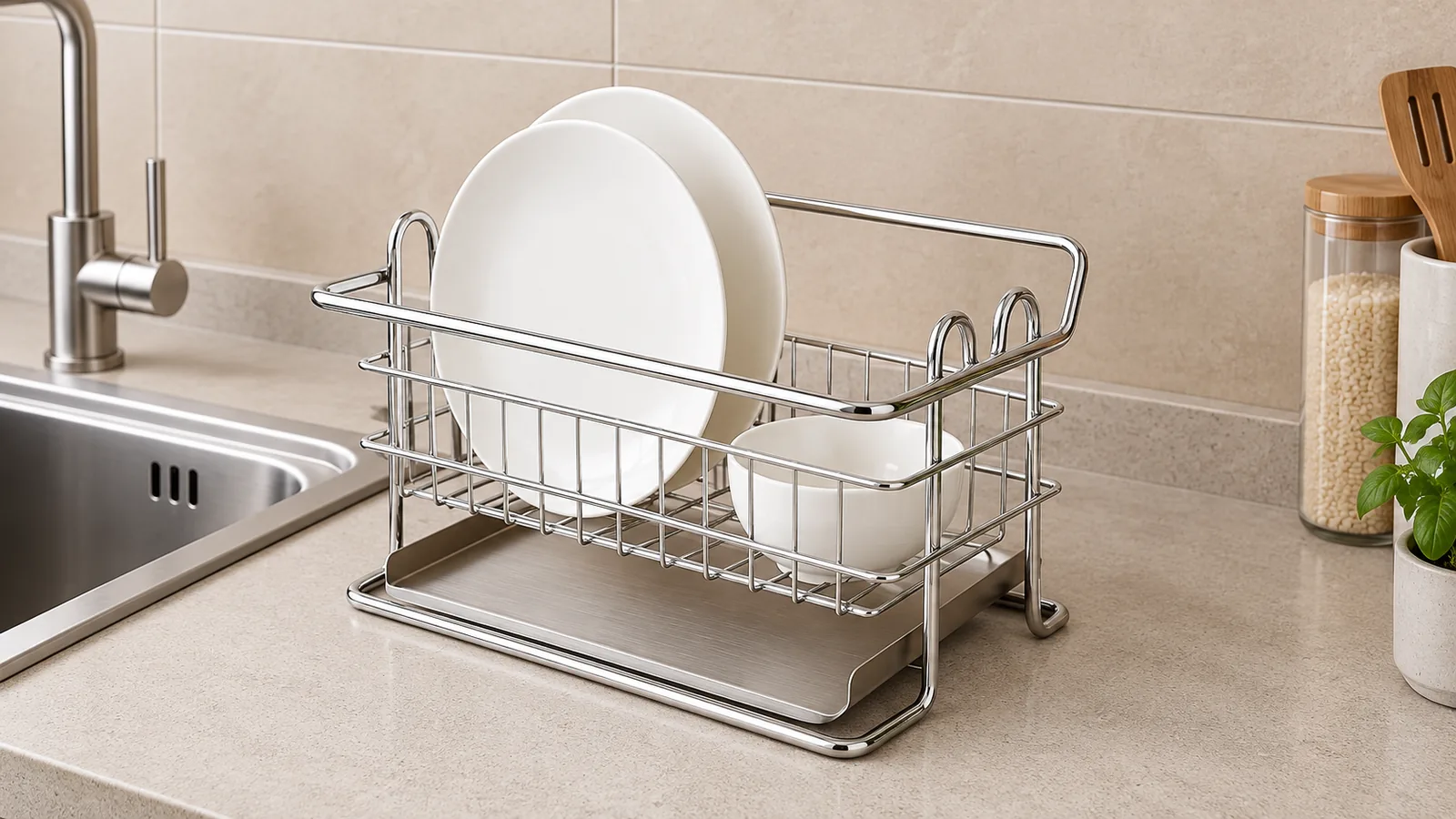
Kitchen sink dish rack drainage design should be evaluated as a complete water path: from wet dishes through the wire basket, into a collection tray or drainboard, and finally to the intended destination. Open wire spacing alone does not establish that a countertop stays dry or that collected water reaches the sink. OEM buyers should first distinguish a tray that needs emptying from a board designed to discharge into the sink, then approve placement, cleaning access and loaded-sample observations. Record the agreed criteria against the actual rack and tray revision before confirming retail copy or bulk production.
Which drainage arrangement fits the intended kitchen location?
The intended location determines whether a rack needs water collection, a directed outlet or neither. A countertop rack, an in-sink rack and an over-sink product should not share one drainage specification merely because each holds dishes.
A collection tray catches runoff beneath the rack and is emptied according to the approved care instructions. A drainboard directs water toward an outlet positioned for the sink. An in-sink rack lets runoff enter the basin, while an over-sink arrangement needs its own support and placement specification. Identify the selected architecture in the quotation request so suppliers can review the same product concept.
Manufacturer examples show the distinction. Rubbermaid describes a sloped drainboard with a lip over the sink edge. This is a product-specific arrangement, not a property of every dish rack. A Koitor reference photograph showing a shallow tray does not establish that the tray has an automatic outlet.
| Arrangement | Buyer specification priority | Sample review question |
|---|---|---|
| Countertop rack with collection tray | Collector coverage, access and emptying method | Can the tray be removed and emptied without spilling into inaccessible areas? |
| Countertop rack with directed drainboard | Board seating, outlet position and sink-rim interface | Does the outlet extend into the intended basin in the approved position? |
| Rack positioned inside the sink | Basin fit, dish support and accessory clearance | Does the loaded rack remain stable and avoid interfering with normal basin use? |
| Rack supported over the sink | Support geometry and approved sink dimensions | Does runoff enter the basin while the rack stays securely supported? |
| Rack on a separate drying mat | Mat compatibility and cleaning responsibility | Are water collection and mat care clearly assigned to the complete product arrangement? |
The comparison is a planning tool, not a recommendation that one arrangement is universally superior. Importers should choose according to the retail brief, target kitchen layouts, package size and buyer-approved maintenance method. A collector may be appropriate when the pack clearly states that it must be emptied; a directed board requires a credible installation interface. Bathroom buyers can consult the separate shower caddy drainage guide; a wall-mounted bathroom basket has different placement requirements from a countertop kitchen rack.
كويتور تصنيع رفوف تخزين مخصصة للمطابخ page is the commercial destination for sourcing discussions. This technical guide focuses on the drainage specification rather than duplicating a manufacturer-selection article.
How should buyers trace water through the rack and collection area?
Buyers should trace runoff from every intended dish position and accessory into the collector. Review the basket, plate supports, cup positions and tray coverage together, because water can leave the product at several different points.
Start with a representative assortment of plates, bowls and cups supplied or approved by the buyer. Product photos often use a small attractive dish set that hides overhang or accessory drainage. A sample review should include the assortment the retail product is intended to accommodate, with the placement limits written down rather than inferred from the image.
Consider where a wet item projects beyond the collector. A plate held upright may extend outside the rack footprint; an inverted cup can drip from its rim; a removable utensil holder may sit beyond the main tray. These are observation points for the proposed sample, not reasons to invent a universal rack dimension or claim that a certain layout cannot work.
Inspect intersections and enclosed details separately. The tray may be accessible while a corner beneath a frame connection is difficult to wipe. Record where water is observed and whether normal disassembly gives access. The buyer can then discuss a change to the frame, collector coverage or user instructions using photographs from the same approved configuration.
Wire spacing is also a support requirement. Increasing gaps solely to make a rack look open can alter how smaller items sit. Specify the intended dish assortment and review it physically before selecting wire layout. For custom metal baskets, Koitor can discuss wire basket structure and manufacturing from drawings or samples, including the relationships between supports, weld points and surrounding components.
Do not assume that a glossy finish, open basket or sloped-looking photograph establishes drainage performance. The complete path needs to be observed on the supplied sample. If the product uses a collector, state where water is retained by design and how it is removed; if it uses an outlet, follow the path all the way to the sink rather than stopping at the edge of the board.
What must the tray outlet and sink interface specification include?
For a directed drainboard, the specification should identify its seating position, outlet extension and relationship to the intended sink rim. For a collection tray, specify accessible removal and emptying instead of implying a discharge feature the product does not contain.
A sink interface is the physical relationship between the rack arrangement and the basin edge. Counter space, rim height, basin position and adjacent fittings can affect where a drainboard can be placed. Ask the buyer to supply representative kitchen layouts, drawings or measurements relevant to the target product before selecting an outlet concept.
Use those layouts to review placement options. An outlet that points toward the sink in a studio photograph may stop short of the basin on a different counter. Rotating the rack to align the outlet can change dish access, frame overhang or the direction of an accessory holder. These interactions should be discussed as part of the product layout, not left for the consumer to discover.
Do not prescribe a universal slope angle or discharge time without a project-specific basis. The buyer and supplier should agree the sample configuration and observations needed to judge the selected design. If dimensions are required, record them in the drawing rather than asking inspection staff to judge them from marketing artwork.
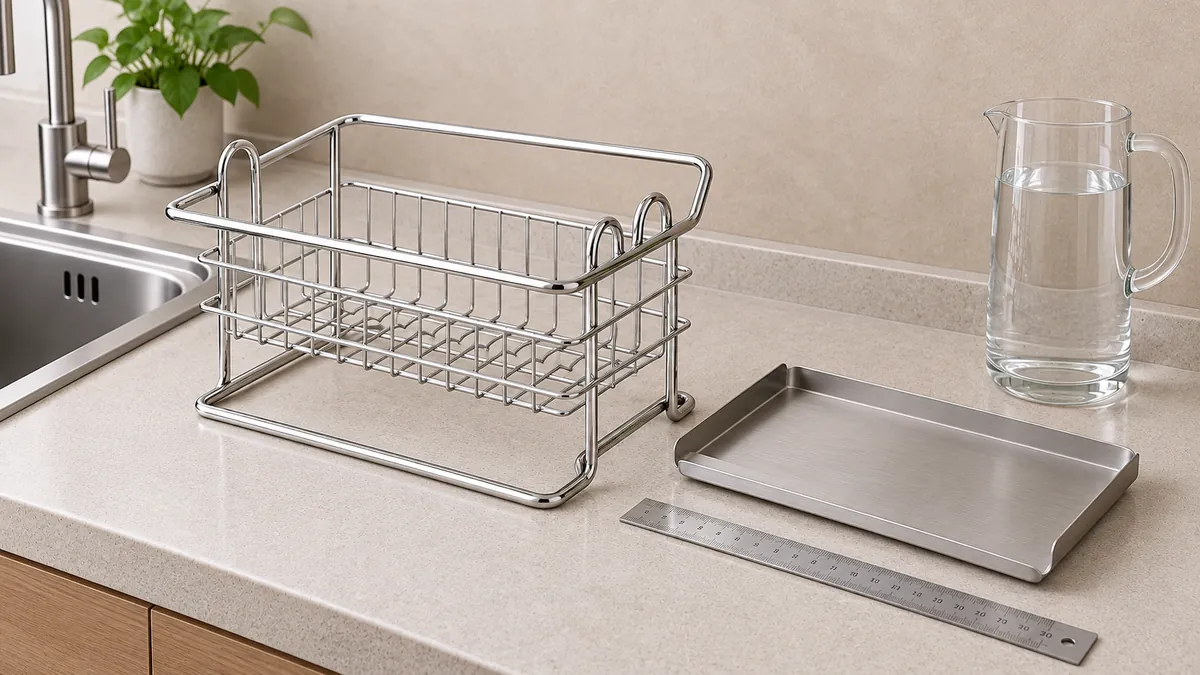
Tray seating also needs a clear description. Confirm which way the tray is inserted, where it rests and how the user recognizes correct placement. If more than one orientation is possible, decide whether both are intended or whether the packaging and instructions need to identify the approved orientation.
For an OEM product using a bought-in tray, do not treat a supplier’s similar-looking replacement as automatically equivalent. A changed lip, edge height or underside profile can affect the rack interface even when overall dimensions appear close. Link the tray identity to the approved sample and review substitutions before accepting them.
How can sample approval reveal water retention and cleaning difficulties?
Sample approval should combine defined runoff observations with a practical cleaning-access review. Agree the conditions before starting so both sides know what constitutes an acceptable result and what needs further development.
First identify the rack revision, tray revision, assembly condition and installation location. Photograph the unloaded sample and note how the tray is seated. Check that the intended dish assortment and accessories are available. A review using only an empty basket cannot show all the drip paths encountered during normal dish placement.
Next use the buyer-approved wet-dish arrangement or other agreed procedure. Record water observed outside the collector, water remaining in designated areas and any interference with the outlet. State the observation period and conditions in the review record. This article provides a planning sequence, not an established test standard or a pass result for Koitor products.
Then perform the intended cleaning and emptying operation. Ask whether the tray can be withdrawn without catching on a foot or support wire, whether accessory parts can be removed as described, and whether the contact areas can be reached with the approved cleaning method. A removable label alone does not tell the buyer whether removal is convenient in the assembled product.
Keep user feedback separate from technical evidence. For example, a public CleaningTips discussion includes complaints about residue beneath a rack and uncertainty about whether its tray drains. Such reports help identify questions for sample review; they do not establish the cause, a hygiene result or a suitable cleaning chemical for a different rack.
Approve care instructions from the actual components and finishes. Do not describe a tray as dishwasher-safe, recommend a solvent or promise a corrosion outcome without supporting confirmation. If a care action requires removing the rack or unloading dishes first, make that order visible in the approved instructions.
For kitchen sink dish rack drainage design, the useful output is a documented decision: approve the arrangement, request a defined revision, or conduct further review. Keep photographs and observations linked to each version so a successful revised sample is not confused with the earlier configuration that produced a concern.
Which drawing and packaging changes require another drainage review?
Changes that affect seating, collector coverage, outlet alignment or loaded dish positions need another review of the complete water path. The buyer should identify these changes explicitly even when a supplier describes them as minor production adjustments.
Wire bending and welding establish the basket and support geometry. A revised foot position, basket height or tray support can alter how a collection tray fits. Changing a plate divider may shift the loaded dish assortment. Discuss the interactions using confirmed drawings and retained samples rather than approving the frame and tray through separate isolated photographs.
Koitor Hardware is a family-owned custom metal hardware factory specializing in bathroom and home storage hardware. Approved capabilities include bending, resistance welding, laser welding, TIG welding, polishing, surface finishing, basic assembly and packaging preparation. In a kitchen rack project, direct factory communication can bring the drawing, tray concept, dish assortment and package arrangement into one manufacturability discussion.
These capabilities are not a claim that Koitor manufactures every plastic tray or offers a verified self-draining system. Buyers should confirm the material, source and production responsibility for each non-metal component. A clear responsibility list prevents assumptions about who approves a bought-in collector, supplies replacement parts or handles a component revision.
Packaging review should include the rack and tray as they will arrive. Protect their contact surfaces and keep the intended assembly order clear. After unpacking the approved package sample, check that the tray seats correctly and that the outlet or collector arrangement remains consistent with the reference sample. Record concerns such as an altered tray fit without presenting an unverified transport-test claim.
Retail copy should describe the selected architecture accurately. “Includes a removable collection tray” is different from “drains directly into the sink.” Choose wording supported by the actual design and evidence. Do not add an outlet to a generated picture merely to make the product appear more convenient; the image, specification and approved copy should show the same product.
What should an importer include in the drainage sample checklist?
The checklist should specify product location, representative dishes, tray function and approval evidence. It also needs to identify who can authorize component or drawing changes before a repeat order.
- Define countertop, in-sink or over-sink placement.
- State whether the arrangement collects water or directs it into the sink.
- Provide relevant sink-rim and counter-layout information.
- Identify the representative plate, bowl, cup and utensil assortment.
- Confirm collector coverage beneath every intended drip area.
- Review tray seating, insertion direction and removal clearance.
- Identify an outlet only if the proposed product actually includes one.
- Record loaded-sample runoff observations under agreed conditions.
- Check cleaning access at corners, supports and accessory holders.
- Confirm material and finish care guidance without unsupported claims.
- Identify rack, tray and artwork revisions in the retained sample record.
- Review unpacking and assembly against the final package configuration.
- Assign approval responsibility for tray or frame substitutions.
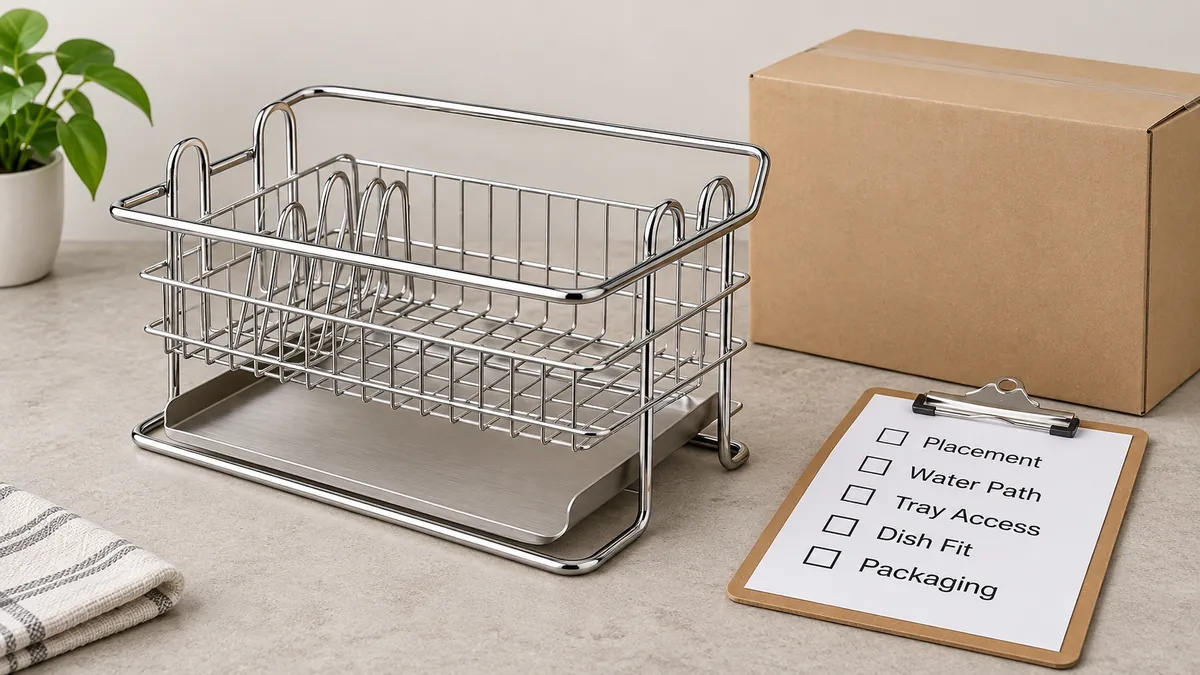
Turn unresolved items into specific requests. Instead of “improve drainage,” identify the observed location and the required review. A supplier can respond more usefully to “the collection tray cannot be withdrawn past this support in the assembled sample” than to a general complaint about convenience.
The quotation brief should also include finish preference, package concept, expected order quantity and sample requirements. Koitor can discuss development from drawings or physical samples with flexible small-batch OEM production. Confirm the project details and evidence requirements first, so sample approval and later production review use the same specification.
Frequently asked questions about kitchen rack drainage approval
Does open wire construction mean a dish rack drains into the sink?
No. Water can pass through an open rack into a separate collector that still needs emptying. A direct-discharge claim requires an actual path from the collector or board to the intended sink location, reviewed on the supplied sample.
Is a collection tray unsuitable for an OEM kitchen rack?
Not necessarily. It can suit the agreed product brief when its coverage, cleaning access and emptying method are clear. Buyers should approve the architecture and describe it accurately rather than expecting every tray to have an outlet.
What slope should a drainboard use?
There is no universal value established here. Discuss the board geometry, material, sink interface and required observations with the supplier. Put agreed dimensions and acceptance conditions into the project specification before approving production.
Can an empty sample establish drainage performance?
It can show seating and access, but it cannot reveal every loaded-dish drip path. Use a representative buyer-approved assortment and record the configured conditions. The chosen procedure and criteria should be agreed rather than inferred from a product photograph.
How can buyers keep kitchen sink dish rack drainage design consistent on repeat orders?
Retain the approved rack and tray identities, drawings, review observations and care artwork. Require proposed changes to supports, tray profiles or outlets to be reviewed against that record before accepting a replacement configuration.
Review your kitchen rack and tray concept with Koitor
Prepare a Drainage-Focused Kitchen Rack Sample
Send Koitor your rack drawing or physical sample, representative dishes, counter and sink layout, tray concept and packaging requirements. Our team can discuss the metal structure, component interfaces, sample review and flexible OEM production options.
OEM / العلامة التجارية الخاصة
حوّل دليل التوريد هذا إلى موجز منتج
يرجى إطلاعنا على المنتج المستهدف، والحجم، والتشطيب، وكمية الطلب، ومتطلبات التغليف. وسيتلقى فريقك تقييمًا عمليًّا لإمكانية التصنيع قبل تقديم عرض الأسعار.
 English
  Español
  Português
  Français
  Deutsch
  العربية