
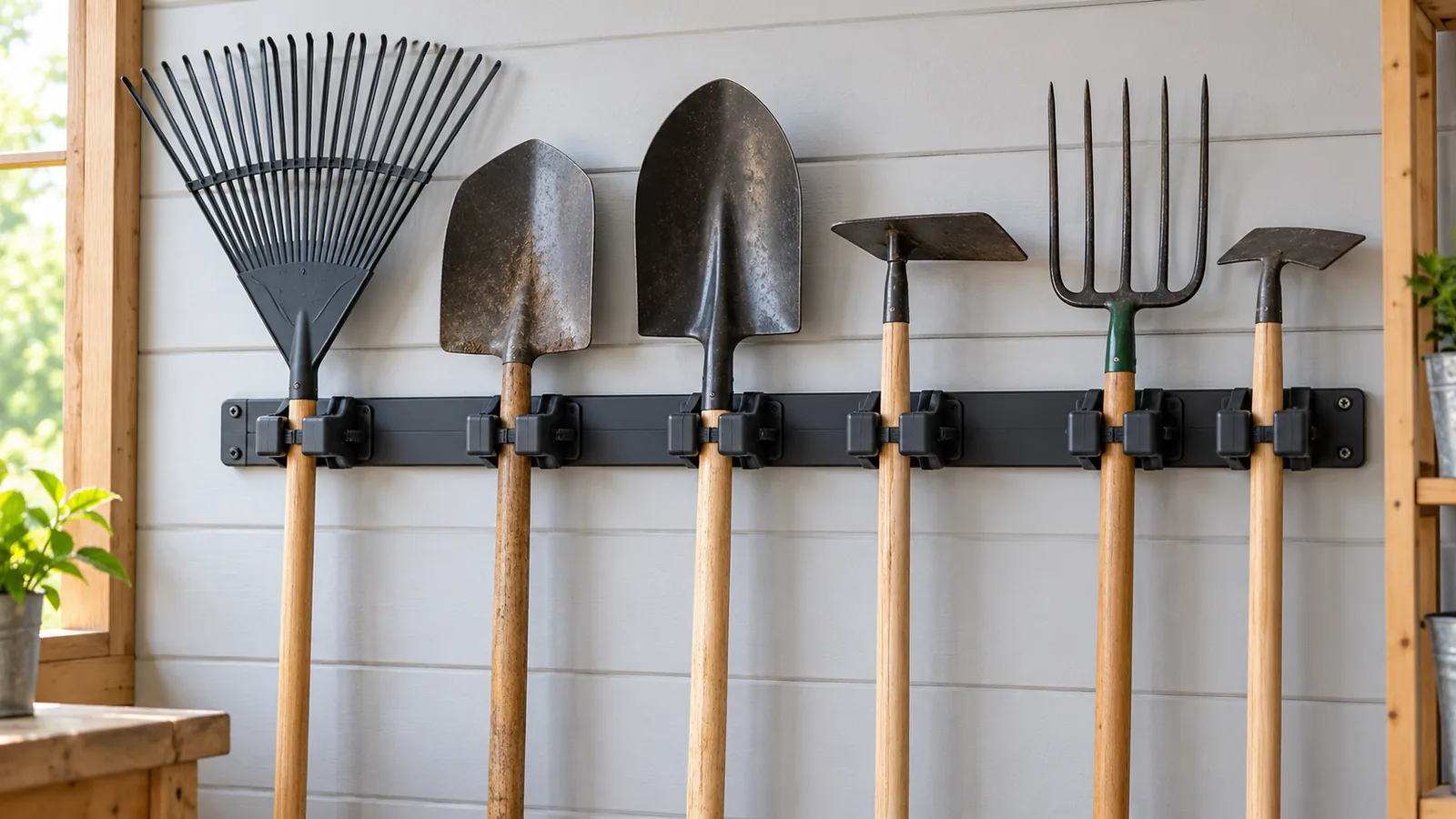
A long handle tool rack should be specified around the actual rake, shovel, hoe, broom or other tools it is expected to hold, not just a headline holder count. Before approving a sample, importers should define the handle and head envelope, holder style, spacing, rack or rail interface, supplied components, finish brief, instructions and pack configuration. Then check representative tools against the exact sample and revision. Those steps make supplier quotations more comparable without assuming that one rack fits every tool or wall system.
What should an importer define before requesting a quotation?
Start with the assortment and the use case. A wall rail with movable hooks, a row of fixed slots, a clamp-style holder and a freestanding retail display can all be described casually as a garden tool rack, but they solve different storage or merchandising problems. State whether the product is intended for home storage, a garage or shed organization range, or retail display. K1094 concerns a storage-product RFQ and sample decision; a full store fixture brief is a separate project scope.
Make a list of the tools the rack is meant to hold. Include product type and model where known, handle length and diameter range, handle shape, grip or end cap, and the size and orientation of each tool head. Rakes, shovels and hoes may share a long shaft but differ at the end that needs clearance. A short-handled tool, a D-grip shovel and a straight broom also present different contact and retention points. If buyers do not have final samples, provide dimensioned drawings and clearly mark which measurements are estimates.
The RFQ should also identify the expected number of positions, whether the tools hang vertically or rest in a horizontal row, and whether the rack is fixed-width or part of an adjustable rail. Define included hooks, clips, brackets, end caps, fasteners, templates or other components as a bill of materials rather than assuming a product photograph shows everything in the carton. Ask suppliers to identify any optional part separately so the quoted base configuration can be compared consistently.
| RFQ input | What to provide | What the sample should answer |
|---|---|---|
| Tool assortment | Representative rake, shovel, hoe, broom or other intended SKUs | Do each item fit the intended holder without blocking the neighboring position? |
| Handle and head envelope | Diameter, taper, grip shape, length and head dimensions | Can the tool be inserted, retrieved and returned in the expected orientation? |
| Holder configuration | Slot, hook, clip, clamp or rail-mounted holder, with quantity | Does the contact point suit the intended tool, and is the arrangement clear? |
| Rack layout | Overall length, position count and center-to-center spacing | Do handles and tool heads interfere with each other or nearby items? |
| System interface | Rail, panel, brackets and supplied components, with revision | Do the sample parts match the defined system and pack contents? |
| Finish and package | Finish reference, protective parts, labels, instructions and carton plan | Does the approved appearance and pack configuration match the buyer brief? |
These are quote inputs and sample questions, not universal dimensions. The exact acceptable values depend on the product range and the buyer’s chosen installation or retail system. For a long handle tool rack, the agreed tool set and holder configuration should stay attached to the same drawing revision throughout quotation and sample approval.
How should buyers check handles, grips and tool heads?
Measure the parts that touch or pass through the holder. A single “fits long tools” statement is not a measurable acceptance criterion. For a closed socket or slot, record the opening dimensions, entry direction and any shoulder that stops the handle from passing through. For a hook, document the throat, bend and edge details that contact the tool. For a clamp, identify its operating range and which handle surfaces it grips. These features are model-specific and should be confirmed on the sample.
Different tools may need separate positions or holder inserts. A tapered wooden handle can behave differently from a straight shaft with a thick rubber grip. A D-handle may require a wider opening or a different orientation than a shaft-only tool. Tool heads also need room: a rake head can overlap a neighboring shovel even when the handles fit the row. For a mixed assortment, lay out the actual tools in the proposed order and inspect the clearances at both the handle and head ends.
Product pages illustrate why buyers should avoid generalizing a fit statement. Lee Valley describes one seven-tool rack with sockets sized around a particular taper and gives its own width and mounting-hole spacing; the page says other tools fit only when their handles have a similar shape. Bunnings lists a different wall-mounted organizer with five channels and a stated slot size. Those are examples of model-specific information, not recommended universal dimensions for another rack. Lee Valley’s product details و Bunnings’ Everhang listing show why an importer should name the intended tools and check the actual configuration.
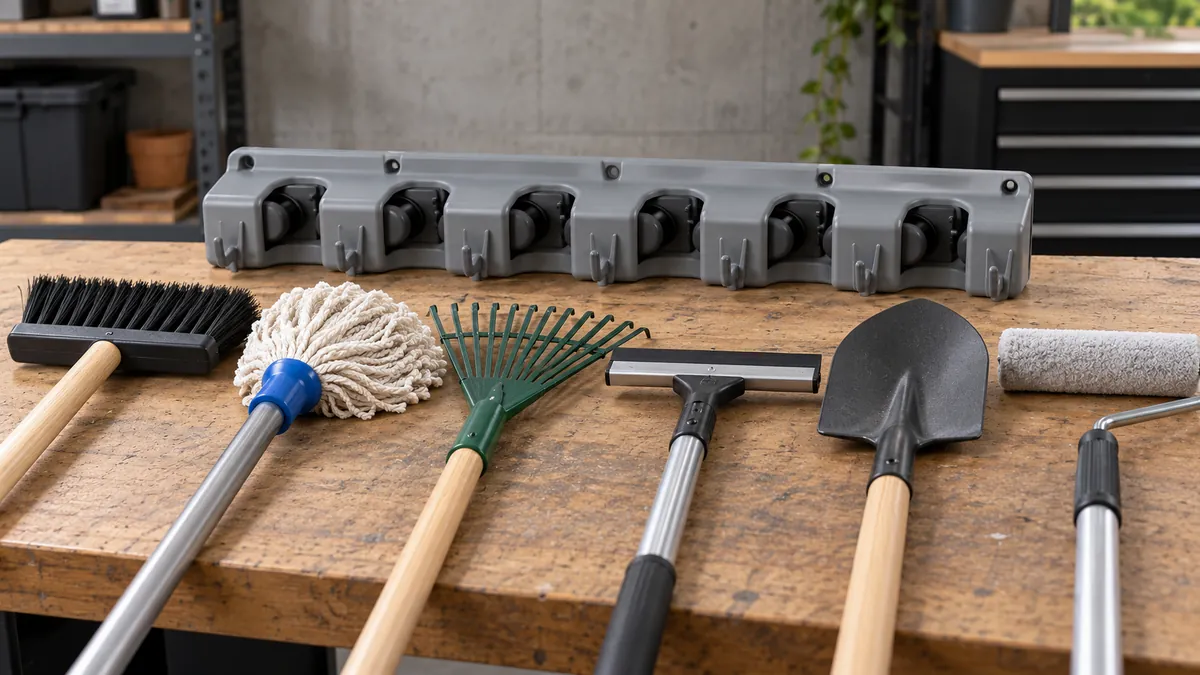
For a representative sample check, use each intended tool or a dimensionally controlled substitute. Record whether the tool enters without forcing, stays in the intended position during ordinary handling, can be removed without catching a neighboring item, and returns to the same position. Note any grip material that can be marked or any tool finish that may rub against a metal edge. This is an observation protocol for comparing the buyer’s chosen configuration; it does not certify product safety or establish a load rating.
Which holder styles and layouts belong in the approved specification?
Choose holder style according to the assortment, replenishment plan and retailer’s product range. Fixed openings keep a known set arranged in dedicated positions but can limit changes to the tool mix. Individual hooks or clips may allow a different spacing pattern, yet the buyer needs to specify the rail or panel they attach to and the exact included attachment parts. A combined rack can add shelves or small hooks, but those additions change the product dimensions and pack contents. Avoid the word “universal” unless the buyer defines the tested range and how compatibility will be verified.
A supplier’s product page may show how its own system is intended to work. Milwaukee describes a long-handle rack designed to connect with its PACKOUT wall plates and identifies quick-access clamps and slip-resistant grips. The useful sourcing lesson is that system compatibility is a named interface, not a generic feature. If your retail assortment includes a proprietary wall plate, pegboard, slatwall or grid system, provide the exact profile or matching component and agree what the supplier must inspect. Do not assume the rack in one catalog fits a different system. Milwaukee Tool’s product page is a model example; it does not establish compatibility with other panels.
Lay out the rack using the whole tool set. Specify total rack length, number of positions, spacing, position sequence and any end clearance. Check whether adjacent handles cross or whether wider tool heads collide when stored together. If one tool requires more width, show that exception in the drawing and quote rather than relying on a generic “five-position” description. If the rack is supplied as a rail with movable holders, define how many holders are included and whether any position range or end stop is part of the approved sample.
Retail display racks are a related but different product. Supplier pages for display equipment often describe full-height fixtures, optional shelves, header boards and merchandising panels. If the buyer needs a floor-standing store fixture, the brief should separately specify overall fixture footprint, display assortment and store layout. Do not mix that scope into a compact wall-storage rack request simply because both hold long tools.
What should the importer confirm about mounting parts and finish?
Describe the mounting interface without turning the article into installation advice. The RFQ should name the rack’s attachment points, supplied brackets or plate, fastener count, hole locations and any included template or instructions. If a buyer expects compatibility with a specific rail or panel, identify it by drawing, part number or sample. Ask the supplier to list what is included and what the customer must source separately. The buyer’s product, quality or compliance team can define any substrate-specific validation and acceptance requirements for its market; do not infer suitability from a product photo.
Finish should also be a buyer-defined appearance and use requirement. Provide a physical color sample, approved finish code or reference part where available, and identify the faces that matter most visually. For racks intended for damp storage locations, ask what material and finishing process the supplier is quoting and what evidence is available for the specific part. A powder-coated appearance alone does not establish corrosion performance, coating thickness or outdoor service life. Ask for project-specific documentation only when it is part of the buyer’s requirement, and do not transfer test claims from another model or supplier.
Packaging deserves the same specificity as the metal configuration. Long handles are not usually included in a rack-only package, so state whether the rack ships alone, with a mounting kit, or with separately packaged accessories. Identify which pieces can scratch each other, whether the rack is assembled or flat-packed, and which labels, instructions and SKU references need to match the retail unit. Request a packing sample or photographs of the agreed arrangement when packaging affects assembly, carton count or shelf presentation. The supplier should confirm the actual pack list rather than infer it from a listing image.
How can buyers compare a quotation and a sample fairly?
Compare each supplier against the same drawing and component list. A low quotation can omit holders, brackets, screws, protective sleeves, a printed instruction sheet or retail packaging that another quote includes. Ask each supplier to mark included and excluded components, material and finish assumptions, assembly steps, sample revision and packaging scope. If a configuration is still open, ask for separate options so a price difference does not conceal a different product.
When the sample arrives, identify it by project, supplier, revision and date. Verify the rack dimensions and component count against the approved drawing. Use the representative tool set to check entry, retention during ordinary placement, retrieval, position spacing and access to neighboring items. Photograph the same check from the same angles for each sample. Record exceptions as measurable observations, such as a stated tool handle not passing through an opening or a particular tool head contacting an adjacent position. Do not convert an observation on one sample into a claim about every unit or a product capacity rating.
Keep separate records for fit, appearance, assembly and packaging. A sample may fit the rake and shovel but still have a finish mismatch or a missing part. If the supplier proposes a revision, ask what changed—holder opening, spacing, fastener, material, finish, assembly order or carton arrangement—and update the sample approval record. The approved sample should represent the configuration the buyer expects to repeat, including any logo, finish reference and packed components.
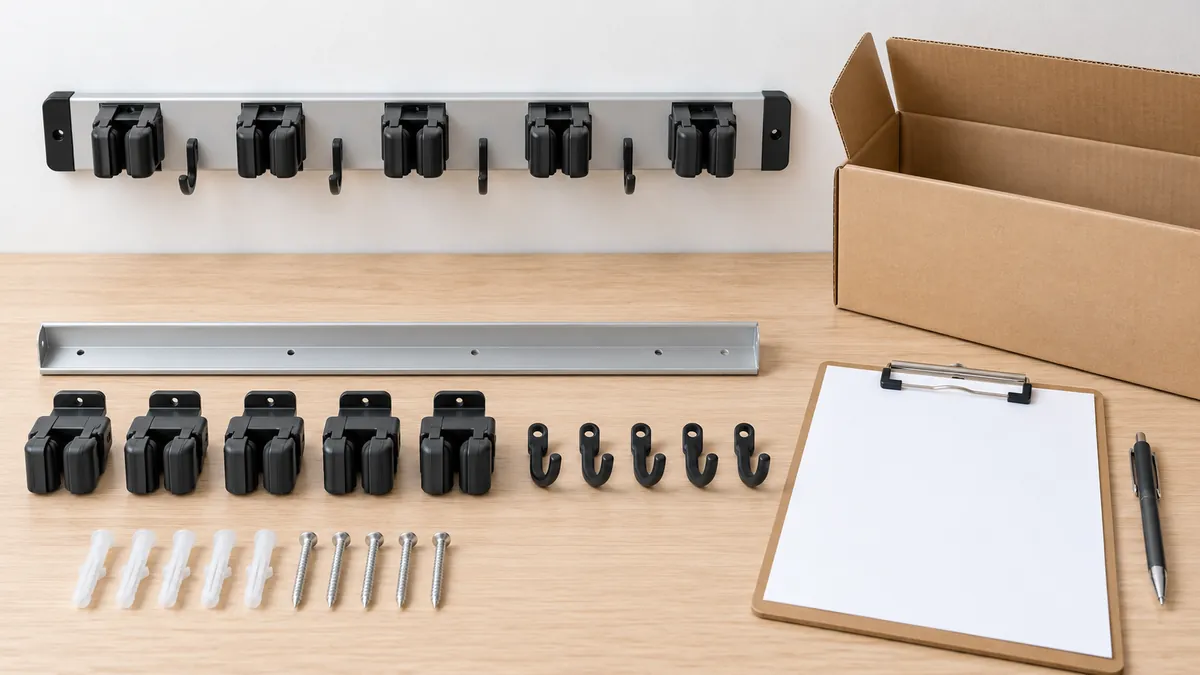
A clear record gives purchasing, quality and product teams a shared answer to “which version did we approve?” It also helps a distributor or private-label team update its product data if the number of holder positions, supplied hardware or package contents change. Keep buyer instructions, labels and carton references aligned with the same revision so a sample decision does not get separated from the final retail configuration.
How can a metal-storage OEM discussion help without overpromising?
Koitor Hardware is a family-owned custom metal hardware factory focused on bathroom and home storage products. Its approved capabilities include reviewing drawings or physical samples and discussing processes such as bending, punching, resistance, laser or TIG welding, grinding, polishing, powder coating, basic assembly and packaging preparation. These general facts can help explain what information makes a metal-storage request easier to review. They do not confirm that Koitor currently manufactures garden-tool racks or any specific holder, clip, rail or mounting system.
For an adjacent product idea, a buyer can share the drawing, representative tools, target holder count, finish brief and pack list for a scope discussion. The factory can clarify whether the requested metal structure fits its current verified capabilities before anyone treats it as a committed product offer. A concept should not be described as production-ready until material, process, components, sample approval and order requirements have been confirmed for that project. Buyers developing broader storage lines may also review Koitor’s custom metal storage rack scope و OEM home-storage hardware overview; those pages describe Koitor’s established product area, not proof of garden-tool rack capability.
What should an importer put on the final RFQ checklist?
Before requesting a firm quotation or approving a sample, include:
- Intended tool types and representative product models, with drawings or photos.
- Handle length, diameter or taper, grip shape and end condition.
- Tool-head dimensions and orientation, including any clearance constraints.
- Holder type, number of positions, spacing, overall rack dimensions and revision.
- Named rail, panel or mounting interface, with the supplied bracket and fastener list.
- Material and finish brief, color reference and any project-specific evidence requested.
- Assembly method and whether the product is supplied assembled or flat-packed.
- Retail package contents, instruction language, labels, protection and carton configuration.
- Target quantity, sample requirements, destination market and private-label details.
- Acceptance notes for fit, appearance, component count and packaging before mass production.
This checklist makes a supplier response easier to compare. It does not replace a product-specific engineering review, installation validation, legal assessment or test plan where the buyer requires one.
الأسئلة الشائعة
What is the first measurement to provide for a long handle tool rack?
Start with the actual handle and grip envelope at the point that will contact or pass through the holder. Include tool-head dimensions and orientation as well, because handles can fit while neighboring heads collide.
Should an importer choose slots, hooks or clamps?
Choose based on the intended tool assortment and how the holder attaches to the rack or wall system. Test representative tools against the exact sample and record the configuration; no one holder style is universally suitable.
Does a sample rack prove its stated load capacity?
No. A sample fit check can confirm the buyer’s specified configuration and observed handling. It does not establish a load rating or long-term performance. Any capacity claim needs a defined product, mounting configuration and appropriate test evidence.
Can a garden tool rack be specified as universal?
Avoid that term unless the buyer defines the range of handle and head dimensions covered and the verification method. Otherwise, specify the actual intended tools or the bounded compatibility range for that model.
Does Koitor currently make garden-tool racks?
The approved company facts establish Koitor’s bathroom and home-storage hardware focus and general metalworking capabilities, but do not confirm this adjacent product. A buyer should share a drawing or sample for a project-specific scope review before describing it as an available Koitor item.
Discuss a Home-Storage Project
Have a metal storage product brief?
Share a drawing or sample, intended product scope and packaging requirements. Koitor can first confirm whether the request fits its current verified manufacturing capabilities.
OEM / العلامة التجارية الخاصة
حوّل دليل التوريد هذا إلى موجز منتج
يرجى إطلاعنا على المنتج المستهدف، والحجم، والتشطيب، وكمية الطلب، ومتطلبات التغليف. وسيتلقى فريقك تقييمًا عمليًّا لإمكانية التصنيع قبل تقديم عرض الأسعار.

 English
 Español
 Português
 Français
 Deutsch
 العربية