

To lubricate drawer slides responsibly, first identify ordinary ball-bearing slides and check the exact slide and checking its maker’s maintenance instructions. A factory-greased slide does not necessarily need grease added on a calendar; Accuride says its standard ball-bearing slides are normally lubricated adequately for ordinary service, while use, environment, contamination, or cleaning can change the maintenance need. If movement changes, first distinguish dirt, misalignment, loose hardware, damage, and lubricant condition instead of assuming every sticking drawer needs more grease.
When Should You Lubricate Drawer Slides?
This guide focuses on ordinary metal ball-bearing drawer slides and on the conditional maintenance path supported by the cited slide-maker guidance. It is not a universal cleaning recipe for every drawer mechanism. Roller slides, specialty sealed slides, polymer systems, wood runners, food-contact arrangements, refrigerator and oven hardware, or other purpose-built mechanisms may have different requirements. The exact product instructions take precedence.
A slide’s apparent similarity to another model is not enough to transfer its cleaning solvent, grease, disassembly method, or lubrication interval. Even within one broad product family, a manufacturer may specify a particular surface treatment, bearing layout, release mechanism, or cleaning condition. Record the manufacturer’s name and model or part reference from the product or project file before acting. If that identity cannot be confirmed, stop before applying a substance that might affect the finish, bearings, polymer components, or intended use.
For procurement and product-development teams, the same principle applies before writing care information. A generic statement such as “oil the rails when stiff” can conflict with the supplier’s intended maintenance. Obtain model-specific instructions for the actual assembly, including whether it is designed to remain factory lubricated, whether the user may disconnect the drawer, which areas are serviceable, and how any residue should be removed.
Do Ball-Bearing Drawer Slides Need Routine Lubrication?
Not automatically. Accuride’s guidance says its normal-service lubrication on standard ball-bearing drawer slides is adequate and that routine re-greasing is generally unnecessary. Environment and use can matter, and a slide that has been cleaned may need the lubricant restored according to its maker. That is a bounded statement about the maker’s covered products, not a schedule for every brand or slide family.
Factory-applied grease has a defined purpose at the sliding and rolling interfaces. Adding more without diagnosis may not improve movement. Excess material can attract or hold dust and debris, and an incompatible product may affect other parts of the assembly. A new lubricant can also obscure an existing problem, making it harder to tell whether the cause was contamination, damage, mounting alignment, or a mechanism fault.
The practical distinction is between maintenance condition and calendar habit. If a slide is moving as intended, has not been exposed to a condition that calls for care, and the maker says its original lubrication is adequate, adding grease simply because time has passed may be unnecessary. If the slide was washed or cleaned, is contaminated, or the maker lists an environmental exception, follow the applicable service direction.
Do not infer that all grease should be left untouched forever. The maker’s instructions may call for inspection, cleaning, or renewed lubrication under defined circumstances. The buyer should identify those conditions rather than extending a normal-service statement to every application.
What Should You Check Before Adding Lubricant?
Start with the symptom and the assembly. Does the drawer resist movement throughout travel, only at one position, or only when loaded? Is the drawer skewed, rubbing a cabinet side, or visibly loose at a mounting point? Is there visible dust, debris, dried residue, corrosion, impact damage, or a bent rail? Does the issue occur on one side or both? These observations help decide whether routine cleaning is relevant or whether the problem needs a different correction.
A simple diagnostic sequence is:
- Identify the exact slide model and retrieve its installation and maintenance information.
- Check whether the drawer is seated and mounted as specified; do not force a release mechanism that is not identified.
- Look for visible dirt, foreign material, physical damage, loosened fasteners, or an alignment change.
- Separate a cleaning need from a mechanical defect or assembly problem.
- Confirm that the maker permits the proposed cleaning and re-lubrication procedure.
- Use only a lubricant and application method the model’s instructions support.
The first observation is not a diagnosis. A drawer can feel difficult to move because a cabinet is out of square, fasteners have shifted, the slide is damaged, the load is different from the intended design, or debris blocks movement. If the drawer has been impacted or a rail is visibly bent, adding grease does not restore its geometry.
A water or bathroom environment deserves careful interpretation. The presence of a metal surface treatment does not mean any cleaner is compatible with that finish. Likewise, the fact that a room is humid does not establish which lubricant or service interval is suitable. The cited maker guidance is specifically scoped; it does not support a universal pH limit, temperature range, chemical recipe, or warranty conclusion for all products.
What Is the Maker-Authorized Cleaning and Lubrication Sequence?
Where the maker authorizes cleaning and re-lubrication for the identified model, follow its actual procedure. The general order supported by Accuride’s covered standard zinc-coated ball-bearing slides is to support and unload the drawer, use the documented disconnect method if the model provides one, remove accessible dirt using a compatible method, clear cleaning residue, dry as directed, then apply appropriate grease to the indicated bearing tracks and cycle or reassemble as instructed. The model’s own details govern each step.
The sequence matters because cleaning can remove lubricant as well as dirt. If detergent or another cleaner remains in a track, it may contaminate the interface or interfere with the maker’s intended lubricant. Drying matters for the same reason. Do not assume that a surface that feels dry to the touch is ready for service if the model’s instructions require another check.
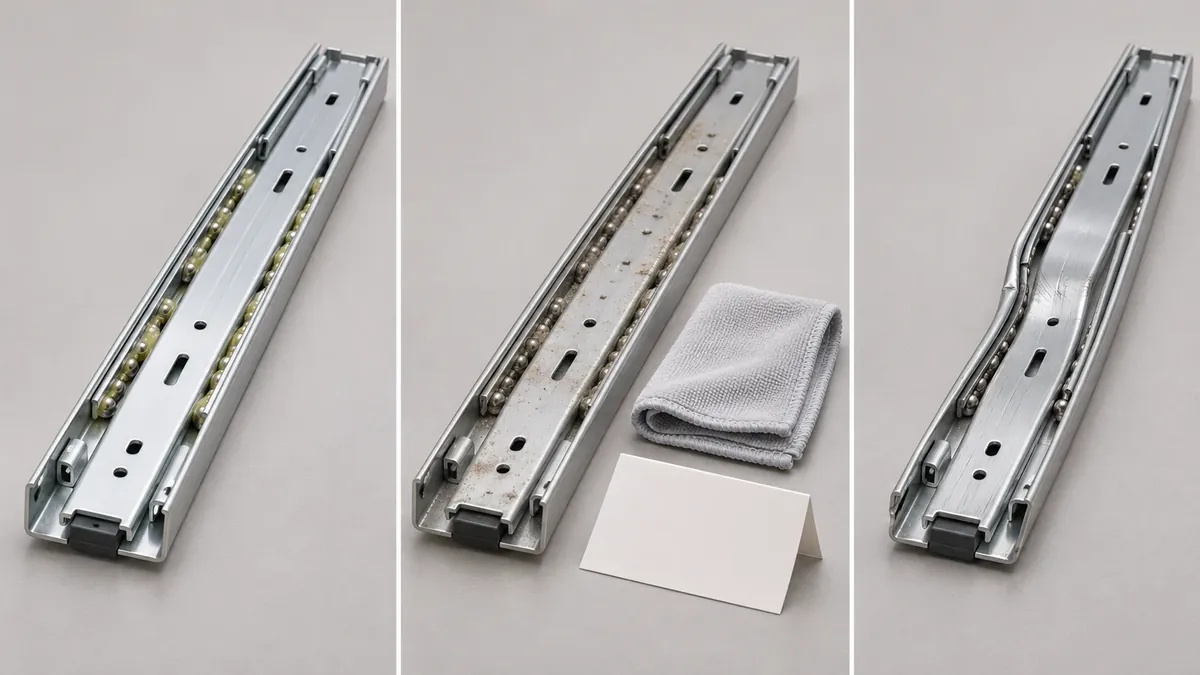
Use the specified access method. Some products have a disconnect feature; others may not. Do not generalize the release direction from a different slide, and do not pry or dismantle a sealed assembly. If the maker’s documentation does not explain how the drawer can be removed or accessed, seek product-specific support before proceeding.
Apply a suitable amount only to the locations the manufacturer identifies. The purpose is to restore the intended lubricant at the rolling or sliding interface, not to fill a rail channel or coat the entire cabinet. Excess grease can collect dirt and make later inspection less clear. Keep lubricant away from surfaces, components, and surrounding products that are not listed for application.
After service, reassemble and cycle the slide only as directed. Observe whether motion has changed without treating that observation as a formal load, endurance, or safety test. If the symptom remains, stop adding material. Re-check the alignment, fasteners, damage, and model instructions, or contact the slide maker. A short hand-operated check cannot establish a rated performance result.
Why Must Cleaning and Lubrication Be Treated as Separate Decisions?
Cleaning removes unwanted material; lubrication supports movement at designated contacts. One does not automatically replace the other. A cleaner may leave residue, remove factory grease, or be incompatible with a finish. A lubricant may not dislodge dirt and can combine with contaminants. The buyer or maintainer needs to follow the actual sequence rather than treating a spray or wipe as a one-step repair.
Accuride’s guidance for its zinc-coated ball-bearing slides discusses compatible cleaning, removing detergent, drying, and then applying grease to the bearings or raceways without excess. This supports the conditional sequence for that scope. It does not establish one chemical formula or grease for every slide, a universal cleaning schedule, or that a zinc finish is unaffected by all bathroom cleaners.
A protective metal surface and a bearing lubricant also solve different problems. A zinc surface treatment is part of the rail’s surface condition; grease serves the moving interface. Lubricating a bearing track does not prove that the finish is protected from a corrosive cleaner, and a finish that appears intact does not prove the bearing contact has enough suitable lubricant. Keep both checks distinct.
Avoid using a household acid descaler just because the cabinet is in a bathroom. The setting does not make a cleaner appropriate for a slide finish or lubricant. Do not select a cleaner or grease based on a general claim that it is “for metal,” “waterproof,” or “multi-purpose.” Product compatibility and maintenance permission should come from the identified slide manufacturer.
What If the Drawer Still Sticks After Maintenance?
Do not keep adding grease as a default response. Recheck the mechanical and installation conditions. Is the cabinet opening square enough for the slides’ installation? Are left and right members installed at the specified positions? Are fasteners secure and in the correct holes? Is the drawer front or box rubbing? Is there visible deformation or a damaged bearing? Has the load or use condition changed from the project assumptions?
If the slide maker’s instructions include an approved adjustment, use that procedure. Otherwise, do not improvise by bending a member, removing a stop, changing a mounting hole, or using an unverified shim. A changed geometry can create a new problem or invalidate the fit. For installation-specific guidance, consult the existing drawer slide types guide, which addresses that separate task.
If the rail is visibly damaged or the issue began after impact, identify the affected side and model and contact the supplier or maker. If a release latch is part of the assembly, refer to the specific drawer slide disconnect and accidental-removal latch guide. The latch topic is not a lubrication instruction, and the user should not force a disconnect based on a generic drawing.
After a documented cleaning and lubrication procedure, compare movement under the same conditions as before, but keep the observation modest. If the drawer is unloaded in one check and heavily loaded in another, the results are not directly comparable. If the user has no defined test method or acceptance criteria, describe what was observed instead of declaring that the slide “passes” a performance test.
How Should Product Teams Write Drawer-Slide Care Instructions?
Product teams buying a slide for a cabinet or home-storage product should ask the slide supplier for care and maintenance text tied to the exact model. The information should state whether the slide is factory lubricated, whether routine re-lubrication is expected, which environments or cleaning events change the maintenance need, whether the drawer may be disconnected, what residue must be removed, and which lubricant or application method is authorized.
Keep the instructions at the correct specificity. If the supplier’s guidance applies only to ordinary ball-bearing slides, do not generalize it to all drawer systems. If a model’s cleaner compatibility is known only for a particular coating, name the model or surface condition. If the supplier has not provided a maintenance interval, do not invent one to make the manual look complete.
A buyer can request a concise service matrix:
| Condition | What to inspect | Next step |
|---|---|---|
| Normal movement, no unusual exposure | Model identity and user instructions | Follow the maker’s normal-service guidance; do not add a calendar-based step unless specified |
| Visible accessible dirt | Exact slide and approved cleaning method | Clean only if the maker permits it; remove residue and dry as directed |
| Slide cleaned or washed | Whether factory grease may have been removed | Re-lubricate only with maker-authorized product and location guidance |
| New resistance or uneven movement | Dirt, alignment, fasteners, damage, and both slide members | Diagnose before adding lubricant; escalate unresolved conditions |
| Specialty or unidentified slide | Product type and supplier documentation | Do not apply the standard ball-bearing procedure by assumption |
The matrix is a communication aid, not a replacement for the supplier’s manual. Attach the model number and source document to internal service instructions so that future revisions do not silently transfer a procedure to a different component.
For an OEM project, the drawer-slide supplier may be a separate component source from the metal-storage hardware manufacturer. Do not imply that Koitor produces a third-party slide unless project facts confirm it. Koitor Hardware’s supported scope is custom metal bathroom and home-storage hardware with manufacturing communication around drawings, samples, finish, assembly, and packaging. The customer and component suppliers remain responsible for verified model-specific service instructions.
What Common Lubrication Mistakes Should Buyers Avoid?
Adding grease on a fixed calendar without a model requirement. Some standard ball-bearing slides are factory lubricated for normal service. Follow the identified product’s maintenance instructions.
Assuming every stiff drawer lacks lubricant. Misalignment, loose screws, contamination, impact damage, or a bent rail may be responsible. Observe the mechanism before choosing a remedy.
Using a cleaner because it is common in bathrooms. A descaler or acid cleaner is not automatically compatible with a slide finish. Confirm compatibility for the exact product.
Leaving detergent or moisture in the track. The cited maker sequence includes residue removal and drying where its procedure applies. Do not skip steps from the actual instructions.
Applying an unknown lubricant or excessive grease. A generic “metal lubricant” claim does not establish compatibility. Excess may retain dirt and obscure the interface.
Forcing a disconnect or dismantling a sealed assembly. The correct release method is model specific. Use only the documented access route.
Treating a brief hand check as proof of rated performance. An informal observation is not a standardized load, cycle-life, or safety test.
Using one maintenance guide for every drawer mechanism. Ball-bearing slides, rollers, polymer systems, wood runners, and specialty products may differ. Confirm the component family first.
Before and after maintenance, record the same observable condition: which drawer, which slide model, the position where resistance occurs, whether the drawer is empty or under its normal specified load, and what service action was authorized. This record helps a buyer distinguish a change after cleaning from a pre-existing fit issue without claiming a laboratory result. If several cabinets use different slide models, do not copy one service note across the entire installation. Identify the component on each unit, attach the relevant maker instruction, and keep unresolved movement or damage as a separate service item. Consistent notes support a focused question to the supplier and reduce the temptation to repeat an unverified lubricant application.
How Should a Maintenance Record Separate Observation From Diagnosis?
A useful maintenance note records what was observed before it names a cause. Note which drawer and side showed resistance, whether the behavior appeared across the travel or at one position, whether visible contamination or damage was present, and what the drawer’s loading condition was during the observation. Record the slide model and any authorized service step that followed. This gives the slide maker enough context to ask a focused question without treating a brief user observation as a formal test result.
If a cleaning step is authorized, record the cleaner and method only as specified by the slide maker, along with the residue-removal and drying steps that were actually completed. If the product instructions do not name a lubricant or permit access to the track, leave that detail unresolved and request clarification. Do not write “lubricate drawer slides as needed” as a catch-all instruction when the model-specific maintenance conditions are not known.
This distinction also helps product teams update a care leaflet. A revised instruction should identify the component revision and the source document behind it. If the supplier changes its slide model, the old cleaning and lubrication text should be reviewed rather than copied automatically. A maintenance note is useful only when the product it describes can be identified.
When Should the Buyer Escalate Instead of Repeating Maintenance?
Escalate when the component identity is uncertain, the maker’s instructions do not cover the observed condition, or a visible defect remains after an authorized cleaning step. A rail that is bent, a bearing that appears damaged, a fastener that has loosened, or a mounting position that has shifted calls for a different review from ordinary dirt removal. Record the symptom and product model, then ask the slide supplier or responsible service owner what inspection or replacement path applies. Repeated lubrication without a documented basis can hide the original condition and make later comparison harder. If a safety or installation issue is suspected, keep the assembly out of service according to the responsible product procedure rather than treating lubricant as a fix.
Buyer Checklist Before Specifying a Slide or Care Guide

- Is the exact manufacturer and slide model recorded?
- Does the supplier say the product is factory lubricated for normal service?
- Which usage or environmental conditions change the care instructions?
- Is cleaning permitted, and which cleaner is compatible with the named surface?
- Must detergent or another residue be removed, and how should the rail be dried?
- Does the product have a documented disconnect feature?
- Which bearing track or contact is lubricated, and with what maker-approved product?
- Is the amount or application method specified?
- What conditions should trigger inspection or supplier support instead of additional grease?
- Are specialty slides clearly excluded from a general maintenance procedure?
Save the answers with the product revision and manual. If the supplier has not answered a field, label it unknown and request clarification before writing end-user care instructions. Do not turn missing evidence into an invented product recommendation.
الأسئلة الشائعة
Should I lubricate new ball-bearing drawer slides?
Not automatically. The maker may supply them already lubricated for normal service. Check the exact product instructions before adding anything; do not transfer advice from a different model.
How often should drawer slides be re-greased?
There is no universal interval supported for every slide. Follow the model’s maintenance schedule and environmental guidance. If no interval is specified, do not invent one.
Can I use a household cleaner on metal drawer slides?
Only if the manufacturer confirms it is compatible with the exact slide and finish. A bathroom location does not make an acid descaler or multipurpose cleaner suitable.
What if a drawer sticks after cleaning?
Stop adding lubricant and inspect the model, alignment, fasteners, contamination, and visible damage. Follow the maker’s approved adjustment or service instructions and contact the supplier if the cause remains unclear.
Does grease protect the slide from corrosion?
Do not infer that from the presence of lubricant. Surface treatment and bearing lubrication have distinct functions. The finish and cleaner compatibility should be evaluated separately from the moving interface.
المصادر
- Accuride Europe: Do Ball Bearing Drawer Slides Need to Be Lubricated?
- Accuride Europe: How to Clean Metal Drawer Slides
- Accuride US: How to Clean and Lubricate a Drawer Slide
اعمل مع شركة «كويتور» للأدوات
Discuss a Custom Metal Storage Hardware Project
Share a drawing or sample, component interfaces, finish, assembly needs and expected quantity. Koitor Hardware can review the defined metal hardware manufacturing scope; model-specific drawer-slide service instructions should come from the slide maker.
OEM / العلامة التجارية الخاصة
حوّل دليل التوريد هذا إلى موجز منتج
يرجى إطلاعنا على المنتج المستهدف، والحجم، والتشطيب، وكمية الطلب، ومتطلبات التغليف. وسيتلقى فريقك تقييمًا عمليًّا لإمكانية التصنيع قبل تقديم عرض الأسعار.


 English
 Español
 Português
 Français
 Deutsch
 العربية