

Buyer Decision and Project Scope The buyer should document art drying rack shelf size as a named requirement. The buyer should record the exact "art drying rack shelf size" requirement in the sourcing file.
Buyer Decision and Project Scope
Direct answer: check usable support and the loading path with the actual sheet
For a metal art-drying rack, an importer should compare the actual sheet or substrate with the usable support area, contact layout, clearance to adjacent shelves, and loading path. A nominal shelf dimension or advertised shelf count does not show whether a specific sheet can be placed, supported, and removed in the intended rack configuration. Ask the product maker which substrates and operating arrangements its product information covers.
Manufacturer examples separate different rack configurations and support features. AWT distinguishes specialty, mid-range, and heavy-duty products and limits one overhang description to narrow rigid substrates. Its Tensor product page describes mesh, a backstop, retaining strip, shelf supports, and a tray-locking feature as separate design elements. Copernicus’ parts list identifies racks, spacers, paper catches, and locking-bar arms in a specific model. These are model-specific product descriptions, not universal rack rules or Koitor art-rack claims. See AWT’s drying rack range, AWT Tensor, ، و Copernicus’ assembly parts list.
This guide is a B2B product-specification aid for non-powered metal racks. It does not specify drying time, sheet load, spring or locking adjustments, student safety, solvent or heat resistance, or a product certification.
Define the sheet and its condition
The buyer should state what the rack is intended to support: paper, a print, a rigid board, or another named substrate. Record the supplier or product reference, nominal size, actual edge dimensions where relevant, orientation, and whether the item is flat, flexible, wet, curled, or otherwise in a condition that changes how it is handled. The rack supplier should confirm which conditions its product information covers.
“Paper” is too broad to specify the use. Different sheet products can have different rigidity, thickness, edge behavior, and handling needs. A rigid panel and a flexible sheet of the same format may interact with a wire shelf differently. The article does not calculate sag or set a minimum stiffness; the buyer should provide the actual reference substrate and have the responsible product maker or reviewer assess it.
If a display will be used with multiple formats, list each. A shelf that supports one sheet may not offer the same usable edge support for a larger sheet or a different orientation. Identify whether the format may rotate and whether any retainer or backstop changes the available area.
Distinguish a dry reference sheet from the intended production or use condition. If the buyer’s application involves a wet medium or coating, the responsible product owner must confirm whether the rack and finish are suitable. Do not assume a generic metal finish can contact all inks, solvents, coatings, or wet materials.
Separate nominal size from usable support area
A catalog may state overall shelf width and depth, but the frame, wire spacing, stop, or support bars may reduce the continuous area available to a particular substrate. Ask the supplier how shelf dimensions are measured and whether the stated size refers to the outside frame, support surface, or another reference.
Map the sheet outline onto the actual support layout. Identify which edges rest on the rack, where gaps occur, and whether any portion extends beyond a support. Do not assume an overhang is acceptable because a different model or substrate description mentions it. Ask for the maker’s specific approval for the named substrate and rack configuration.
A retaining strip or backstop may improve location in one use but take up part of the usable shelf envelope. A divider or frame member can also restrict the path through which a sheet enters. The buyer should consider both the static support area and the movement needed to load the sheet.
The buyer can request a drawing that shows the inside opening, relevant wire spacing, retainer position, and shelf orientation. If the supplier provides only overall dimensions, ask which product areas are intended to support the sheet. Do not fabricate a universal clearance threshold or convert the drawing into a load rating.
Check loading and removal with the rack assembled
The sheet must pass through the available opening in the rack’s intended operating configuration. Check the entry path, hand access required by the stated workflow, edge clearance, and the positions of adjacent shelves or components. If shelves move, raise, tilt, or lock, follow only the product maker’s instructions for that model; this article does not describe adjustment or repair.
A sheet can fit within the shelf outline and still be difficult to load if a crossbar, backstop, or neighboring shelf blocks the approach. A buyer should observe insertion and removal with the actual reference substrate and record any contact or obstruction. That observation does not establish safe operation or suitability for every user.
Record whether the review used a fixed shelf position, a movable shelf, or a specific operating state. If the product has multiple configurations, assess the ones the buyer intends to sell or specify. Do not infer that a maximum shelf count equals the number of positions usable for every sheet format.
If the buyer cannot review the assembled rack, identify which details remain unverified. A drawing review can identify likely interference, but it is not the same as a physical sample observation. A photo may not reveal the movement or clearance of adjacent components.
Create a sheet-to-rack review record
| Review item | Buyer record |
|---|---|
| Rack identity | Manufacturer, model, revision, drawing |
| Reference substrate | Type, source, size, condition, orientation |
| Shelf dimensions | Measurement reference and stated source |
| Support layout | Contact points, gaps, frame or wire pattern |
| Retainers | Backstop, strip, catch, spacers or other included parts |
| Usable envelope | Areas available after frame and retainers |
| Loading path | Entry direction, opening, adjacent shelf state |
| Sample observation | Rack/sample ID, date, reviewer, notes |
| Maker evidence | Supported substrate or overhang statement and scope |
| Limits | Unreviewed formats, conditions, claims, or configurations |
The review record is a buyer worksheet, not a testing standard. The project can add fields required by its quality process. Record facts, observations, and assumptions separately. For example, “sample sheet contacted the adjacent crossbar during loading” is an observation. “The model is unsuitable for all large sheets” is a broader conclusion that requires more evidence.
Ask the maker about overhang and edge support
If the intended sheet extends beyond a support area, ask the product maker whether that arrangement is covered for the exact model and substrate. A manufacturer may describe an overhang for a narrow rigid material; that statement should not be transferred to a flexible sheet, another model, or a different loading orientation.
Record the allowed arrangement exactly as the maker states it, including any conditions. If the product page is ambiguous, request clarification rather than interpreting a promotional phrase as an engineering limit. Do not infer a safe overhang amount, load, or sheet deflection from a photograph.
If the buyer needs a specific overhang or edge-support claim for its product listing, request suitable evidence from the responsible product maker. Koitor does not have confirmed art-rack testing or product history to support such a claim. An importer should not advertise a universal substrate capacity based only on overall shelf dimensions.
| Buyer input | Record before approval |
|---|---|
| Named product or component | Exact model, code, and revision |
| Interface or project condition | Reference sample, drawing, or site input |
| Evidence and owner | Source, reviewer, and unresolved questions |
| Release status | Approved scope and excluded claims |
Product Fit and Specification
Buyer checks for art drying rack shelf size
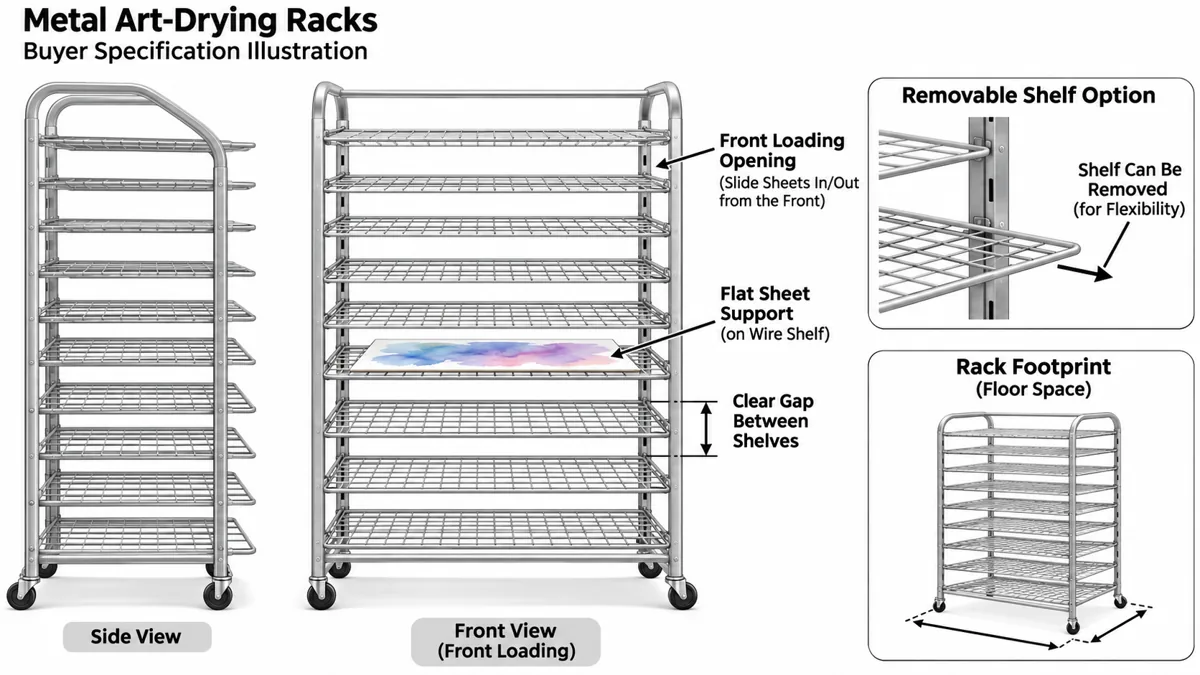
Compare rack configurations and shelf counts
Different rack designs can use different support surfaces, shelf spacing, retainers, and access arrangements. Compare complete model details rather than treating specialty, mid-range, and heavy-duty labels as standardized classes. Those names are supplier-defined unless a formal standard is specified.
The number of shelves is not automatically equivalent to usable capacity. The buyer should define which sheet formats each shelf position accommodates, whether adjacent sheets can be loaded independently, and whether a position becomes unavailable under a chosen format. The supplier’s model data should substantiate any advertised count or configuration.
If a rack includes spacers, catches, or locking arms, identify them by model and confirm which pieces are included in the quote. A missing component can change how the rack is used, but this guide does not advise adjusting or repairing mechanisms. Follow the maker’s current manual for operation and maintenance.
Define the sample acceptance plan
Before ordering a production-intent sample, decide what it must demonstrate. The plan can identify the rack model and revision, reference sheets, operating positions, support areas to observe, loading/removal sequence, visible contact issues, and documentation expected. Avoid unsupported numerical limits; set criteria with the product maker or qualified reviewer based on the real application.
The sample record should say whether it represents the production-intent configuration or a prototype. Identify changes from the requested design, if any. If finish, wire spacing, frame geometry, shelf count, or a retainer changes after approval, determine whether the change affects the reviewed support or access and whether a new sample is needed.
Separate visual acceptance from functional observations. A finish sample may help review appearance but does not prove contact suitability with a medium. A sheet fitting in one sample does not prove load capacity, durability, or drying performance.
Write an RFQ that is specific but does not invent test requirements
An importer RFQ should identify the intended substrate, formats, condition, orientation, and required loading path. Attach a drawing or reference sample if available. Ask suppliers to state which shelf areas support the sheet, how dimensions are defined, what retainers are included, and which model documents apply.
Request a sample that represents the intended configuration and ask for the current manual or assembly document. If there are multiple shelf options, list the buyer’s required arrangement and have the supplier identify any assumption. Do not copy another maker’s feature names or claim that one supplier’s mechanism is compatible with another’s.
If the quote includes only the rack, list accessories or catches separately. State the finish, packaging, quantity, delivery scope, and product documentation requested. Keep intended-use approvals and user safety obligations with the relevant product owner or project reviewer.
Common buyer mistakes
- Treating overall shelf dimensions as the entire support area.
- Assuming an advertised shelf count suits every sheet size.
- Applying a rigid-sheet overhang note to a flexible substrate.
- Ignoring the loading path and neighboring shelf positions.
- Assuming a retaining strip or catch is included without checking the quotation.
- Treating a dry mock sheet as proof for a different medium or condition.
- Assuming a drawing or photo proves actual assembled clearance.
- Turning a sample fit observation into a load, durability, or drying claim.
- Adjusting or repairing locking or spring mechanisms without the model’s instructions.
- Claiming Koitor art-rack manufacture or certification without verified company facts.
الأسئلة الشائعة
Sample Review and Change Control
Is the catalog shelf size the usable sheet size?
Not necessarily. Confirm how the maker defines the dimension and which areas provide support after frames and retainers are considered.
Can a sheet overhang the shelf?
Only if the responsible product maker supports that arrangement for the named rack and substrate. Do not generalize from another model or a rigid material.
Does a higher shelf count mean more usable capacity?
Not for every format. Check the positions, spacing, support, and loading path for the actual sheet configuration.
Can I approve a rack from a drawing?
A drawing can support a review, but it may not show every handling condition. State which observations remain unverified and decide whether a physical sample is required.

Does the sample show that the rack dries artwork correctly?
No. A fit and loading review does not establish drying time or process performance. Those claims require evidence from the responsible product maker.
Can the rack be used for wet, coated, or solvent-treated sheets?
Do not assume so. Ask the maker about the exact medium, finish, and intended use, and obtain relevant evidence.
Distinguish format compatibility from a general capacity claim
A buyer may need a rack to accommodate several paper or board formats. Record each format separately and identify whether the sheet is loaded horizontally, vertically, or in another maker-approved orientation. A general claim that the rack has many shelves does not explain how many positions remain useful for each format.
A simple configuration table can connect a product code to its intended sheet set:
| Rack reference | Sheet reference | Orientation | Shelf state | Support/access note | Evidence status |
|---|---|---|---|---|---|
| Named model and revision | Named substrate and size | As specified | Fixed or maker-defined movable state | Observed or supplier-documented | Document, sample, or open |
This record is intentionally descriptive. It does not assign a load or state that every sheet of the same nominal size behaves identically. If formats differ in rigidity or condition, list them as separate use cases and request confirmation from the product maker.
If the buyer sells a rack for a broad range of users, identify which configurations are actually represented in the sample review. Avoid allowing one demonstrated sheet to stand for every advertised format. The product page and sales documents should match the reviewed scope.
Purchasing Questions and Practical Decisions
Control changes to the rack and reference sheet
A rack revision can alter frame opening, wire spacing, support members, shelf spacing, stops, or included accessories. A substrate reference can also change in size, stiffness, edge treatment, or intended condition. The buyer should identify changes that trigger a review rather than assuming a model number or product family remains identical.
Request supplier change notice for product revisions that affect the buyer’s documented configuration. When notified, compare the revision summary with the review record and ask which support or access observations remain applicable. A purely cosmetic packaging change may require a different review than a geometry change, but the buyer should document that judgment.
For a substrate change, update the reference ID and review whether the shelf envelope and loading path still apply. A new paper stock or board thickness may appear similar yet behave differently. This article does not provide a mechanical formula; use the actual sample and supplier guidance.
Keep the previous approved drawing and sample record. Mark superseded references clearly and show which order or lot used each revision if the buyer’s system requires that trace. Do not leave an old sample on a product table without its identifier, where future staff could mistake it for the current version.
Coordinate product data and documentation
The RFQ and order should identify the exact rack model, shelf count/configuration, included catches or retainers, finish, packaging, and documents. Ask the supplier for the current assembly and operation manual and identify who is responsible for ensuring the correct version reaches the end user. Do not paraphrase instructions for a spring, lock, or lifting mechanism from an unrelated model.
If the buyer imports a rack for an institution or studio, it may need to provide a product data sheet, parts list, or assembly document to its customer. The buyer should distinguish supplier-provided information from its own marketing text and preserve applicable limitations. A source document for one model should not be reused for a different configuration without confirmation.
For any statement about cleaning, chemical contact, finish suitability, load, or user safety, ask the responsible maker or qualified reviewer for evidence specific to the intended product and environment. A generic metal fabrication capability does not substantiate those application claims.
What the buyer should ask during sample review
- Which exact rack model and revision does this sample represent?
- Where are shelf dimensions measured, and which areas support the sheet?
- Which reference substrates and conditions are covered by the maker’s guidance?
- Does any stated overhang apply to this model and this substrate, or to another configuration?
- Which frame, retainer, stop, or catch reduces the usable area?
- What shelf position or operating state should be reviewed?
- What accessories and documentation are included in the offered SKU?
- Which product changes require a new sample or document review?
- What application claims are not supported by the available data?
- Who owns final approval for the buyer’s specific use?
Write down the answers, supplier document revision, and unresolved questions. If the supplier cannot confirm a point, keep it open rather than filling it with a guess.
Avoid confusing an art rack with other drying equipment
An art-drying rack in this article means a non-powered metal support product. A buyer should not infer that it heats, ventilates, cures, or accelerates drying. If the intended process requires those functions, it is a different equipment scope and needs a qualified product source.
Likewise, a rack for hanging garments, a vertical document pocket, or a drawing clamp may share the word “rack” but answer a different handling question. The buyer should identify whether the material lies on a shelf, hangs from a support, or is retained by a clamp. The mechanism and use evidence cannot be transferred by noun alone.
Do not adapt instructions from one supplier’s locking bar or spring mechanism to another product. Follow the exact model’s current manual and contact its maker for operation, service, or repair questions. The procurement review here checks sheet support and access; it does not instruct users to alter a mechanism.
Delivery and sample record handoff
The purchase record should link the production order to the approved rack model and sample review. Identify the sample ID, reference sheet, drawing revision, finish, included accessories, and reviewer. If the buyer approved only a document review, state that clearly; do not describe the sample as physically validated.
When goods arrive, the receiving team can verify model labels and packaging against the order and note visible discrepancies through its normal process. This identity check does not establish support performance. If a wrong accessory or revised shelf configuration is received, preserve the carton and order reference and ask the responsible supplier to clarify before distribution.
For institutional supply, pass the current manual and product limitations to the distributor or end user through the agreed documentation channel. Avoid relabeling supplier instructions as a Koitor-tested use case. The product owner remains responsible for its own claims and operation guidance.
Practical takeaway
Specify the substrate, its condition and orientation, the usable support layout, and the loading path. Check the actual rack with the intended reference sheet and record which maker statements cover that model. Keep loading observations separate from capacity, safety, finish compatibility, and drying claims.
For a non-powered metal rack concept, share the drawing, intended sheet references, support and loading requirements, finish, packaging, and quantities for a scoped feasibility discussion. Koitor can discuss confirmed metal fabrication scope but does not claim art-drying rack production, educational-product approval, or drying performance. See the custom bathroom hardware manufacturer page for confirmed metal hardware scope or اتصل بـ «كويتور».
Scope a Metal Rack Feasibility Review
Share the intended sheet samples, rack drawing, support and loading envelope, finish, packaging, and quantity. Koitor can discuss confirmed metal fabrication scope; full application approval remains with the product owner.
OEM / العلامة التجارية الخاصة
حوّل دليل التوريد هذا إلى موجز منتج
يرجى إطلاعنا على المنتج المستهدف، والحجم، والتشطيب، وكمية الطلب، ومتطلبات التغليف. وسيتلقى فريقك تقييمًا عمليًّا لإمكانية التصنيع قبل تقديم عرض الأسعار.

 English
 Español
 Português
 Français
 Deutsch
 العربية