
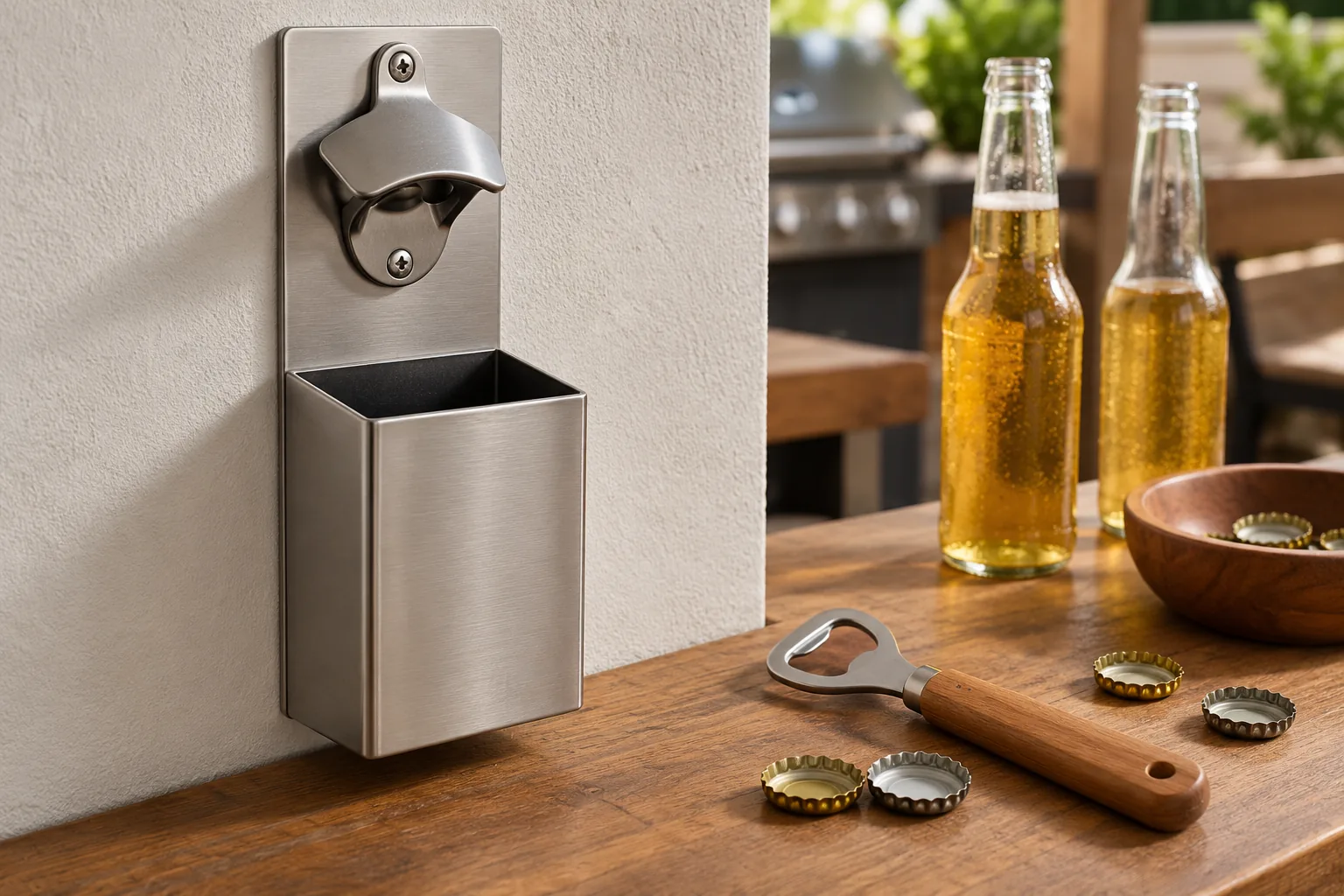
A metal bottle cap catcher should be approved as part of the exact opener-and-receiver arrangement that the importer intends to sell. Check where the opener sits, where a released cap travels, how the catcher mounts, whether hands or bottles interfere, and how the receiver is emptied. A catcher that looks compatible beside an opener may have a different release path, offset, projection, or mounting pattern. The useful acceptance unit is the paired sample and its pack list, not a generic claim that a cap catcher fits all openers.
Why should the opener and catcher be evaluated together?
The opening tool controls the cap’s exit path. The receiver must be placed where that path actually leads, while leaving space for the bottle, hand, and any surrounding wall or counter. A standalone photograph cannot prove those interfaces align. Buyers should therefore record the opener model or drawing and the catcher opening, mounting locations, and installed position as a matched configuration.
Supplier catalogs provide examples of paired products. Tablecraft lists a stainless cap catcher in a product family alongside a named opener pairing and mounting hardware. This shows that kit identity and component pairing are real purchasing details. It does not establish that another opener has the same release geometry, nor does it support a universal-fit claim. Keep any compatibility statement limited to the specific combination the buyer has reviewed. Keep that distinction explicit in a metal bottle cap catcher specification so a model-specific pairing is not presented as universal.
Prepare a reference set before issuing the RFQ:
- The opener model, mounting drawing or physical sample.
- The bottle styles and closure types expected in the target assortment.
- A representative cap sample, including any edge or liner features relevant to the opening method.
- The intended mounting surface and available space.
- The catcher sample or concept with its opening, depth and access route.
- The expected replenishment, cleaning and emptying routine.
If an opener is purchased from a second supplier, identify who coordinates the interface. The catcher manufacturer may control the metal receiver but not the opener’s cap-release direction. The importer should designate who owns the paired-system fit review and who supplies replacements or mounting hardware.
| Interface | What the buyer records | Why it matters |
|---|---|---|
| Opener | Model, orientation and mounting drawing | Defines the release position |
| Cap | Representative closure dimensions and sample | Confirms the intended item being collected |
| Drop path | Release location and receiver opening | Shows whether parts align in the reviewed setup |
| Wall or panel | Substrate, access and available clearance | Affects mounting and service access |
| Catcher | Opening, depth, removable parts and edges | Defines capacity and retrieval interface without assuming a rating |
| Kit | Included screws, opener, receiver and instructions | Prevents missing-component surprises |
How can buyers map the cap path and clearances?
Mark the opener’s installed reference points and the receiver’s corresponding position on a dimensioned sketch. Include the distance between the cap release point and catcher opening, the lateral alignment, and the projection of both parts from the wall or panel. Do not assume that a cap falls vertically just because the catcher is below the opener; the release motion and opener design can change direction.
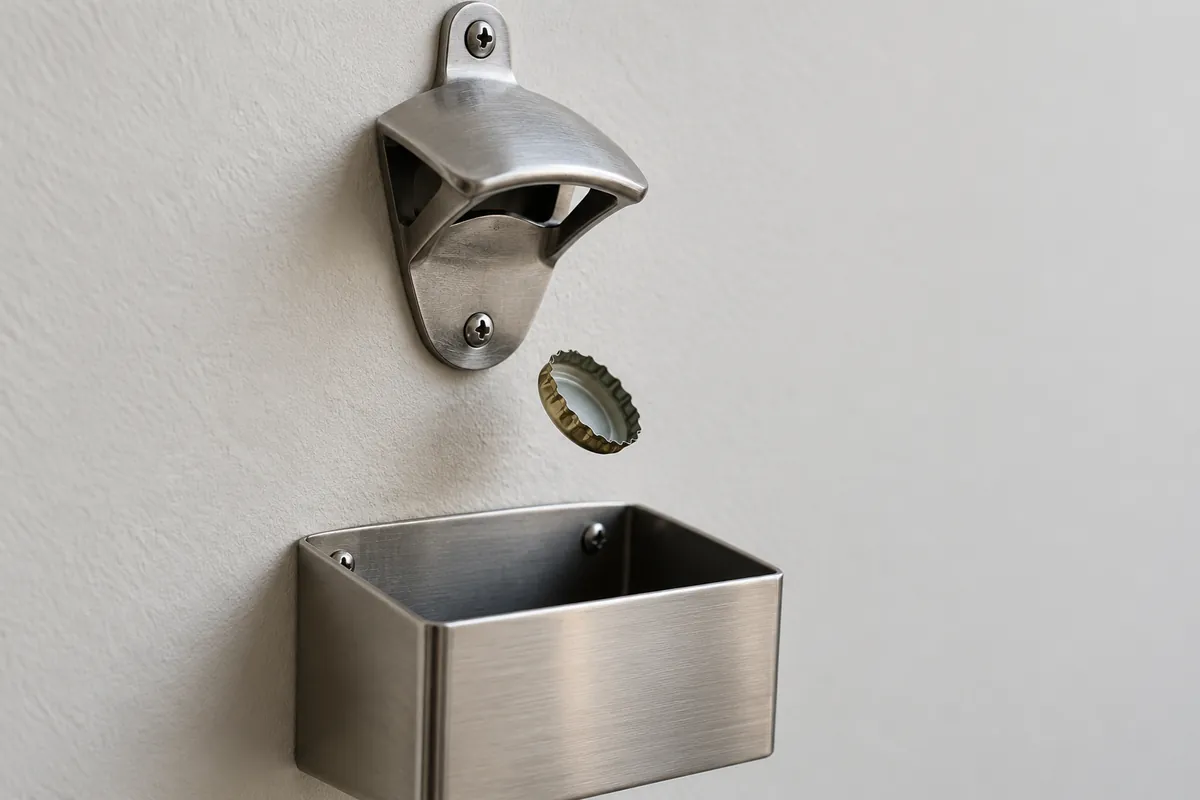
Run a sample check using the exact opener, catcher, mounting plate, fasteners, and representative cap. Observe the release direction and where the cap lands. The purpose is to verify the designed interface under an agreed setup, not to declare that every cap will be captured under every motion. If a buyer’s product statement depends on a capture rate or defined use condition, the responsible parties need a controlled test method and evidence for that claim.
Check user clearances at the same time. A bottle may need room beneath or beside the opener. The user’s hand may approach from a direction that overlaps the catcher lip. If a countertop, backsplash, shelf, or neighboring product restricts approach, include that in the installation sketch. A useful fit review records both the cap’s route and the operator’s movement.
Document the sample result with a simple layout:
- Identify the opener, catcher, fasteners and cap sample by revision.
- Mark the mounting surface and intended installation height.
- Record the receiver opening relative to the opener’s release point.
- Operate the opener in the expected manner with the reference bottle and cap.
- Note observed misses, rebounds, collisions, sharp edges or unclear retrieval.
- Agree on any design revision and repeat the same check after the change.
The buyer should avoid inventing an acceptance number during the test. If the product needs a measurable criterion, define the number of trials, cap types, operator motion and permitted result before testing. Record the evidence and its limits.
What mounting details belong in the drawing?
Separate the catcher mounting pattern from the opener mounting pattern. Record hole diameter, spacing, edge distance, screw direction, any slot adjustment, and whether the fasteners are included. Ask for the actual substrate assumptions: wood, masonry, metal panel, or another surface. A screw supplied for one substrate may not suit another, and no single fastener arrangement is right for every wall.
Show the installed projection and orientation. A catcher may sit below, alongside, or behind an opener depending on its design. If the receiver can be removed for emptying, note which direction it travels and how much free space is needed. If the opener and receiver attach to a shared plate, define whether the plate arrives assembled or whether the end user assembles it.
The purchase specification should also identify who is responsible for hardware that is sourced separately. A metal fabricator may form, punch, weld, grind, finish, assemble, and package metal components, while screws, bumpers, opener mechanisms or other bought-in parts may come from another vendor. Koitor’s approved company information does not establish production of a cast or machined opener head. Avoid writing a bill of materials that silently assigns an unconfirmed part to the metal supplier.
For private label, confirm whether the logo or printed instructions belong on the opener, catcher, packaging, or a separate insert. Do not copy another company’s protected marks or product shape. The buyer should provide authorized artwork and define who approves print placement and color.
How should emptying and cleaning access be approved?
A catcher can collect caps yet still be inconvenient if the user cannot remove or empty it. Identify the intended service method: lift-off receiver, open front, removable base, or another mechanism shown in the sample. The actual design determines the appropriate check. Do not assume a mechanism that has not been provided.
Simulate the emptying sequence with the installed sample. Check whether the receiver can be removed without taking down the opener, whether its contents can be poured or removed cleanly, whether fingers contact a sharp edge, and whether the catcher can be returned to its approved position. If the unit has a lid or retaining feature, test its operation and record how it is secured. Avoid claiming a capacity from a simple visual estimate; request a supplier drawing and state the buyer’s intended service interval if that informs design.
Cleaning requirements need similar specificity. Ask the operator or importer to define the expected soil, cleaning agent, cleaning frequency and any finish restrictions. A model-specific care instruction cannot be generalized to all stainless or coated products. Do not claim dishwasher suitability, corrosion resistance, or food-contact compliance without evidence for the exact item and use.
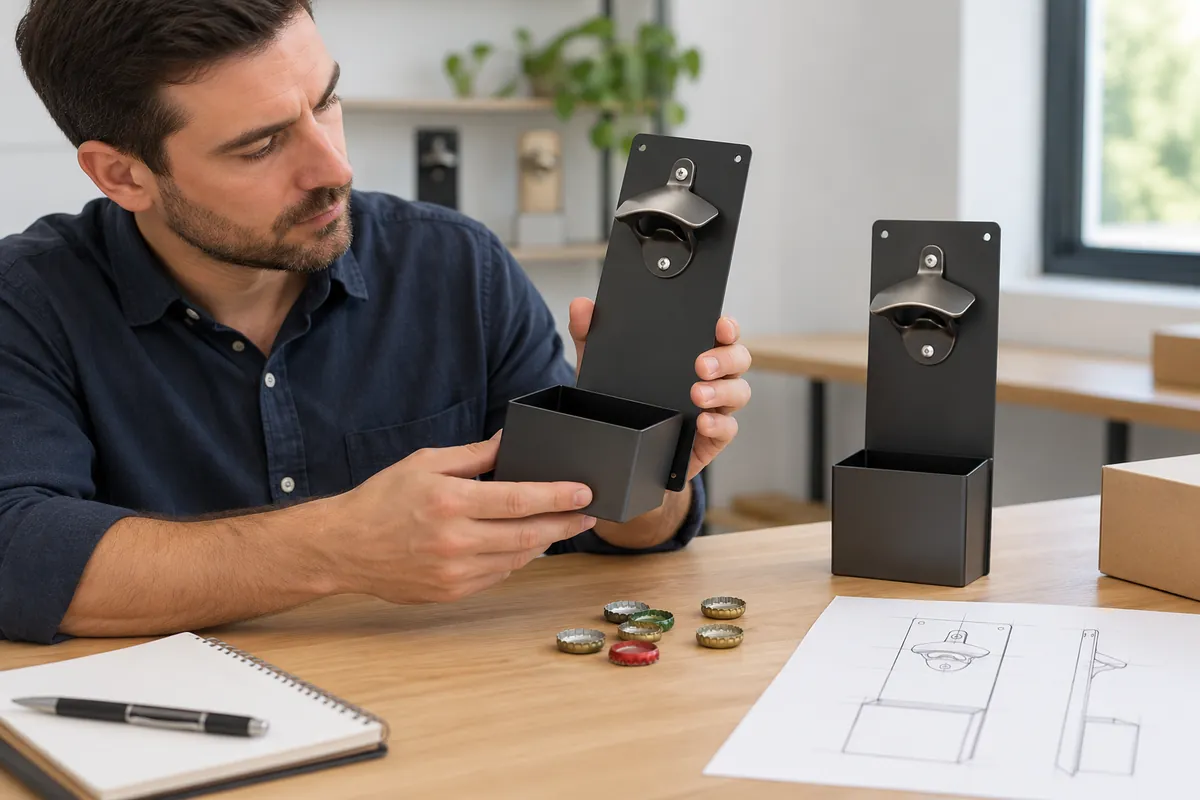
The trial should include both a normal service cycle and the end-of-cycle task: retrieve caps, empty the receiver, clean as specified, and reinstall. Watch for a cover that blocks access, a receiver that is awkward when full, or an installation that makes removal impossible near a corner. Record the tested configuration rather than relying on a statement such as “easy to empty.”
How can the importer define a complete kit and SKU?
A “cap catcher” SKU can mean a receiver only, an opener and receiver set, or a multi-piece kit with mounting hardware. The RFQ should name the exact scope. This matters for cost, packaging, after-sales questions, and replacement orders. If the opener is not included, say so in product copy and packaging.
Use a controlled bill-of-materials table:
| Component | Included? | Supplier or owner | Sample / revision reference |
|---|---|---|---|
| Metal catcher body | Yes/No | Named supplier | Drawing and finish reference |
| Bottle opener | Yes/No | Named supplier | Model and orientation |
| Mounting plate | Yes/No | Named supplier | Hole pattern |
| Fasteners and anchors | Yes/No | Named supplier | Substrate assumptions |
| Removable parts | Yes/No | Named supplier | Emptying method |
| Instructions and labels | Yes/No | Importer or print supplier | Approved artwork |
| Protective packaging | Yes/No | Named supplier | Packed sample |
A separate-component assortment may simplify replacement, but it transfers compatibility coordination to the buyer. A combined kit can reduce user interpretation only if the included opener, receiver and fixing parts have been checked together. Neither sourcing model is automatically better. The importer should compare landed kit scope, refill or spare availability, package dimensions, and the clarity of the end-user instructions.
Packaging should protect the visible finish and prevent loose metal components from rubbing together. Ask for a packed sample and inspect the receiver lip, corners and surface after unpacking. Define the number per inner pack, any separator, bag, screws, instruction sheet, carton label and barcode. A drop or transit test, if required, should use the buyer’s chosen method and shipping configuration; no result should be implied from a carton photograph.
Which sourcing errors should be prevented before production?
One error is pairing by appearance alone. Two products may both be wall-mounted and still have different centers, offsets, or movement. Require the named opener and catcher to be present at the sample review.
Another is treating the opening as the whole interface. The receiver opening, depth, brim and emptying method matter, but so do the cap release point, user hand, bottle body, wall surface and mounting projection. Confirm all together.
A third error is leaving substrate and fasteners vague. A sample installed on a workshop board does not prove the supplied screws suit every market wall. The buyer should define the intended surfaces and either specify hardware by substrate or make the limitation clear in instructions.
A fourth is approving the sample but changing a component later. Replacing the opener, moving the receiver, changing the cap type, or revising the wall plate can change the assembly. Treat such changes as a new fit question and identify the revision in the purchase order.
A fifth is overstating the product claim. “Works with every opener,” “captures every cap,” “rust-proof,” and similar language needs evidence that covers the claimed scope. A sample check supports only the checked configuration and conditions.
What should the buyer include in the RFQ?
A concise RFQ can prevent several rounds of clarification. Attach a dimensioned layout, opener and cap references, clear mounting assumptions, and a statement of supplied components. Include these items:
- Target markets and intended venue.
- Opener model or authorized drawing and mounting orientation.
- Representative bottle/cap assortment for the fit trial.
- Catcher opening, depth and removal requirements.
- Mounting surface and available installation envelope.
- Metal, finish, visible-face and edge requirements.
- Whether the opener, mounting hardware, instructions and labels are included.
- Target quantity, trial-order expectations and repeat-order plan.
- Private-label artwork and packaging/label requirements.
- Sample sequence, approval owner and acceptance record.
- Any requested performance claim and its evidence/test protocol.
Keep quote assumptions visible. If the supplier has proposed an alternative opening or mounting pattern, request a separate drawing and identify it as an alternative rather than silently mixing it into the main offer. This makes supplier comparisons clearer and helps preserve the approved sample as a reference for reorders.
How can Koitor contribute without overstating the product range?
Koitor Hardware is a family-owned custom metal hardware manufacturer focused on bathroom and home-storage hardware. Documented experience with bending, punching, welding, grinding, polishing, finishing, powder coating, assembly, packaging and sample review can support discussion of a metal receiver body, mounting plate, finish and protection approach. It does not prove an existing Koitor cap-catcher SKU, licensed design, opener mechanism production, or a tested capture result.
A bounded feasibility request should include the reference opener, cap sample, intended mounting surface, receiver concept, installation sketch, metal/finish preference, target quantities and packaging expectation. Identify any bought-in opener, fastener, pad or instruction component and say which supplier owns its data. Koitor can then clarify whether the metal part fits its documented process knowledge and what information is needed for a sample discussion.
For background, buyers can read the Koitor OEM home-storage hardware page و custom metal storage-rack information. These explain the company’s core metal-hardware context; they are not a product listing for this adjacent accessory. For a specific concept, share drawings and the paired components through the contact page.
What should be recorded at paired-sample approval?
Record the complete assembly, not just the receiver. The approval sheet should identify component models, drawings, finish references, mounting hardware, cap/bottle examples, orientation and the tested configuration. List any items that were not included or that were not checked. Separate visual approval from fit and operating observations so that a good-looking sample is not mistaken for a fully evaluated assembly.
A practical sign-off should capture:
- Approved opener and catcher revisions.
- Receiver-to-opener position and installation drawing.
- Reference cap and bottle examples.
- Release path and observed landing during the agreed trial.
- Hand, bottle and nearby-surface clearance.
- Emptying and cleaning sequence reviewed.
- Fastener scope and intended substrate.
- Finish, edge and packaging observations.
- Open issues, acceptance method and responsible owner.
- Changes that require a new sample review.
When a test reveals a mismatch, decide which party changes the opener position, catcher shape, mounting plate, or kit contents. Then repeat the relevant checks using the revised sample. The acceptance record should not promise performance outside the test scope.
A metal bottle cap catcher is a paired interface decision. When the buyer specifies opener, cap, mounting, service and pack scope together, the supplier can quote a more comparable item and the importer has a clearer reference for future reorders.
الأسئلة الشائعة
Can a metal cap catcher be paired with any wall-mounted opener?
No universal compatibility should be assumed. Verify the opener’s release position, catcher location, cap path, mounting pattern and surrounding clearances with the actual samples.
Does a sample trial prove that every cap will be caught?
No. It proves only what was observed under the agreed components and method. Any broader capture claim needs a defined test scope and supporting evidence.
Should mounting screws be included in the kit?
That depends on the markets and installation surfaces. The RFQ should say whether fasteners are included, list their assumptions, and explain if the buyer or installer must select anchors for the actual wall.
How can buyers evaluate whether the catcher is easy to empty?
Install the sample, operate it through the intended service sequence, and observe removal, retrieval, cleaning and reinstallation. Record the exact method and any limitations.
اعمل مع شركة «كويتور» للأدوات
Evaluating a Metal Cap-Catcher Concept?
Share the opener and cap references, installation sketch, receiver requirements, finish and target kit scope for a bounded metal-component feasibility discussion.
OEM / العلامة التجارية الخاصة
حوّل دليل التوريد هذا إلى موجز منتج
يرجى إطلاعنا على المنتج المستهدف، والحجم، والتشطيب، وكمية الطلب، ومتطلبات التغليف. وسيتلقى فريقك تقييمًا عمليًّا لإمكانية التصنيع قبل تقديم عرض الأسعار.


 English
 Español
 Português
 Français
 Deutsch
 العربية