
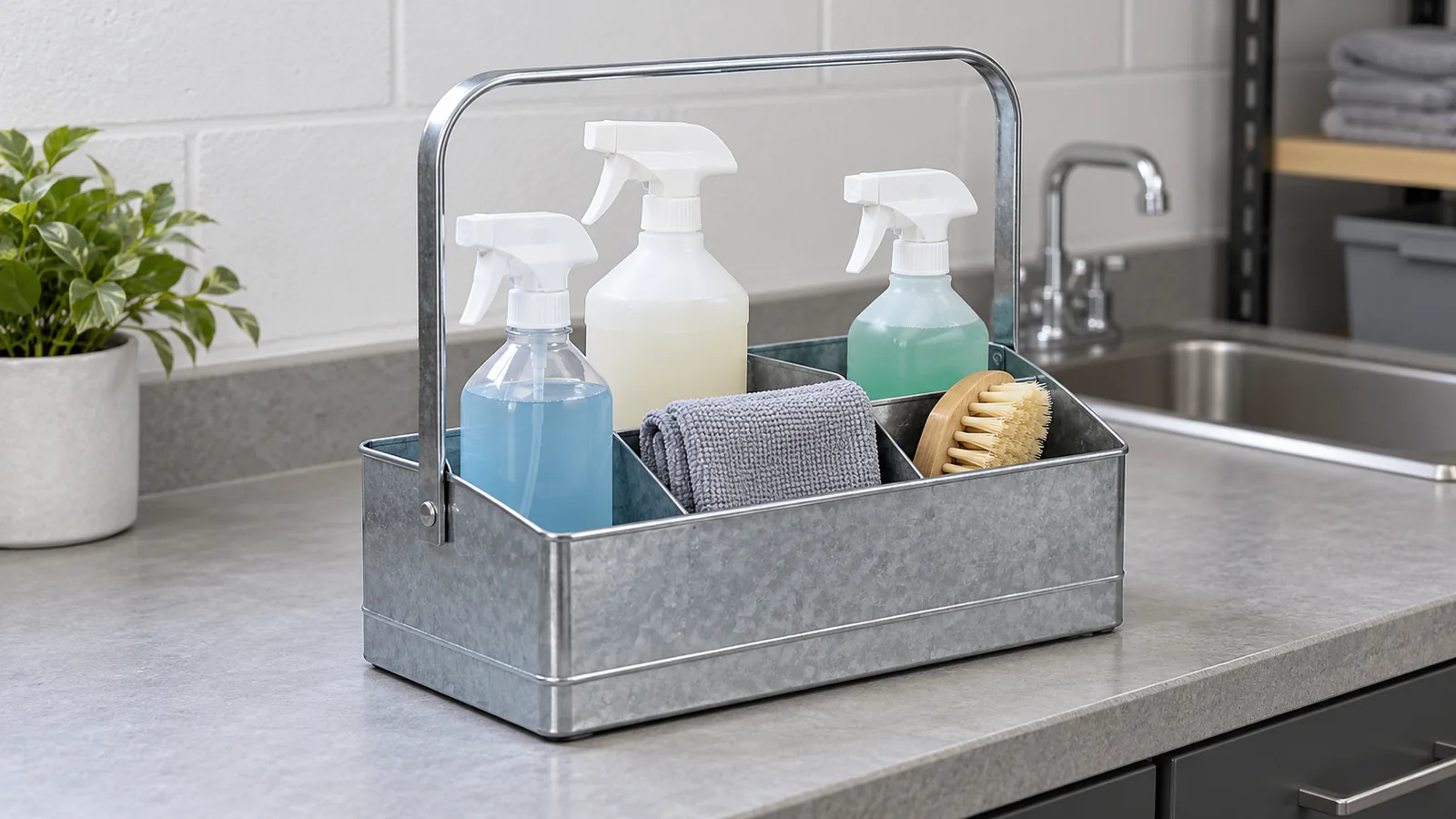
A metal cleaning caddy can look roomy on a product page and still frustrate the buyer’s assortment. A spray bottle may fit by body diameter while its trigger head collides with a divider or the carry handle. A cloth can consume the space expected for a brush. The overall basket may be large, yet a narrow compartment opening can make a frequently used bottle awkward to remove.
For an importer, the useful question is not simply whether a caddy holds cleaning products. It is whether the exact assortment planned for a target market fits, remains accessible and can be carried in the arrangement the product description implies. Approve that question using named reference bottles, their actual trigger shapes, a buyer-defined loaded configuration and a recorded sample review. There is no universal bottle set, compartment count or safe carrying load that applies to every design.
This guide focuses on product specification and sample acceptance. It does not assess chemical storage safety or compatibility, prove corrosion performance, or claim that Koitor currently offers a portable cleaning caddy. The images are conceptual references for the decisions described here.
What should the buyer define before requesting a quote?
Begin with the assortment promise. List the products a customer is expected to carry together: for example, a set of spray bottles, a narrow brush, a cloth and a small refill container. Separate required items from optional accessories. If the caddy is intended for a particular retailer or private-label range, use representative products from that assortment rather than selecting convenient substitutes after the metal layout has already been approved.
For each bottle, record the filled and empty reference sample, overall height, maximum body width or diameter, base shape, shoulder transition, trigger-head width and projection, and any cap or nozzle that extends beyond the body. A bottle’s widest point is not always its body: a trigger may be the first feature to hit a neighboring bottle or the caddy’s handle. Keep the physical samples tied to the project by SKU, source, revision and date, and photograph the test arrangement so later design changes can be compared against the same baseline.
Define whether bottles must stand upright, whether one compartment is reserved for a cloth or brush, and whether the assortment may vary across markets. If multiple bottle sizes will be sold, identify the intended range and decide which combination is the critical fit case. A “fits most bottles” claim is difficult to verify when “most” has not been translated into actual reference products and measurable envelopes.
In the request for quotation, distinguish the metal caddy dimensions from the usable compartment openings. Provide the target outside size, partition layout, handle style, finish and any known packaging constraints, but ask the supplier to identify assumptions that remain unresolved. A drawing can depict a bottle-shaped space without proving that a real trigger bottle can be inserted, lifted and returned without snagging. The purpose of early review is to surface that difference before finalizing a sample.
How do bottles, triggers and compartments interact?
Measure the usable opening at its narrowest point, not only the compartment’s floor area. Dividers may taper, lean or meet a rim, so a wide base does not guarantee a wide entrance. For each reference bottle, check insertion and removal in the intended orientation. Include the shoulder, trigger and any cap because the bottle may need to tilt slightly during handling even if it stands vertically once stored.
The trigger head deserves its own clearance check. It can overhang the bottle body and occupy the space above a neighboring divider. A bottle may fit alone but interfere with the handle, another trigger or the caddy’s rim when the full set is loaded. Record the tightest relationship: which bottle is next to which, the direction each trigger faces, and whether users are expected to turn the nozzle before storage. Do not silently assume that the customer will rearrange the bottles after every use.
Compartment partitions should reflect the actual assortment rather than an arbitrary count. A larger open bay may suit bulky spray bottles; narrower sections may keep brushes upright or separate smaller containers. Those are layout choices, not universal rules. A divider that improves organization can reduce flexibility if it limits the base width needed for a future bottle revision. If the buyer expects range extensions, compare a fixed partition plan with a more open configuration and assess the trade-off in stability and organization.
| Reference item | What to record | What to check in the caddy |
|---|---|---|
| Spray-bottle body | Maximum width or diameter, base shape and filled sample | Can it pass through the opening and stand in the intended position? |
| Trigger and nozzle | Overall height, width, projection and orientation | Does it clear the handle, rim, divider and neighboring bottle? |
| Brush or narrow tool | Length, grip shape and stored direction | Can it be lifted without catching on a partition or another handle? |
| Cloth or refill item | Folded size and planned location | Does it occupy the space reserved for larger bottles or block access? |
| Optional market variant | Exact product sample and revision | Does the stated compatibility range remain true for that variant? |
Retail products illustrate why these dimensions vary. Williams Sonoma’s Hold Everything caddy FAQ describes separate bottle and brush areas and notes the raised handle clearance in relation to taller bottles for that specific model. Dunelm’s metal cleaning caddy listing describes a perforated basket and long carry handle for its own dimensions and configuration. These examples show features buyers can inspect; neither listing validates a different design or establishes universal dimensions.

What does handle clearance mean in a real fit review?
Handle clearance is the space relationship among the handle’s full movement, bottle tops and trigger heads. If the handle pivots, test its entire arc. If it is fixed, check whether the bottle assortment can be loaded and removed beneath it without catching. Even a tall arch can be restrictive if its side supports sit over the compartments where wide triggers need room.
Review the handle in at least three states: empty caddy, planned assortment loaded, and items being taken out or returned. Verify that the handle can move to its carrying position without pushing a trigger or tipping a bottle. Then check that fingers can reach the grip and that knuckles have room between the grip and the highest bottle or caddy rim. A clearance that works for a photograph may not work when the user has to grasp the handle from the side or lift it from a shelf.
Ask the buyer to define whether the handle should remain upright when set down, fold flat for packing, or move freely. Each choice affects pivots, stops, attachment points and possible interference with the contents. If a pivot is part of the concept, inspect the joint for controlled movement and pinch exposure as a design question; this visual review alone is not a safety certification. The handle’s shape and attachment should be evaluated with the actual caddy geometry and the approved assortment.
Do not rely on the handle’s nominal height alone. Capture the shortest distance to the tallest trigger in the approved arrangement, but also note whether that space is usable across different bottle positions. The buyer can specify a design target after reviewing the sample and its intended products. Avoid a generic “fits tall bottles” phrase unless the supported reference height and trigger envelope are defined and checked.
How should loaded carrying and balance be reviewed?
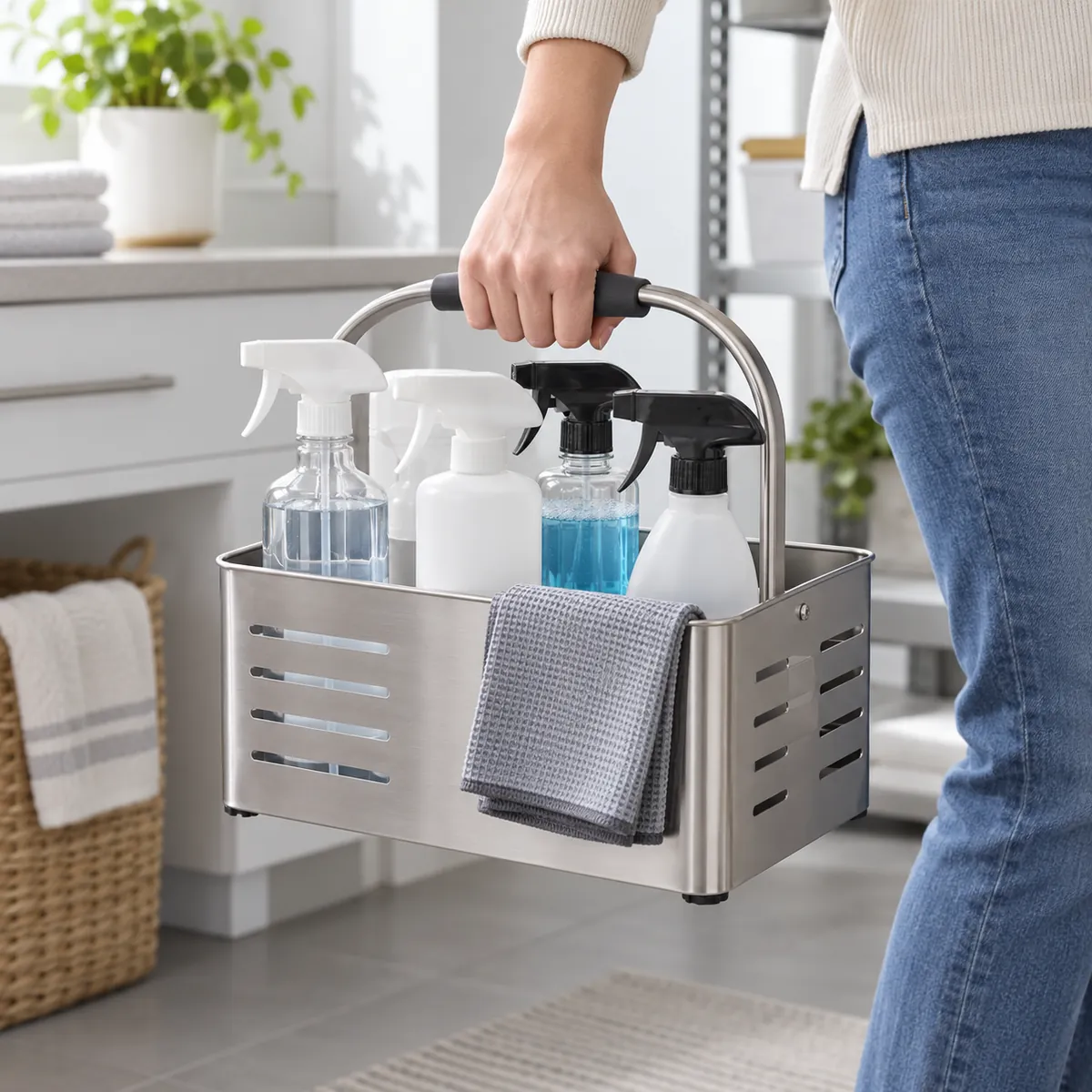
A metal cleaning caddy’s carry behavior depends on what is inside and where each item sits. A wide bottle at one end can shift the balance relative to a smaller one in the center. A heavy refill container can make the handle feel different from an empty display arrangement. A caddy with a long base may also rotate or swing differently from a compact model. Consequently, a count of bottles or a single empty-product photograph cannot establish how every loaded configuration will feel.
Define a buyer-selected reference load from the actual intended assortment. Use the products in the condition relevant to the retail promise, and record whether they are empty, partially filled or filled according to the product team’s ordinary use scenario. The article does not set a universal load rating. If the caddy will carry liquid products, do not treat a visual review as proof of a safe working load or chemical compatibility; any load or material claim requires the applicable engineering basis and separate validation.
On the assembled sample, place the reference items in their planned positions and lift using the intended grip. Observe whether the caddy tilts, the contents collide, the handle contacts the trigger heads, or the user’s hand is crowded by the load. Set it down on a level surface and review whether the base rests as expected. Repeat the handling steps that represent the product’s ordinary use and record the chosen method, observations and acceptance criteria. This is a buyer-defined sample check, not a substitute for a designed test protocol where one is required.
If a caddy includes feet, grips or other nonmetal parts, confirm their material, supplier, attachment and role in the approved bill of materials. Do not assume that the metal supplier makes or validates those parts. A product listing may include silicone feet, a grip or a dock, but those features belong to that specific model. Joseph Joseph’s CleanTech caddy page, for example, states a product-specific maximum load for its model; that figure must not be copied as a general benchmark for another caddy.
Which base, drainage and finish details belong in the specification?
Choose a base footprint and construction that suit the intended assortment and setting. A base that is too narrow for the bottle arrangement can reduce usable space or make the loaded layout awkward. A raised rim may help define the storage area but could obstruct removal of a low, wide container. Openings or perforations may support visibility or drainage in some designs, while a more closed base may change how residue and cleaning access are handled. The buyer should select features for the product brief and inspect them on the actual sample rather than assume a pattern is always superior.
Record whether the caddy is meant to be wiped, rinsed or maintained in another specified way, and confirm that the form gives access to the areas the product instructions expect to be cleaned. This is not a chemical-resistance assertion. The metal grade, surface finish, cleaning agents and use environment must be assessed for the specific product if compatibility or corrosion performance is to be claimed. A metal appearance alone does not prove resistance to a particular liquid, coating damage or long-term exposure.
Check edges, seams, joints, corners and the interface between metal parts for visible workmanship and access. Review the interior as well as exterior surfaces because bottles and hands repeatedly contact the inside. If the finish has a directional appearance, define the visible faces and sample reference so the team can compare consistency. Avoid evaluating finish only from a styled product photograph; inspect under agreed lighting and document any acceptance criteria that matter to the brand.
Packaging also affects whether a caddy reaches the buyer in the approved condition. Identify exposed edges, handle projections and any finish surfaces that can rub against one another during packing or transit. Review the packed configuration, protective materials and carton layout with the supplier responsible for each component. A sample packed for a photo does not prove shipment performance, so any transit claim needs its own agreed method and evidence.
How should importers run a repeatable sample approval?
Use the same reference kit and sequence at each review. Start by checking the caddy’s overall dimensions and the usable opening of every compartment against the drawing. Then load each named bottle in the intended direction and verify insertion, upright storage, trigger clearance and removal. Add the brush, cloth and optional accessories. Finally, move the handle, lift the loaded sample using the buyer-defined arrangement, set it down and examine the base and finish.
Record the result as pass, revise or not evaluated for every check. “Looks good” is not a useful approval record because a later production sample may be compared against a different bottle, arrangement or handle state. Keep clear photos from repeatable angles and note where each reference item sat. Identify the sample revision, metal specification, finish reference, divider layout, handle configuration, feet or grip parts, packaging proposal and date. If something is not included in the sample, mark it as unverified rather than assuming the drawing proves it.
The following checklist can be attached to the sample report:
- Name each bottle, brush, cloth and accessory included in the intended assortment.
- Record the sample or model revision, dimensions, orientation and relevant trigger envelope.
- Check every compartment at its narrowest usable opening and verify both loading and removal.
- Test trigger, cap and nozzle clearance with adjacent products in place.
- Move or position the handle as intended and review bottle, rim and hand clearance.
- Review the buyer-defined loaded arrangement, balance observations and set-down position.
- Inspect base contact, edges, seams, finish and any separately sourced feet or grip parts.
- Photograph the approved positions and list unresolved material, cleaning or packaging claims.
- Update drawings and acceptance records when a bottle, partition, handle or finish changes.
What changes should trigger another fit review?
Repeat the relevant checks whenever a bottle supplier changes the body, trigger, cap, base or fill condition; whenever the caddy’s partition, rim or handle geometry changes; or when a market-specific assortment is added. A small trigger revision can affect clearance even if the bottle body dimensions remain stable. A handle change may affect the loading path without changing the caddy footprint. Tie each approval to the revisions actually reviewed, and ask the responsible team to assess whether a change requires a new sample or a focused verification.
How can a buyer avoid overpromising compatibility?
Describe the assortment that was reviewed, not an undefined universe of “standard spray bottles.” If the commercial team wants a broad fit statement, translate it into bounded bottle dimensions, trigger envelopes and the relevant caddy configuration, then validate the boundary cases. State exclusions or known constraints in the product information. Do not claim universal fit, a tested capacity, chemical compatibility or corrosion resistance from a sample fit review alone.
What should the RFQ and supplier handoff include?
Send a drawing or structured brief with the target outside dimensions, compartment openings, partition positions, handle geometry, visible finish, edge expectations and packaging needs. Attach the reference assortment list with photos and measured envelopes, and state which items are mandatory for compatibility. Identify the product use scenario and the intended carry arrangement. If the buyer has a defined load or durability requirement, describe the basis and ask the appropriate engineering reviewer to define the validation method; do not substitute an arbitrary number for a test plan.
Ask the supplier to flag manufacturing implications before the design is treated as final. Dividers, handle attachments, perforations, folded edges and finish access can interact with forming, welding, polishing and assembly sequence. The supplier should identify where a proposed feature needs clarification or a sample review. A successful prototype demonstrates the reviewed configuration only; it does not by itself establish repeatability across production. Any production-control plan, inspection points and change approval should be discussed separately under the buyer’s quality requirements.
Clarify responsibility for purchased-in parts such as rubber feet, silicone pads, plastic caps or grips. Name the source and specification when those parts affect fit, contact, packing or a product claim. Confirm who supplies them, who approves alternatives and how they are identified on the bill of materials. A metal caddy design can include nonmetal components, but the buyer should not infer that a metal fabricator manufactures or tests them unless the scope expressly says so.
For a supplier discussion, share the defined brief with Koitor through its home-storage hardware manufacturing page أو contact page. This is a request for a project assessment, not a statement that a specific portable cleaning caddy is already in Koitor’s catalog. A related custom kitchen storage rack manufacturer page describes a neighboring storage category; product-specific capability and scope still need confirmation for the proposed design.
What is the practical approval rule?
Approve the caddy against a named assortment and a documented use arrangement. The buyer should be able to identify which bottles fit, how their triggers clear the handle and neighboring items, how the handle moves, and what was observed in the buyer-defined loaded carry check. The product team should also know which material, finish, cleaning, nonmetal component and packaging claims remain unverified.
The research examples make clear that caddies can use different compartment counts, openings, handles and added parts. Those features are design choices, not guarantees that another product will serve the same assortment. A useful sample review connects the buyer’s actual products to the caddy geometry, captures the result and reopens the review when either side changes. This gives the importer a concrete specification and a more defensible product description without pretending that one fit check proves every performance question.
The principle is simple: specify the reference items, test their fit and movement in the intended configuration, and record the limits of the approval. That process helps a sourcing team compare a quote with the product it intends to sell and gives engineering a clear basis for revisions. It also keeps unsupported assumptions—about capacity, materials, chemistry or Koitor’s exact product range—out of the final listing.
Discuss a Metal Caddy Drawing or Sample
Share the reference bottles, caddy drawing, intended assortment and sample requirements with Koitor Hardware to discuss the metal structure and development scope. Confirm materials, cleaning claims and compatibility against the project requirements.
OEM / العلامة التجارية الخاصة
حوّل دليل التوريد هذا إلى موجز منتج
يرجى إطلاعنا على المنتج المستهدف، والحجم، والتشطيب، وكمية الطلب، ومتطلبات التغليف. وسيتلقى فريقك تقييمًا عمليًّا لإمكانية التصنيع قبل تقديم عرض الأسعار.



 English
 Español
 Português
 Français
 Deutsch
 العربية