

— The buyer should preserve the scope of metal tennis racket holder specification in the drawing and approval record.
A metal tennis racket holder specification should define how the actual racket is supported, what area contacts the holder, and how the user removes it. “Fits tennis rackets” is too broad for an engineering brief unless the intended racket types, support region, orientation and clearance have been checked against representative products. A product listing can describe one named holder architecture, but it does not automatically establish compatibility with every frame, cover, grip, wall surface or use context.
This guide is for importers, storage-category buyers and private-label teams evaluating a metal holder concept. It explains how to turn a general idea into a bounded RFQ and sample-approval record. It does not claim that Koitor currently manufactures tennis-racket holders. Koitor’s documented business is custom metal bathroom and home-storage hardware; any adjacent sports-storage request needs a separate project and capability review.
First distinguish a storage holder from a display fixture
A household storage holder is intended to keep specified equipment in a defined place and allow a practical retrieval path. A retail display can prioritize presentation, merchandising density or a paired arrangement. A collection display may prioritize visibility and a particular contact point. These purposes can lead to different geometry, finish, installation and packing decisions. Do not assume a display fixture is appropriate for repeated everyday handling or that a simple storage hook provides a retail presentation system.
The buyer should write the use case in plain language and keep the metal tennis racket holder specification tied to the intended use: where it will be installed, who will use it, whether one or several rackets are stored, whether they are stored with covers, and whether access is frequent. These are scope questions, not a substitute for testing the final product. If the intended customer or channel is not yet known, record that as an open product assumption instead of embedding it in a universal fit claim.
An RFQ should also define whether the concept is a wall-mounted metal component, a complete display assembly, or a storage system that includes rails, fasteners or packaging. A supplier cannot price or review unspecified interfaces reliably. If a buyer wants only the metal support, state which other parts are buyer-supplied or sourced elsewhere. This prevents a rendering from being mistaken for a complete, production-ready bill of materials.
Choose the support region deliberately
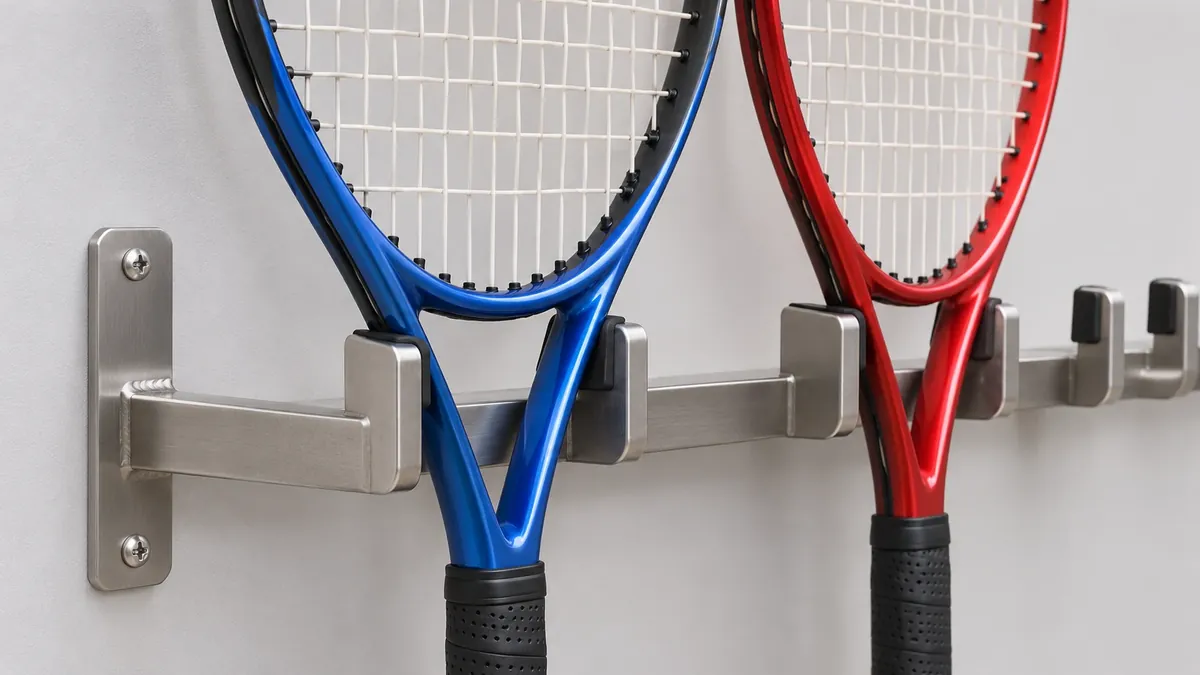
Public product examples show that different makers choose different contact arrangements. Some products cradle portions of the racket frame; another maker’s guide describes a hook at the throat area. These examples establish that design approaches vary. They do not prove that one region is universally safe, stronger, more stable or suitable for every racket. A buyer and product designer must select and approve the contact arrangement for the intended model and use.
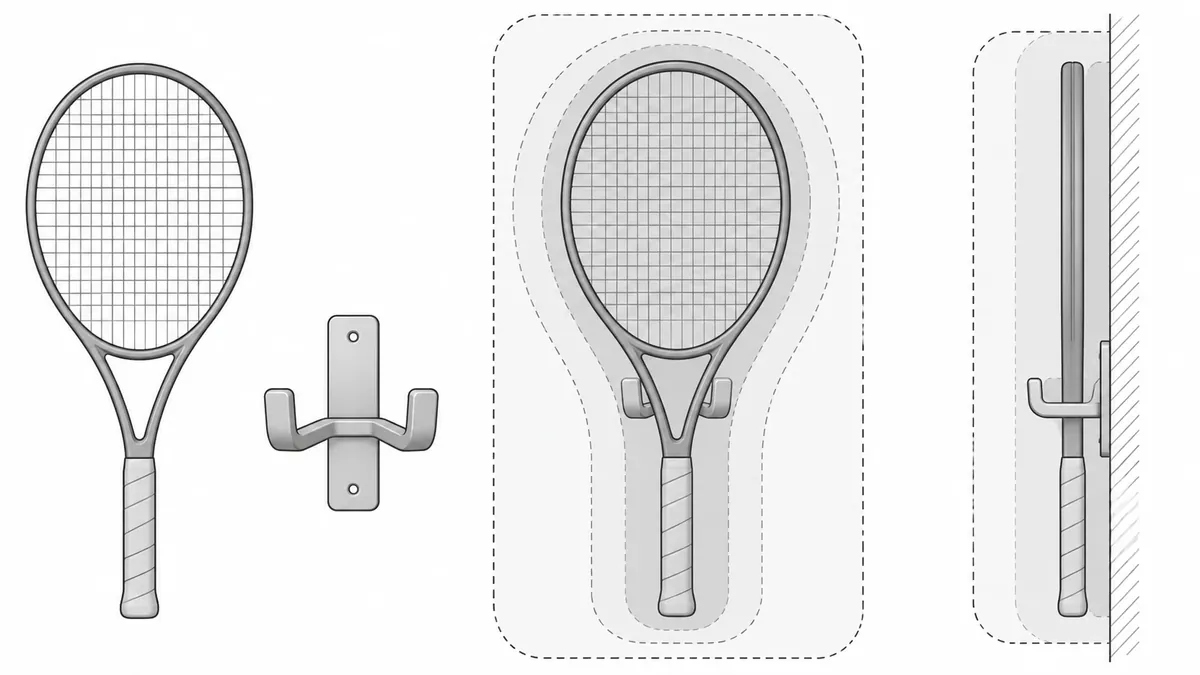
Record the proposed contact surfaces on a drawing or annotated reference image. Identify which racket part rests against each support, whether the holder contacts one or more locations, and whether any secondary feature prevents movement. Use a representative physical racket or an approved dimensional reference. Do not rely on a sport name, nominal length or a product photograph alone to establish local fit. Frame shapes, head profiles, throat structures, covers and grips can differ among models.
The design owner should consider whether the contact is against a structural frame surface, a throat region, or another specified area, and whether the contact is intended to carry the racket’s weight or merely position it. This is a design-review prompt, not a recommendation to load a particular string bed, joint or frame section. The product engineer or responsible supplier should assess the actual contact and geometry. If that assessment is unavailable, keep the claim limited to observed fit with the approved reference sample.
Compare frame support and throat support without assuming equivalence
| Review point | Frame-contact concept | Throat-contact concept | Buyer record to complete |
|---|---|---|---|
| Contact location | Defined portion of the frame engages the support | Defined throat area engages a hook or cradle | Mark location on drawing and sample |
| Local geometry | Opening or seat must match the reference frame area | Hook profile must suit the selected throat geometry | Record dimensions and approved model |
| Orientation | Racket hangs or rests as designed for that frame | Racket orientation follows the selected throat engagement | Photograph the seated reference item |
| Removal | The head and grip need a clear path out of the support | The racket must lift or move clear of the throat feature | Observe insertion and retrieval |
| Applicability | Approval applies only to stated models/configurations | Approval applies only to stated models/configurations | List supported, unverified and excluded cases |
The table is a comparison framework, not a technical ranking. A concept that fits one model may fail on another because of a different local shape, cover, orientation or neighboring-item arrangement. A single sample review can confirm only the particular sample and conditions observed. If a range is intended, select the actual reference items that represent the relevant variation and record why they were chosen.
Do not mix design architecture with unsupported performance language. Terms such as “universal,” “scratch-free,” “damage-proof,” “secure for all rackets” or “fits every sport” require evidence beyond a visually plausible rendering. A soft-looking contact pad does not alone prove finish compatibility, nor does a firm-looking bracket prove structural capacity. A buyer should define what evidence is needed for each claim and omit claims that have not been substantiated.
Make retrieval clearance part of the specification
Fit is not only whether the racket can be placed on the holder. It also includes the approach path, the seated orientation and the removal movement. A head or handle may clear the wall in a static image yet interfere during lifting or rotation. Adjacent rackets, shelves, doors, cabinets or other stored objects may constrain the path. The correct clearance depends on the actual intended arrangement and must be checked with a representative object in the specified location.
For sample review, describe the movement being checked: approach, placement, seated condition, lift or slide, and removal. Note any interference, unintended contact or awkward movement. Do not turn a subjective observation into a formal ergonomic or safety claim without the appropriate evaluation. The purpose of the record is to make buyer approval repeatable and to tell the designer what was observed.
Where two or more rackets are stored, review spacing and retrieval sequence. Can one item be removed without moving another? Does the grip or head cross a neighboring support? Does a cover change the required space? These questions are specific to the proposed layout. Do not publish a universal spacing value or maximum count unless the product owner has defined and validated that configuration.
Wall projection and nearby obstacles also belong in the drawing. State the mounting plane, the holder’s installed orientation and the relevant envelope around the racket. The buyer should confirm that the design can be installed in the intended location and that any required wall attachment is specified by the responsible product team. This guide does not recommend a particular anchor or substrate method; those choices depend on the wall, hardware, installation instructions and applicable evidence.
Define the representative racket and configuration
The phrase “reference racket” should identify a physical sample or a controlled source of dimensions. Record the manufacturer/model where permitted, relevant revision or variant, whether a cover is used, the orientation and the parts of the racket that contact the holder. If proprietary customer information is involved, protect it and use an authorized reference code in the supplier file. A generic image is useful for discussion but cannot replace the specified reference object for fit approval.
If the intended application includes more than one kind of racket, list each intended type explicitly. Tennis, badminton, squash and padel equipment should not be presumed interchangeable merely because all may be described as rackets. The frame and head shapes, handles, covers and support needs may differ. The buyer should determine whether a separate design or separate fit validation is needed. Avoid broad compatibility claims until each included type is defined and reviewed.
Also decide whether the holder is intended for a bare racket, a covered racket, or both. A cover can change the contact surface and envelope. If the brief excludes covers, state that clearly in the product information and sample record. If the product team has not decided, mark it as an unresolved requirement; do not silently test the bare sample and promote the result as covered compatibility.
The final approved configuration should tie together the racket identity, holder drawing revision, support concept, installed orientation and sample observations. If any of these changes, the approval may no longer describe the new arrangement. A buyer should decide which changes trigger a renewed fit review. Typical examples to discuss include a changed contact profile, altered hook opening, different wall stand-off, new cover use or revised multi-racket spacing. Whether each change is material is a project decision.
Separate physical fit from finish and material claims
A sample that sits in a holder proves only an observed fit under the reviewed conditions. It does not establish that the contact surface will never mark a coating, that a finish is compatible with every racket material, or that an assembly will retain performance through a defined service life. Those are separate claims and require their own evidence, test conditions and acceptance criteria. Do not treat a buyer’s visual review as a substitute for an engineering or materials evaluation.
If the holder uses a coating, pad, liner or purchased component at the contact point, identify the material and revision in the specification and confirm who supplies it. A component description should not imply a verified protective function unless the product team has supporting evidence. Ask the manufacturer or component supplier what information is available, and let the responsible party review it against the intended racket surfaces and environment.
Environmental conditions affect the information needed. Indoor household storage, a humid room, a club environment and a retail display may present different exposure, cleaning and handling conditions. State the intended conditions and cleaning practices that the buyer actually expects. Avoid statements such as “rustproof” or “safe for all finishes” unless they are substantiated for the exact product, materials, process and use conditions under the claims policy.
For an OEM quotation, describe specified metal parts, material and finish requirements, visible surfaces, contact edges and any purchased soft components. Identify cosmetic faces and inspection references. The exact manufacturing route and feasibility need project review; no material grade, coating system or production method should be assumed from a concept image. Where the current product facts do not confirm a capability, ask for confirmation before making it part of the sales specification.
Prepare a buyer-owned fit and retrieval matrix
| Field | What the buyer should record |
|---|---|
| Intended application | Home storage, club, retail display or another defined use |
| Reference racket | Controlled sample or traceable dimension source |
| Cover condition | Bare, covered, both, or excluded |
| Support architecture | Frame, throat or another explicitly drawn contact arrangement |
| Contact region | Marked surfaces and intended engagement |
| Installed orientation | Holder orientation and resulting racket position |
| Clearance | Relevant wall, adjacent-item and removal envelope |
| Observation | What was placed, moved or retrieved during sample review |
| Supply scope | Metal parts, secondary supports, fixings, packaging and instructions |
| Applicability decision | Approved, unverified or excluded models/configurations |
| Approval reference | Drawing revision, sample identity, date and owner |
This matrix is a buyer record, not a test standard or a guarantee of performance. It helps an importer preserve what the sample was meant to prove. If the reference item or holder changes, reviewers can see whether the prior approval remains relevant. If a field is unknown, label it open rather than filling it with an assumed specification.
The matrix should travel with the supplier’s controlled drawing and the product team’s approval. Keep the consumer-facing product description within the approved applicability. If only one representative model was checked, do not imply a full category-wide fit assessment. If the product is intended for a defined range, keep the inclusion list current and make exclusions visible to the people writing listings, packaging and instructions.
Specify the metal-component RFQ clearly
The buyer should provide a dimensioned drawing or controlled prototype and identify critical dimensions, finish requirements, intended mounting interface, visible surfaces, packaging scope and requested quantities. If the holder comprises more than one component, show the assembly and identify which components are supplied by the metal manufacturer versus another party. Identify any customer-supplied accessory or fastening item and who approves it. A rendering can explain intent but should not be treated as a complete production drawing.
Ask the supplier to identify open manufacturing questions rather than silently resolving them. A bend, weld, return, edge treatment or finish access decision may affect manufacturability or appearance. The supplier can review these details against its confirmed capabilities and the supplied documentation. Whether a specific metal part, finish or assembly can be produced is a project-specific capability question. No claim in this article establishes a current Koitor racket-holder SKU or accepted production route.
State sample expectations before the sample is made. Which drawing revision is being sampled? Which reference racket should be used? Is the buyer checking only geometry, or also packaging and assembly? Who records observations and approves changes? A sample for fit evaluation is not automatically a production approval. If a sample is altered after review, record what changed and whether another review is needed.
Plan packaging and identification without inventing protection
A finished holder may have edges, projections, contact surfaces or multiple parts that require defined packing and identification. The buyer should describe the intended pack-out, product grouping, components, instructions, labels and any retailer-specific requirements. If the product has a surface that should not rub against another part, identify it in the packing specification and ask the supplier to confirm a suitable method for review. Do not claim that a particular bag, divider or carton guarantees no transit damage without applicable evidence.
Package testing, if required, should be specified by the buyer using the applicable program and shipment context. This article does not prescribe a drop-test procedure, transit standard or protection performance. Packaging responsibilities can be divided among the product owner, factory, packaging supplier and logistics provider; the RFQ should make that division visible. Include the required packaging artwork and revision in the approval record where relevant.
Product identification should make it possible for the buyer to distinguish the approved configuration, included parts and any excluded use. Ensure listing copy, carton marks, assembly instructions and the approved drawing describe the same product. If the buyer changes racket compatibility or included accessories, review all affected records. Clear identification avoids a gap between the sample that was assessed and the item the customer receives.
Common specification gaps that slow a project
An RFQ that says only “metal racket holder, black, wall mounted” leaves many decisions open. The supplier may not know the target racket, contact region, number of items, wall projection, included fixings, finish reference, packaging format or whether a rendering depicts intended or approved geometry. The quotation may then contain assumptions that do not match the buyer’s intended product.
Another common gap is providing a reference image without identifying what it is meant to show. Is it a visual style, a competitor product, a protected design reference, a dimensional control, or only an example of a use case? Explain the permitted use and required outcome. Do not instruct a supplier to copy a proprietary design. Use buyer-owned geometry, authorized references and project-specific design approvals.
A third gap is an unlimited claim. “Fits all rackets” does not tell a factory which models or dimensions matter. Replace it with a defined initial applicability list and a review route for additions. Likewise, “strong and safe” does not establish a load condition, installation, test or acceptance basis. Translate each intended claim into a defined question and assign evidence responsibility before publishing it.
Finally, buyers may approve a sample without recording the sample identity or drawing revision. Later, the team cannot tell whether the production unit, a revised sample or a different model was actually reviewed. Capture the identification at the time of approval and retain the record with the product file. That traceability is a document-control practice, not a claim that the item has passed an unspecified performance test.
A compact pre-RFQ checklist
Before requesting a quote, answer these questions:
- Is this for household storage, retail display or another clearly stated application?
- Which racket model or representative sample defines the intended fit?
- Is the racket bare, covered or both?
- Where does the holder contact and support it?
- How does the user place and remove the racket?
- Which adjacent items, wall conditions and clearances matter to the concept?
- Which product types are approved, unverified or excluded?
- What exact metal, finish, component and mounting scope is being quoted?
- What packaging, instructions and identification are included?
- Which sample and drawing revision will be reviewed, and by whom?
- Which performance or compatibility claims need evidence before use?
- Which items remain assumptions or require supplier capability confirmation?
The checklist does not dictate a product design. It helps the buyer turn a broad concept into a reviewable scope. If several answers remain open, the first project step may be a design clarification rather than a production quotation. A clear list of open decisions can still support an initial feasibility discussion, provided it is not confused with an approved product specification.
الأسئلة الشائعة
Does a tennis racket holder automatically fit badminton, squash or padel equipment?
No. The sport label does not define the exact frame, throat, grip, cover or support geometry. List the intended products and review representative samples or controlled references. Any additional type remains unverified until the responsible product team evaluates it.
Is frame support better than a throat hook?
There is no universal answer supported by the product examples discussed here. Different designs use different contact arrangements. The buyer should assess the actual racket, intended orientation, contact location and retrieval path with the responsible designer or supplier.
Does a soft pad prove that the holder will not mark a racket?
No. A soft-looking component does not establish material compatibility, finish safety or long-term contact behavior. Those claims need product-specific evidence and should be reviewed under the applicable claims process.
Can an advertised holder capacity replace fit approval?
No. A stated quantity does not show that the buyer’s reference racket, cover, wall layout or retrieval path was assessed. Confirm the exact configuration and keep the applicability statement bounded to its evidence.
What should accompany an OEM drawing?
Provide the intended application, controlled geometry, reference racket, support region, mounting interface, finish, supply and packaging scope, requested quantity, sample expectations and unresolved questions. The manufacturer then can review the defined metal-component scope and identify project-specific feasibility issues.
Sourcing takeaway
Before sourcing a metal tennis-racket holder, approve the reference equipment, contact architecture, retrieval path, installation envelope and applicability statement. Put those decisions on a controlled drawing or fit matrix, then ask the supplier to review the defined metal parts, finish, mounting and packaging scope. Keep fit observations separate from finish safety, load performance, universal compatibility and other claims that require additional evidence.
For a metal-storage OEM discussion, Koitor’s home-storage hardware manufacturing page is the appropriate contact route for sharing a project drawing and asking about current scope. The supplier must confirm capability for this adjacent product before it is represented as an offered Koitor item. Related storage products have their own application-specific fit and finish questions; they do not validate racket compatibility.
Sources and scope notes
- GPX: Tennis Racket Wall Mount. A maker-specific product example; its dimensions and advertised scope apply to that item only.
- ONE MAAY: How to Display a Tennis Racket on a Wall. A maker guide describing its own throat-hook approach; not proof of universal suitability or finish safety.
- Koitor home-storage OEM manufacturing scope. Contact pathway for confirmed metal-storage project scope; not evidence of a current racket-holder product.
For this article, treat metal tennis racket holder specification as the exact buyer question recorded in the approved project brief. Use the phrase only when discussing this defined decision; it does not establish an industry-wide problem or a Koitor product claim.
اعمل مع شركة «كويتور» للأدوات
Discuss Your Project Scope With Koitor
Send Koitor your controlled drawing, reference sample, configuration, finish and packaging requirements. Our team can review the defined metal hardware scope and confirm whether the project fits current capabilities before quotation.
OEM / العلامة التجارية الخاصة
حوّل دليل التوريد هذا إلى موجز منتج
يرجى إطلاعنا على المنتج المستهدف، والحجم، والتشطيب، وكمية الطلب، ومتطلبات التغليف. وسيتلقى فريقك تقييمًا عمليًّا لإمكانية التصنيع قبل تقديم عرض الأسعار.


 English
 Español
 Português
 Français
 Deutsch
 العربية