
Buyer specification guide | Under-bed metal storage
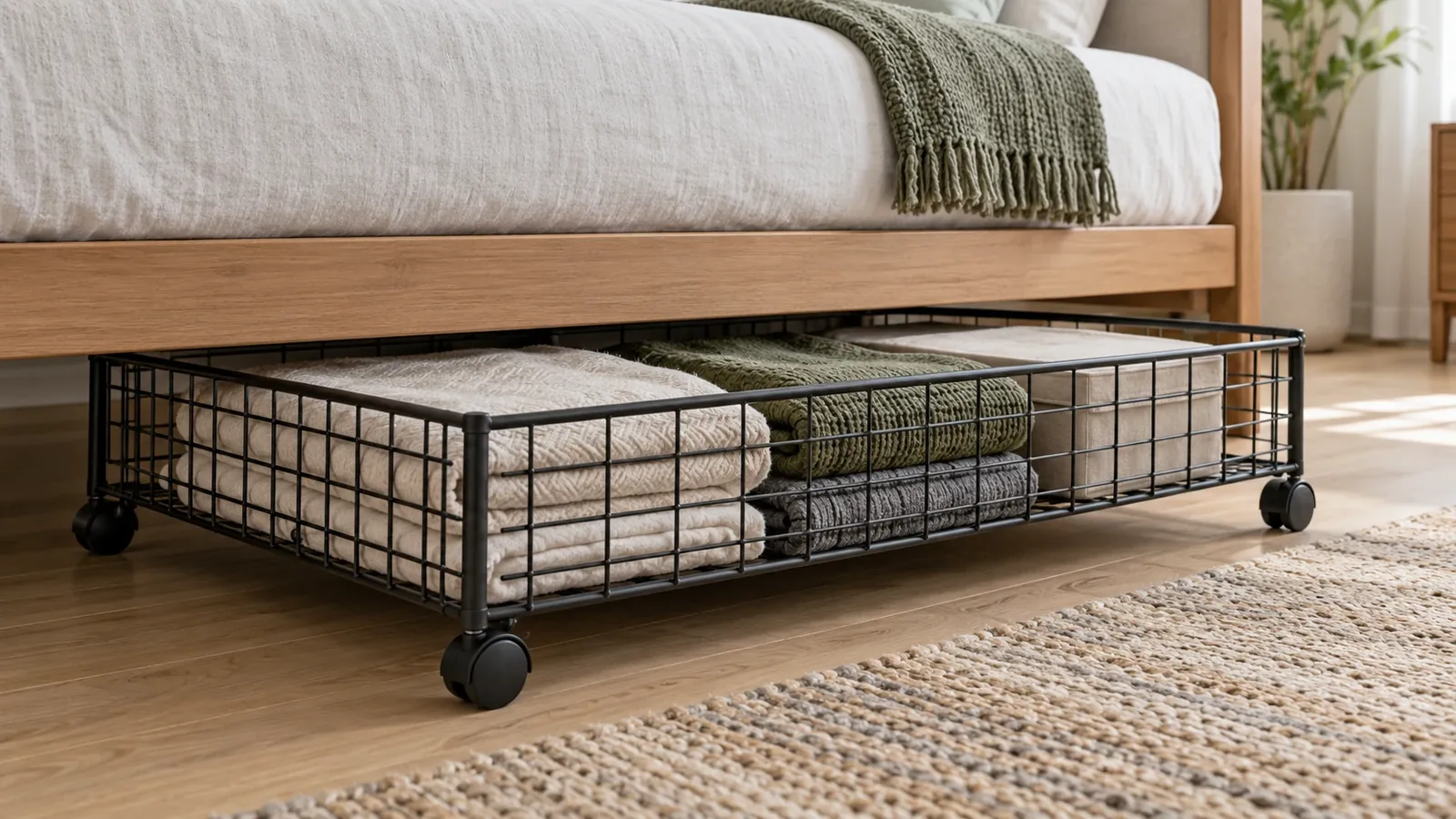
An under-bed basket is useful only if its finished assembly can pass beneath the intended bed and roll back out along the actual floor route. For underbed rolling basket caster clearance, the basket body height is not enough. Buyers should specify the overall envelope with casters fitted, the bed’s lowest rail or bracket, any handle or lid projection, and the path across rugs or thresholds. Approve a production-intent loaded sample under defined conditions rather than assuming one product height fits every bedroom.
Why does the basket’s advertised height fail to predict fit?
A basket listing may describe the metal container without making clear whether the measurement includes wheels, handle, cover or projecting fasteners. The top of a loaded soft item can also rise above the rim. None of those details is a reason to reject a product; they are reasons to define the measurement datum. The buyer needs the assembled maximum height in the condition relevant to use, not an isolated body dimension.
First-party product information illustrates the distinction. Shelter Outfitters lists overall dimensions for a metal rolling under-bed basket and distinguishes a body dimension from a handle-inclusive dimension. Wideny describes model-specific basket height and recommends a corresponding under-bed clearance. Neither example creates a universal allowance for a different basket or bed. A buyer should request the proposed supplier’s assembled drawing and sample rather than transplant those numbers.
The fit question has a travel component as well. A user report of an under-bed drawer meeting a rug obstruction shows why the floor route can defeat a product that appears to fit under the frame. This observation is not a controlled test of rolling baskets, but it establishes a practical problem for a buyer to include in the use scenario. A caster may swivel, compress into a soft surface or meet a rug edge; the exact result depends on the chosen hardware and load.
For an importer or private-label manager, the central buying question is: What is the assembled basket’s largest moving envelope, and what is the smallest opening anywhere along the intended insertion and retrieval path? The supplier may be able to quote a metal basket from an outside length and width, but cannot verify this application without the caster and route information.
Measure the complete assembly, not a convenient component
Begin with the metal body’s maximum height, then add the installed caster assembly as it actually sits under load. Include any lid, top rim, handle, screw head or bracket that projects beyond the nominal body. If the handle rotates or folds, state whether it must be in a particular position to fit. An allowance based on a photo is not a dimension; the assembly drawing should identify the highest point in the intended rolling configuration.
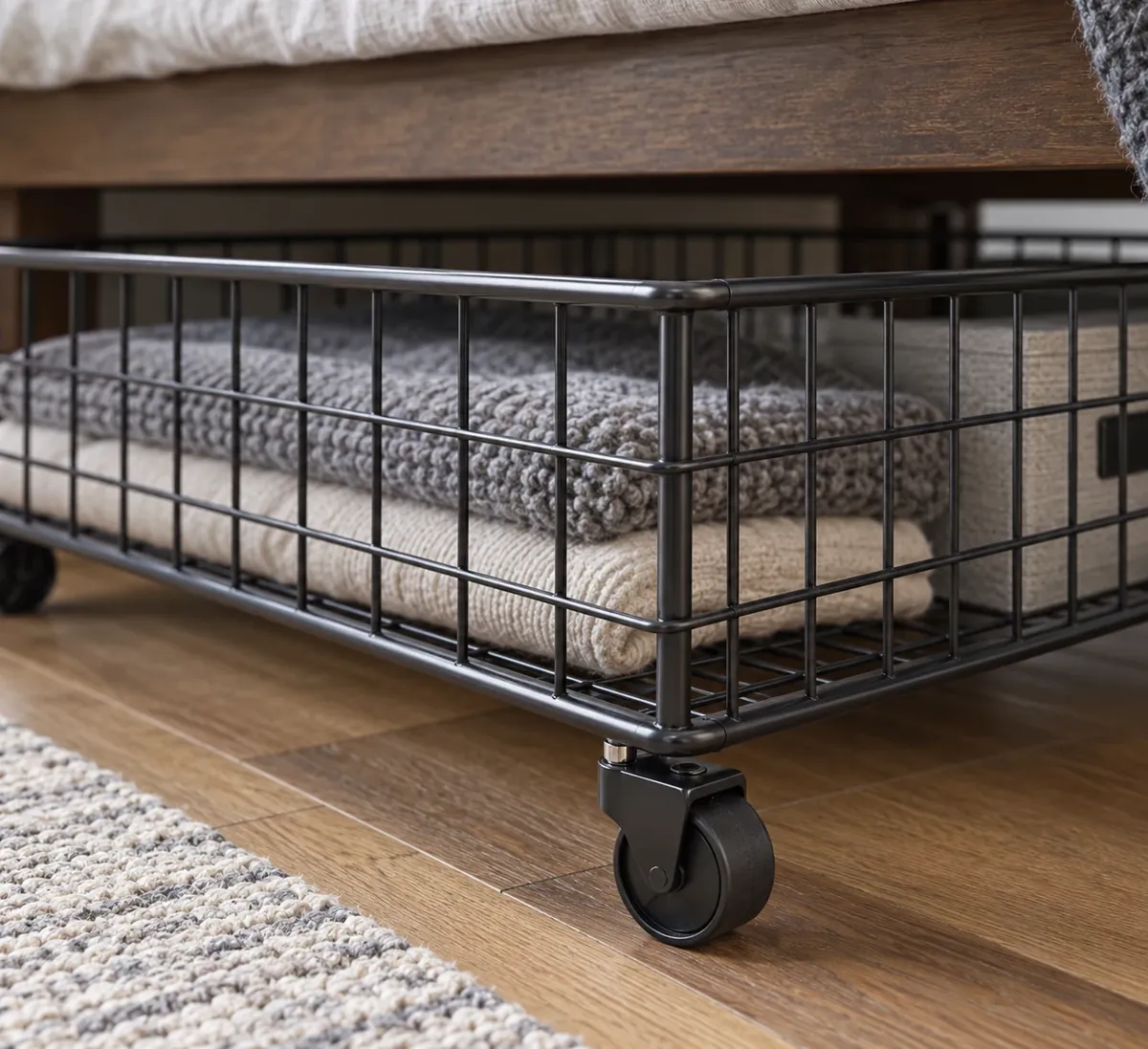
The wheel position can alter the envelope when a caster swivels. On some designs, a wheel’s swept area may reach beyond the basket footprint or a swivel fork may protrude. If the product is sold as rolling in either direction, check the caster positions that are likely during insertion and withdrawal. If locks are supplied, document their accessible orientation and whether they add width or height. This is a drawing and sample issue, not proof that every caster behaves the same way.
Ask the supplier to dimension the assembled part from the floor-contact plane to the highest metal or accessory point. Record the overall width and length including handles and the caster sweep, where relevant. Keep usable basket capacity dimensions separate from outside envelope dimensions. The two answer different buyer questions and should not share an unlabeled figure in a catalog.
Identify the bed’s true lowest obstruction
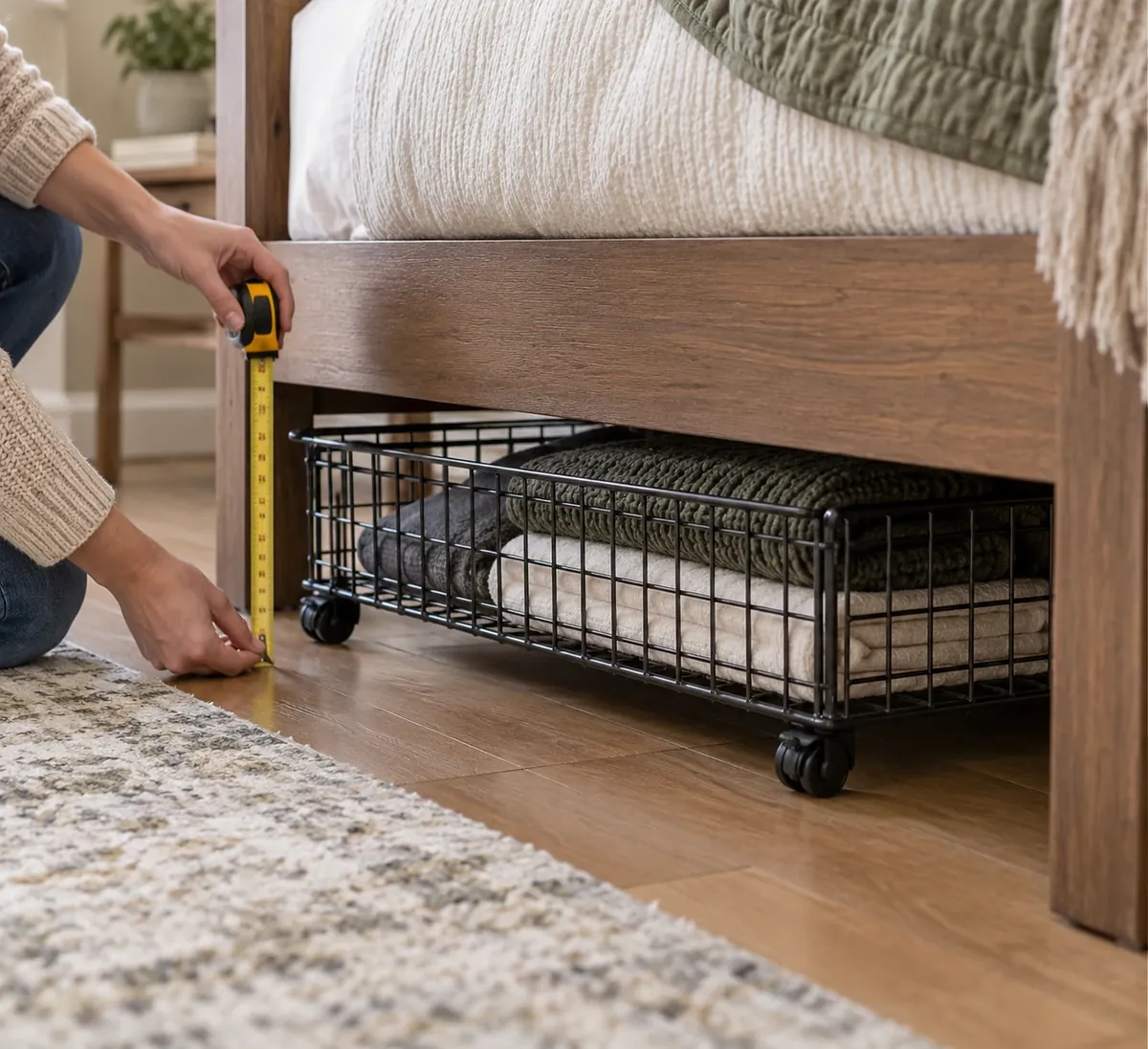
Measure from the finished floor surface to the lowest fixed part the basket must pass. A decorative side rail may not be the limiting point: a cross member, center support, fastener or bracket can hang lower along the travel path. For a range of beds, the buyer should define representative target frames or a stated minimum opening rather than claiming universal fit.
Measure at the entrance and farther underneath, not just beside the bed. A basket that passes the side rail may strike a lower center support. Likewise, a bed frame can be slightly out of level, and flooring can vary across the room. If the storage product is marketed for a particular bed model, document the bed revision and assembly state used for the review. If it is a general-market item, express a clear minimum clearance requirement and avoid “fits all beds” language.
Loaded bedding may compress into an open basket or expand above its rim. Decide whether the intended contents are constrained below the rim, secured by a cover, or allowed to mound. The acceptable condition should be visible in the product instructions and sample test. A nominally low basket cannot guarantee that users will pack it within its metal outline.
How should buyers map the entire rolling path?
The starting point is not necessarily a flat floor directly in front of the bed. A rug, carpet pile, transition strip, threshold, floor vent or nearby furniture can change access. The buyer’s worksheet should show the basket’s insertion and withdrawal route, not only a single height arrow under the rail. The path may require the basket to turn; when it turns, its handles and caster sweep create a different footprint than straight-line travel.
Mark the entry point, intended parking position and pull-out destination. Record the lowest overhead obstruction at each stage and the narrowest lateral passage. If the basket is wider than the clear gap between bed legs or other furniture, it may fit beneath the frame yet be impossible to retrieve conveniently. If there is a rug at the front edge, compare the caster’s behavior at that transition under the agreed load; do not assume a hard-floor demonstration predicts performance there.
| Route point | Buyer measurement or observation | Why it matters |
|---|---|---|
| Bed entry | Floor to lowest rail, bracket or fastener | The basket’s highest assembled point must pass the entrance |
| Under-bed travel | Lowest cross member or center support | Clearance can tighten after the basket enters |
| Side passage | Legs, neighboring furniture and handle sweep | A fitted basket can still be blocked laterally |
| Floor transition | Rug edge, carpet pile or threshold | The wheel may hesitate or change basket pitch |
| Pull-out zone | Space for hand, handle and turning movement | Removal can fail even when parked storage fits |
These are project inputs, not prescribed clearance margins. A buyer should determine acceptable values for the target bed, wheel, flooring and contents. Record how the floor surface was measured so the supplier can repeat the review. If the product is sold without a bed, packaging should communicate the assembled envelope and a conditional fit requirement in a way that a retailer can substantiate.
Why a static measurement is necessary but insufficient
A static height comparison identifies an obvious mismatch. It does not show whether the basket rolls over the rug edge, whether a swivel caster aligns during extraction, or whether the user can grip the handle under a low rail. When the basket turns, a corner may move closer to a bed leg. When loaded, a flexible basket or caster may deflect differently from the empty sample. These are reasons to perform an agreed use check, not to assert a universal performance result.
The trial should use a representative load chosen by the buyer, while avoiding unsupported capacity claims. Push the basket into its intended position and pull it out using the normal handle motion. Observe contact at the bed rail, wheel transition, handle, side legs and basket contents. If it contacts, identify the first contact point before changing the design. Simply reducing the metal basket height may not solve a wheel-path or handle-sweep problem.
What should an RFQ and drawing specify?
بالنسبة لـ underbed rolling basket caster clearance, ask suppliers to return an assembly drawing, not just a wire-basket outline. The drawing should show the metal frame, top rim, caster location and installed height, plus any lid, handle or detachable accessory. Label dimensions as body-only, usable interior or assembled outside envelope. Without those labels, two suppliers may quote apparently comparable products whose true fit differs.
The RFQ can include target overall length, width and height, an intended minimum bed clearance, the proposed caster type or functional requirement, target floor surfaces, representative contents and packaging format. It should say whether the basket must fit in a straight movement only or be maneuverable around legs. If a locked caster position is required, note how the user sets and accesses it. Avoid demanding an unexplained “heavy-duty” caster or a generic load rating; define the product use and ask for an appropriate evidence-backed proposal.
The metal frame should provide a stable caster attachment location and a smooth top/side contact profile. Discuss how the supplier will control dimensions after forming, joining and finishing. Changes in a welded corner, frame tube, wire spacing or finish thickness can shift the assembled envelope. A caster substituted late in development can alter both height and rolling behavior even when its nominal wheel diameter seems similar.
كويتور custom metal storage rack و OEM home-storage hardware positioning makes the metal basket geometry, sample review and small-batch development relevant discussion areas. This does not assert Koitor currently manufactures this exact under-bed caster basket, certifies caster performance, or supplies any of the referenced brands’ products. Confirm component sourcing and responsibility in the actual project.
Separate buyer claims from supplier assumptions
If a seller wishes to say “fits under most beds,” that wording needs a defensible definition of bed clearance and the product’s assembled height. A supplier quotation alone does not prove a market-wide fit claim. A safer specification gives the buyer the actual maximum assembled height and describes how to compare it with a measured bed opening. Similarly, “rolls on carpet” should not be claimed solely from a hard-floor sample.
Ask the supplier to identify which dimensions are controlled in production and how a buyer can inspect them. For a modular or flat-pack design, include assembly instructions that place the correct caster at the correct corner and make the final height clear. If a handle can be mounted in more than one way, note which orientation was approved. Retail imagery should show a plausible bed clearance and should not hide a wheel or frame obstruction.
How should a production-intent sample be approved?
Before approval, identify a sample ID and drawing revision. Assemble the basket using the intended hardware and instructions. Measure maximum height from the test floor to the actual highest point with wheels correctly mounted. Measure width and length including the handle and relevant caster orientation. Note whether the basket is empty or loaded and which floor surface is used. Compare those recorded figures with the buyer’s bed and route worksheet.
Then perform the insertion and retrieval check under the agreed ordinary use conditions. The acceptance statement can be simple: the identified loaded sample passes the entrance and lowest under-bed point, can be parked in the stated location, and can be retrieved without contact or lifting on the specified route. This is an example of a buyer acceptance method, not a claim that Koitor has completed any such test or that the product fits every bed.
Photograph the basket at the entrance, under the lowest rail and at the rug or threshold. Document any wheel hesitation, frame contact or handle obstruction separately. If the sample only fits when the caster is manually pointed in one direction, decide whether that is acceptable for normal users. If the basket must be lifted, it is not performing as a rolling storage unit under those conditions, even if it technically fits beneath the bed when stationary.
| Sample record field | What to retain |
|---|---|
| Product identity | Drawing revision, sample ID, caster part and assembly state |
| Fit envelope | Measured maximum height, outside width/length and handle projection |
| Target setting | Bed-frame lowest point, floor surface and route obstacles |
| Contents | Representative load and whether it protrudes above the rim |
| Observation | Entry, under-bed travel, parking and retrieval results |
| Decision | Pass, change request or limited-use approval with responsible reviewer |
Keep this record with the supplier quote and approved sample. If a different wheel, handle, bracket or frame section is proposed for bulk production, the earlier approval may no longer apply. The change-control rule should say when a new sample or targeted recheck is required.
What changes deserve another fit check?
Review any change that can affect the complete height or path: caster model, wheel size, fork geometry, mounting plate, frame bottom, basket top rim, lid, handle, leg clearance, packaging distortion or assembly instruction. A lower basket body paired with a taller caster may have the same or greater final height. A wheel that fits on a clean hard floor may meet a rug edge differently. A coating or frame adjustment can shift an already tight interface.
Do not collapse these changes into a generic “same product” statement. Ask the supplier to mark revisions on the drawing and identify the part that changed. Where a component is sourced separately, confirm who owns its dimensions and approval. A buyer can keep a small sample set of the target bed and floor conditions to check a revised assembly before another order, subject to the project economics and market.
Buyer checklist before releasing the order
و underbed rolling basket caster clearance review is complete only when the measured assembly and the intended rolling path are recorded together.
Use this checklist to turn a loose under-bed storage idea into an inspectable product brief:
- Define the bed models or minimum under-bed opening the SKU is intended to address.
- Measure the lowest rail, bracket and center support along the complete travel route.
- Identify rugs, carpet, thresholds, nearby legs and the pull-out space.
- Request the assembled height including casters, handle, lid and protrusions.
- Keep basket body dimensions separate from usable interior and overall dimensions.
- Define representative contents and whether they may rise above the basket rim.
- Ask for a production-intent sample with the specified caster and assembly hardware.
- Check insertion, parking and retrieval on the agreed floor and bed arrangement.
- Record contact points, wheel behavior, sample ID and drawing revision.
- Agree which component or packaging changes require another buyer approval.
If the supplier cannot yet provide an assembled drawing, the topic remains a development question rather than a ready-to-approve SKU. A buyer can still discuss metal-frame feasibility, but should not publish a universal fit promise or release packaging claims before the interface is understood.
الأسئلة الشائعة
Is basket body height enough to judge under-bed fit?
No. Body height omits installed wheels and can omit a rim, handle, lid or projecting hardware. Compare the fully assembled product’s highest point with the bed’s lowest point along the route.
Should a buyer add a fixed clearance margin?
There is no universal allowance in the cited sources. A project-specific gap should reflect the bed, floor, caster, assembly variation and expected contents. State the chosen requirement on the drawing and verify a sample.
Can a basket that fits under a bed still be unusable?
Yes. The rug edge, a leg, a center support or insufficient space to grip and turn the basket can block retrieval. A static fit check should be followed by the intended rolling-path review.
Do caster changes need another approval?
If the caster substitution changes installed height, swivel envelope, attachment or rolling behavior, review the changed assembly against the same acceptance sheet. A nominal wheel diameter alone does not establish equivalence.
What should suppliers receive with an under-bed basket RFQ?
Send the bed-opening requirement, route sketch, floor conditions, proposed basket envelope, representative contents, caster expectations, packaging format and sample acceptance statement. Include a bed sample or verified measurements where feasible.
Developing a Low-Profile Metal Storage Basket?
Send Koitor your basket drawing or physical sample, target assembled envelope, caster concept, floor and bed-clearance conditions, finish, packaging and order quantity. The factory team can discuss the metal structure and practical small-batch OEM development options. Product-specific fit and rolling claims should be verified on your approved assembly.
OEM / العلامة التجارية الخاصة
حوّل دليل التوريد هذا إلى موجز منتج
يرجى إطلاعنا على المنتج المستهدف، والحجم، والتشطيب، وكمية الطلب، ومتطلبات التغليف. وسيتلقى فريقك تقييمًا عمليًّا لإمكانية التصنيع قبل تقديم عرض الأسعار.
 English
 Español
 Português
 Français
 Deutsch
 العربية