

Wire shelf divider compatibility depends on the shelf’s depth and wire layout—not simply on whether both parts are described as “wire.” Buyers should confirm how the divider engages the rear and front crosswires, how it releases, and whether the shelf above leaves enough clearance. A sample should be fitted to the actual shelf revision before approval. Exact clip geometry is system-specific, so a supplier should not assume that one divider fits every wire shelf.
This guide is for importers, distributors and private-label closet-system buyers evaluating a clip-on divider as part of a matched assortment. The goal is to make the interface, operating motion and sample acceptance measurable before a purchase order or repeat order.
Why can a divider fit poorly on a wire shelf?
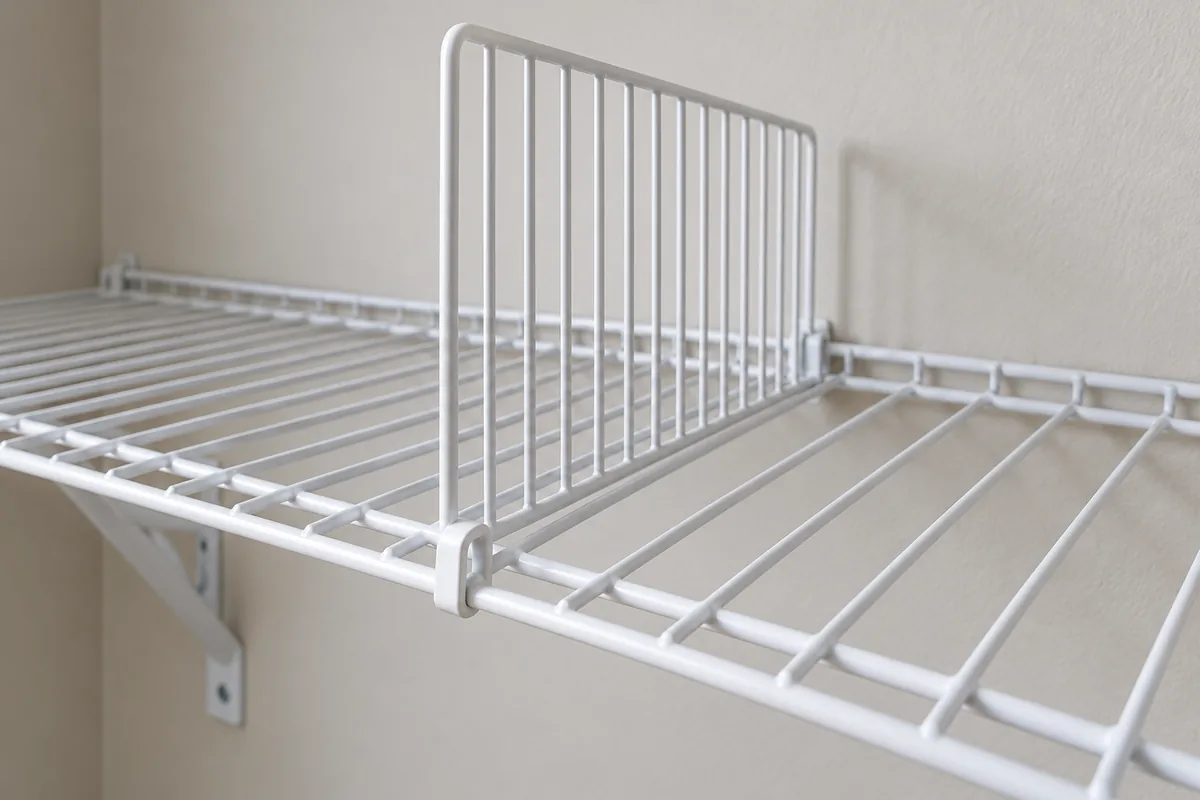
A divider spans the shelf from front to back while standing vertically to separate stored items. Its hooks or clips must meet particular wires at both ends. If the shelf depth differs, a rear hook may miss its intended crosswire; if front-wire spacing or diameter differs, the front clip may not seat as designed. A divider can then lean, rock, shift during repositioning or simply fail to install.
These outcomes are not proof that every loose divider is defective. The part may have been paired with an incompatible shelf, installed in the wrong direction, or designed for a specific product family. A Reddit organization discussion about dividers flopping on shelves illustrates the mismatch question, but is anecdotal and does not quantify its frequency. The useful sourcing response is to define the matched shelf-and-divider interface and test it together.
Elfa’s Décor+ divider is one documented example: its specification says to use the corresponding shelf depth, while its instructions describe rear fittings engaging the back double crosswire before front clips snap over a front-middle wire. Removal is performed by lifting the front upward and forward. This sequence applies to that cited system; it is not a universal design rule. See Elfa’s divider specification and instructions. The same manufacturer describes its wire shelf construction, including double wires at the front and back. Do not transfer those product dimensions or compatibility claims to another supplier’s shelf.
What should buyers match before requesting a quote?
Start with the actual shelf model or drawing revision, not a generic shelf label. Record usable front-to-back depth, the position and form of the front and rear crosswires, wire diameter where the clip contacts, and the direction in which the divider is intended to face. If the shelf is adjustable or offered in multiple depths, identify each compatible configuration separately. This is the core of a useful wire shelf divider compatibility review: identify the interface before discussing appearance or price.
The divider design should be reviewed at both engagement points. Rear hooks may locate the divider and establish its angle; front clips may constrain movement at the front edge. Their geometry, gap and spring or opening behavior—if any—must suit the shelf wires. Do not specify a universal “tight fit” without defining the expected installation force and removal behavior. Too loose can allow movement; too tight can make fitting difficult or damage a coating. The product owner and supplier should agree a practical acceptance range using the chosen materials and finish.
Also clarify whether the divider is intended to slide laterally along the shelf, be repositioned only after lifting, or remain fixed in one location. Those are distinct behaviors. “Adjustable” can mean several things, so describe the user action and where the component is allowed to move.
| Compatibility input | What to record | Why it matters |
|---|---|---|
| Shelf identity | Model, depth, revision and material/finish reference | Prevents testing against a substitute shelf |
| Front and rear wires | Contact wire positions, forms and relevant diameters | Defines where clips or hooks must engage |
| Divider orientation | Front face, rear face and installation direction | Avoids reversed assembly assumptions |
| Movement | Fixed, laterally adjustable, lift-to-release or another defined action | Aligns user expectations with clip design |
| Clearance | Divider height and nearest shelf above | Checks usable opening in the planned system |
| Sample status | Sample IDs and drawing/BOM revision | Makes approval traceable to the intended build |
How should clip engagement and release be checked?
Use a representative shelf and divider from the intended product family. Install the divider following the proposed instructions and observe whether the rear interface locates first, whether the front clips seat fully, and whether the divider stands in its intended plane. Then apply the planned repositioning motion. If release requires lifting the front, the instructions and design should make that action apparent without creating an unintended snag point.
Check both sides of the interface and more than one position if the divider can move across the shelf. A sample that works only at one location may reveal local wire variation, a geometry assumption, or a design feature that limits placement. Record the location and result rather than relying on “fits.” Photograph the front engagement, rear engagement and divider orientation. If a change is made to wire spacing, clip opening, coating or frame geometry, confirm whether the sample approval must be repeated.
Does shelf depth and overhead clearance affect compatibility?
Yes. A divider designed around one front-to-back shelf depth may not align with a deeper or shallower wire pattern. Overall divider depth is not the only dimension: the distance between the rear locating feature and front clip matters, as does the usable space between the shelf’s front and rear wires. When a shelf depth changes, require a compatibility review rather than assuming the same divider remains suitable.
Vertical clearance also affects the complete storage system. A tall divider may collide with the shelf above, interfere with stored goods, or prevent convenient removal. Measure the divider’s installed height and the planned shelf spacing. The Elfa product cited above gives a system-specific divider height and planning guidance; those values belong to that product only. For a new program, the buyer should set clearance based on the intended cabinet or closet layout, product dimensions and user access.
Consider neighboring components too. A shelf lip, side frame, bracket, wall, garment or storage bin may constrain where the divider can sit or how it can be lifted. A top-view drawing can show lateral placement, while a side view can show clearance and release travel. If the divider is intended for several shelf widths or depths, list each allowed pairing in a compatibility matrix rather than using an open-ended “universal” claim.
What belongs in the RFQ, drawing and sample approval?
An RFQ should identify the buyer’s target shelf system, the divider’s intended role, desired finish, expected sales configurations and any packaging or labeling needs. Attach a dimensioned drawing or physical shelf sample where available. Ask the supplier to mark the clip-contact wires and the intended installation direction on the drawing. The drawing should make the front/rear relationship unambiguous.
The sample approval should define what “pass” means. For example, the divider should engage at both specified ends, remain in its intended position during the agreed handling demonstration, and release using the documented motion without visible damage to the relevant finish. These are proposed buyer acceptance checks, not a certified test standard or a claim about a particular product’s performance. The buyer should decide whether to define a cycle count, force range or other numeric criterion; do not invent one after sampling has started. Recording these checks as wire shelf divider compatibility criteria gives purchasing, product and quality teams a shared reference for later sample reviews.
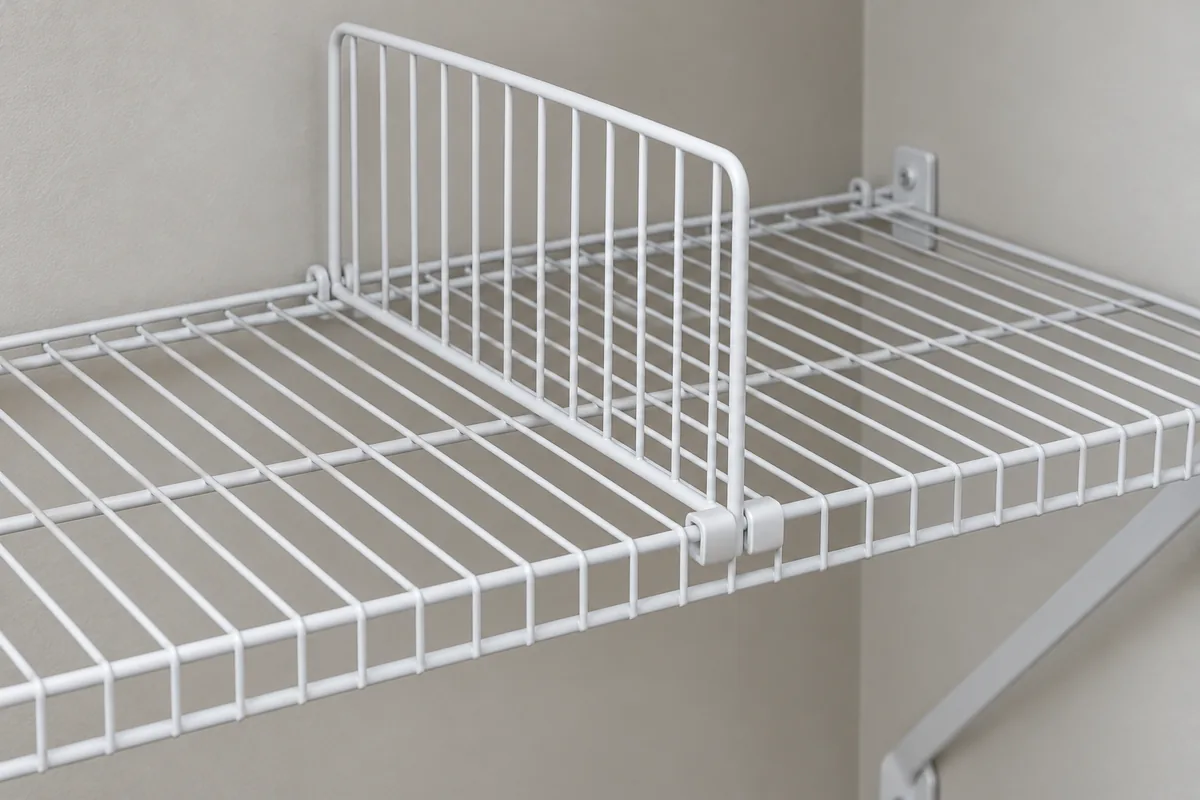
Keep the signed-off sample, drawing revision, component list and instruction artwork connected. If the shelf supplier, coating, wire layout, divider clip or packaging changes, assess whether compatibility or instructions need reapproval. This is especially useful for private-label programs that use multiple shelf widths or a changing assortment.
What sourcing mistakes create avoidable fit problems?
- Buying by shelf depth alone without checking crosswire positions and contact geometry.
- Assuming that a clip-on divider from one system fits another because the overall shelf looks similar.
- Approving a divider on a substitute shelf or early revision instead of the production-intent assembly.
- Leaving front and rear orientation unclear in the drawing or product instructions.
- Calling the divider “adjustable” without defining whether it slides, lifts out or stays fixed.
- Ignoring overhead clearance and the access needed to release the front clip.
- Changing wire spacing, coating or clip geometry after approval without reviewing fit again.
- Treating a single successful installation as proof of compatibility across every shelf size or production revision.
The practical control is to make the component pairing explicit. Use a model/revision reference, a drawing that shows the engagement points, and a sample check that follows the actual installation and release sequence. If several versions are sold, identify the permitted combinations at SKU level.
One useful purchasing document is a compatibility matrix with one row per shelf/divider combination. Include the shelf model, depth, revision, divider item number, finish, drawing revision, sample approval date and the intended user action. Mark combinations that have not been checked as “not validated” rather than allowing a distributor or downstream retailer to assume interchangeability. If the buyer expects the same divider to work across a family of shelves, test each geometry that changes the front-to-rear wire position or the clip-contact wire. A product family can share a visual style without sharing an interface.
The carton, instruction sheet and online product data should also use the same compatibility language. A label that says “fits wire shelving” is too broad if the approval applies only to a named shelf profile or depth. For private-label programs, retain the approved sample or clear reference photographs so future sourcing teams can compare a replacement sample with the accepted interface. These records help make a repeat order more predictable without implying that a sample alone guarantees every production outcome.
How can an OEM manufacturer support the review?
A custom metal hardware manufacturer can review the shelf and divider interface from a buyer drawing or physical sample, discuss forming and attachment geometry, and prepare a sample for fit review. The discussion should focus on the specific parts, finish and intended user action. It should not imply that an adjacent manufacturer already offers a particular divider or plastic clip unless that capability is confirmed.
Koitor Hardware is a family-owned factory focused on bathroom and home storage hardware, with OEM customization based on drawings or samples. For a wire-storage development project, buyers can share the target shelf model, interface views, finish requirement, intended repositioning motion, packaging and forecast quantity. Koitor can discuss manufacturability and small-batch options for relevant custom metal hardware; any divider-specific scope must be confirmed project by project. Learn more about Koitor’s OEM home-storage hardware work.
Buyer checklist before approving a wire shelf divider
- Confirm shelf model, revision, depth and wire construction.
- Identify the exact front and rear wires contacted by each clip or hook.
- State the divider orientation and intended user movement.
- Review the installed height and clearance to the next shelf or obstruction.
- Fit the sample to the production-intent shelf, not a visually similar substitute.
- Record engagement, repositioning and release observations at agreed positions.
- Tie approval to drawing, finish, component and instruction revisions.
- Recheck compatibility after relevant design or supplier changes.
- Define each compatible shelf/divider SKU pairing in product data and packaging.
الأسئلة الشائعة
Will one wire shelf divider fit every wire shelf?
No universal fit should be assumed. Shelf depth, wire layout, contact-wire diameter and clip geometry can differ by system. Confirm the exact pairing with drawings and a representative sample.
Which wires should a clip-on divider engage?
That depends on the design. A documented Elfa Décor+ example uses rear fittings over a rear double crosswire and front clips on a front-middle crosswire, but other products may use a different interface. Use the target system’s own drawing and instructions.
How should a removable divider be repositioned?
Specify the intended motion in the product instructions and verify it on the sample. Some designs may lift at the front before moving; do not infer that action for a different clip design.
What should change control trigger a new fit review?
Review changes that could affect engagement or clearance, including shelf depth or wire spacing, clip geometry, finish build, divider height, supplier revision and assembly instructions. The buyer and supplier should agree which changes require renewed approval.
Review a Home-Storage Hardware Interface
Send Koitor your drawing, sample, target shelf interface, finish requirement and packaging idea. Our team can discuss manufacturability and suitable small-batch OEM options for relevant metal storage hardware.
OEM / العلامة التجارية الخاصة
حوّل دليل التوريد هذا إلى موجز منتج
يرجى إطلاعنا على المنتج المستهدف، والحجم، والتشطيب، وكمية الطلب، ومتطلبات التغليف. وسيتلقى فريقك تقييمًا عمليًّا لإمكانية التصنيع قبل تقديم عرض الأسعار.



 English
  Español
  Português
  Français
  Deutsch
  العربية