

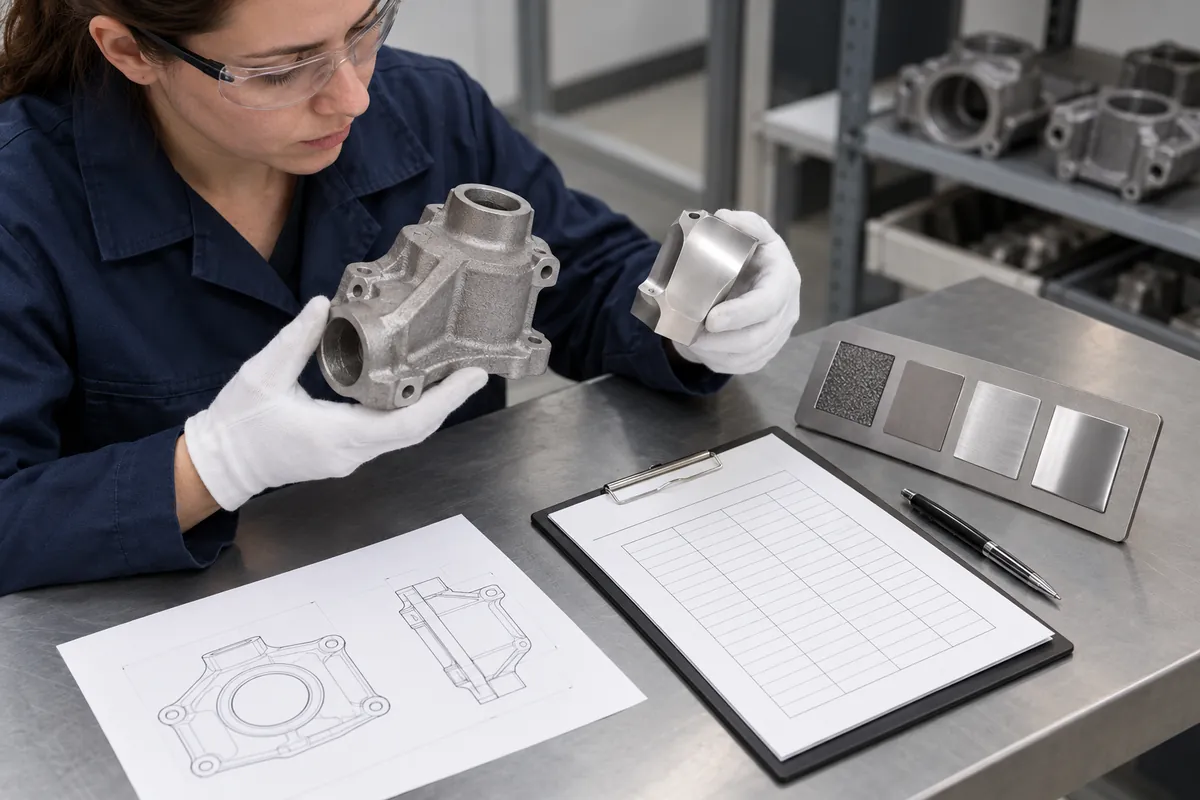
When a plated zinc die casting shows a blister or raised surface, a buyer should not assume a single cause from appearance alone. Zinc die casting plating blistering can involve the cast substrate, surface condition, cleaning and preparation, intermediate layers, plating controls, handling, or an interaction among them. The useful first step is to preserve the affected part and trace its lot, then compare the defect against an approved production-intent sample and ask the casting and finishing suppliers for evidence at each process boundary.
What does the visible defect tell a buyer?
A blister is an observation, not a diagnosis. Raised or uneven plating may appear as isolated bubbles, larger lifted areas, streaks, pits or a texture change. Similar-looking symptoms can arise through different mechanisms, and a photo rarely reveals what is happening under the finish. Buyers should document location, size and distribution, but avoid declaring “porosity” or “poor adhesion” until a qualified investigation supports that conclusion.
Start by separating three records: the part’s appearance before plating, the finished condition, and any inspection or failure evidence after handling or use. If no pre-plate images or retained samples exist, note that limitation. It may not be possible to determine whether a surface irregularity originated in the casting or developed during finishing. Do not destroy the only failed part before the supplier agrees on examination or sample retention.
For a private-label bathroom accessory, the decorative surface can be commercially important while the component also has functional interfaces. A hook base, trim piece or mounting cover might be a bought-in zinc-alloy part rather than a component made by Koitor. Verify who cast it, who plated it, and which organization controls the released specification. A metal hardware factory’s general experience in fabrication does not establish that it operates a die-casting or plating line.
A concise problem statement helps: identify the product revision, purchase lot, component, finish specification, affected quantity, defect location and when it was discovered. Include whether the issue appeared on incoming inspection, after assembly, after packaging or after a defined exposure. This is enough to initiate a structured review without claiming a root cause prematurely.
For zinc die casting plating blistering, preserve the distinction between a defect description and a confirmed mechanism in every email, inspection record and corrective-action request. This keeps the supplier investigation open to evidence from both the substrate and finish stages.
How can substrate and plating hypotheses be separated?
The casting substrate and decorative finishing sequence interact, so suppliers may need to examine both. Buyers can ask the caster whether the affected lot shows relevant variation in surface condition, filling, density or other controlled characteristics. The finisher can explain the agreed preparation and plating sequence, control records and whether the particular part geometry presents difficult areas. These are questions for the responsible process owners; they are not conclusions from a photograph.
| Review area | Evidence the buyer can request | What it can help establish | What it cannot establish alone |
|---|---|---|---|
| Part identity and lot | Traceability, lot code, purchase and revision records | Which component and production lot are under review | Root cause of a finish defect |
| As-cast condition | Retained unplated sample, casting inspection record, supplier assessment | Whether the substrate merits further examination | Plating-process cause |
| Pre-plating preparation | Supplier’s process scope and relevant control records | Whether preparation steps are documented for the part | That every step was effective on every part |
| Finished surface | Approved sample, defect map, inspection images | Pattern and location of the observed appearance | Internal mechanism below the finish |
| Failure examination | Agreed examination or cross-section by a qualified provider | Additional physical evidence about layers or substrate | A universal conclusion for unrelated lots |
| Process responsibility | Purchase specification and supplier agreements | Who must investigate or contain each operation | Scientific cause without technical evidence |
Ask the parties to state what they know, what remains a hypothesis and what evidence could distinguish the possibilities. If a supplier says the part is “porous” or the finisher says “bad cleaning,” request the observation or test behind that statement. Avoid treating a common defect label as proof that the named process caused it.
The International Zinc Association’s technical guidance on polishing and plating explains that cast surface condition and finishing requirements need to be coordinated. It is useful technical context, but it does not diagnose a particular Koitor or buyer part. The actual alloy, casting design, supplier route and plating specification must be confirmed for the project.
What should a buyer define in the finish specification?
A finish callout should make the required appearance and verification scope understandable to both the casting and plating supplier. Identify the substrate or approved part reference, finish system by the purchaser’s controlled specification, visible surfaces, critical interfaces, acceptable sample and inspection conditions. If a standard or proprietary finish code governs, identify the applicable document and revision rather than paraphrasing it in a purchase note.
A visual standard should show representative acceptable appearance and, when possible, clearly agreed unacceptable examples. State the viewing conditions and which faces are cosmetic or hidden after assembly. Define how the supplier should handle questionable defects: segregation, review, rework authorization or rejection. Avoid adding invented defect-size thresholds if the buyer has not established them.
The part design should be reviewed for areas that are hard to cast, polish, rack or plate consistently. A deep recess, sharp transition, narrow channel or contact point may affect the available process or make inspection difficult. The correct response depends on supplier capability and the actual design. During development, ask the supplier to flag surfaces where the required appearance may be difficult to achieve or verify.
Where the product uses more than one supplier, define the handoff. Which party owns the substrate drawing? Who releases the production-intent cast sample? Who approves the finished master sample? Who retains process records and investigates complaints? If responsibilities are unclear, a defect can move between suppliers without anyone accepting containment or evidence collection.
How should the production-intent sample be approved?
Approve a sample that represents the intended production chain as closely as practical: specified cast part, planned preparation and plating, actual geometry, and the final assembly context. A hand-polished prototype may demonstrate visual direction but not production consistency. If an early sample differs from the planned process, label that limitation in the approval record.
Inspect the complete part under the defined lighting and viewing conditions. Record the side, edge, recess or feature where the surface is visible. Check interfaces that will be covered or contacted during assembly, since appearance and fit can both matter. Photograph the sample with a neutral background, scale reference where appropriate and enough context to locate the feature. Do not use a single attractive front view as the only quality record.
Keep the approved sample under controlled identification. Tie it to the product, drawing, finish description, supplier route and approval date. If the finish vendor changes, the casting source changes, a process step is revised, or the design is altered, decide whether reapproval is needed. The old sample may no longer represent the new route.
For an issue, compare failed production with the approved sample and any first-article record. Confirm whether the sample and suspect parts share the same substrate source and finishing process. If the affected parts are limited to one component or position, record that pattern. It can guide the investigation, but it does not prove cause without supplier evidence.

What should happen when blistering is reported?
Containment comes before root-cause claims. The buyer and suppliers should agree which lots, components and finished goods are affected, what inventory is on hold, and whether additional inspection can reliably separate conforming from questionable pieces. If the issue may affect product function or a contractual requirement, follow the buyer’s established escalation and disposition process.
For zinc die casting plating blistering, a useful corrective-action response explains which observation supports each proposed cause and what follow-up could disprove it. This makes the investigation reviewable rather than a list of assumptions.
Preserve representative failed samples and, if available, acceptable parts from the same lot and an approved reference sample. Keep packaging and labels that establish traceability. Photograph the defect before cleaning, polishing or other intervention. Record the discovery date and how the item was handled. If an independent lab or specialist examination may be needed, agree on sample custody and the questions before destructive analysis.
A useful corrective-action request asks for a process map, likely cause(s) labelled as hypotheses, evidence collected, scope of containment, corrective action, verification method and change-control plan. It should distinguish correction of existing stock from prevention on future orders. “Operator retrained” or “100% checked” is not by itself proof that the cause is understood or the control will remain effective.
Do not authorize cosmetic repair without understanding whether it changes the specified finish, dimension, adhesion or assembly condition. Rework should be evaluated and documented by the responsible supplier under the approved specification. If the buyer accepts a deviation, make the quantity, lot and duration explicit rather than turning a one-time concession into an undocumented permanent standard.
For repeat orders, define a trigger for review when substrate, tooling, finishing location or process route changes. A corrective action that applies to one supplier route may not control another. The sourcing team should maintain the approved route and change history alongside the visual standard.
How can the buyer make the supply chain accountable?
Map the sequence from casting through finishing, inspection, assembly and packing. Identify which company controls each operation, where the part changes hands and which record follows the lot. This is especially important if the buyer contracts one supplier who subcontracts finishing. The commercial supplier should still clarify its responsibility for communication, containment and evidence even when an external process provider performs the operation.
Use the RFQ to request the proposed substrate and finish source, sample plan, appearance approval method, traceability and process-change notification. Do not assume every supplier provides laboratory analysis or accredited testing. If a special examination is needed, specify who arranges it, which sample is tested and how the conclusion will be used.
Supplier qualification should reflect the product’s importance and risk. A capability conversation can ask how the supplier reviews cast geometry, finish access, sample approval and complaint evidence. It should not claim that Koitor itself is a casting or plating laboratory. Koitor’s role should be represented according to the actual contracted manufacturing scope for the project.
A practical sourcing checklist:
- – Identify the cast component, supplier, lot and drawing revision.
- – Define substrate and decorative finish by controlled specification.
- – Mark visible faces, interfaces and any agreed appearance reference.
- – Approve a production-intent sample and retain its traceability.
- – Clarify who controls casting, surface preparation and plating.
- – Record defect location and preserve failed and comparison samples.
- – Separate containment from root-cause hypotheses.
- – Request evidence and a verification plan for corrective action.
- – Define approval requirements for supplier or process changes.
- – Document any concession with lot, quantity and expiration scope.
How can Koitor support a buyer review?
Koitor is a family-owned bathroom and home-storage hardware manufacturer with experience in metal component sourcing, fabrication, assembly and drawing/sample communication. That experience can help a buyer clarify the finished product requirement and supplier handoffs. It does not mean that Koitor currently casts zinc alloy, performs decorative electroplating, or operates an accredited test laboratory.
For a project involving a plated accessory component, share the part drawing, finish specification, visible-surface requirements, reference sample and supplier responsibility map. Confirm which components Koitor will manufacture directly and which are sourced from specialist suppliers. Keep claims about current process ownership specific to the quotation and approved production route.
الأسئلة الشائعة
Does a blister prove the zinc casting was porous?
Can a photo identify whether preparation or plating caused the defect?
Should the buyer reject an entire order after one blister?
Who should lead a corrective action if plating is subcontracted?
Does an approved sample guarantee every production part will match?
For related supplier context, see Koitor’s custom metal storage basket manufacturing page و OEM home-storage hardware information. To discuss component scope and approved samples, اتصل بـ «كويتور». For zinc substrate finishing background, review the International Zinc Association’s technical guidance on polishing and plating.
Review a Decorative Metal Component
Share the part drawing, finish specification, visible surfaces and approved reference sample so supplier responsibility and inspection expectations can be clarified.
OEM / العلامة التجارية الخاصة
حوّل دليل التوريد هذا إلى موجز منتج
يرجى إطلاعنا على المنتج المستهدف، والحجم، والتشطيب، وكمية الطلب، ومتطلبات التغليف. وسيتلقى فريقك تقييمًا عمليًّا لإمكانية التصنيع قبل تقديم عرض الأسعار.


 English
 Español
 Português
 Français
 Deutsch
 العربية