
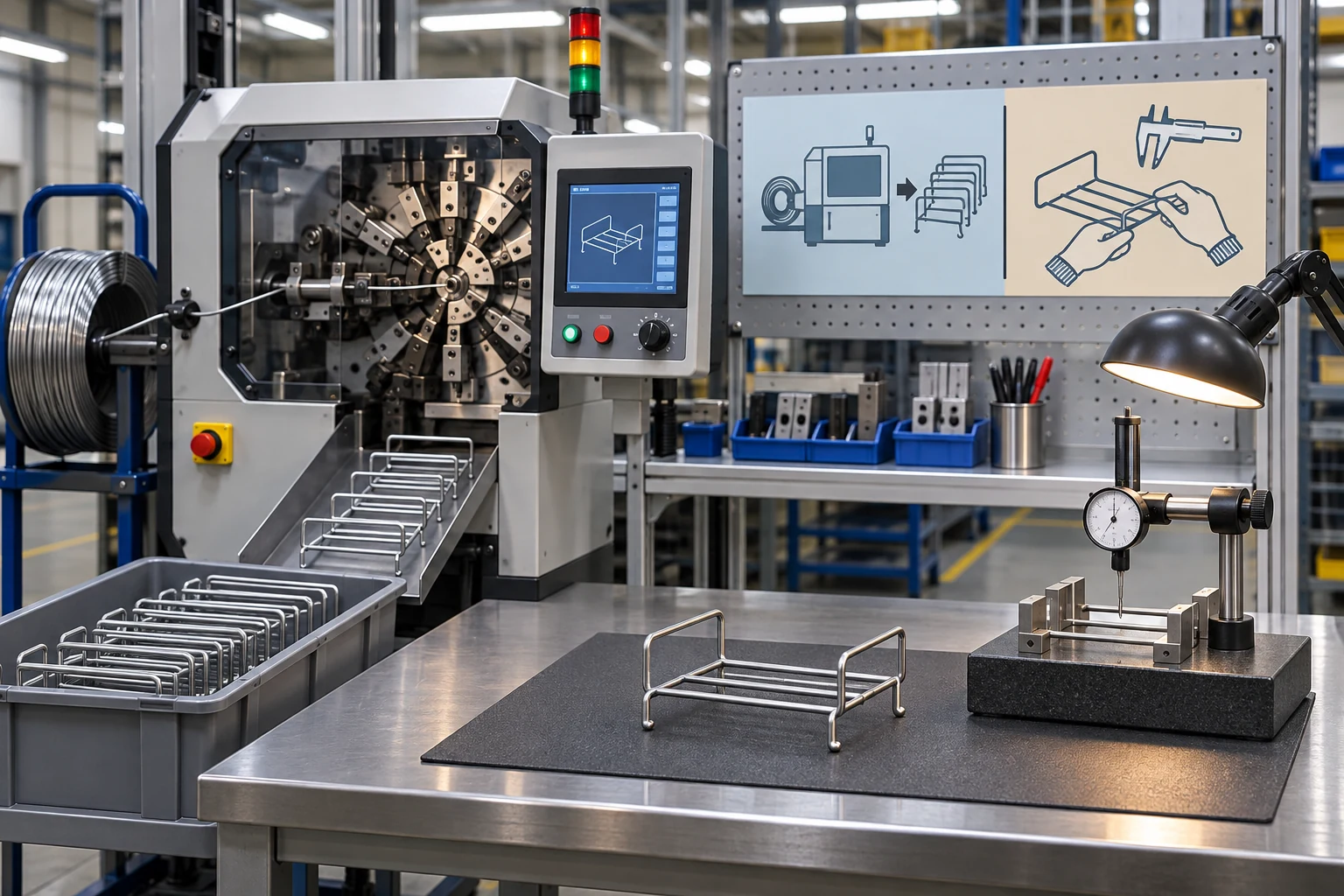
Capacity and capability answer different supplier questions. Capability concerns whether an organization has the tools, knowledge, skills, and controlled process needed to perform a task. Capacity concerns whether enough time and resources are available during a stated period. A supplier may have the capability but no open production window, or free time without the process evidence needed for the requested part. Buyers should assess the two dimensions separately before treating a quotation or sample as confirmation that an order is feasible. For buyers, capacity vs capability is the concise label for the distinction explained in this guide.
Capacity Vs Capability: buyer guide and process boundaries
The phrase capacity vs capability often appears in organizational planning. In supplier evaluation, it is useful only when the buyer names the exact product, operation, and period being discussed. “Can your factory make this?” could mean several different things: has the supplier performed a comparable process, can it meet a drawing revision, can it repeat an approved sample, or can it allocate enough resources by a requested date?
These questions need different evidence. A sample may show that a particular design can be assembled once under the conditions used for that sample. It does not, by itself, establish a recurring monthly output or a reserved production slot. Likewise, a machine list may describe equipment, but not prove that the equipment is suitable for a critical feature, correctly maintained, staffed, or available for the buyer’s order window.
A practical conversation separates the statements:
| Buyer question | Dimension | Useful evidence to discuss | What the evidence does not establish alone |
|---|---|---|---|
| Is the required operation within the supplier’s process range? | Capability | Relevant process description, tooling or fixture plan, sample review, inspection method | Available quantity or date |
| Can the operation meet the specified feature? | Capability | Drawing review, critical-feature agreement, sample or first-article records where applicable | Repeat performance across every lot |
| Is there a feasible period for the requested order? | Capacity | Dated schedule assumptions, resource allocation, material status, quantity and operation sequence | Technical suitability of an unproven process |
| Can both conditions be met together? | Both | Agreed revision, process route, quantity, timing, and documented open issues | A guarantee beyond the agreed scope |
The “evidence” column is a discussion aid, not a universal audit standard. A buyer should request records that fit the product, risk, purchase terms, and supplier relationship. Some information may be commercially sensitive; a supplier can sometimes provide a bounded summary or a sample-specific record instead of exposing unrelated customer or production data.
Skills for Justice explains the organizational distinction in terms of having the ability and resources to perform work, while Agile Management Office describes capability through the means and skills available and capacity through resources over time. These definitions are useful for clarifying language; they do not establish any particular factory’s performance. In statistical process control, “process capability” can have a narrower technical meaning involving process variation relative to specification. That is a different conversation from whether a supplier has available labor or machine hours. Keep the context explicit.
A two-axis supplier readiness matrix
A simple matrix makes the two questions visible. It is an authored planning model, not a rating system or a claim that supplier readiness can be reduced to one score.
| Capability for the specified work | Capacity in the requested period | Buyer interpretation | Next question |
|---|---|---|---|
| Evidence established for the relevant operation | Availability confirmed for the scoped order | The two principal conditions may align | What assumptions, revision, quantity, and dates are included in the written confirmation? |
| Evidence established | Not currently available | The supplier may be able to perform the work, but the requested timing or resources are unresolved | Is another period or phased schedule acceptable? |
| Not established | Resources appear available | Free time does not prove the required operation is understood or controlled | What sample, process review, tooling plan, or qualification step is needed? |
| Not established | Not established | Neither technical fit nor timing is confirmed | Which uncertainty should be resolved first, and what information is needed? |
Consider a hypothetical bathroom storage bracket with a revised hole position and a requested delivery window. If a supplier has previously made a comparable bracket, the buyer still needs to check whether the revised hole, weld location, finish, and inspection points fit the existing process route. That is a capability question. If the supplier has other confirmed work in the same period, the available time for the requested order is a separate capacity question. Neither row should be inferred from the other.
The matrix also helps avoid an unhelpful yes-or-no question. A supplier may say “yes” to making a product because the process is familiar, while the buyer hears that as “yes” to the requested volume and date. Conversely, a supplier may say “not now” because the schedule is full, and the buyer may misread that as a technical inability. Ask the supplier to identify which dimension is established and which remains open.

Why a machine count is not a capability or capacity conclusion
Equipment is one input to a process. A machine’s name, size, or count does not tell a buyer whether it can handle the part’s material, geometry, quality requirement, or approved process route. The equipment may require tooling, a compatible fixture, trained operators, maintenance, or downstream operations. A process may also depend on work that is not visible in a single machine photograph.
Machine count also fails to answer the time question. Two similar machines do not necessarily mean twice the available output. They could have different tooling, maintenance status, staffing, or assigned work. A machine might be available but unsuitable for the buyer’s feature. Another might be suitable but committed elsewhere. The buyer needs a scoped, dated conversation rather than an arithmetic estimate based on an equipment list.
For an OEM metal-storage component, capability might involve whether the supplier can interpret the drawing, form or weld the relevant geometry, reach the cosmetic surfaces, assemble the parts, and inspect the agreed features. The appropriate evidence depends on the actual design. A generic statement that a supplier “has welding” does not confirm a specific joint, material, appearance, fixture, or acceptance condition.
Capacity is similarly scoped. It is not an abstract annual number unless the buyer has agreed on what the number includes. A quote may depend on raw material availability, component sourcing, finishing, assembly, inspection, packing, and shipment timing. A supplier that can perform every production operation may still need a realistic schedule for external processing or a sub-supplied component. The buyer should ask what is included in the stated period and what remains an assumption.
Separate a successful sample from repeat production readiness
A sample is valuable because it lets the buyer and supplier review a defined product version. It can reveal fit, finish, assembly, packaging, and specification questions. The sample should be identified by drawing revision, material or finish description, and any deviations that were accepted for evaluation. Without those identifiers, later discussions can confuse one version with another.
A sample is not automatic proof of volume capability. The process used for one sample may differ from the planned production route. A prototype may be hand-fitted, made with temporary tooling, or assembled with extra attention. That does not make it useless; it means the buyer should ask what the sample does and does not represent.
A repeat-production conversation can include:
- Which sample or drawing revision is the reference?
- Which features are critical to fit, appearance, or function?
- What production route is proposed for those features?
- What inspection evidence is available for the agreed points?
- Are any tooling, fixtures, or bought-in parts still unresolved?
- Does the order quantity or requested period require a different process plan?
- Which deviations are temporary and which are accepted in the final specification?
For a wire basket or metal shelf, the buyer might inspect geometry, weld placement, contact points, coating coverage, and package fit on the sample. Those observations concern the sample in hand. If a larger order needs a fixture or route change, the buyer should identify how that change will be reviewed. A supplier’s answer should remain linked to the specific part and agreed requirements, not generalized into a blanket claim about every product.
Distinguish capability from statistical process capability
The word “capability” is overloaded. In general supplier planning, it can mean organizational ability: people, process, equipment, knowledge, and methods to perform a task. In statistical quality engineering, “process capability” often refers to quantitative analysis of process behavior against specification limits under defined assumptions. That technical use is not interchangeable with available production capacity.
Do not use a process index as a substitute for a schedule. A statistical result does not tell the buyer that a line has open time next month. Likewise, a supplier’s estimated output does not establish that a measured feature is stable relative to the specification. Each answer requires its own context, data, and assumptions.
If a supplier report includes an index, the buyer should identify the feature, data set, measurement method, process conditions, and assumptions behind the analysis. Do not infer from one number that all characteristics, products, or future lots are covered. If the buyer’s actual question is whether the supplier can perform a process, a sample or process review may be more relevant. If the question is whether the process is statistically capable, use the appropriate quality discussion instead.
For related explanations of available time, cycle time, takt time, and changeovers, see supplier capacity, takt time, cycle time, and changeover. For a structured view of supplier process evidence, see the technical factory audit guide for metal hardware suppliers. Those pages cover adjacent questions; this article keeps the ability-versus-availability distinction at the center.
A buyer’s sequence for assessing a supplier response
A useful sequence reduces ambiguity without demanding a universal audit package.
1. Define the work
Share the product identifier, drawing revision, material, finish, quantity, package configuration, and requested period. If some fields are not yet decided, mark them as open. Avoid asking whether a supplier can make a product based only on a rendering or a broad category name.
2. Ask the capability question
Ask which operations and features are within the proposed route, what evidence supports that view, and what remains unproven. A supplier may identify a need for a sample, tooling review, fixture, or outside process. That answer is more useful than an unqualified claim that “everything is possible.”
3. Ask the capacity question separately
Once the scope is clear enough, ask what period or schedule can be considered, what assumptions affect it, and whether external processes or materials are included. A stated date should be classified accurately: requested, estimated, proposed, or confirmed under the actual commercial arrangement.
4. Preserve unresolved items
If a critical dimension, material, finish, or packaging method is unknown, record it as an open item. Do not turn a tentative date into a commitment or a sample into proof of repeat output. The buyer and supplier can then decide which uncertainty has to be resolved before an order is placed.
5. Read back the boundary
A short written readback can say: “For drawing revision C, the supplier has described the forming and assembly route; the surface finish specification still needs confirmation. The requested quantity is 500 units. The supplier has proposed a production window beginning in May, subject to material confirmation.” This example is illustrative and makes no claim about a real order. It preserves the difference between process fit, resource availability, and unresolved conditions.
Warning signs in supplier discussions
Some statements sound decisive but leave the buyer’s actual question unanswered.
“We have many machines.” Ask which machine or route applies to the specified feature, and whether the relevant tooling and process are available. Machine count alone does not establish either suitability or open time.
“We made the sample.” Ask which revision and which route the sample represents. A sample may prove that a version was produced, but the buyer should still understand what changes between prototype and planned production.
“We can do any quantity.” Ask for a scoped quantity and a period, including material, finish, assembly, inspection, and packaging assumptions. A universal statement cannot substitute for a dated plan.
“The schedule is open.” Ask whether the supplier has also reviewed process fit, material availability, external operations, and the required acceptance criteria. Availability alone does not establish capability.
“The process is certified.” Ask what certificate or record is meant, which operation or product it covers, who issued it, and whether it applies to the buyer’s part. Do not infer scope from a logo or a broad verbal statement.
These are prompts for clarification, not proof that a supplier is unreliable. A clear answer may be conditional because a drawing, order quantity, or material has not yet been finalized. The goal is to capture the conditions, not pressure a supplier into an unsupported guarantee.
How OEM buyers can use the distinction
For a new private-label product, capability and capacity should be revisited at different project milestones. During concept or RFQ review, the buyer may need to understand whether the design is feasible and which details affect tooling or assembly. During sample approval, the buyer can confirm the actual version and clarify the production route. Before a purchase order or schedule commitment, the buyer can discuss available resources and dependencies for that specific quantity and period.
The distinction is especially useful when a design changes. A new hole location may be technically manageable yet require a fixture adjustment. A different finish may be available through an outside process with its own timing. A larger order may use the same process but need another schedule. The buyer should identify whether the change affects capability evidence, capacity planning, or both.
For ongoing products, the same discipline helps with reorders. A historical order does not automatically establish current availability. The process may have changed, a specification may have been revised, or the requested quantity and delivery period may differ. Reconfirm the relevant evidence and schedule assumptions without treating every reorder as a completely new qualification.
Koitor’s approved positioning is as a family-owned custom metal hardware factory specializing in bathroom and home storage hardware, with flexible OEM communication. That does not imply that every process, material, timing, or quantity is available for every project. A practical RFQ can include drawings or a physical sample, target quantity, required finish, packaging needs, and timing so that the product scope can be reviewed.
Questions to put in a supplier review
A buyer can keep a short, specific list:
- What product revision and operation are we discussing?
- Which evidence shows the operation is suitable for this feature?
- What process, tooling, fixture, or outside step remains unresolved?
- What quantity and period does the capacity statement cover?
- Which assumptions could change that period?
- Are the sample and proposed production route the same?
- Which inspection points and records are part of the agreement?
- Which parts, materials, finishing, or packaging steps are supplied by another party?
- What is requested, proposed, confirmed, or still unknown?
- Who will update the buyer if a dependency changes?
These questions do not create a guarantee or replace a contract. They help both sides make a more precise decision and preserve the boundary between “able to do” and “available to do now.”
It is also useful to keep the answer attached to a date. A capability review can become stale after a drawing revision, process change, or transfer to another facility. A capacity statement is even more time-sensitive because other orders, holidays, material arrivals, and outside-process bookings can alter the available window. Record when the supplier gave the answer, what scope it covered, and what event should trigger a new review. This is a practical document-control habit, not a claim that every supplier needs a particular software system.
Buyer checklist: keep ability and availability separate
Save the date and scope of each review so later revisions can be compared fairly.
Before approving a supplier or order:

- Name the product, revision, operation, quantity, and period.
- Ask for evidence relevant to the specific operation and critical features.
- Treat equipment lists as context, not as proof of process fit.
- Treat a sample as evidence for its identified version, not a blanket volume claim.
- Record capacity assumptions for materials, outside processes, assembly, inspection, and packing.
- Keep tentative dates labeled as tentative until the appropriate confirmation exists.
- Do not confuse statistical process capability with available time or labor.
- Revisit both dimensions when quantity, design, finish, or timing changes.
- Keep unresolved questions visible instead of compressing them into one “yes.”
When you are comparing a custom bathroom or home-storage hardware project, send the drawing or sample, quantity, finish, and target timing to contact Koitor. Koitor can review the project scope and discuss suitable OEM next steps after the requirements are clear.
A supplier review is stronger when it ties every answer to a defined operation. “We can weld” is broad; “the proposed route includes the specified bracket joint, followed by visual review of the identified cosmetic face” is easier to discuss. The buyer can ask what drawing information, sample, or process record supports that scoped statement. If the supplier’s answer depends on an outside finisher, purchased component, or a buyer-approved change, keep that dependency visible. An order may be technically suitable while timing remains open, or timing may look available while process evidence is incomplete. Record the two conclusions separately, together with who supplied the information and when. This prevents a later schedule update from being mistaken for a change in technical capability. It also gives procurement, engineering, and quality teams a shared description of what is actually established.
Frequently asked questions
What should a buyer confirm first?
Start with the exact product, process, or measurement scope and the applicable drawing or specification.
Does one sample or record prove every production condition?
No. Keep the part, revision, method, and evidence scope attached to each conclusion.
What if the requirement is unclear?
Record the open question and ask the responsible supplier or technical owner before approval.
For related buyer context, see the technical factory-audit guide and OEE versus production capacity.
Discuss a related hardware project with Koitor
Share the relevant drawing or sample, product revision, finish, order quantity, and packaging scope to clarify the manufacturing discussion. Confirm project-specific processes and evidence with the responsible supplier.
OEM / PRIVATE LABEL
Turn this sourcing guide into a product brief
Share your target product, size, finish, order quantity and packaging requirements. Your team receives a practical manufacturability review before quotation.


 English
 Español
 Português
 Français
 Deutsch
 العربية