

For a curtain holdback projection specification, define the distance from the finished wall to the working contact point, the usable tieback opening, the fabric bundle it must capture, and the installed mounting position together. A product photograph rarely shows the true usable projection or the clearance around a gathered curtain. Importers and private-label buyers should confirm the holdback, tieback, fabric reference, mounting surface, and installation drawing as a single interface before approving a production-intent sample. The checks below concern buyer specification and sample approval; they do not imply that Koitor currently manufactures curtain holdbacks. A clear curtain holdback projection specification keeps the projection datum tied to the actual tieback contact point. Record curtain holdback projection with the finished wall datum and the intended fabric bundle.
What does “projection” mean in a curtain holdback specification?
Projection is the distance a holdback extends from the mounting surface toward the room, but the dimension needs a clear datum and endpoint. A catalog may measure from the wall face to the tip, the centerline of a hook, the front of a ring, or another point. Those values are not interchangeable. When the useful question is whether a gathered curtain will sit clear of the wall and window hardware, the buyer needs the working contact point, not a decorative overall length alone.
State the measurement in a drawing or specification and identify the two reference surfaces. For example, define the finished wall plane as the starting datum and the centerline of the tieback loop or the inward face of the retaining element as the endpoint. The chosen endpoint depends on the construction. A rigid hook may retain fabric near its end, while a ring, knob, or curved arm may control the fabric bundle at a different point. If the supplier’s standard drawing uses another datum, ask for both the catalog dimension and the buyer-relevant installed projection instead of silently converting one into the other.
Projection is affected by the whole installed assembly. A wall plate, stand-off, decorative spacer, screw head, or wall irregularity may move the working part outward. A holdback can meet a nominal projection on a drawing yet sit closer to the usable curtain space after installation if the measurement ignores the mounting plate or a required stand-off. Conversely, a thick backing or a mounting surface that is not flush may increase the distance. Buyers should decide which assembled condition is the controlling one and record it with the accepted sample.
Projection also has a practical relationship to the curtain’s path. A short arm may pull a thick or lined curtain too close to the wall, press the fabric against trim, or leave insufficient room to insert the tieback. A longer arm can create clearance, but it can also hold the curtain too far into the room, increase leverage on the mounting point, or interfere with a nearby door, blind, window handle, or furniture. There is no universal “best” projection independent of the textile, window layout, and intended drape.
The measurement should describe what the buyer will evaluate. If the key outcome is a clear gap between the fabric and a window handle, list that clearance and show the holdback’s working point. If the objective is keeping a gathered panel within a defined reveal, mark the wall plane, fabric bundle, and desired position. A dimension chain is more useful than a single unexplained arrow because it lets the factory and buyer distinguish part geometry from the installed result.
The product instruction sheets from manufacturers illustrate why model-specific diagrams matter. Rowley’s HLB20 concealed tieback instructions show a specific product and mounting arrangement; AriA’s installation sheet covers a different holdback design. Neither drawing establishes a universal measurement convention for all brands or shapes. Use each only to understand its own model and installation sequence, then request the supplier’s drawing for the actual item being sourced. See Rowley’s HLB20 installation instructions and AriA’s holdback installation instructions.

Which tieback interface should the sample represent?
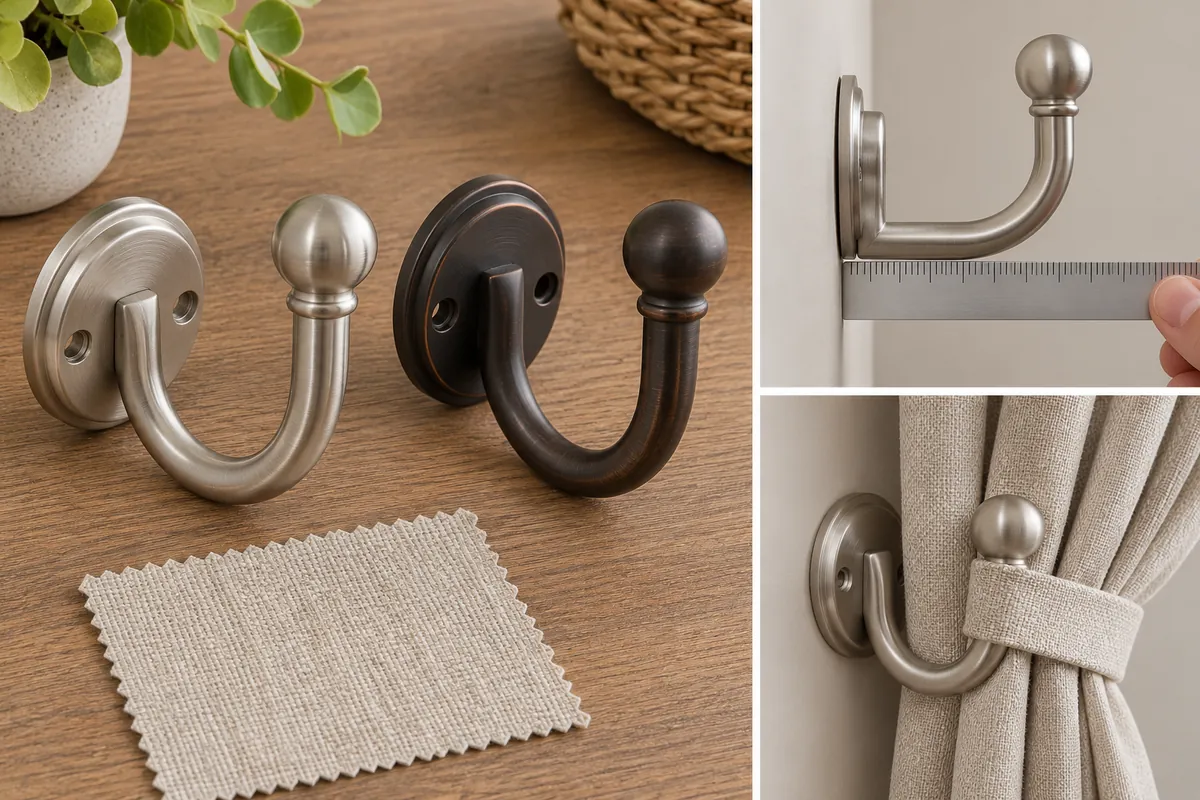
“Holdback” describes a family of retaining arrangements, not one standardized interface. A buyer may be evaluating an open hook, a knob or post, a ring, a concealed fitting, or a fixed decorative arm that works with a separate tieback. The shape determines how the fabric is captured, how the bundle is inserted and removed, and which dimension should be treated as the working opening. A sample that looks similar from the front may behave differently when loaded with the actual curtain.
For an open hook, specify the entry direction and the usable throat. The hook needs enough opening for the intended fabric bundle to enter without snagging, but an excessively open geometry may not retain the gathered textile as intended. Review the throat at its narrowest point, the curve that contacts fabric, and any exposed end that could catch a loop, lining, or decorative trim. The buyer should not assume the hook’s outside width equals the opening available to the curtain.
For a ring or loop, distinguish the outside diameter from the clear inside opening. A thick ring can look substantial while leaving a relatively small opening. The inside shape can be circular, oval, or otherwise contoured, and a small change in that geometry may affect insertion and fabric contact. Record which opening dimension matters and whether the fabric must pass through the loop or merely rest against it. If a separate cord, band, or textile tie is part of the assortment, name it in the sample plan and confirm that it is included or supplied by another party.
For a knob or post, clarify how the tieback is retained. The buyer may wrap a separate fabric band around the post, pass a loop over it, or use the post as a stop against which gathered fabric is positioned. These are different use cases. Specify the intended retention method, the post’s usable length, the distance from the wall, the end shape, and whether the post must accept a particular loop thickness. If the tieback is a separate SKU, assign responsibility for matching the two components rather than treating a visually coordinated set as automatically compatible.
For a concealed fitting or two-part arrangement, the visible decorative element may not reveal the installation hardware or engagement mechanism. Ask for an exploded view or installation sheet that identifies the wall-side component, the removable element if any, the direction of engagement, and the clearance needed for installation. Confirm whether the user can remove the tieback without removing the wall plate, and whether a small locating feature changes the usable projection. Do not infer concealed construction from a lifestyle image.
When reviewing a sample, use the exact textile reference, not an empty hook or a thin ribbon chosen because it is easy to handle. Record fabric type, lining, panel construction, and the method used to gather the curtain. A tightly pleated panel, a lined drape, and a loose sheer can create different bundle thicknesses even when they cover a similar window. The test is not a performance certification; it is a fit check against the buyer’s intended assortment and use conditions.
If the buyer’s range serves several fabric weights, select at least a representative thin and thick bundle for sample review, or specify a separate holdback configuration for each intended range. Record whether the holdback must retain the curtain with a separate tie, whether the tie is included in the retail pack, and whether the customer is expected to create the bundle. Those decisions affect both the hardware geometry and packaging contents.
How should buyers measure the curtain bundle and installed clearance?
Begin with the curtain and window context that the product is meant to serve. Identify the fabric panel, lining, finished hem, pleat or gather method, and likely bundle position. The fabric bundle is not a fixed cylinder: it changes with fabric thickness, fullness, folds, and how tightly a user draws the panel together. A single measurement on a flat curtain does not describe the bundle at the holdback.
For a practical sample check, gather the panel using a repeatable method and measure the compressed bundle at the intended holdback height. Note whether the fabric is folded, pleated, or simply drawn into the tieback. If the product is meant for a separate textile tie, include the tie and its fastening method in the trial. Ask the buyer team to define a range, such as “fits the identified thin sample and the identified lined sample,” rather than a vague description like “fits most curtains.” A range should be tied to actual references, not an unsupported industry-wide size claim.
The vertical location matters because a curtain has different drape and tension at different heights. A holdback near the floor may capture more fabric and interact with a hem or puddling; a higher position may encounter a narrower bundle but pull the panel into a different shape. The buyer should mark the intended height from a stable room datum, such as finished floor level or a defined window reference, and specify the mounting centerline. If multiple installers or markets are involved, a dimensioned installation guide can reduce interpretation differences.
Check clearances in the installed position. The curtain should not obstruct a window handle, blind mechanism, ventilation feature, door swing, or the normal route through the room. Check the holdback against trim and adjacent wall returns. Include both the unloaded position and the curtain gathered into place, because an empty fitting may clear nearby objects while the loaded fabric does not. A plan-view sketch can show how far the fabric bundle projects into the room and whether it covers a control or edge.
The mounting location should be a controlled part of the specification. A difference of a few centimeters in height or horizontal position may change how much fabric is gathered, the angle at which it meets the holdback, and the visible symmetry between paired curtains. If the buyer sells a pair, specify whether the left and right installation positions mirror one another and which feature controls the pair spacing. Avoid leaving an installer to infer symmetry from a front-view product photo.
Use a simple approval matrix:
| Buyer question | What to define or observe | Why it matters |
|---|---|---|
| Projection datum | Finished wall plane and working contact point | Prevents comparison of different catalog measurement methods |
| Tieback opening | Clear internal opening or usable hook throat | Determines whether the intended tie or fabric bundle can engage |
| Fabric reference | Identified panel, lining, and gathering method | Makes the fit trial repeatable |
| Mounting position | Height and horizontal location from named datums | Controls drape, symmetry, and clearance |
| Obstructions | Handles, trim, blinds, doors, and nearby furniture | Reveals conflicts that a product-only check misses |
| Installed sample | Holdback mounted on a representative surface | Captures the effect of plate, screws, spacers, and installation |
| Pack contents | Holdback, screws, anchors, textile tie, and instructions | Prevents a bundle image from implying unlisted components |
Keep observed fit separate from structural or safety claims. A sample that holds a curtain during a short demonstration does not establish long-term performance, wall-anchor suitability, or a defined load rating. Those requirements should be specified and verified separately when they matter to the project.
Which wall attachment and finish details need to be agreed?
Mounting details should be reviewed on the actual substrate and with the intended installation hardware. A screw shown in a product image does not establish which screw or anchor is suitable for every wall. The buyer should request the supplier’s proposed mounting arrangement for the intended wall construction and ask who is responsible for confirming installation suitability. If the product is sold across several markets, local installation guidance and supplied hardware may differ, and the buyer should confirm the kit for each program.
The wall plate and screw pattern affect both appearance and installation tolerance. Record the plate footprint, hole centers, orientation, and any concealed fixing arrangement. Check whether the holes allow the installer to make a small alignment adjustment or whether the position is fixed. If a cover hides the screws, confirm how it engages and whether the cover can be removed without damaging the finish. These details can affect assembly, service, and the amount of space needed around the fitting.
A holdback can experience an outward pull as the curtain is gathered, but the actual force depends on fabric, how the user handles it, and the installed geometry. Do not infer a load rating from metal thickness, product weight, or a brief hand pull. If the buyer has a defined performance requirement, state the intended setup and acceptance method, then request evidence appropriate to that specific configuration. A simple showroom fit check and a documented structural test answer different questions.
Finish approval should use the actual material and surface process proposed for the order. The buyer should identify the visible surfaces, color reference, texture, gloss or sheen expectation, and acceptable variation method. A digital image may shift color across displays and lighting; it is useful for direction but does not replace a physical finish sample when exact coordination matters. If a holdback is sold with curtain rods or other decorative hardware, assess the pieces side by side under a consistent light source.
Contact surfaces deserve separate attention. A sharp edge, burr, seam, or rough transition can snag fabric even if the visible face looks attractive. Inspect the hook end, ring interior, transitions near the wall plate, and any seam or joint that the fabric may touch. If the finish is applied after forming or joining, inspect the final finished sample rather than only a pre-finish part. Keep this review tied to the actual geometry and process; a smooth appearance alone does not demonstrate coating adhesion or corrosion resistance.
A buyer may request several finish families for one assortment. If so, confirm whether the same base part and surface preparation are used, whether different finishes change the fit at a mating component, and whether colors are coordinated from a shared sample set. Avoid assuming that two products with similar catalog names share the same coating or color tolerance. Record the approved physical sample, revision, and finish identifier to prevent future substitutions.
How can an importer compare samples and supplier quotations fairly?
A reliable comparison begins with a common specification. If one quotation includes a wall plate, matching screws, and individual retail packaging while another covers only the decorative holdback, the unit prices do not describe the same deliverable. Provide each supplier with the same drawing or physical reference, curtain bundle, target finish, mounting kit expectation, labeling, packaging, and inspection points. Ask suppliers to list deviations and assumptions explicitly.
The buyer’s request for quotation should separate commercial quantities from technical requirements. State expected order quantity or forecast range, sample quantity, whether left-right pairs are required, and how many finish variants are planned. Ask whether the quotation includes a sample, tooling or special components if applicable, assembly, installation hardware, instruction artwork, and packing. A supplier should not be expected to infer that a decorative tieback is included just because it appears in a concept image.
For a first development round, approve functional interfaces before fine appearance details become locked. The team can first verify that the wall projection, fabric opening, mounting plate, and clearance work with the identified textile. Then approve finish, color, packaging, labeling, and artwork on the final configuration. This order can reduce the risk of approving a polished sample whose interface later has to change. If the project has a tight launch calendar, agree what evidence is needed at each review milestone and who has authority to approve it.
Compare samples using the same fabric and mounting setup. Photograph front, side, and installed views with a ruler or marked datum where useful, but do not treat a photograph as a substitute for direct measurement if the dimension controls the fit. Record the sample identifier, drawing revision, material, finish, component list, and any accepted deviation. If the sample is revised, make clear whether the prior approval is superseded or remains valid for a particular SKU.
A quotation matrix helps expose scope differences:
| Quotation line | Supplier A | Supplier B | Buyer action |
|---|---|---|---|
| Holdback architecture | Hook, loop, concealed post, or other form | State actual construction | Match the approved user interface |
| Working projection | Datum and endpoint stated | Datum and endpoint stated | Reconcile measurement conventions |
| Tieback components | Included or excluded | Included or excluded | Define retail pack contents |
| Mounting hardware | Type and quantity listed | Type and quantity listed | Confirm market and substrate assumptions |
| Finish | Named physical sample or code | Named physical sample or code | Approve a consistent visual reference |
| Packaging | Individual unit, pair, or bulk pack | Individual unit, pair, or bulk pack | Compare protection and pack-out scope |
| Documentation | Drawing and instructions | Drawing and instructions | Assign revision and approval responsibility |
Do not choose a supplier solely because the initial unit price is lower. A different projection, a missing mounting kit, or an unapproved tieback opening can create downstream returns or relabeling work that is not visible in the unit price. Conversely, do not assume that an elaborate option is necessary if it does not answer a buyer requirement. Ask for costs only after the scope is clear enough to compare.
If the product is outside a supplier’s confirmed range, determine whether a partner, purchased component, or alternate source would be involved. Koitor’s public positioning is a family-owned custom metal hardware factory focused on bathroom and home storage products; that does not establish current curtain-holdback production. Buyers can use Koitor’s custom metal hardware manufacturing information to understand its established product scope, then ask directly whether a particular adjacent concept is feasible rather than assuming capability from a related material or product name.
What should the buyer verify before approving the sample?
A useful approval is specific enough that another reviewer can understand what was accepted. Record the exact sample version, dimensions, finish, material description, mounting components, fabric references, and installation arrangement. If the buyer approves a sample with a minor cosmetic deviation, note its location and acceptance scope. “Sample approved” alone can be ambiguous if the production drawing, pack contents, or finish remain unresolved.
Use a staged review. First, verify the interface dimensions: projection from the named datum, usable opening, plate footprint, hole pattern, and clearances. Second, verify fit using the selected curtain panel and tieback. Third, examine surface and fabric contact, including edges and joints. Finally, verify pairing, instructions, retail packaging, and labeling. The order is practical because a major geometry change can invalidate a finish or pack approval.
Document who measures each feature. The supplier may measure part geometry against a drawing; the buyer may verify the assembled fit with its fabric reference; a retailer or installer may be responsible for the installation guide. These are different responsibilities. A clear record names the feature, method, reference, and acceptance owner rather than assigning everything to “QC.”
If the buyer relies on a sample mounted on a test board, note the board construction and fixing method. A sample screwed into a thick timber board may not represent a thin panel, masonry wall, tile, or another installation condition. The test board helps compare geometry; it does not approve every wall installation. If anchors are supplied, confirm who specifies and validates them for the target application.
Changes after sample approval should trigger a focused review. A change to the arm length directly affects projection; a change to the ring diameter affects the opening; a new wall plate affects the mounting pattern; a finish change may affect appearance and fabric contact; a packaging change may affect protection. Ask the supplier to identify what changed and which acceptance points are affected. This is more useful than restarting every check without regard to the change, while also avoiding an assumption that all changes are harmless.
For a paired assortment, sample both sides or confirm that the components are genuinely mirror images where needed. Check that the orientation of decorative details, screw slots, and concealed fittings works for left- and right-side installation. A single sample may reveal the finish but not prove that the pair is packed or labeled correctly. Keep the pair identity on the sample record and retail pack review.
A practical approval record can include:
- Topic or SKU and revision identifier.
- The curtain or tieback sample used in the check.
- Projection datum and measured result.
- Clear opening or usable hook throat.
- Mounting location, plate, and installation hardware.
- Obstruction and fabric-clearance observations.
- Finish sample reference and contact-surface observations.
- Whether the fitting is supplied singly or as a pair.
- Components included in the retail package.
- Open issues, deviations, decision owner, and approval date.
These fields make the approval transferable from product development to purchasing, inspection, and packaging. They also help prevent a future reorder from silently substituting a visually similar holdback with a different usable projection or tieback interface.
What should a curtain holdback RFQ include?
A concise RFQ can still be technically complete if it answers the key interface questions. Send a dimensioned drawing or an identified sample, the intended curtain reference, the wall-side installation concept, finish expectations, order quantities, packaging format, destination market, and required documentation. Mark which dimensions are fixed and which can be proposed by the manufacturer. If you do not yet know the best projection, state the intended fabric clearance and ask the supplier to return a proposal for review.
Include labeled images of the intended use. A front image can show the style; a side view can show projection; an installed view can show curtain clearance; and a close-up can show the tieback engagement. Add arrows or callouts that identify what each photo demonstrates. Avoid using one image as if it proves dimensions, strength, finish durability, and installation suitability simultaneously.
The RFQ should name the components expected in the delivered set. For example, list the holdback body, wall plate, screws, anchors if included, textile tie if included, instruction sheet, and retail package. Mark components that are buyer-supplied or purchased from a separate supplier. This avoids a frequent sourcing ambiguity: a product photo depicts a complete installation, but the quoted supply scope covers only one visible metal piece.
Ask suppliers to identify assumptions about manufacturing and final assembly. A design might use a formed or cast decorative element, a separate mounting plate, a concealed fastener, or a bought-in installation component. Do not insist on a particular process unless it is a genuine product requirement. Instead, explain what the final sample must achieve and request a manufacturable proposal when a geometry or assembly detail is uncertain. If the construction changes from the sample, the supplier should identify the change and its effect on appearance, interface, and packing.
Define what constitutes the approval sample. State whether it must use production-intent materials, the intended surface finish, final mounting hardware, and the intended retail packaging. A bare prototype can confirm basic shape but may not represent the finished piece that the customer receives. If a component is temporarily substituted during development, label it as provisional and do not confuse that sample with final approval.
An RFQ response should identify the proposed projection and its datum, usable tieback opening, plate dimensions, hole centers, finish reference, and proposed kit contents. It should call out any point where the supplier interpreted the buyer’s drawing. That makes the first sample more useful and reduces circular clarification after the hardware has already been made.
Buyer checklist and frequently asked questions
Before requesting a quotation or approving a sample, confirm the following:
- What is the target buyer, market, and use context?
- Which curtain panel, lining, and gathering method represent the intended range?
- What is the required working projection, and from which datum is it measured?
- Is the tieback an open hook, ring, post, concealed fitting, or separate textile component?
- What clear opening or throat must accept the reference fabric or tie?
- Where is the mounting centerline relative to the floor, window, and trim?
- Which handles, blinds, doors, or furniture create potential interference?
- Which mounting plate, screws, anchors, and instructions are in the supply scope?
- What finish sample controls color, texture, and sheen?
- Is the product sold individually or as a left-right pair?
- What sample version and deviations are being approved?
- Who owns each measurement, installation, finish, and packaging decision?
Is overall length the same as projection?
No. Overall length may include the wall plate, decorative cap, outermost tip, or another feature. Projection should identify how far the installed working point extends from the wall plane. Ask the supplier to show both dimensions if both are commercially useful, and specify the datum used for each.
Should buyers choose the longest projection available?
Not automatically. A longer arm can create room for a thick gathered curtain, but it may extend farther into the room, affect appearance, or create different leverage at the mounting point. Select projection against the identified curtain and installation layout, then test the actual bundle and nearby clearances.
Can a product photograph confirm that the tieback will fit?
A photograph can help identify the design, but it usually does not show the clear internal opening, exact projection, mounting datum, or the thickness of the fabric bundle. Request a drawing and inspect a sample with the intended tieback or curtain reference.
Does one successful sample approve all wall conditions?
No. A sample confirms only the configuration and mounting arrangement that were reviewed. The wall substrate, supplied fastener, installation method, and local instructions may change the result. Buyers should define the target installation and have the responsible party confirm the supplied hardware and guidance for it.
Does Koitor currently manufacture curtain holdbacks?
The available company profile confirms Koitor’s focus on bathroom and home storage hardware, not a current curtain-holdback SKU. Buyers should not infer that this adjacent product is in production. Contact Koitor with a drawing or sample to ask whether a specific metal component or concept is within the factory’s confirmed scope.
Work With Koitor Hardware
For a custom metal hardware project, send the drawing or physical sample, intended finish, order quantity, and packaging expectations for an initial feasibility discussion. Koitor Hardware is a family-owned manufacturer focused on bathroom and home storage hardware; any curtain-holdback or adjacent product capability must be confirmed for the specific design.
Discuss Your Hardware Project
OEM / PRIVATE LABEL
Turn this sourcing guide into a product brief
Share your target product, size, finish, order quantity and packaging requirements. Your team receives a practical manufacturability review before quotation.
 English
 Español
 Português
 Français
 Deutsch
 العربية