
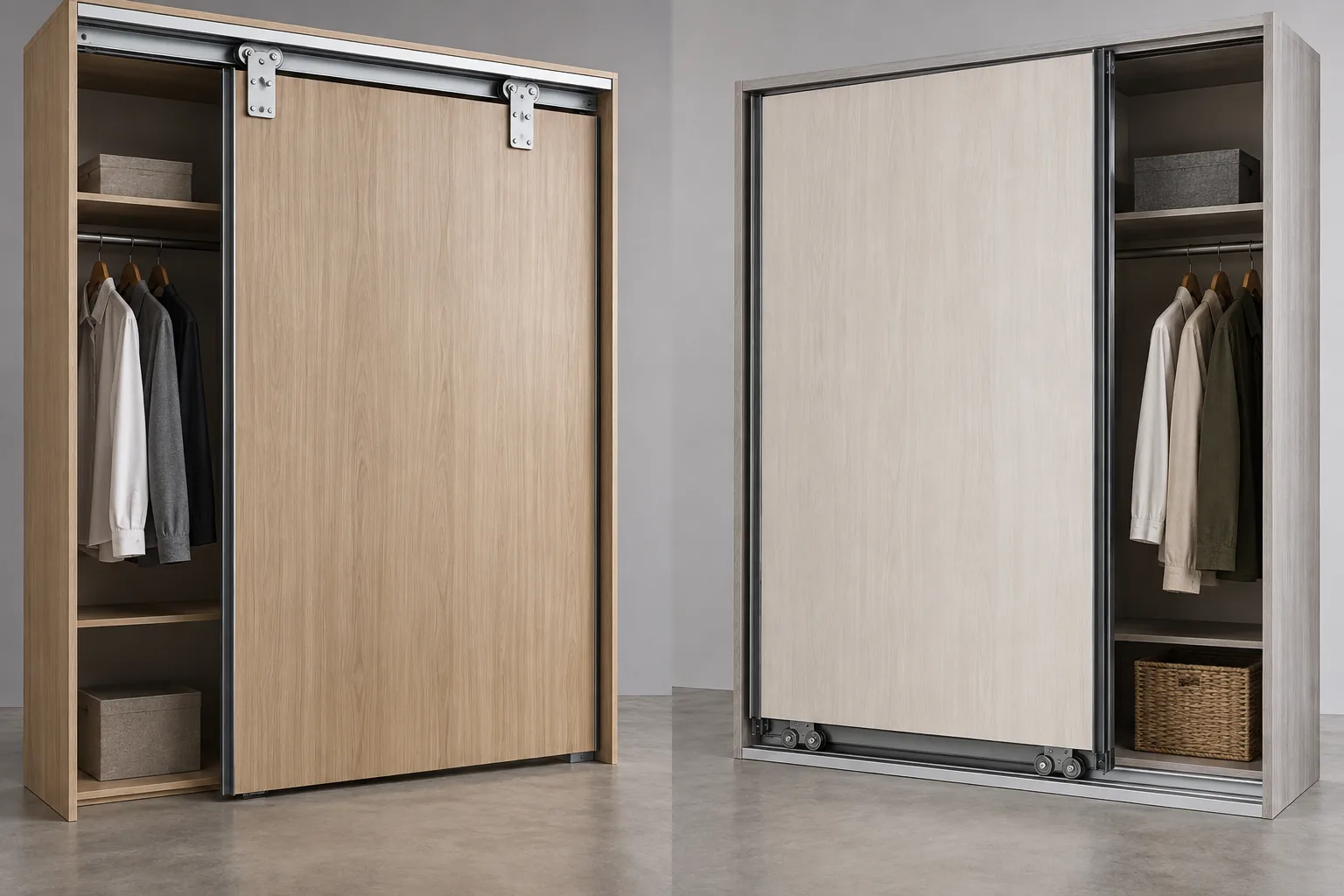
When comparing top hung vs bottom rolling cabinet doors, the buyer should compare the complete load path and installation responsibilities rather than judge the door by its visible movement alone. A top-running system suspends the door from an upper track; a bottom-running system supports it on lower rollers, as described in the cited Hettich planning guide. That distinction affects which cabinet structure carries the load, what floor or bottom track is required, and which clearances and alignment conditions the supplier must document. It does not establish that one arrangement is universally better.
This short video shows the product or manufacturing context discussed in this guide.
What decision does the door-support arrangement control?
The main decision is where the door's vertical support and running guidance are located, and which cabinet members must transfer those forces. In a top-hung proposal, door hardware engages an upper rail or support structure; the cabinet top, side panels or specified reinforcement therefore matter. In a bottom-rolling proposal, the lower track and its supporting base carry the roller interface, while an upper guide may still constrain sway. The exact arrangement is system-specific, so buyers should confirm it from the selected supplier's drawing rather than infer it from a catalog photograph.
This is a sourcing and design coordination question, not a generic installation tutorial. The importer or product developer needs to know how the system fits the cabinet, what must be included in the furniture design, how the door is restrained, and which components ship together. A supplier may sell a running system whose hardware is designed around a defined door thickness, weight range, track layout or cabinet construction. Those limits belong to the supplier's current technical documentation and must not be copied from a different product family.
The Hettich planning reference distinguishes doors supported by bottom rollers from doors suspended from above. Use that source to orient the comparison, not as proof that a particular system fits the buyer's project. The actual component series, revision and installation instructions must be confirmed. When systems are custom bundled or private labeled, identify the underlying qualified hardware supplier and preserve the approved system identity in the quotation and sample record.
Which cabinet and door inputs should buyers specify?
Define the door panel material, thickness, width, height, mass or supplier-declared mass calculation, number of panels and intended travel. Where exact dimensions or limits are not final, label them as provisional rather than presenting estimates as verified. Record whether the panel is solid, framed or otherwise constructed because fixing methods and stiffness can differ. Ask the system supplier which values are required for a valid selection and which are merely helpful context. Do not invent a universal door-weight threshold or claim that all upper tracks need the same reinforcement.
Describe the cabinet structure that receives the track or brackets: panel material, top or bottom construction, span, side support, fastener access and any reinforcing member. Clarify whether track mounting is to the top face, underside, floor, side wall or another documented surface. A drawing should show the exact datum and the screw or attachment zone, with the supplier indicating required substrate or reinforcement. A general statement that a cabinet is made of wood or metal is not enough to resolve local fixing capacity or compatibility.
Record the room-side installation envelope: floor level, base or plinth, adjacent walls, ceiling or top panel, neighboring doors, handles and access for service. Identify whether the track is concealed or exposed and what floor interface is acceptable to the product team. These are appearance and cleaning considerations as well as technical fit. Do not assume a recessed track is easy to maintain or that a top track is invisible; confirm the actual cross-section and installation orientation on the proposed system.
Specify operating intent: which panels overlap, whether they move independently or in sequence, required opening access, parking position and any expected relationship to drawers or storage. This article does not set a maximum opening force, cycle life or safety limit. If those are required, cite the applicable supplier data, buyer specification or jurisdictional requirement and confirm who will provide qualified evidence. The approval sheet should separate the functional observation from any certified performance requirement.
How do top-hung and bottom-rolling proposals compare?
A top-hung system can keep the lower cabinet region free of a full running track, but it makes the upper support condition central to the design review. Buyers should verify where the load is transferred and how the supplier constrains the door at the bottom. A bottom-rolling system makes the lower rail and supporting base critical; buyers should review track continuity, levelness, debris access and the lower attachment. These are conditional design trade-offs, not proof that either option is more durable, easier to install or lower cost in every cabinet.
The comparison must include the complete set of purchased parts: upper or lower track, rollers or trolleys, guides, stops, brackets, fixing screws, adjustment pieces and any soft-close or synchronization components if they are actually included. Confirm whether the same named part number covers all accessories shown in a sales image. If a supplier proposes a visually similar replacement, document the substitution and revalidate compatibility before the buyer approves the quotation. This is also the practical purpose of a top hung vs bottom rolling cabinet doors review: make the supporting parts and installation responsibilities visible before price comparison.
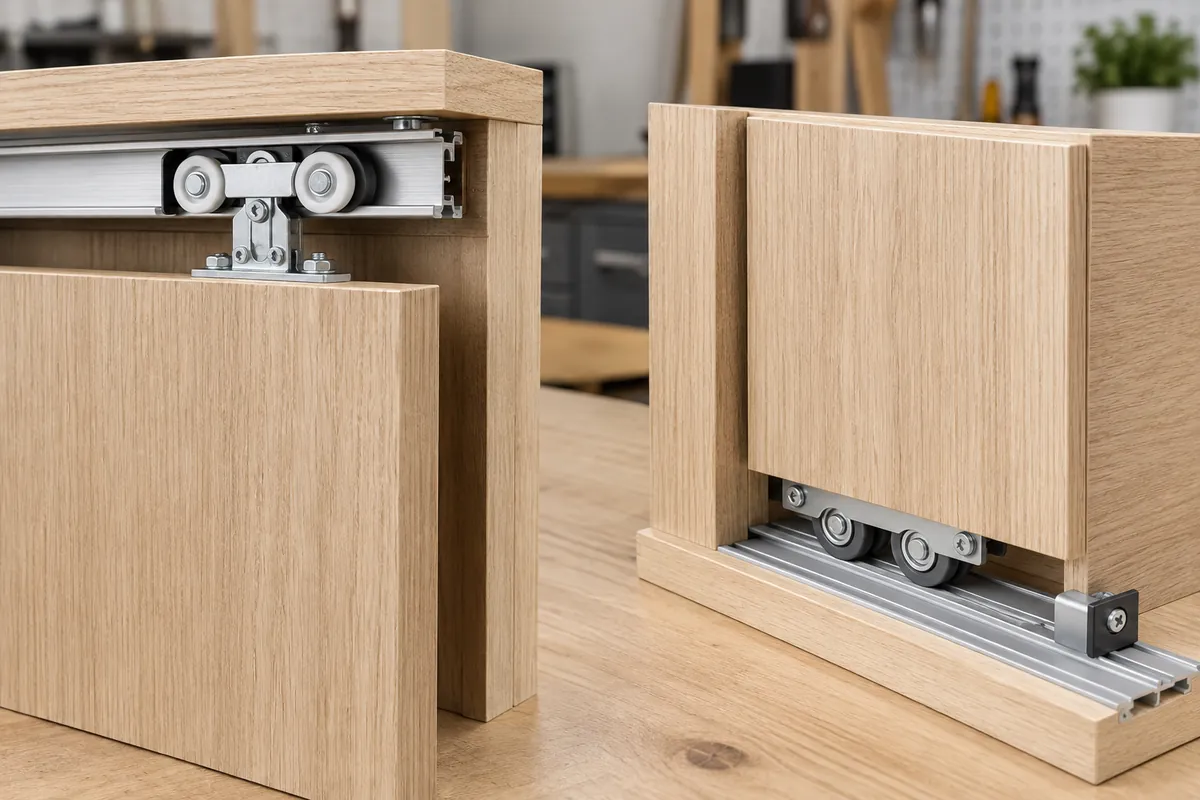
For top hung vs bottom rolling cabinet doors, compare a single defined cabinet and panel scenario with each supplier. This prevents a proposal from appearing preferable only because it was reviewed with easier mounting conditions or a different door construction.
The buyer should also distinguish the load-bearing member from a decorative cover or trim. A visible channel may conceal the actual carrier, while a guide component may only keep the panel aligned. Ask the supplier to label support, guidance and stopping functions separately, and to show the connection to the cabinet substrate. This avoids comparing two proposals on appearance while overlooking different preparation requirements. If the cabinet design is still changing, mark the support surface and track position as open inputs and hold final approval until the responsible furniture party confirms them.
Pay attention to constraints hidden by the front panel. A top-hung trolley may need installation access, adjustment access and a supporting surface; a bottom roller may need a continuous base, a suitable track location and clearance around the panel. An upper guide can coexist with a bottom-running load path, so avoid the simplistic assumption that a top feature means top support. Ask the supplier to mark support, guidance and anti-derailment functions separately on the assembly drawing.
A useful proposal should identify a system family, current instructions, required door and cabinet inputs, installation orientation, adjustment method and known exclusions. The buyer compares proposals against one shared cabinet design and use case. If the supplier cannot provide sufficient information, hold the selection rather than deciding from a low price or a smooth showroom demonstration. The short-term efficiency of a familiar arrangement is not a substitute for verifying that the intended cabinet can carry and guide it.
| Decision area | Top-hung review | Bottom-rolling review |
|---|---|---|
| Primary support | Confirm upper rail and cabinet support path | Confirm lower rollers, track and base support path |
| Guidance | Identify lower guide and restraint functions | Identify upper guide and restraint functions |
| Cabinet input | Top panel, span, attachment and service access | Base level, track location and floor/plinth clearance |
| Evidence | Supplier drawing plus representative assembled sample | Supplier drawing plus representative assembled sample |
What should a representative sample demonstrate?
Build the sample using the intended door panel and cabinet support surfaces, not a light display door that hides the real attachment conditions. Record the system model and revision, panel identity, track location, fixing method and any reinforcement used. Photograph the rail-to-cabinet interface before it is concealed. This makes it possible to distinguish a system issue from a cabinet preparation issue if the first assembled sample binds, sits out of plane or cannot reach the intended opening position.
Move the door through the approved travel and check that its support and guide features remain engaged in the documented configuration. Observe panel alignment, interference, floor or top-track clearance, access to stops and any contact with adjacent doors or drawers. The test is a project sample review, not a formal durability or safety test unless it follows a specified method and authorized acceptance criteria. Do not attach a numeric service-life claim to an informal movement demonstration.
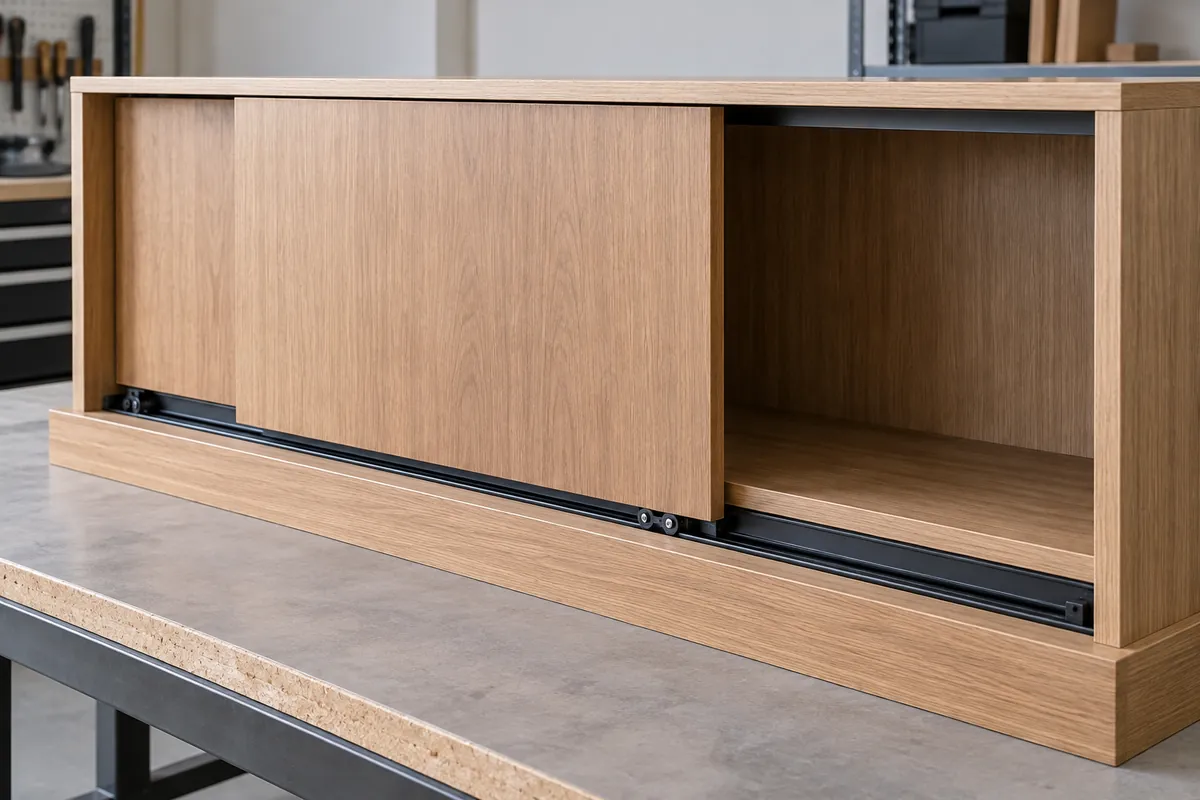
Check the cabinet through its full intended use state. A door may move freely when the cabinet is empty yet interfere after shelves, adjacent drawers, handles or stops are installed. A floor rail may be level on a bench but not on the buyer's actual base. A top support may look adequate before the cabinet top is assembled with its final joinery. Record the actual configuration and repeat observations after material changes that could affect the running interface.
At approval, identify the party responsible for the cabinet substrate and the party responsible for the purchased running system. Document any agreed deviation, temporary shim, altered fastener or substituted part. If the sample required a correction, update the controlled drawing and repeat the relevant check on the corrected version. The approved result should specify which system and cabinet conditions were reviewed; it should not say simply that the door passed.
How can buyers control supplier changes and project risk?
Use a compatibility matrix in the RFQ. Identify the door, cabinet structure, mounting surface, track, rollers or trolleys, guides, stops, fasteners and adjustments. For each interface, list the supplier's requested input and the evidence the buyer expects before approval. This keeps responsibility visible when the furniture maker, hardware distributor and system manufacturer are different companies. The matrix is particularly useful for private-label programs where a catalog part may be bundled with buyer-specific cabinet panels.
Require change notification for modifications to the running system, attachment points, material or finish at contact surfaces, track extrusion, roller assembly, guide, stop or recommended substrate. Define which changes require a new sample or only a document update based on their effect. Preserve the approved parts list and drawing revision together. Do not assume that a visual match or unchanged marketing name means the running interface remained the same.
Consider packaging and logistics as part of the acceptance plan. Long tracks can be vulnerable to bending or surface damage, while small rollers, stops and fasteners can be lost or mixed if poorly identified. Ask the supplier how the product is protected and how loose parts are tied to the assembly revision. Verify the pack-out and labeling on the production-intent sample. Avoid claims that a package test or extra carton material guarantees damage-free transportation.
Koitor Hardware can contribute verified experience in metal forming, fabrication, assembly, drawing/sample development and buyer communication for bathroom and home-storage hardware. That is relevant when discussing a metal cabinet or storage product's interfaces, brackets and packaging. It does not establish that Koitor manufactures sliding door systems or their specialized rollers, trolleys or tracks. Keep the slide-system supplier responsible for its component compatibility limits and the cabinet manufacturer responsible for its supporting structure.
Buyer checklist before quotation
- Identify the exact system, part numbers and current instructions
- Record panel construction and supplier-relevant door inputs
- Mark where the system supports, guides and restrains each panel
- Review access, overlaps, travel, stops and nearby drawers or doors
- Inspect the representative installed sample and document deviations
- Define change notification and resubmission responsibilities
For a project-specific question, consult the manufacturer reference cited for this buyer issue. It describes the named planning point; it does not replace the selected supplier’s current documentation.
For related sourcing context, see Koitor OEM home-storage hardware information und private-label bathroom accessory sourcing.
Häufig gestellte Fragen
Is top-hung always better because it avoids a floor track?
No. It shifts the support and design requirements upward and still needs appropriate guidance. Review the actual cabinet structure and supplier instructions.
Does bottom-rolling mean there is no upper guide?
Not necessarily. A lower roller may support the door while an upper component guides it. Ask the supplier to separate those functions on the drawing.
Can a catalog door-weight rating be used for another system?
No. Use the current data for the selected system, panel construction and mounting conditions. Do not transfer a rating across product families.
What should a buyer approve before ordering?
The system identity, cabinet and panel inputs, support path, installation details, representative sample observations and any agreed deviations.
Discuss a product-specific sourcing question
Koitor Hardware is a family-owned custom metal hardware factory. For bathroom and home-storage hardware projects, share the drawing or physical sample, the approved interfaces, target market, and the buyer decision that still needs evidence. Specialist purchased fittings should remain matched to their qualified system supplier.
OEM / EIGENE MARKE
Verwandeln Sie diesen Beschaffungsleitfaden in ein Produktdossier
Teilen Sie uns Ihr Zielprodukt, die Größe, die Oberflächenausführung, die Bestellmenge und Ihre Verpackungsanforderungen mit. Ihr Team erhält vor der Angebotserstellung eine praxisorientierte Prüfung der Herstellbarkeit.
 English
  Español
  Português
  Français
  Deutsch
  العربية