
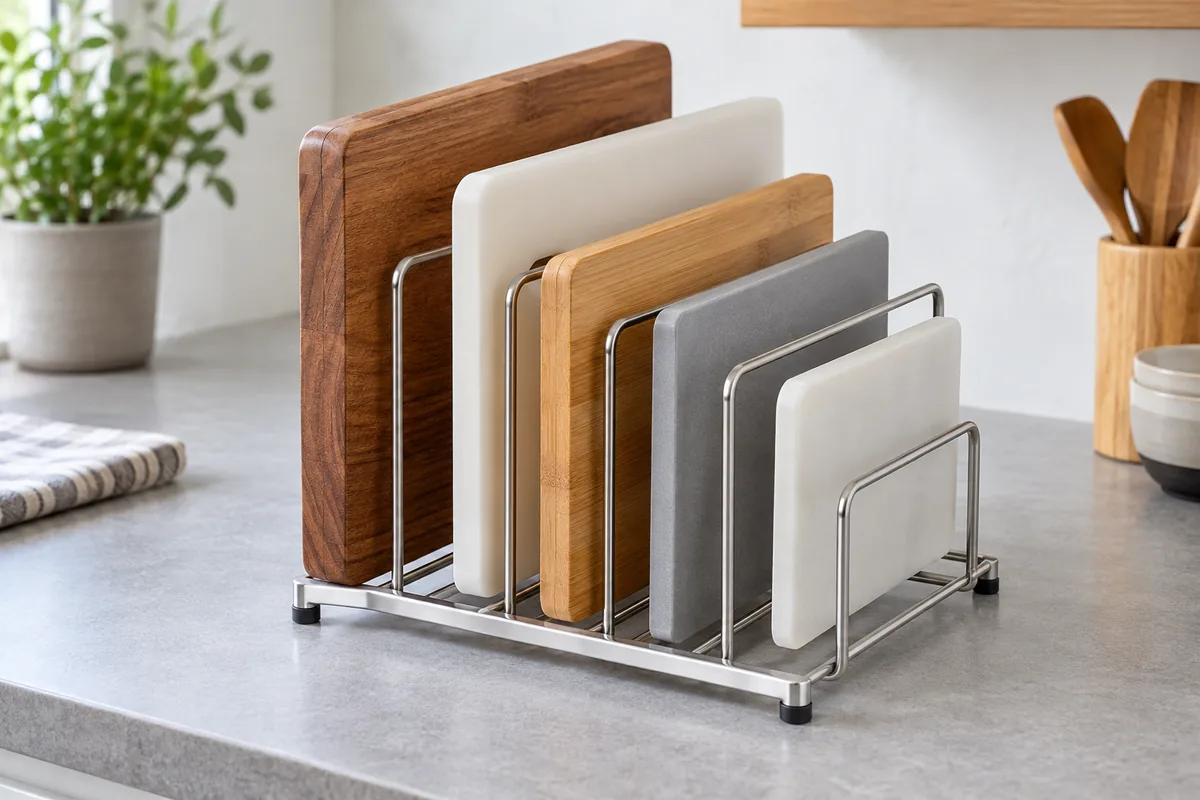
A cutting board rack slot width should be specified against the buyer’s actual board assortment, not chosen from a product photo or a single nominal board thickness. Record the thickest and thinnest boards, edge features, rack orientation and the narrowest clear opening; then verify insertion and removal using representative boards in a finished sample. Manufacturer specifications show that slot limits can differ by design and even between positions in one rack, so a mixed assortment needs an explicit fit decision rather than an assumed universal gap.
What should buyers measure before setting cutting board rack slot width?
Buyers should measure the board envelope that enters the slot and compare it with the rack’s usable opening at its narrowest point. The required fit depends on actual board thickness, edge shape, handles or lips, how boards are loaded, and the rack’s finished structure.
A board’s nominal thickness may not describe the part that contacts the rack. A bevel, grip edge, raised border, handle, hanging hole or flexible corner can change the effective insertion envelope. Measure the boards planned for the assortment at the points that will pass through the slot, not only at the center of the broad face.
Record the following for every representative board type:
- Maximum thickness at the slot-contact area, including a raised rim, grip or edge feature.
- Board face height and depth, plus any handle or tab that changes how it enters or rests.
- Intended orientation: vertical, inclined, side-loaded or placed into an under-shelf opening.
- Number of boards to be stored and whether neighboring positions need to remain independently accessible.
- Surface condition at the rack contact point, including a soft edge, coating, or feature that may catch.
- Whether the board must slide freely, lift out vertically, or be removed through a limited cabinet opening.
Do not substitute “fits standard cutting boards” for a measurable board range. The supplier and buyer should agree which models, drawings or samples represent the thickest, thinnest and most difficult-to-handle items in the assortment.
Why can a product title or nominal thickness mislead the buyer?
A product title usually summarizes the rack’s category; it may not disclose the usable opening, the maximum board thickness at each slot, or the separate thickness limit of the mounting surface. Buyers should treat the model’s dimensional specification and installation arrangement as distinct inputs.
For example, Yamazaki’s Plate Under Shelf Cutting Board Rack lists separate maximum board thicknesses for its upper and lower positions and a separate shelf-thickness range for mounting. Tablecraft’s CBR6 specification sheet lists a maximum board thickness for that six-board rack. Those are different products and model-specific limits—not a shared industry standard or a Koitor specification. Compare the relevant source documents for the precise model rather than copying a number from another product family.
The wording “slot width” can also be ambiguous. It might refer to:
- The clear distance between adjacent wires or dividers.
- The usable opening after a coating, sleeve or end feature is applied.
- A nominal gap shown on a drawing before finishing.
- A maximum board thickness stated for a particular slot.
- The entry opening, which may differ from the space where the board rests.
Ask the supplier to identify the measurement location and whether the value is nominal, a controlled finished dimension, or simply a stated compatibility limit. If the document does not define it, request a section view or marked-up sample rather than inferring a tolerance.
How should the slot and rack geometry be specified?
Specify the slot opening together with the board range, frame geometry and retrieval path. A number by itself does not tell the supplier whether the board can enter, remain separated from its neighbor, and be removed without catching.
| Specification item | Buyer should record or request | Sample-review question |
|---|---|---|
| Board envelope | Representative board IDs, maximum thickness at the contact area, edge features, and face dimensions | Does each board enter in the intended orientation? |
| Clear slot opening | Finished opening at the narrowest point and the drawing location where it is measured | Is the measured point the same one that controls insertion? |
| Slot layout | Number of positions, slot pitch, divider shape and any position-specific opening | Does one board obstruct a neighboring position? |
| Rack footprint | Overall width, depth and height, plus required installation or countertop envelope | Does the rack fit the intended space without blocking adjacent storage? |
| Retention and retrieval | Contact points, board lean or stop geometry, grip access and removal direction | Can the user retrieve one board without pulling the next board out? |
| Finish and contact condition | Specified finish and buyer-defined acceptable contact/edge condition | Are visible contact points consistent with the approved sample? |
| Mounting interface | Countertop feet, under-shelf attachment, or other mounting arrangement and compatible surface thickness if relevant | Does the installed configuration remain accessible and avoid interference? |
This drawing-level schedule helps prevent the terms “slot width,” “slot spacing” and “board capacity” from being used interchangeably. If a rack has different openings in different positions, identify each position separately. If the buyer expects one slot to take several board thicknesses, show the range and the board models that define its ends.
How should a finished sample be checked with mixed boards?
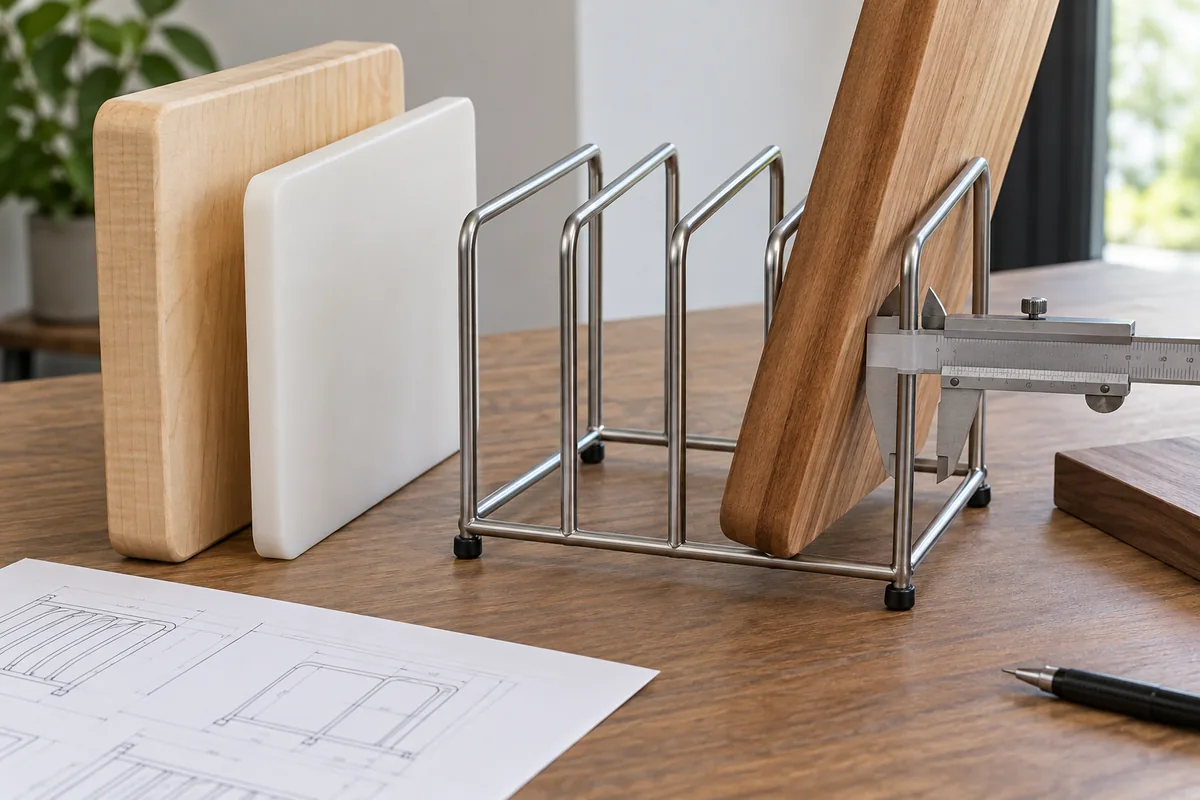
Use a representative rack sample and the actual boards, or accurate physical samples, that define the assortment’s fit extremes. A rendering or loose wire frame cannot reveal every contact point, retrieval issue or mounting obstruction in the finished product.
A practical sample sequence is:
- Confirm the sample model and drawing revision against the quotation and approval record.
- Check the finished slot opening at the drawing’s stated measurement locations. Record the tool and method used if a numeric acceptance value is part of the buyer’s specification.
- Insert the thickest board in each intended position without forcing, bending the board or moving the rack out of its normal location.
- Repeat with the thinnest board and observe whether the specified structure keeps it in the intended storage position.
- Load neighboring slots with the planned board mix. Check whether one board rubs, blocks access to, or lifts another during insertion and removal.
- Remove each representative board in its intended direction. Note whether the user can grasp the board and whether handles, lips, rack edges or neighboring items interfere.
- Review the installed arrangement in its intended location, including the mounting surface or counter footprint and any nearby cabinet or appliance obstruction.
- Record deviations from the drawing, sample changes and who accepted them before bulk production.
Do not create an arbitrary universal clearance, load limit, stability value or cycle test. If the buyer needs a numerical insertion force, retention limit, cycle count or durability test, define the method and acceptance criterion with the qualified supplier for the actual rack and board set. A simple hand fit check can expose interference; it does not establish long-term performance.
Which rack configurations should buyers compare?
Compare configurations based on the buyer’s board mix and installation context, not on a generic assumption that more slots or adjustable dividers are always better. Published product examples show at least two practical arrangements: under-shelf racks with position-specific fit limits, and countertop racks whose specification identifies a maximum board thickness.
| Configuration | What the buyer should compare | Main trade-off to validate |
|---|---|---|
| Under-shelf rack with different slot limits | Board fit by position, compatible shelf thickness, attachment access and available space below the shelf | Uses overhead storage, but mounting fit and reach depend on the cabinet shelf and installation location |
| Countertop multi-slot rack | Opening by slot, overall footprint, board separation and retrieval path | Can hold several boards in one place, but takes counter or cabinet space and neighboring slots may affect access |
| One opening intended for a defined board range | Supplier’s documented supported range and the actual thickest/thinnest sample boards | Simplifies assortment planning if verified; a broad claim without test examples may conceal a fit gap |
| Alternative divider or adjustable arrangement, if offered | How dividers are located, retained and repositioned; whether the resulting opening is controlled | Flexibility may help assortment changes, but added moving parts require their own retention and repeatability checks |
Ask the supplier to quote like-for-like scope. Confirm whether the rack, mounting parts, feet, dividers or other accessories are included, and whether any samples or boards shown in product photos are excluded from supply. Do not interpret a product’s stated board capacity as evidence that every board within a buyer’s assortment will fit each position.
How do material, finish and production changes affect slot fit?
The buyer should recheck slot fit when a material, wire or divider size, joining method, coating, mounting part or design revision changes. A drawing may remain unchanged while a finished opening or contact edge changes through a component substitution or finishing allowance.
For a metal rack, supplier review can cover the chosen wire or sheet form, bend positions, divider attachment and finish at contact areas. These are design and fabrication questions—not proof that Koitor currently manufactures a cutting-board rack or has a particular cutting-board SKU. Koitor’s verified context is metal home-storage hardware, fabrication and assembly discussion; the specific board rack and any non-metal board-contact component must be confirmed with the responsible supplier.
For each approved change, keep a traceable record of:
- Board assortment revision and sample identifiers.
- Rack drawing, slot-opening measurement points and revision.
- Material and finish description supplied for the quoted configuration.
- Which sample checks must be repeated after a change.
- The disposition of any board that no longer fits the approved range.
- Buyer approval and supplier confirmation of the replacement component.
This is especially useful for repeat orders, where the buyer may add a new board model or revise the rack without changing its product name. The name does not replace the approved dimensional and sample record.
Buyer checklist for cutting board rack slot width approval
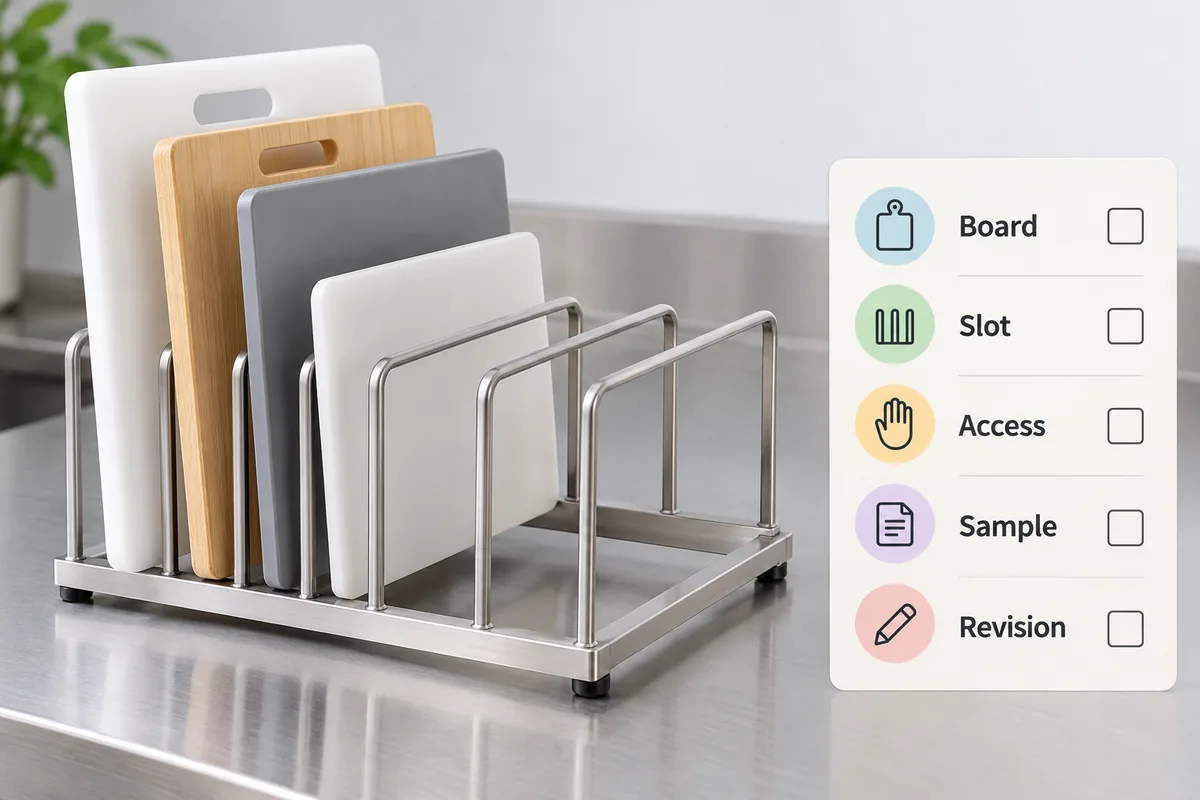
Before approving a cutting board rack slot width for a mixed assortment, confirm that the specification answers the fit, access and change-control questions that matter to the buyer. Keep the board IDs and rack revision together in the approval record.
- Identify the thickest and thinnest representative boards at the points that enter the rack.
- Record edge details, handles, lips, raised borders and intended orientation.
- Ask the supplier where and how the finished slot opening is measured.
- Identify position-specific openings instead of assuming all slots are identical.
- Confirm the rack’s mounting arrangement and the relevant shelf or countertop envelope.
- Check insertion, retention in the intended position, neighboring-slot interference and removal.
- Review the actual supplied scope, including feet, dividers and mounting hardware.
- Document the approved sample, drawing revision, finish and any deviations.
- Define any numeric test only with an agreed method and product-specific acceptance limit.
- Recheck fit after a board assortment or rack component change.
Häufig gestellte Fragen
How should buyers measure a cutting board before choosing a rack slot?
Measure thickness at the area that enters or rests in the slot, including raised edges, grips or handles that contact the rack. Also note the board’s face dimensions and intended orientation.
Should every slot have the same width?
Not necessarily. A supplier’s design may use position-specific openings or a common opening, depending on the intended board set. The buyer should identify the fit range by slot and verify it with representative boards.
Does a product’s maximum thickness prove that every board will fit?
No. A model-specific maximum does not necessarily describe edge shape, handles, mounting access or interaction with neighboring boards. Confirm the specific model and actual board assortment on a finished sample.
Does a metal rack specification establish food-contact suitability?
No. A rack’s listed material or finish does not by itself establish food-contact status, sanitation performance or suitability for every cleaning method. Buyers should request the relevant supplier documentation for their market and application.
Arbeiten Sie mit Koitor Hardware zusammen
Review a Kitchen Storage Rack Specification With Koitor
Share the rack drawing, target board assortment, mounting arrangement, finish and package requirements. Koitor can review related metal storage-hardware geometry and sample questions; the specific rack capability and any food-contact requirement must be confirmed for your project.
OEM / EIGENE MARKE
Verwandeln Sie diesen Beschaffungsleitfaden in ein Produktdossier
Teilen Sie uns Ihr Zielprodukt, die Größe, die Oberflächenausführung, die Bestellmenge und Ihre Verpackungsanforderungen mit. Ihr Team erhält vor der Angebotserstellung eine praxisorientierte Prüfung der Herstellbarkeit.
 English
  Español
  Português
  Français
  Deutsch
  العربية