
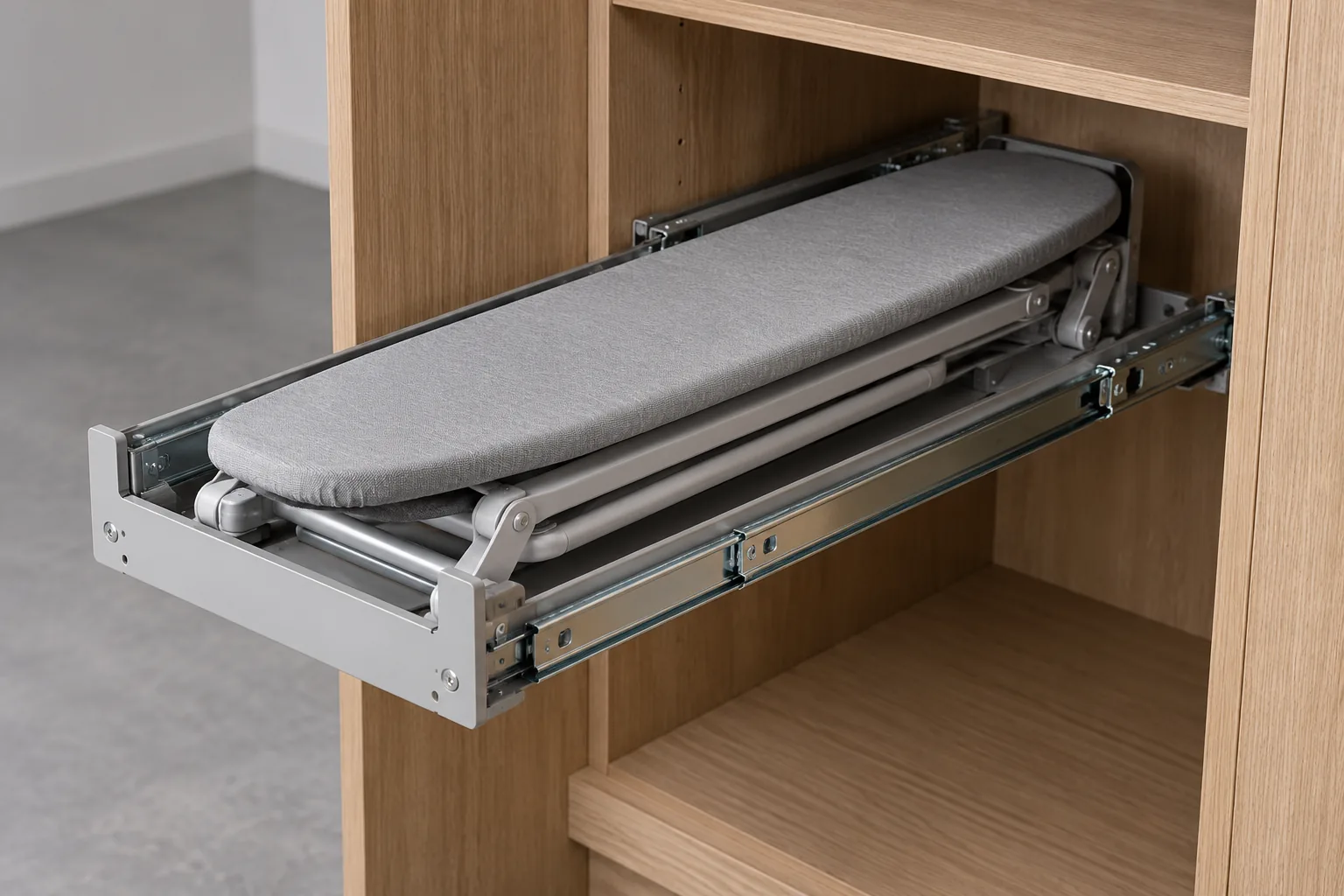
Pull out ironing board dimensions are not just the board’s working surface size. Buyers need to approve the complete module-to-cabinet envelope: minimum clear internal width and depth, folded height, drawer-front or fascia interface, runner extension, and the deployed board’s sweep and support. Confirm those dimensions on the selected supplier’s drawing and assembled sample; different models can require different cabinet openings.
A board that fits a cabinet while folded may still collide with a front, countertop overhang, adjacent drawer, handle, hinge or nearby appliance as it extends and unfolds. Treat the module and cabinet as one coordinated assembly, not as two products whose catalog dimensions can be compared loosely.
Why is the ironing surface not the cabinet installation size?
The ironing surface describes the usable top, but the product also includes a frame, slides, pivots, stops, fixing points and sometimes a drawer front or storage components. These parts occupy space before, during and after deployment. The clear opening needed by the mechanism may also differ from the cabinet’s nominal outside width because side panels, drawer runners and installation tolerances reduce the available space.
That distinction matters in an assortment. A buyer may specify a board top around a familiar width yet overlook the cabinet depth or the clearance required to rotate the surface into position. Conversely, a cabinet that meets a catalog’s minimum width may not accept a different module whose bracket positions or runner bodies are wider.
For sourcing, keep at least three envelopes separate:
- Installed envelope: the space occupied by the module inside the cabinet when stowed, including slides, support frame and fixing hardware.
- Operating envelope: the clearance required as the module pulls out, unfolds, pivots or locks into its working position.
- Use envelope: the space occupied by the deployed board and the user’s access area, including any nearby door, drawer, appliance or wall obstruction.
A product page’s top dimensions do not substitute for these views. Ask for the relevant cabinet-interface drawing and identify which dimensions are minimums, which are nominal and which include fitting clearance.
Which cabinet dimensions should buyers specify?
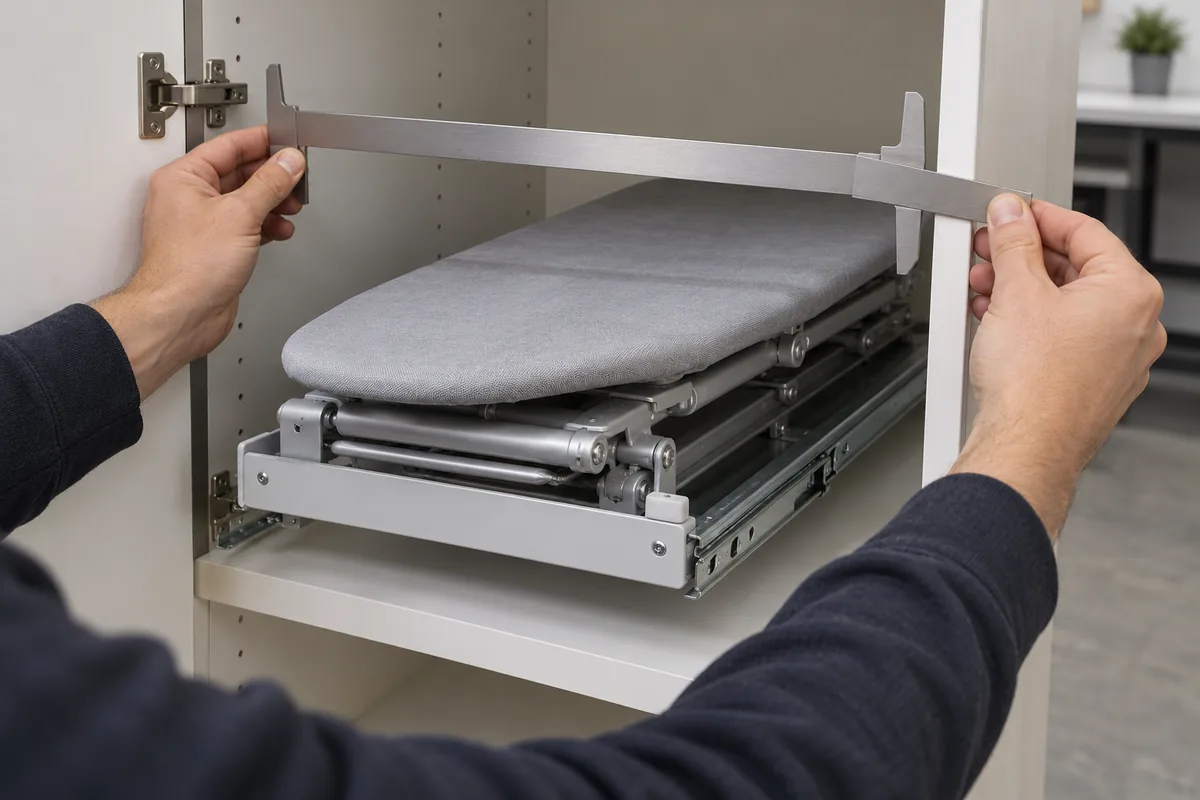
Begin with the cabinet opening that will receive the module. Record the actual clear internal width between the installed side panels, not only the cabinet’s nominal width. Record usable internal depth from the front reference plane to the first obstruction at the rear. If a back panel, service pipe, cable, hinge or reinforcement intrudes into the space, show it in the layout.
Then check vertical room. A pull-out board can have a low folded height yet require more room for a pivot or support to move. The drawing should show the folded profile, the transition path and the fully open position. Identify any front rail, drawer box, shelf or crosspiece that remains in place.
Use a dimension schedule like this:
| Interface item | Buyer should record | What to confirm with the supplier |
|---|---|---|
| Cabinet internal width | Minimum clear width between finished side panels | Module body width, runner envelope and fixing offsets |
| Usable internal depth | Clear depth to the first rear obstruction | Required installation depth and any rear clearance |
| Vertical clearance | Space above and below the folded module | Folded height and mechanism movement path |
| Cabinet front | Front thickness, opening and overhang | Handle/front interference and required opening sequence |
| Fixing interface | Panel material, thickness and accessible faces | Screw position, load path and any approved reinforcement |
| Deployed zone | Nearby drawers, doors, counters and appliances | Full extension, rotation and use clearance |
The figures in a supplier’s published specification apply to that particular model and configuration. For example, Emuca lists a minimum 500 mm furniture depth and 360–520 mm internal width for its Iron 8037512 product, and describes a full-extension stop in its product FAQ. Those numbers are useful as a concrete example of the parameters to compare—not as a universal cabinet standard or a target dimension for another module. See Emuca’s product page and technical FAQ.
How should buyers check the drawer front and cabinet opening?
The face of the cabinet is part of the fit problem. A module may pull through an opening that is nominally wide enough, yet the board edge, bracket or handle may meet the front during the first part of travel. A front that is too thick, an overhanging countertop, nearby trim or a neighboring door can change the movement path.
Ask the supplier to define the front condition used for the drawing: open drawer, removed drawer, hinged fascia, or a specific front panel attached to the module. Clarify whether the front is included in the supplied assembly and whether the buyer’s cabinet maker must provide it. Do not assume the same mechanism supports every front style.
Review a side view for the relationship between the cabinet front, runner, pivot and board. Review a top view when the assembly rotates or swings sideways. If the product has a stop or lock at full extension, confirm the intended position and the clearance needed to engage and release it. Any movement should be checked without forcing the mechanism against the cabinet.
The word “drawer” can be misleading: some products use drawer-like slides but do not install as an ordinary drawer box. Ask for the actual installation sequence and required access to screws. Verify that the buyer’s assembly method does not obstruct adjustment or later service.
What does full extension mean for the working clearance?
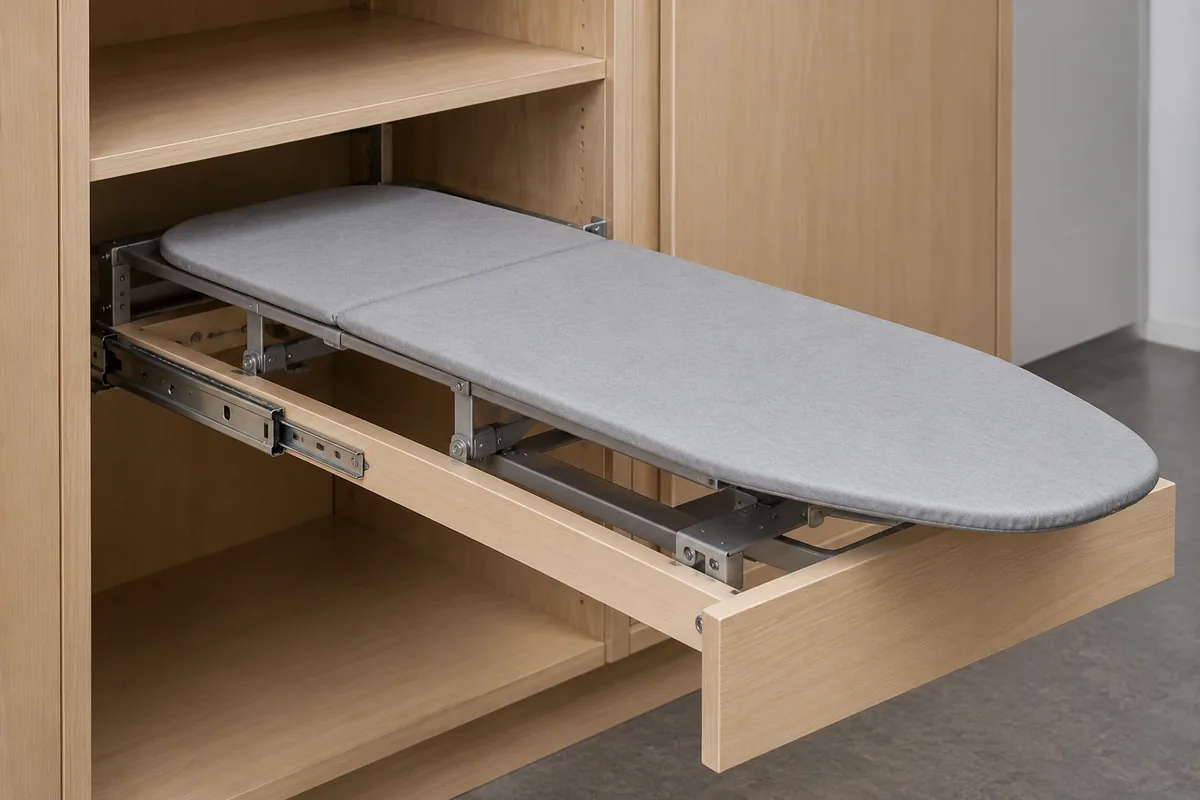
“Full extension” describes travel of the slide or module, but it does not by itself confirm that the board reaches the intended working position or clears the cabinet front. Different designs pull out and then unfold, pivot, swing or lift. The board’s outer edge and support links can sweep through a larger zone than the final deployed footprint.
Request a sequence drawing or product-specific installation guide showing the key positions: fully stowed, initial pull-out, any intermediate pivot, and locked/deployed. Ask the supplier to mark the furthest projection at each state and the location of any pinch or collision point. This helps product teams plan adjacent drawers, doors and appliances without treating a catalog photograph as a clearance drawing.
If the board rotates, confirm whether rotation is part of normal operation, an optional adjustment or not supported. Record its allowed range only when the selected model documentation specifies it. Do not apply one supplier’s movement path or stop position to another product.
A sample review should use the intended cabinet-side spacing, front panel and mounting method. A loose module placed on a table can reveal general operation, but it cannot establish the final cabinet fit. Where a full cabinet mock-up is impractical, a dimensionally accurate test frame can reproduce the relevant opening, depth, front and obstructions.
How should buyers compare pull out ironing board dimensions?
Compare like with like. One quotation may describe the board top, another the folded module, and a third the minimum cabinet opening. When comparing pull out ironing board dimensions, put each figure beside its measurement state and datum. Ask suppliers to identify whether the dimension includes the runners, brackets, fixing heads, front panel, cover or optional iron holder.
Do not rank modules by a single “smallest cabinet” number. A compact folded body may need a wider opening for its slides; a module with a larger top may still fit a narrower cabinet if its support geometry differs. The useful comparison is the complete fit against the buyer’s actual cabinet specification, including operation and service access.
When supplier data conflicts, ask for a revised drawing rather than averaging the numbers. Clarify whether a published dimension is nominal, minimum or recommended. Record the drawing revision and confirm that the quoted product, sample and production configuration match it. A change to a runner, pivot, bracket, front attachment or panel thickness may affect fit even if the board top remains unchanged.
What should a pull-out ironing-board sample approval include?
Use the same cabinet reference for each supplier sample. The review record should identify the cabinet’s clear width, usable depth, vertical clearance, front configuration, mounting plane and nearby obstructions. Attach the supplier’s current drawing and mark the specific sample revision.
Check the sample through its full cycle without loading or modifying it beyond the manufacturer’s stated instructions. Confirm it can be installed, pulled out, unfolded, placed into its intended working position, released and returned to the cabinet. Note interference, uneven motion, exposed edges, fixing access and any variation from the approved drawing. This is an interface and operation review, not proof of long-term durability or a substitute for product-specific safety testing.
For an organized approval, record:
- Product model and drawing revision.
- Cabinet internal width, depth and available height.
- Front/fascia thickness, overhang and handle condition.
- Stowed, moving and deployed positions reviewed.
- Fixing points, fasteners and any required reinforcement.
- Interference points and required installation tolerances.
- Approved sample photos and unresolved items.
- Which design or bought-in component changes require reapproval.
Do not approve a catalog image in place of a physical sample when the cabinet interface is critical. If the buyer cannot test the final cabinet, agree on a fixture or mock-up that reproduces the installation geometry.
Which design changes should trigger a fit recheck?
Recheck the cabinet interface after a change to slide length or section, bracket position, pivot location, support link, board width, folded height, front attachment or fixing hardware. A small change can affect where the board travels or where it sits when closed. A new cabinet supplier or panel thickness can also alter usable internal dimensions.
Not every cosmetic change changes the fit, but buyers should define that decision with the supplier. A finish update may have little geometric effect; a revised coating build, added cover or protective cap could change a close clearance. Ask the supplier to identify the change’s impact rather than assume that the previous sample approval automatically covers it.
For private-label products, place fit-critical dimensions and approved component references in the controlled drawing or specification. Identify the revision sent with the purchase order. If the supplier proposes an equivalent slide or fastener, request a fit-impact review before substitution. This keeps changes traceable without requiring buyers to repeat a full development cycle for unrelated updates.
Before requesting a quotation, send the supplier more than a board surface size. Include the intended cabinet type, minimum clear opening, usable depth, available height, front arrangement and deployment requirements. If the cabinet standard is not finalized, identify the range the product must fit and provide the reference drawing or a representative cabinet sample.
Ask the supplier to return a dimensioned installation drawing, identify all model-specific minimum cabinet dimensions, and explain the pull-out/unfolding sequence. Confirm whether the quote includes the module, slides, fasteners, textile cover or front parts. If any specialist or bought-in component is outside the supplier’s scope, ask who supplies and validates it.
Share the relevant assembly and component drawings with Koitor’s OEM home-storage team to discuss confirmed metal-hardware scope and manufacturability. Current Koitor production of a complete ironing-board module is not assumed; product-specific scope should be confirmed before quotation.
Häufig gestellte Fragen
Are pull-out ironing board dimensions standardized?
No single catalog dimension should be treated as universal. Published minimum width, depth, board size and extension differ by model. Use the selected supplier’s drawing and installation instructions for the exact module.
Is cabinet nominal width enough to confirm fit?
No. Confirm the clear internal opening after panels, runners, hardware and obstructions are accounted for. Nominal cabinet size alone does not show the available installation envelope.
Should the folded and deployed dimensions both be listed?
Yes. The stowed body, movement path and final use envelope describe different conditions. Separate them on the drawing so cabinet fit and operating clearance can be reviewed independently.
Does a full-extension slide prove the board clears the cabinet?
No. It describes slide travel but does not prove that the board can unfold, rotate or lock without interference. Review the full operating sequence on the intended cabinet interface.
What if a supplier only provides a product photo?
Request a dimensioned drawing and installation instructions before approving the fit. A photo may help identify the configuration, but perspective and cropping make it unsuitable for confirming cabinet clearances.
Discuss a Custom Metal Home-Storage Project
Send a drawing or sample, cabinet interface, intended finish and packaging requirements. Koitor can review confirmed metal-hardware scope and discuss manufacturability; complete ironing-board-module capability should be confirmed for each project.
OEM / EIGENE MARKE
Verwandeln Sie diesen Beschaffungsleitfaden in ein Produktdossier
Teilen Sie uns Ihr Zielprodukt, die Größe, die Oberflächenausführung, die Bestellmenge und Ihre Verpackungsanforderungen mit. Ihr Team erhält vor der Angebotserstellung eine praxisorientierte Prüfung der Herstellbarkeit.
 English
 Español
 Português
 Français
 Deutsch
 العربية