

Packaging EPR laws by state can create a difficult handoff for a U.S. hardware importer: the factory knows what went into a package, while the importer usually controls the brand, sales destinations, importer-of-record information, and market-specific compliance review. A supplier spreadsheet is useful evidence, but it does not automatically identify the legally responsible producer or complete a state filing.
For bathroom and home-storage hardware, request a revision-controlled packaging record for each sellable SKU. It should identify each package component, material and form, count, weight, package level, measurement source, supplier, and effective revision. Then map that record to the products actually supplied into each relevant state and ask the importer’s compliance owner or qualified adviser to determine coverage, producer status, exemptions, reporting units, and deadlines under the current program.
This is an operational supplier-data guide, not legal advice. The examples below show why one national spreadsheet cannot replace state-specific review. Program rules and implementation guidance change; the official state sources linked here were checked on October 21, 2026.
Why should a hardware importer request packaging data by SKU?
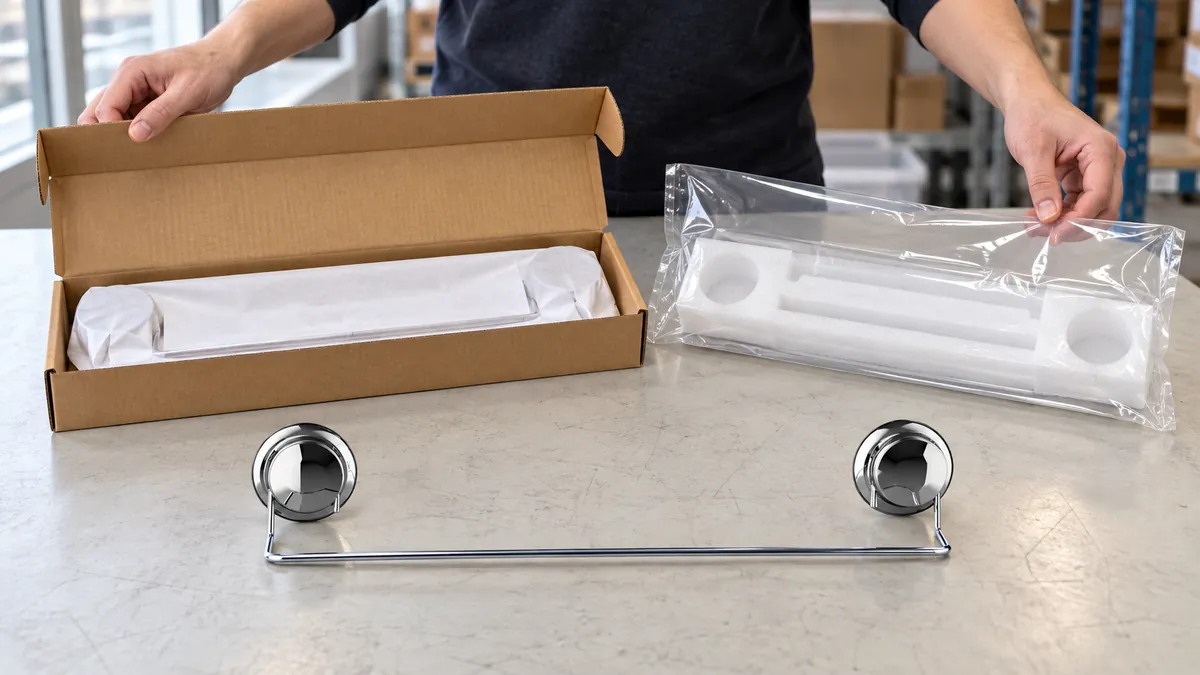
A bathroom shelf or shower caddy may be shipped with several packaging layers: a retail box, a protective bag, a paper insert, corner protection, a master carton, tape, and a pallet or stretch wrap. The exact combination varies by product and order. A generic statement such as “one carton per item” may not tell a reporting team what materials are present, how much each component weighs, or whether the supplier changed the pack-out after the last reporting period.
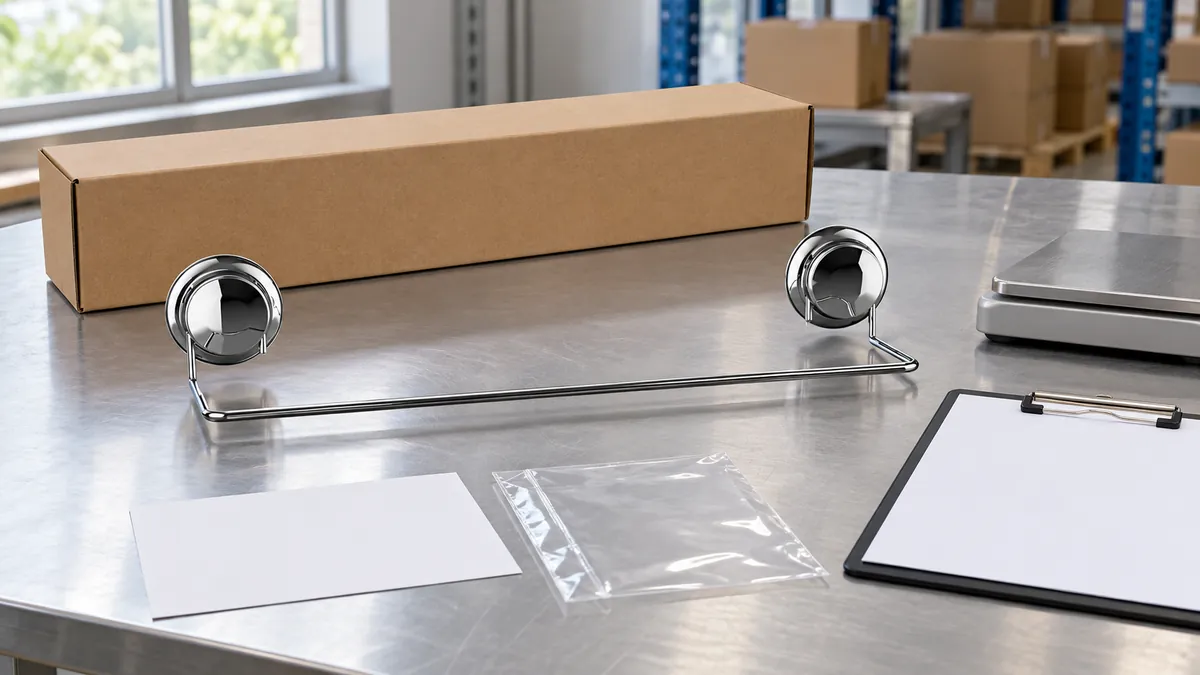
The data request should therefore start with the actual saleable unit and its packaging configuration. Separate the product itself from the packaging, and separate each packaging level. A metal towel rack is not packaging; its retail box, protective sleeve, instruction sheet, and shipping carton may each need their own record under a program’s definitions. A component can be made from more than one material, and the governing program may classify it by material and form. Do not use a supplier’s broad label such as “paper” or “plastic” as a substitute for the applicable state category.
SKU-level records also make changes visible. If a buyer replaces a foam end guard with a molded-pulp protector, changes the polybag gauge, adds a second inner tray, or moves from a single-unit carton to a mixed-SKU master carton, the packaging record should show which revision became effective and which products or orders use it. Without that link, a weight from an old sample can be mistaken for the current production pack-out.
The practical objective is traceability, not a promise that every supplier already maintains regulatory reporting data. Ask what the supplier can substantiate, how the value was obtained, and which package revision it describes. If the value is estimated from a drawing, material specification, or nominal weight rather than weighed, label it as an estimate and preserve the method. Never present an unverified figure as a measured fact.
What should the supplier data sheet contain?
Use a structured request that allows the buyer to reconcile packaging components against a product SKU and revision. The following fields are a starting point for an importer’s own data model; the relevant program may require other categories or units.
| Field to request | Example of the record | Buyer control |
|---|---|---|
| Produktidentität | Buyer SKU, supplier item code, product name, revision | Confirm that codes map to the same sellable product and kit configuration |
| Package level | Direct/retail, grouped, transport, e-commerce or pallet-level component | Keep package function and distribution stage distinct; do not assume the legal category from the name alone |
| Component identity | Carton, insert, bag, sleeve, tape, edge guard, label or pallet wrap | Give each component a stable ID so it can be updated without rewriting the whole SKU record |
| Material and form | Corrugated fiberboard, paper insert, plastic film, molded protector, metal clip | Record the supplier’s factual description; the compliance owner maps it to the applicable jurisdiction’s category |
| Component quantity | Pieces or area per sellable unit and pack-out | State the unit and whether the quantity is per product, inner pack, master carton or pallet |
| Component weight | Net weight per component, with unit of measure | Identify actual weighing, calculation, specification, or estimate and the date/source |
| Supplier and site | Packaging supplier, manufacturing site, or source document | Keep source evidence and contact ownership with the record; do not infer a certified value |
| Revision and effective date | Drawing, packaging BOM, sample approval, change notice | Tie the data to the approved package and first affected production or shipment date |
| Mixed-SKU details | Carton ID, SKU mix, component allocation method | Explain how shared packaging is allocated; do not divide weight using an undocumented assumption |
| Importer-owned market data | Destination state, units supplied, reporting period, channel | Reconcile against sales and distribution records; this is not a factory packaging fact |
If a package component is shared across several SKUs, record the basis for allocation. For example, a common master carton might hold different quantities depending on the product family. The importer should preserve the actual pack-out or a controlled allocation rule, rather than copying one per-unit weight across all configurations. Where packaging is kitted or packed at a separate warehouse, identify that stage and ask that party for the relevant records.
Do not confuse component weight with shipping gross weight. Gross shipment weight may include the product, accessories, inner packs, carton, pallet, and other load materials. Packaging EPR analysis may ask for packaging material information that cannot be recovered from a single gross-weight field. If a supplier can only provide total packed weight, request the underlying bill of materials or a documented weighing method before using the number for a more detailed material breakdown.
What belongs to the supplier, and what stays with the importer?
A supplier can often describe the package it makes or packs: component identity, material specification, number of parts, package drawing, product-to-carton configuration, and a measured or calculated weight with its basis. A packaging vendor can provide corresponding evidence for the components it supplies. These are useful inputs, but neither supplier should be asked to make a definitive legal determination for every U.S. state on the importer’s behalf unless the parties have expressly established a qualified and accurate process for doing so.
The importer or its compliance adviser must connect supplier facts to market facts and legal rules. That review may involve the product/brand relationship, who imports or distributes the item, the states where units are supplied, applicable material and product definitions, thresholds or exclusions, reporting periods, and the current method used by the state or its approved program. The applicable role can vary by state and transaction structure.
| Work item | Supplier or packaging vendor can document | Importer/compliance owner should determine |
|---|---|---|
| Current pack-out | What components are used for a specific SKU, order and revision | Whether the configuration is within a program’s scope and how it is categorized |
| Material evidence | Material/form description, drawing, specification, source and any supported weight | Which state category or reporting unit applies and whether additional substantiation is needed |
| Component weight | Measurement or calculation, unit, method, date and uncertainty | Whether the value is suitable for the program method and how it is combined with supply data |
| Product and brand | Supplier item code, buyer SKU mapping, private-label configuration | Which entity meets the state-specific producer definition and whether an agreement changes the allocation |
| Market activity | Shipment records the supplier holds, if available | State destinations, sales/distribution channel, units supplied and reporting period |
| Filing | Supporting documents requested under a buyer’s contract | Registration, PRO relationship, legal declaration, report submission, fees and deadlines |
This division prevents two common errors. First, an importer should not send a blank legal questionnaire to a factory and treat its answer as the final producer decision. Second, a factory should not be expected to know state-level destination sales simply because it shipped the order. The importer can use supplier data as the packaging evidence layer, then reconcile it to importer-controlled sales and distribution records.
Minnesota illustrates why the producer decision must stay jurisdiction-specific. Its 2025 statute establishes a hierarchy for certain packaged items sold through physical retail and provides that the importer of record is the producer only when specified earlier categories of U.S.-based persons do not apply. It also contains separate language for packaging used in e-commerce and other packaging. That statutory sequence is a Minnesota example, not a nationwide rule that every importer of record is always the EPR producer. Review the current Minnesota producer definition and obtain advice on the actual transaction.
Why do the state examples require a current, separate review?
Oregon’s Department of Environmental Quality says that covered producers must register with an approved Producer Responsibility Organization, report supply data, and pay program fees, subject to the Act’s defined exclusions and exemptions. DEQ’s current producer page says that prior-year supply data are due to the PRO by May 31 beginning in 2026, and directs producers to identify covered products, determine whether they are the obligated producer, and apply the relevant reporting method. These steps are useful prompts for an importer’s evidence file, but they do not prove that a particular hardware SKU is covered or that a particular importer is the producer. See Oregon DEQ’s current producer guidance and its exemptions information.
California’s SB 54 program uses a covered-material list organized by material type and form, and its implementation status continues to develop. As of October 21, 2026, CalRecycle’s program page reported that permanent regulations became effective May 1, 2026 and that the agency received the Producer Responsibility Organization plan on October 13, 2026 for review. The agency also maintains producer guidance and a January 2026 covered material categories list. A buyer should consult the current CalRecycle program updates, producer guidance, and covered material categories before deciding which components, reporting details or exclusions apply.
These examples demonstrate process variation; they are not an exhaustive list of states or a complete legal comparison. Do not publish a fixed state count, universal threshold, or single producer hierarchy from an old comparison table. Confirm the states relevant to the importer’s actual market, the effective rule and program documents, the covered products and packaging definitions, the responsible producer, any available exclusions, and the reporting method and deadlines. Where a state’s implementation is still under review, distinguish binding statutes/regulations from agency guidance, proposed plans and future program instructions.
For comparison, EU PPWR reporting and package questions are not substitutes for U.S. state EPR analysis. Koitor’s separate PPWR empty-space guide und Article 29 reuse-target guide cover EU packaging questions; their definitions, responsible actors and rules should not be copied into a U.S. state worksheet.
How should buyers control packaging changes and data quality?
Treat the packaging record like a controlled specification. Maintain one current record per buyer SKU and package revision, and retain prior versions rather than overwriting them. Each entry should identify the person who supplied the data, the source document, the date received, the measurement method, and any uncertainty or missing field. If a packaging supplier changes a board grade, bag material, insert count, carton size, or unit weight, request a dated revision notice and determine which purchase orders and reporting periods it affects.
For teams comparing packaging EPR laws by state, this revision trail keeps the supplier’s package facts tied to the right SKU while the importer separately maps those facts to each state’s current reporting rules.
Use a simple evidence-status field to distinguish:
- Measured: a component or representative pack-out was weighed using a documented method, with the result and date retained.
- Calculated: the value was derived from dimensions, material specification, density, or a controlled formula; preserve the inputs and calculation.
- Supplier-declared: the supplier provided the figure but has not provided the underlying method or source. Keep that distinction visible.
- Estimated or unknown: no reliable component-level figure is available. Do not quietly replace this with zero or label it measured; assign a follow-up owner and due date.
When a mixed-SKU shipment uses a shared outer carton, establish whether the reporting method needs each packaging component allocated to individual products or captured at another unit level. The buyer’s method should match the applicable program rather than a convenient spreadsheet formula. Retain the carton configuration, item count, packaging revision, and source records so another reviewer can reproduce the calculation. If the package is assembled by a third-party fulfillment provider, include that party in the evidence request where it controls the final consumer shipment pack.
The data handoff should also define what is explicitly outside the supplier request. The factory can return a package specification; it usually cannot confirm where every unit is ultimately sold, how the buyer allocates products among states, or whether a legal exemption applies to the importer. Those decisions need market and company records. A contract may allocate responsibilities, but the parties should have counsel confirm how any agreement interacts with the relevant state law.
What is a practical RFQ checklist for packaging EPR data?
Before production or an annual data request, send the packaging supplier or factory a narrow, factual checklist:
- List every packaging component used for this buyer SKU and current packaging revision, including each package level and its function.
- For each component, give the material and form description, quantity per sellable unit or pack-out, and component weight with unit of measure.
- State whether each weight was measured, calculated, supplier-declared, estimated, or is unknown; identify the method, source and date.
- Provide the current packaging drawing, specification, bill of materials or other evidence that supports the component description and pack-out.
- Identify shared or mixed-SKU packaging and explain the actual carton configuration; do not invent an allocation method if one has not been agreed.
- Notify the buyer before a material, component, quantity, supplier, construction or weight change, and identify the first affected revision or order.
- Confirm which packaging activities occur at the factory and which occur at a separate packer, distributor or fulfillment site.
- Return the data in a buyer-provided template with a named source, date and revision rather than an untraceable summary sentence.
The buyer should then reconcile the response against current samples, packaging drawings, purchase-order revisions, product/SKU master data, sales destinations, and the state-by-state compliance review. A packaging data sheet is only as reliable as the relationship between its measurements and the units actually supplied. If a data point is missing, preserve it as a gap and resolve it; do not make a supplier guess what the state authority expects.
Koitor’s role is to discuss the metal hardware product and the manufacturing/packaging information that can be supported for a specific order—not to act as a U.S. EPR law firm, PRO, filer, certification body, or source of verified values for every SKU. For a product drawing, packaging revision or supplier handoff, buyers can contact the custom bathroom hardware manufacturer team or use the contact page. Ask the importer’s compliance owner or qualified adviser to confirm legal scope and reporting requirements.
The practical takeaway is simple: a strong packaging EPR laws by state workflow keeps supplier evidence and importer decisions connected but separate. Request component-level material, form, count, weight, source and revision data for the hardware SKU. Then use current official state sources to determine who is the producer, what is covered, which sales count, and how reporting must be completed. This gives the buyer a traceable starting point without asking a factory spreadsheet—or a single state’s rule—to answer every U.S. compliance question.
Build a packaging data handoff around the real SKU
Share the product drawing, package configuration and revision questions with Koitor for a manufacturing-feasibility discussion. Your U.S. compliance owner should confirm state coverage, producer status and filing obligations.
OEM / EIGENE MARKE
Verwandeln Sie diesen Beschaffungsleitfaden in ein Produktdossier
Teilen Sie uns Ihr Zielprodukt, die Größe, die Oberflächenausführung, die Bestellmenge und Ihre Verpackungsanforderungen mit. Ihr Team erhält vor der Angebotserstellung eine praxisorientierte Prüfung der Herstellbarkeit.



 English
 Español
 Português
 Français
 Deutsch
 العربية