
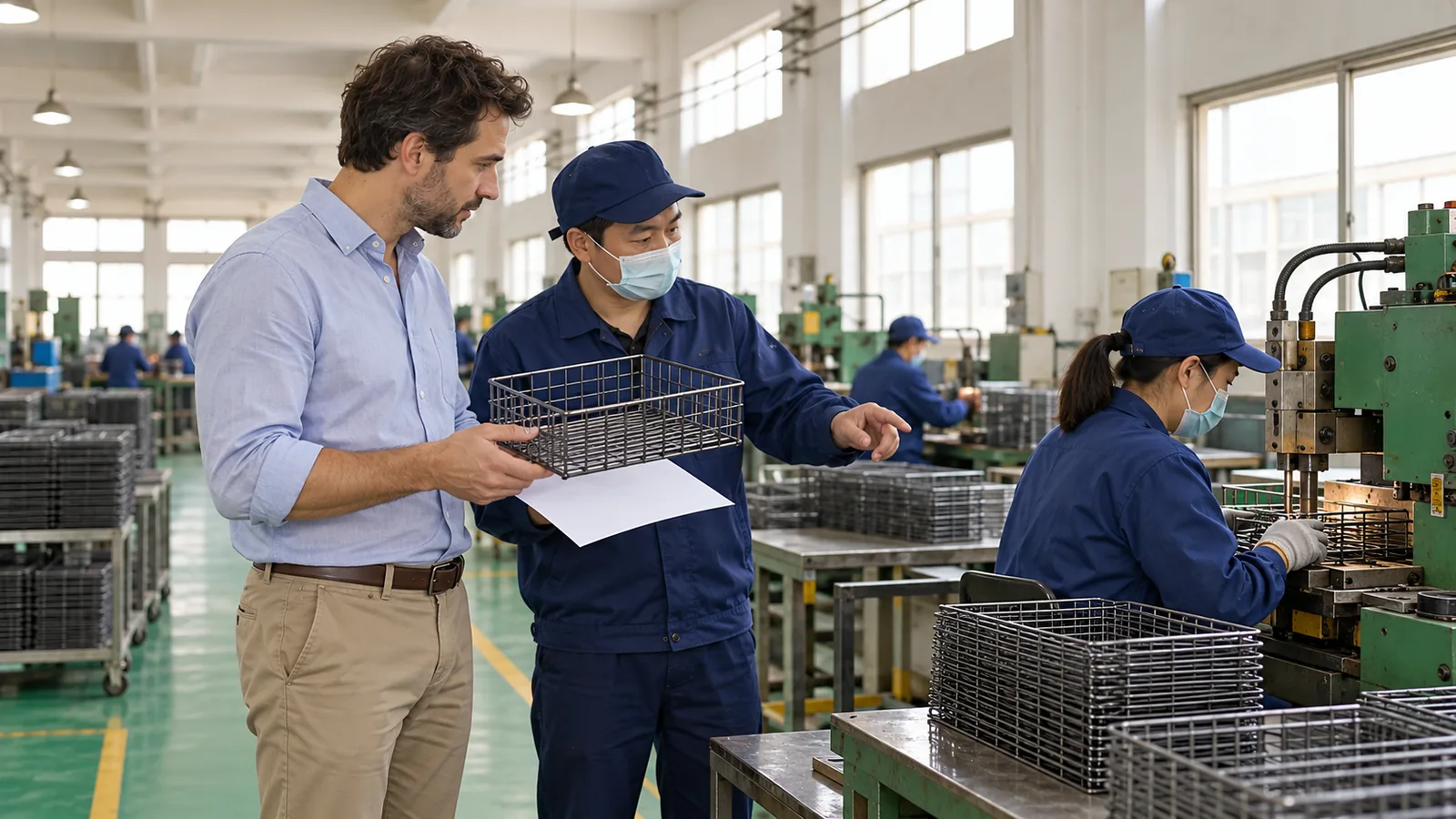
A China factory visit checklist for bathroom hardware buyers works best when it follows one named product and revision through only the operations relevant to that design. Bring the approved drawing or physical sample, agree what may be viewed or photographed, and note each step as something directly observed, stated by a supplier, supported by a record, or still unknown. A short visit can reveal useful questions about forming, joining, finishing, assembly and packing, but it is not a formal audit, a production inspection, proof of annual capacity or a guarantee about future orders.
Why follow one representative product instead of touring every department?
A product-focused walk-through connects the buyer’s specification to the supplier’s actual work sequence. A general tour may show equipment and finished goods without establishing which processes apply to the item being quoted. Following a specific compact wire basket, towel rack or shower accessory makes the visit more useful: the buyer can ask how a critical bend is formed, where a visible joint is made, which finish is applied, how the product is assembled and how the approved sample is packed.
Before the visit, select one representative SKU or proposed design and identify its drawing, sample, finish and revision. State the questions that matter for the sourcing decision. For a wire basket, those questions might concern wire spacing, basket geometry, weld locations, edge treatment and finish coverage. For a tube-and-wire towel rack, the buyer may instead need to understand tube joints, alignment, mounting interfaces and assembly. Actual routes vary by design and finish, so do not assume every supplier uses the same process sequence.
Ask the supplier which steps are relevant and whether they are performed at the visited site or by another party. Outsourcing is not automatically a defect. It is a fact to record, then follow up on if the process affects appearance, traceability, delivery timing or the buyer’s acceptance requirements. The visit should help the buyer identify evidence to request—not turn a brief observation into a broad supplier rating.
How should buyers use a China factory visit checklist for bathroom hardware buyers?
Send a short agenda in advance and identify the product or sample the team wants to follow. Ask permission before entering controlled areas, handling work in progress, photographing equipment or viewing customer-specific work. Respect safety instructions and confidentiality. If photography is not permitted, take written notes after leaving the area rather than capturing another customer’s drawing, label or product.
Bring a small visit pack with:
- The relevant drawing or sample identifier and revision date.
- The target finish and the surfaces most important to the buyer.
- A short list of critical features, such as basket width, mounting interface, visible welds or fit with another component.
- Questions about material identification, process sequence, inspection records and packaging.
- A note-taking method that separates observation, supplier explanation, record reviewed and open question.
- The names or roles of people responsible for answering follow-up questions, if the supplier chooses to provide them.
A factory visit is one input to partner due diligence. The U.S. International Trade Administration describes due diligence as a way to assess a potential foreign business partner’s suitability; an on-site product walk-through is narrower than a complete background check. It cannot independently establish legal identity, ownership, creditworthiness or every capability. See the International Trade Administration’s due-diligence guidance.
Before confirming the agenda, ask which product can be followed safely without disrupting work and whether a representative sample or an approved process record will be available if a relevant operation is not running. Confirm the visit language, the person who can explain technical steps and any photography restrictions. These arrangements help the buyer use limited floor time on the unresolved product questions rather than on a general presentation.
How can buyers trace the product through relevant processes?
Start with the raw material or incoming component that the product actually uses. Ask what the supplier can show about the material identity and how it stays associated with the product or order. A label, certificate or verbal explanation has a defined scope; record what it identifies, which item or lot it covers, who issued it and what remains unverified. Do not infer a grade from appearance or a magnet check alone.
Follow the product through forming, joining and surface preparation only where those steps apply. For wire products, look at how the shape is held during bending and where intersections or frame joints are made. Ask how the supplier controls the relationship between the approved drawing and the production setup. At a joining step, compare the observed joint location and appearance with the buyer’s cosmetic and functional requirements. A brief look at one workpiece does not measure joint strength or prove that every later unit will be identical.
If grinding or polishing is relevant, ask which faces are treated as visible and how sharp edges, scratches or discoloration are assessed. If the design uses powder coating or plating, ask what preparation and coverage checks are relevant to that finish. A finished surface may look acceptable under one light while a recess, cut end or weld area needs separate attention. Use an approved production-intent sample and agreed inspection criteria when the decision depends on appearance or fit.
At assembly, compare the product with the approved sample or drawing: orientation, hole alignment, component fit, fastener access and any movement expected from the design. At packing, ask how the product is protected from scratching or deformation and how the correct accessories and instructions are associated with the SKU. These are questions to investigate on the actual route, not a claim that every site has the same stations or records.
| Process stage | Buyer question | Evidence to note | What one observation cannot prove |
|---|---|---|---|
| Material or incoming component | What material or bought-in part is specified for this SKU? | Marking, lot reference, purchasing record or supplier explanation and its scope | Exact composition or every lot’s identity without appropriate records or testing |
| Forming | How is the sample’s bend or shape produced and held? | Relevant workpiece, fixture, drawing revision and any stated control | Repeatability across a production run |
| Joining | Which joints are critical or visible on this design? | Joint location, sample appearance, inspection criteria and open questions | Strength, durability or hidden joint quality from appearance alone |
| Endbearbeitung | How are visible faces, corners and recesses addressed? | Finish sample, preparation questions and acceptance reference | Corrosion life or coating performance without a suitable agreed test |
| Assembly | Which features must align or fit together? | Sample-to-drawing comparison and assembly sequence | Performance under use from an untested sample |
| Verpackung | How is the product protected and kept with the correct kit? | Pack sample, component list and responsibility for final checks | Transit performance or future shipment accuracy from one carton |
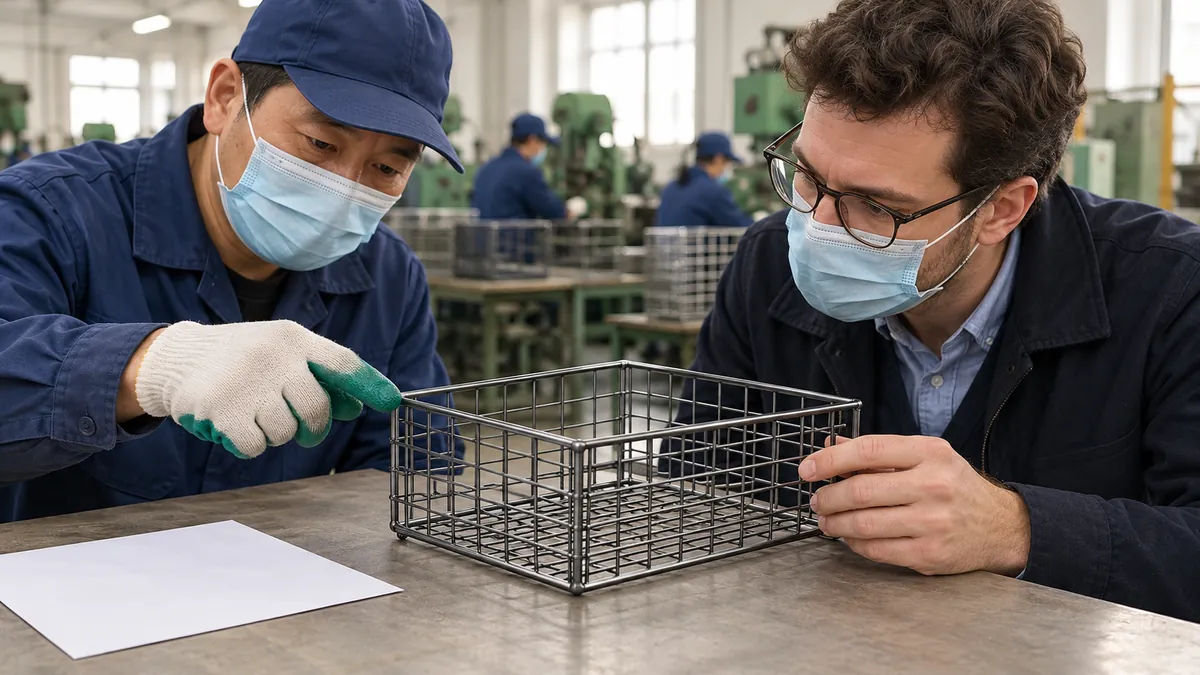
What should buyers record—and what should remain open?
Use a simple evidence log with one line for each important question. Record the product and revision, process area, time or visit section, what was seen, what the supplier said, any record reviewed, and the follow-up owner. A clear distinction matters: “operator formed this sample at this station” is an observation; “this setup is used for every order” is a supplier statement unless the buyer also reviewed relevant evidence.
Do not turn an incomplete answer into a confirmed specification. If a material grade, finish code, tolerance, production location or inspection frequency was not established, mark it as unknown or to confirm. Convert that gap into a written question after the visit. Ask for a relevant document, sample, process explanation or production-intent confirmation, depending on the issue.
When taking notes, preserve the context needed to interpret them later. “Weld checked” is not enough: note which joint, what characteristic, what acceptance reference and what evidence was actually reviewed. “Finish sample approved” should identify the physical sample or controlled reference and who approved it. Keep photos tied to the correct SKU and permission, and avoid photographing unrelated customer information.
The visit may reveal that a process was not running while the buyer was there. That does not automatically mean the supplier cannot perform it; it means the buyer did not observe that step. Ask what evidence could close the gap and whether the answer should be confirmed by a later sample review or production inspection. The right follow-up is proportionate to risk, not a generic demand for every record.
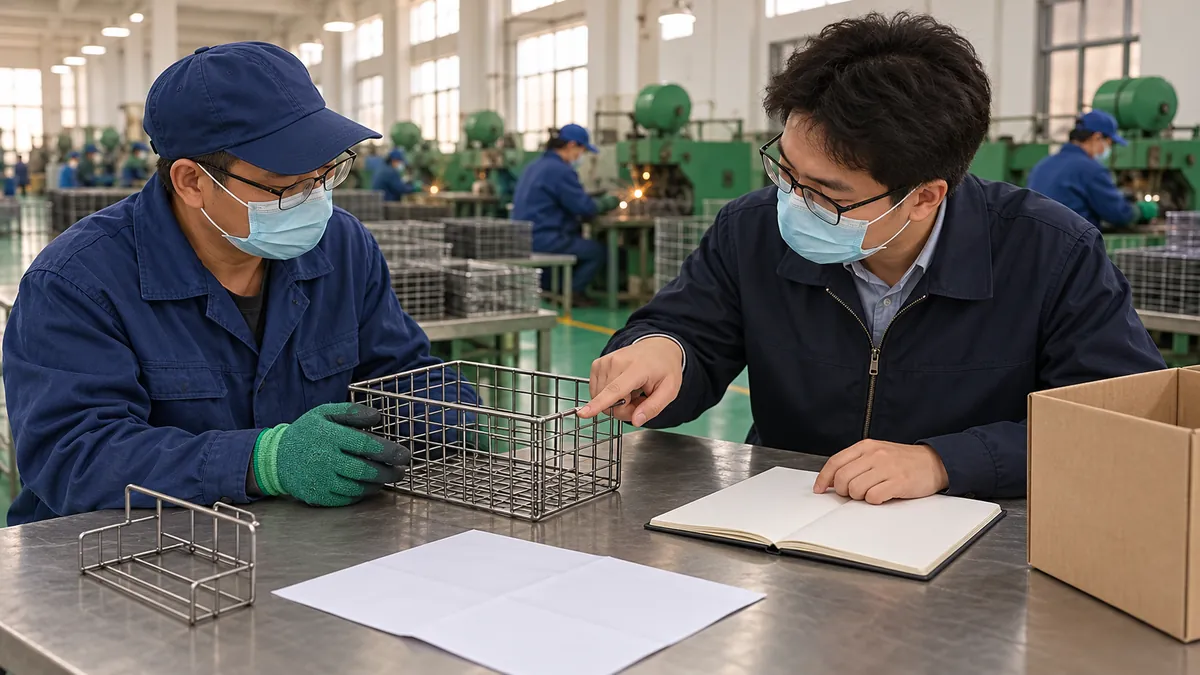
How does a factory visit differ from an audit or production inspection?
A buyer visit is an opportunity to ask questions and observe a limited product route. A formal management-system audit has defined objectives, scope, criteria, evidence methods, competence expectations and reporting. ISO 19011:2026 provides guidance for management-system auditing, but a normal supplier tour should not be described as compliant with that standard simply because the buyer took notes. The current ISO 19011:2026 page describes guidance for auditing management systems; it does not make a brief product walk-through a certification or audit.
A first-article review checks an identified production-intent item against defined requirements. A pre-shipment inspection examines a particular order or lot under an agreed scope. Neither is interchangeable with a visit to the factory floor. If the buyer needs order-specific acceptance evidence, define the inspection item, sample selection, criteria, timing, responsible party and report before production or shipment. Do not use a visit photograph as a substitute for those controls.
Treat machines, tidy areas, stocked components and a polished sample as limited observations. They may prompt useful questions, but they do not independently prove annual output, stable process control, product compliance, or future lot quality. A supplier’s explanation should be assessed with appropriate records and samples when the decision requires them.
What should buyers do after the visit?
Within a day or two, organize notes while the context is fresh. Separate confirmed buyer requirements from supplier statements, observed details, records reviewed and unknowns. Send the supplier a concise follow-up list with the product reference and drawing revision, the question, the requested evidence and a due date. Ask the supplier to correct any misunderstanding before the buyer uses the notes as an RFQ or sample brief.
A practical follow-up sequence is:
- Reconcile each observation with the drawing or physical sample.
- List any step that was not observed and ask how it is performed for this product.
- Request only the records relevant to the unanswered sourcing decision.
- Confirm any change to material, finish, joint, assembly or packing in writing.
- Decide whether a sample review, first-article check or order-specific inspection is still needed.
- Update the buyer’s supplier assessment with evidence and uncertainty clearly separated.
A China factory visit checklist for bathroom hardware buyers should end in a written next-step decision: what can proceed to RFQ, what needs supplier confirmation, and what needs a sample or order-specific check before approval. This keeps a useful observation from being mistaken for completed verification.
A factory visit should improve the next decision, not create a false sense of certainty. Use the visit to sharpen an RFQ, clarify a sample plan or identify a risk that requires a separate check. The custom bathroom hardware manufacturer overview describes Koitor’s product context; for a project-specific discussion, send the product drawing or sample details through Koitor’s contact page.
Häufig gestellte Fragen
Is a factory visit checklist a substitute for supplier due diligence?
No. It supports a narrow on-site product and process discussion. Identity, legal standing, financial exposure and other partner checks require separate sources and procedures appropriate to the buyer.
Should a buyer expect every process to be performed in one building?
No. Product routes differ. Ask which steps are performed at the site, which are handled elsewhere and what evidence connects those steps to the product or order. The answer is context, not an automatic pass/fail.
Does seeing a sample being made prove mass-production quality?
No. It documents a limited observation. A production-intent sample, agreed acceptance criteria, process controls and order-specific inspection may still be needed depending on the buyer’s risk and requirements.
Is a supplier visit the same as an ISO audit?
No. ISO 19011:2026 concerns guidance for management-system audits. An informal factory visit does not become an audit or certification merely because it follows a checklist.
What should a buyer do when photography is not allowed?
Use a written evidence log with permission, product revision, process area, observation, supplier statement, records reviewed and open questions. Ask for approved documents or sample photographs through the supplier’s authorized channel.
Prepare a product-focused factory discussion
Share the product drawing or sample reference, target finish and the process questions you need to resolve before requesting a quote or approving a sample.
OEM / EIGENE MARKE
Verwandeln Sie diesen Beschaffungsleitfaden in ein Produktdossier
Teilen Sie uns Ihr Zielprodukt, die Größe, die Oberflächenausführung, die Bestellmenge und Ihre Verpackungsanforderungen mit. Ihr Team erhält vor der Angebotserstellung eine praxisorientierte Prüfung der Herstellbarkeit.


 English
 Español
 Português
 Français
 Deutsch
 العربية