

EU anti-dumping steel shelves China checks should begin with the exact product construction, origin and current customs entry—not the broad label “metal rack.” The European Commission’s Implementing Regulation (EU) 2026/2023 directs customs to register imports of a narrowly described range of Chinese-origin bolted and boltless steel shelving units and components. Registration is not itself a final anti-dumping duty, and the listed “ex” CN codes do not mean every shelf, wire basket or bathroom organizer is covered. Importers should match the actual SKU to the legal description with a customs professional and monitor the case before shipment.
Buyer note: This article explains a published EU trade-defence action as checked on 23 October 2026. It is not customs classification, legal advice, a tariff calculation or a prediction about the investigation’s outcome.
What is happening in the EU steel-shelving case?
The European Commission opened anti-dumping proceeding AD755 concerning certain bolted and boltless steel shelves originating in China. On 10 September 2026, the Commission adopted Implementing Regulation (EU) 2026/2023, which instructs customs authorities to register qualifying imports with a view to potentially allowing duties on registered imports later.
That procedural step matters to buyers because the goods may be recorded during the investigation even though the act of registration is not the same as a definitive duty currently assessed on each shipment. The regulation says registration expires nine months after the regulation enters into force. It does not announce a final rate, determine that a particular importer’s goods are covered, or remove the need for the buyer’s own customs advice.
The search phrase “EU anti-dumping steel shelves China” is not itself a legal product category; the case uses a detailed product definition and origin condition.
At the time of this review, the Commission case-history record for AD755 showed the proceeding as ongoing and “No measure,” with the case-history page last updated 29 July 2026. Since that portal timestamp predates this review, treat it as the latest portal status found—not as a guarantee that no later action exists. Check the current case portal and Official Journal before shipment, customs entry or pricing decisions.
The primary legal texts are Commission Implementing Regulation (EU) 2026/2023 and the Notice of initiation C/2026/3097. Read the full text and any subsequent amendment rather than relying on a summary.
Which steel shelves and components are described in the registration rule?
The registration regulation describes bolted and boltless steel shelving units and components, including steel uprights with two flat connecting surfaces and steel beams without welded upright connectors. It says a shelving unit may include any of those components with or without decks, regardless of deck material. The scope is also tied to Chinese origin and specified “ex” customs headings and TARIC codes.
The word “ex” is important: it signals that only part of the products classified under a broader heading may be covered. A code match alone is not enough, and a commercial label such as “storage rack” does not decide the question. Conversely, a product’s marketing name or small size does not automatically exclude it.
| Scope input | What the buyer should verify | Warum das wichtig ist |
|---|---|---|
| Product configuration | Unit, component, bundled set, deck material and whether parts are imported separately | The act covers described shelving units and certain components, not every metal storage item |
| Upright construction | Whether steel uprights have the two flat connecting surfaces named in the regulation | This is a structural part of the legal product description |
| Beam connection | Whether the steel beams have welded upright connectors or the configuration described in the act | Generic “boltless” wording does not fully describe the connection geometry |
| Origin | Country of origin for the relevant goods and components, supported by records | The registration act is limited to goods originating in the PRC |
| Classification | Current CN/TARIC code and complete product description reviewed by the broker | The codes are “ex” headings; scope must be read with the legal description |
| Shipment status | Import declaration date, entry details and applicable measures at that time | The investigation can change, and registration is a time-bounded procedural status |

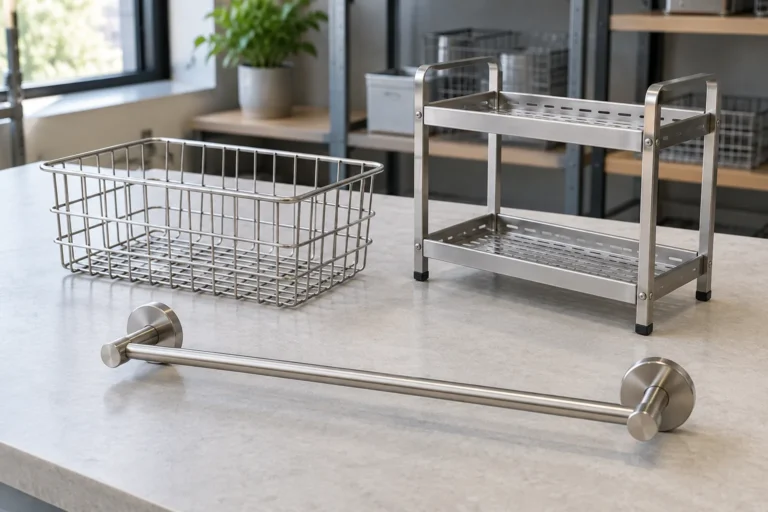
Generic shelf and component-review illustration. It does not establish that this configuration—or any Koitor product—is within AD755.
Does registration mean an importer already owes anti-dumping duty?
No. Registration is an administrative measure that records covered imports while an investigation proceeds. The regulation states its purpose is to allow possible anti-dumping duties to be levied on imports subject to registration. Whether duties are ultimately imposed, their rate, whether they may apply to registered imports retrospectively, and which goods are in scope depend on later legal measures and the facts of the case.
This is why buyers should not add an assumed duty rate to a quotation merely because a shipment is registered. They should also avoid the opposite assumption—that there can never be a later financial consequence. Ask a customs broker or trade-remedy counsel to explain the current procedural posture, relevant entries, any security or collection mechanism, and how the importer’s own goods are treated under current EU law.
The Commission’s notice of initiation explained that registration could lead to retroactive collection of definitive duties on registered imports. The later registration regulation makes that mechanism operative for the described goods. Neither notice nor registration sets the final outcome by itself.
How should importers map a shelf SKU to the legal description?
Build a SKU-level evidence file and ask the broker to compare the product facts with the live legal wording. A useful review separates what the supplier can document from the customs conclusion made by the importer and its adviser.
- Freeze the shipment configuration. Record the SKU, drawing revision, order quantity, parts included, deck material, packaging configuration and whether units or components ship separately.
- Photograph and describe the relevant joints. Capture upright cross-sections, connecting faces, beam ends, connectors and assembly method. Avoid relying only on a styled product photo that hides structural details.
- Record country-of-origin evidence. Keep the origin determination and supporting commercial or manufacturing records through the buyer’s normal customs process. Do not infer origin from the supplier’s address or a product’s visual appearance.
- Ask a customs professional to confirm the candidate code. Provide dimensions, function, construction, components, assembly state and commercial invoice description. Ask for the code and rationale, not just a yes/no answer.
- Compare the product against the regulation’s full wording. Check whether the described uprights, beams or relevant components are present and review the exact “ex” CN/TARIC scope. Do not treat a broad heading as automatic coverage.
- Ask about registration and current case status. Have the broker check whether the goods and entry date are within the current measure, and whether any later notice or provisional/final measure has been published.
- Save the conclusion with a date and owner. Record the source reviewed, adviser, SKU revision, origin facts, open questions and next review trigger.
If the facts are incomplete or the structural wording is ambiguous, mark the SKU “scope review pending.” Do not change a product description to force it into or out of the case. A broker may need a technical drawing, additional photos, a customs binding-tariff decision or specialist legal advice depending on the uncertainty.
What should a buyer ask the supplier to provide?
Ask for factual product documentation tied to the exact product revision. A metal-shelving manufacturer may be able to confirm its own documented materials, construction, component dimensions, assembly details and manufacturing origin facts. The supplier should not be asked to decide the buyer’s tariff classification or guarantee that EU trade-defence measures do not apply.
| Supplier information | Buyer or broker decision it can support |
|---|---|
| Current drawing and revision | Confirms the exact configuration being reviewed |
| BOM and component list | Identifies which uprights, beams, decks and fittings are included |
| Close-up photographs of connections | Helps assess whether the named structural features may be present |
| Material description and part numbers | Supports the technical product description |
| Assembly instructions or exploded view | Shows how separate components connect in the finished unit |
| Origin records available from the supplier | Provides facts for the importer’s origin assessment; it is not a customs ruling |
| Invoice, packing list and SKU mapping | Helps reconcile the shipped goods to the reviewed drawing and entry |
| Change history since sample approval | Flags whether a prior review still matches the shipped version |
Do not request a generic “anti-dumping certificate” unless the customs adviser identifies a specific document and legal basis. A supplier declaration may help establish product facts, but it does not replace the importer’s classification, origin analysis or review of current measures.
Which investigation milestones should a buyer monitor?
The EU notice of initiation says the Commission’s investigation should conclude within one year and no more than 14 months from publication. It also says provisional measures may be imposed no later than seven months, and in any event no later than eight months, from publication of the notice. The registration regulation states the registration period expires nine months after it enters into force.
These are statutory timelines, not a promised publication date or result. The case may be amended, extended where legally permitted, or resolved through later acts. For a live sourcing decision, track:
- new notices or regulations in the Official Journal;
- changes in the Commission’s AD755 case history and measure status;
- any announced provisional or definitive duties and effective dates;
- any amendments to the product description, CN/TARIC codes or registration period;
- the import declaration date and relevant customs advice for each entry.
Do not rely on a saved screenshot or article date as a substitute for checking the live legal record at the time of entry.
What sourcing mistakes can create avoidable cost or delay?
- Treating all steel shelving as covered. The regulation describes a specific structure and “ex” headings; the actual product and code need review.
- Treating all bathroom racks as covered because they are metal. Wire baskets, shower caddies and household organizers are not automatically the shelving product described in AD755.
- Using a code without matching the legal description. The TARIC numbers appear within a narrow measure; classification remains product-specific.
- Confusing registration with a final duty. Registration does not establish a final rate, while the possibility of later duties should not be ignored.
- Using a supplier’s country as proof of origin. The supplier’s location and the goods’ customs origin are different facts.
- Reviewing an outdated drawing. Beam, connector, deck or component changes can invalidate an earlier product-scope assessment.
- Waiting until goods arrive to ask the broker. Product geometry and origin records are easier to gather before order and shipment milestones.
- Putting a guessed tariff cost into a quote. A guessed rate can misprice the order and mislead the customer; ask the trade adviser for a scenario based on the current record.
For an OEM buyer, share the final assembly drawing, BOM, origin information and exact order configuration with the broker early. Koitor Hardware can discuss documented construction facts for its own quoted metal storage hardware; it is not a customs broker, tariff classifier or trade lawyer. See the home-storage hardware OEM page for product-development context.
Buyer checklist and questions before confirming an EU shipment
- [ ] Freeze SKU, drawing revision, component list, deck material and packaging.
- [ ] Document upright and beam connection geometry with clear photographs or drawings.
- [ ] Confirm the goods’ origin with the responsible customs professional.
- [ ] Obtain the current CN/TARIC classification and its rationale.
- [ ] Compare the exact goods with the AD755 product wording and “ex” code scope.
- [ ] Check the current registration measure and any later provisional or definitive act.
- [ ] Confirm what the registration status means for the particular entry date and importer.
- [ ] Keep supplier evidence separate from the importer’s legal classification conclusion.
- [ ] Reopen the review if product structure, origin, route, date or law changes.
Häufig gestellte Fragen
Does the EU anti-dumping case cover every steel storage shelf from China?
No blanket answer is safe. A search for “EU anti-dumping steel shelves China” is only a starting point, not a scope decision. AD755 concerns a defined product description and registration regulation with “ex” codes. The importer should compare the exact shelving construction and components with the full current legal text and obtain customs advice.
Are bathroom wire baskets automatically included?
No. A bathroom wire basket or shower caddy is not automatically the bolted or boltless shelving described in the regulation simply because it stores items or contains steel. The exact function, construction, components, origin and classification require review.
Is registration the same as an anti-dumping duty?
No. Registration records imports under the measure with a view to possible duties; it does not itself announce a final duty rate or decide that a specific SKU is covered. Later legal acts and case facts matter.
What does “ex” before a CN code mean for the buyer?
It signals that the measure applies to only part of the goods that may fall under a broader code heading. Read the product description together with the code and consult a broker; do not use the heading alone as a scope decision.
What should a supplier send to support a review?
Provide a revision-controlled drawing, BOM, close-up joint photographs, component list, assembly details and available origin facts. The importer and customs adviser use those inputs to reach the classification and legal conclusion.

Illustrative buyer worksheet, not an official customs form, tariff ruling or determination of case coverage.
Before each shipment, an EU buyer sourcing steel shelves from China should match the actual product and origin to the current AD755 legal description, verify its CN/TARIC classification with a customs professional and check the latest measure status. The Commission regulation reviewed here is dated 10 September 2026; this article was checked on 23 October 2026, and the official case record should be rechecked before relying on it.
Prepare a Broker-Ready Product File
Share a drawing revision, BOM and specific construction question for a discussion of documented metal-hardware facts. Koitor does not provide tariff classification or trade-remedy advice; the importer should confirm scope with its customs professional.
OEM / EIGENE MARKE
Verwandeln Sie diesen Beschaffungsleitfaden in ein Produktdossier
Teilen Sie uns Ihr Zielprodukt, die Größe, die Oberflächenausführung, die Bestellmenge und Ihre Verpackungsanforderungen mit. Ihr Team erhält vor der Angebotserstellung eine praxisorientierte Prüfung der Herstellbarkeit.

 English
 Español
 Português
 Français
 Deutsch
 العربية