

When a bathroom basket or towel rack is shipped into the EU, the buyer may receive several documents: a packaging material statement, a test report, an EPR registration record, a supplier email saying “PPWR compliant,” and an EU declaration of conformity. Before approving the order, the importer should know what its PPWR packaging declaration of conformity covers and how it differs from those other records. It also needs to establish who is responsible for the packaging under the Packaging and Packaging Waste Regulation (PPWR), whether the applicable declaration identifies the packaging being supplied, and whether the supporting technical documentation can be made available if an authority requests it.
A PPWR packaging declaration of conformity is the manufacturer’s formal statement that the applicable requirements have been demonstrated for the identified packaging. It is not automatically a certificate issued by a third-party laboratory, and it is not interchangeable with a material declaration or an EPR registration. A hardware importer’s job is to verify the role, scope, identity, and access to supporting evidence before placing packaging on the market. It should not ask a supplier to make a legal conclusion about every party in the supply chain.
The practical control is a document-to-packaging match: record the packaging type, its identifier and revision, the responsible manufacturer, the declaration version, the applicable requirements and the supplier records that support it. The right details depend on the packaging and transaction. A plain retail carton, protective sleeve, grouped pack and transport carton may involve different packaging types and suppliers; do not assume that one generic PDF covers every configuration.
Short answer: identify the manufacturer and match the evidence
The PPWR places the core conformity and declaration duties on the packaging manufacturer. Before placing packaging on the market, the manufacturer must carry out or commission the applicable conformity assessment and prepare the required technical documentation. Once conformity has been demonstrated, the manufacturer draws up the EU declaration of conformity. Suppliers of packaging or packaging materials provide information and documentation needed to support that assessment.
An importer should verify that the required assessment and documentation exist, that packaging is labelled and accompanied by required documents, and that the manufacturer identification information is present as required. The importer must retain a copy of the declaration and ensure that the relevant technical documentation can be made available to market-surveillance authorities on request. For single-use packaging, the retention period is five years; for reusable packaging, it is ten years from the date the packaging is placed on the market.
This checklist does not mean that every importer of a packaged product automatically has the same legal role for the packaging. PPWR role definitions, packaging type, who ordered or designed the packaging, whose name or trademark appears on it, and the route by which it is made available can all matter. If the business sells packaging under its own name or trademark, or modifies it in a way that could affect conformity, Article 21 may treat it as the manufacturer. Confirm the specific facts with the responsible compliance reviewer or legal adviser.
Do not treat every supplier paper as a declaration
The document’s title is not enough. A file labelled “PPWR Certificate” might contain useful information, but the title alone does not establish that it is the EU declaration described in Article 39. A buyer should identify what the document is, who issued it, which legal role that party has, and which packaging type it covers.
| Document or record | What it can help establish | What it does not establish by itself |
|---|---|---|
| EU declaration of conformity | The manufacturer declares that applicable PPWR requirements have been demonstrated for the identified packaging | It does not automatically prove every SKU, pack revision or requirement outside its stated scope |
| Technical documentation | The manufacturer’s assessment basis, such as packaging description, drawings, components, applicable specifications, analysis and relevant test reports | A partial extract does not necessarily show that the complete required file is held or available |
| Material or composition statement | A supplier’s description of materials or components, within the scope of its records | It is not the EU declaration and does not decide who is the manufacturer or importer |
| Test report | Results from a stated method, sample, laboratory and date | One test does not prove all PPWR requirements or replace the manufacturer’s assessment |
| EPR registration or PRO record | A producer’s registration or arrangement for extended producer responsibility in a jurisdiction | It is not the Article 39 EU declaration and does not prove packaging conformity |
| Generic “compliant” email | A supplier’s assurance that may point the buyer to supporting records | Without an identified author, product scope, revision and evidence, it is not enough to verify the required documents |
The declaration is a manufacturer document. The technical file is the evidence base behind the assessment. A packaging supplier may provide drawings, material descriptions, specifications or test data to the manufacturer, but that support does not automatically make the supplier the manufacturer or transfer the manufacturer’s responsibilities. Commission guidance explains that the responsible role depends on the packaging type and transaction facts.
Do not infer that a document is invalid only because it is not called a “certificate,” or that it is valid because a laboratory logo appears on it. The question is whether the document set satisfies the applicable legal requirement for the packaging and whether the responsible party can support the declaration. An independent third-party certificate is not automatically the same thing as the manufacturer’s EU declaration.
Start with the packaging type, route and legal roles
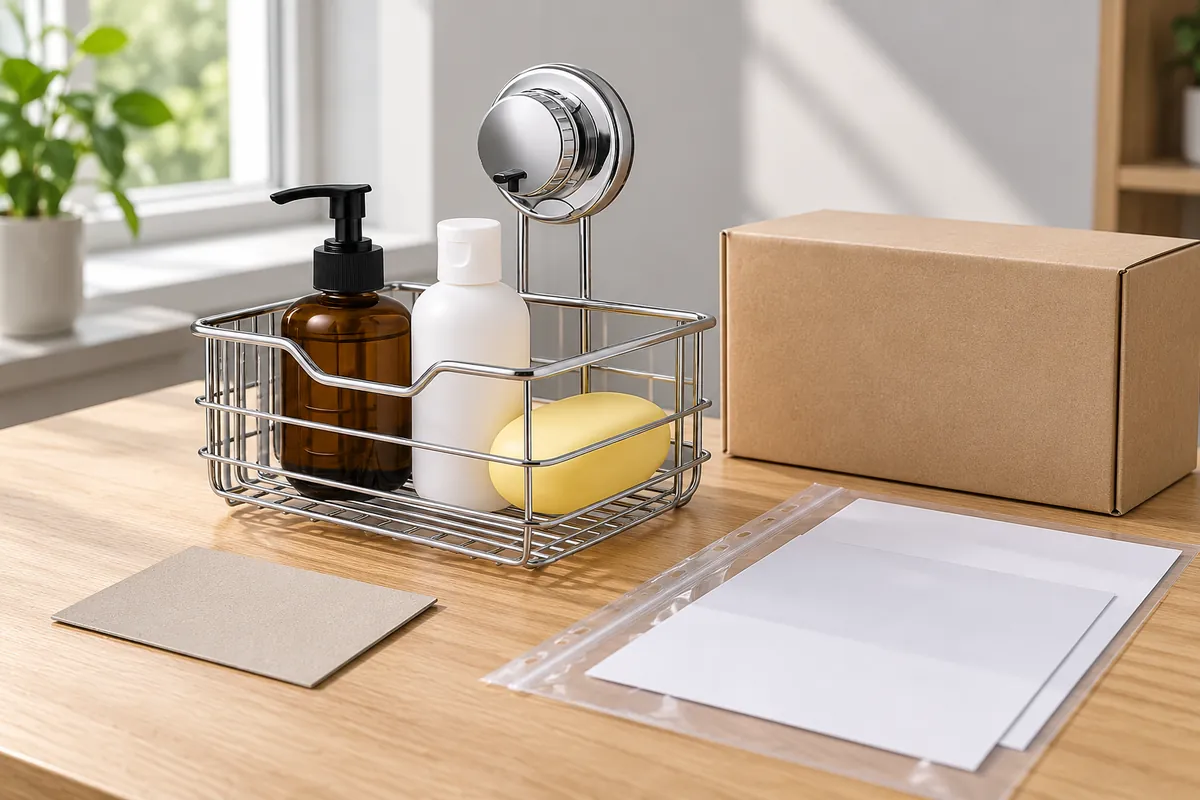
Before reviewing the paperwork, map the packaging that will actually enter the market. A metal shower caddy may use an inner protective sleeve, a retail carton, a paper insert, a grouped pack, a master carton and transport packaging. These examples are illustrative; the actual pack-out must come from the approved SKU or purchase order. Different components may come from different upstream suppliers, and the person who specifies or places each type on the market may differ.
Map the transaction before assigning a role
Record the contracting entities, product brand, packaging brand or marks, who decides the packaging specification, who supplies the materials, where the first EU placement occurs, and whether the importer or distributor changes the packaging. A seller importing packaged hardware should check whether it is the PPWR importer of the packaging for that transaction, rather than assuming that the customs label or shipping paperwork alone answers the question.
Under Article 21, an importer or distributor that places packaging on the market under its own name or trademark, or modifies packaging already placed on the market in a way that could affect compliance, can be treated as a manufacturer. Commission guidance also explains that the relevant manufacturer may vary by packaging type: for sales or grouped packaging, the filler is often the manufacturer, while transport or service packaging may follow a different rule. These are role clues, not a substitute for applying the definitions to the actual design, order and supply chain.
Keep extended producer responsibility separate. A business may have EPR obligations in a market and still have a different role for the packaging’s technical conformity documents. Our multi-country EPR importer checklist addresses destination-by-destination registration and reporting workflow. It does not replace this DoC and technical-file review.
Set the review boundary
The PPWR began applying on 12 August 2026, but individual requirements have different transition dates and scope. Do not tell a supplier “all PPWR requirements apply to every packaging item now” without checking the requirement, packaging type and relevant transitional rule. The Commission’s implementation guidance and FAQ explain selected interpretive issues, but the regulation remains the primary source and national authorities may provide practical instructions for their market.
The article’s focus keyword—PPWR packaging declaration of conformity—is a useful search label, not a claim that a buyer must collect one identical file for every piece of packaging. First establish which packaging types are in scope and which requirements apply; then ask the responsible manufacturer for the corresponding declaration and evidence.
Review the declaration against the packaging and requirements
Article 39 says the EU declaration must state that the applicable requirements in or pursuant to Articles 5–12 have been demonstrated. It follows the model structure in Annex VIII, contains the relevant elements specified in Annex VII, must be kept up to date, and must be in one or more languages required by the Member State where the packaging is placed or made available. If another EU act also requires a declaration, Article 39 provides for a combined declaration where appropriate, with the acts identified.
Use the following checks as a practical document review. They help surface gaps for follow-up; they are not a legal opinion on whether the package is compliant.
- Issuer and role: Is the responsible manufacturer named? Does the name align with the packaging, order, brand, design decision and transaction facts? If a representative helped prepare or retain documents, is there a written mandate and a clear manufacturer responsibility?
- Packaging identity: Does the document identify a packaging type or model that can be connected to the actual item? Are the reference, description or other identifiers specific enough to distinguish the covered pack from another format?
- Applicable legal requirements: Does the declaration state that the relevant PPWR requirements have been demonstrated? Does it cite the regulation and identify any other EU legislation included, if applicable?
- Technical basis: Does the responsible party have the technical documentation that supports the declaration and the applicable conformity assessment? Is there a clear route for the importer to ensure that authorities can obtain the required documentation?
- Language and version: Is the declaration in a language required for the destination? Is the document dated or otherwise controlled so the buyer can identify the current version and replace a superseded copy?
- Packaging-to-order match: Can the covered type be linked to the packaging components, product SKU, approved artwork, pack-out or order revision actually being supplied?
Where a declaration lists several package types, ask how those types are distinguished and whether the relevant SKU’s packaging is within that stated scope. A declaration can cover a defined range if the manufacturer has established that scope, but the buyer should not assume the coverage from a shared supplier, carton color or product family name alone.
Check that identifiers on the packaging or accompanying documents are consistent with the declaration’s scope. PPWR requires manufacturer identification and a type, batch, serial number or other identifying element, with a document accompanying the packaged product available where size or nature of the packaging makes marking impracticable. The importer also has its own identification obligation when it is acting in that role. A mismatch is a question to resolve before release, not a reason to edit the manufacturer’s declaration itself.
Know what the technical file does and does not need to show
Annex VII describes the technical documentation behind the conformity assessment. As relevant to the assessment, it can include a general packaging description and intended use; design concepts, manufacturing drawings and component materials; explanations needed to understand those drawings; applied harmonised standards, common specifications or other technical specifications; a qualitative account of how relevant assessments were performed; and test reports. The manufacturer establishes the file and uses it to evaluate the applicable requirements and risks of non-conformity.
This is not a universal checklist requiring every listed item for every carton. The phrase “wherever applicable” and the scope of the relevant requirements matter. A buyer should ask the manufacturer to identify the technical file or explain how the required information can be made available, not demand a laboratory test that is unrelated to the packaging or claim that every file must contain a third-party certificate.
The importer keeps a copy of the declaration and ensures that the technical documentation required under the relevant PPWR provisions can be made available to market-surveillance authorities upon request. The importer does not necessarily need to receive the entire technical file as an attachment to each shipment. Operationally, however, it should know who holds the file, how to request access, which version it supports, and whether language or response arrangements could delay a regulator’s request.
The regulation specifies five-year retention for single-use packaging and ten years for reusable packaging, measured from the date the packaging is placed on the market. If the same supplier sells both types, do not apply one retention period to both by habit. Record the packaging type and placement date basis with the declaration copy and link it to the version actually placed on the market.
What a buyer can request from an OEM supplier
For a hardware order, request facts the factory or packaging supplier can substantiate: SKU and product revision, pack-out revision, packaging type and component list, component supplier where known, available material descriptions, relevant drawings or specifications, evidence source, change date and the responsible contact for the manufacturer file. If a value or record is not held by that supplier, ask it to mark the field “not held” and identify the upstream party that may have it.
The buyer should not ask a factory to decide whether the buyer is the PPWR manufacturer, importer, distributor or EPR producer unless the factory has been formally appointed and has the necessary role-specific information. The buyer’s own legal entity, brand, packaging order, sales route and changes may affect that determination. Keep supplier evidence and buyer-side legal decisions in different fields of the review record.
Build an importer checklist around a specific packaging revision
For every new product or material packaging change, maintain a record that connects the order to the documents reviewed. This example shows the fields a sourcing or quality team can track without making the factory act as the regulator:
| Review field | Buyer should record | Evidence or owner to ask |
|---|---|---|
| Product and order | Buyer SKU, product revision, PO and destination market | Buyer ERP, approved drawing and order |
| Packaging type | Unit, grouped, sales or transport packaging; describe actual components | Factory pack-out record and packaging supplier specification |
| Legal role | Manufacturer, importer, distributor or open question for each relevant packaging type | Buyer compliance/legal owner; current regulation and guidance |
| Declaration | Issuer, document ID, date/version, language, packaging type and applicable requirements | Responsible manufacturer |
| Technical file | Holder, packaging revision covered, availability route and responsible contact | Manufacturer; relevant upstream suppliers provide evidence to it |
| Marking and documents | Manufacturer/importer identification, packaging identifier and accompanying documents where required | Approved artwork, actual sample and order documents |
| Change control | What changed, effective date, affected orders, prior document replaced and reviewer | Factory/packaging supplier change notice plus buyer approval |
| Release decision | Approved, hold for clarification or refer for legal review; reviewer and date | Buyer-side authorized approver |
The buyer can keep this as a short cover sheet and retain the declaration and supporting supplier documents in the relevant product file. A spreadsheet line that says “PPWR passed” without the declaration version, packaging scope and reviewer is difficult to audit later.
When a problem appears, the appropriate next step depends on its importance. A missing document date may be a clarification request. A declaration from a different legal entity may require role verification. A mismatch between the approved packaging and the document’s type identifier can require the manufacturer to confirm coverage or reassess. If the importer considers or has reason to believe the packaging does not conform to applicable requirements, Article 18 says it must not place the packaging on the market until it is brought into conformity. Do not convert every paperwork discrepancy into a technical failure, but do not dismiss a material mismatch as a clerical issue without evidence.
Our guides to transport packaging empty-space ratios und PPWR packaging reuse targets cover separate packaging decisions. They may inform a pack-design discussion, but neither replaces the declaration, the technical file or a role assessment.
Trigger a new review when the pack or role changes
Article 15 requires manufacturers to account for changes in packaging design or characteristics, and changes in standards or specifications used to demonstrate conformity. Where a manufacturer finds that conformity could be affected, it carries out or commissions reassessment. The buyer should therefore treat document matching as revision-controlled work, not a one-time vendor onboarding form.
Reopen the review if the packaging changes in a way that may affect its applicable requirements or its identity. Examples include a new material or component supplier, a changed wall or barrier layer, a new adhesive or coating, a revised carton structure, a different pack size, a reusable pack replacing a single-use format, a new brand printed on the pack, or a material change in the product’s packing instructions. These are triggers to ask what changed and whether the manufacturer’s assessment is affected; they do not each automatically require a new declaration.
Also reopen the role check if a retailer begins selling under its own trademark, the importer starts specifying packaging under its own name, a fulfilment provider repacks goods, the business changes from distributor supply to direct sales, or the packaging is modified after it was placed on the market. The exact legal consequence depends on facts. Escalate a change that could affect conformity or the legal role instead of allowing procurement to substitute a file from an earlier configuration.
Keep an approval trail with the change notice, affected SKUs or purchase orders, old and new packaging identifiers, manufacturer response and the buyer’s release decision. This creates a useful evidence link between the actual shipment and the PPWR documents without inventing data that the supplier does not hold.

Häufig gestellte Fragen
Does every shipment need a new declaration attached?
The regulation requires the declaration for the packaging type and requires the manufacturer and importer to keep the specified records available for authorities. It does not mean a fresh declaration must be created for every shipment if the same covered packaging type and revision is supplied. The buyer should confirm the declaration’s scope and keep the copy and technical-file access tied to the packaging it actually imports.
Must the importer receive the complete technical file before ordering?
The importer must ensure the relevant technical documentation can be made available to the market-surveillance authorities on request. The exact documents and access arrangement depend on the applicable requirements. A buyer can request a summary or evidence needed for its own approval, but should not claim that the entire file must be attached to every order or shipment.
Is a test report the same as a PPWR declaration?
No. A test report is evidence about a stated sample and method. The EU declaration is the manufacturer’s statement under Article 39 that applicable requirements have been demonstrated for the identified packaging. A test report may form part of the technical documentation, but it does not automatically replace the declaration.
Does a private-label carton make the buyer the manufacturer?
It may affect the role, but the answer depends on the packaging type, who places it on the market under whose name or trademark, and other transaction facts. Article 21 contains cases where importers or distributors are treated as manufacturers. Review the actual arrangement with a qualified adviser; a private-label product name alone is not enough for a complete legal conclusion.
Does “PPWR compliant” on a supplier email prove the packaging is approved?
No. Treat the email as a pointer to evidence. Ask for the responsible manufacturer’s declaration, connect its scope to the packaging type and revision, confirm the technical file can be made available, and resolve any missing identity, language, applicable-requirement or change-control detail before the release decision.
Should a buyer ask the factory to sign the declaration?
Ask who the legal packaging manufacturer is and who is authorized to issue the declaration. The factory may be the manufacturer for a particular packaging type, but it may instead be supplying the packaged product or packaging materials to another manufacturer. Do not ask an entity to sign in a role it has not verified.
The workable approval rule is simple: identify the responsible role, match the EU declaration to the packaging type and revision, confirm that supporting technical documentation can be produced, and record what remains unresolved. This PPWR packaging declaration of conformity check is about document identity and traceability; the legal manufacturer remains responsible for its declaration, and the importer retains its own obligations under the applicable rules.
Sources checked on 26 October 2026
- Regulation (EU) 2025/40 (PPWR), EUR-Lex
- European Commission Notice C/2026/3084: PPWR implementation guidance
- European Commission: PPWR Frequently Asked Questions, published 3 August 2026
- Swedish Environmental Protection Agency: Manufacturer, importer or distributor—what applies to you?
Developing a Private-Label Bathroom Hardware Product?
Share the product drawing or sample, target packaging format, SKU and approved pack-out revision. Koitor can discuss the hardware specification and the supplier-side packaging facts available for a documented order. PPWR role determinations and conformity declarations must be handled by the responsible legal manufacturer and buyer-side compliance team.
OEM / EIGENE MARKE
Verwandeln Sie diesen Beschaffungsleitfaden in ein Produktdossier
Teilen Sie uns Ihr Zielprodukt, die Größe, die Oberflächenausführung, die Bestellmenge und Ihre Verpackungsanforderungen mit. Ihr Team erhält vor der Angebotserstellung eine praxisorientierte Prüfung der Herstellbarkeit.
 English
 Español
 Português
 Français
 Deutsch
 العربية