
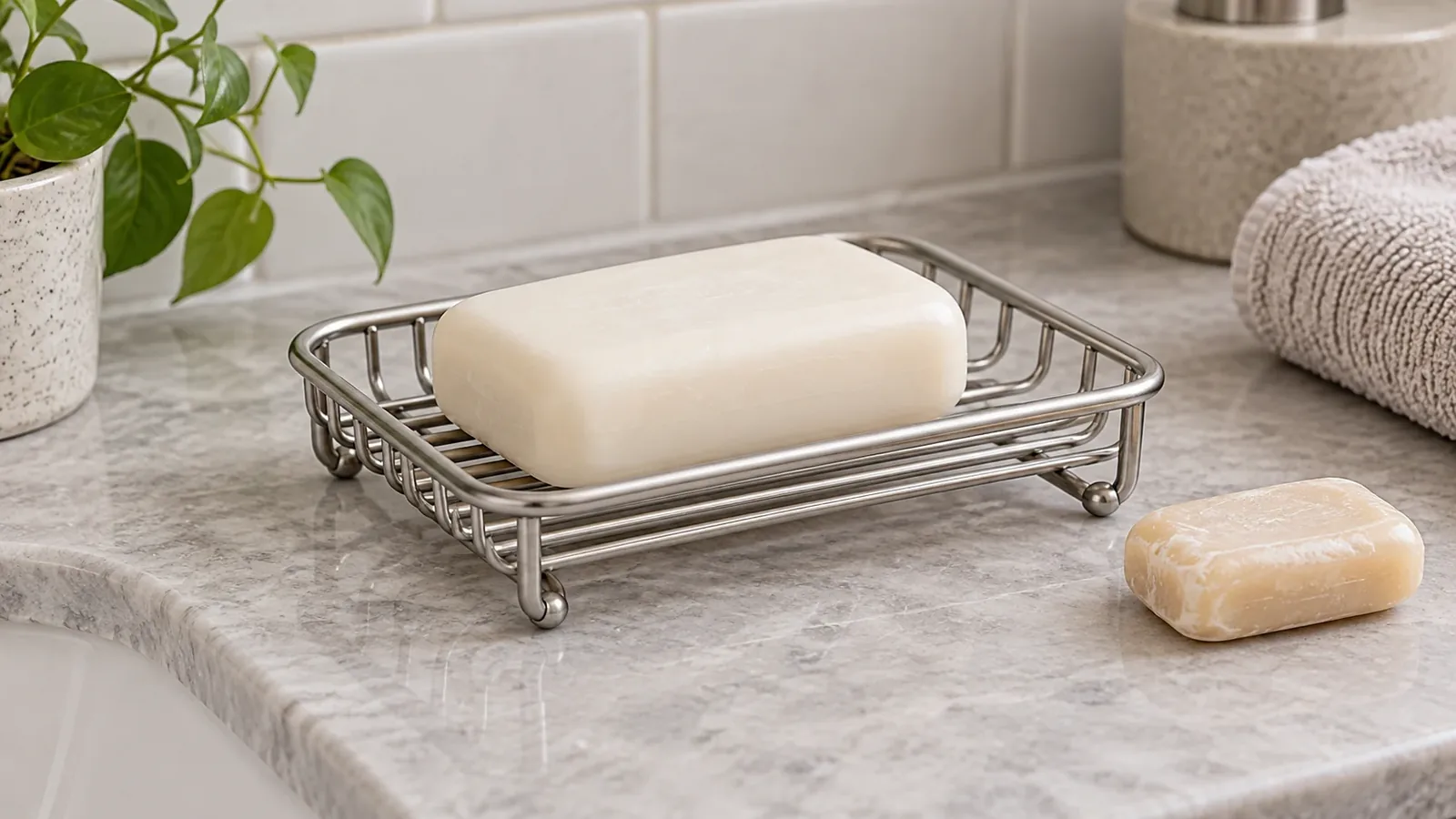
A wire soap dish should be approved against the soap bars it is expected to hold, including a smaller bar near the end of use. Buyers should record the bar’s length, width, thickness and contact points, then test the full-size and partly used references on the production-intent dish. Support spacing, edge shape and the path available for water to leave are connected design inputs, but a visible gap alone does not prove faster drying, longer soap life or easier cleaning. The practical acceptance question is whether the named bars stay supported, can be lifted out, and leave the dish accessible for routine cleaning.
This guide is for importers and private-label teams comparing a wire form for a bathroom assortment. It covers the bar-to-dish interface and sample approval. It does not select a wall-mounting system, establish a universal spacing, verify hygiene or corrosion performance, or confirm that Koitor currently sells a specific soap dish.
What should buyers define before comparing wire soap dishes?
Start with the soap reference set rather than a catalog photograph. Soap bars differ in outline, thickness, corner radius and how much their shape changes during use. A dish that supports a new rectangular bar may handle a rounded or reduced bar differently. The buyer should identify the actual target-market formats, the intended pack assortment and the reason the dish is included in the SKU.
For each reference bar, record the manufacturer/model when known and measure the length, width and thickness at its largest cross-section. Include a representative partly used bar, or make a controlled sample by using or trimming an identical bar. Do not describe a handmade sample as a standard size for the whole market. The goal is to define the dimensions the product team wants the sample to accommodate.
Also decide how the soap will be placed. Some buyers expect the bar to sit in a chosen orientation; others expect consumers to place it down without aligning it. If a dish has a defined “long side” or a raised rim, show the intended orientation in the drawing and packaging. Ask whether a bar may be placed crosswise, diagonally or near an edge, and include those positions in the review when they are plausible in normal handling.
A compact reference matrix prevents vague sign-off:
| Buyer input | What to record | Sample question |
|---|---|---|
| New bar | Length, width, thickness, outline and corners | Does it sit on the intended supports without an unstable contact point? |
| Partly used bar | Representative reduced dimensions and rounded edges | Does the remaining bar stay supported and remain easy to pick up? |
| Placement | Intended orientation and likely offset from center | Does ordinary placement create an edge or tilt concern? |
| Dish | Drawing revision, support layout, edge and finish | Are the actual supports and contact surfaces consistent with the approved sample? |
| Cleaning | Expected access, cleaning method and product instructions | Can the buyer reach the underside and joints that collect residue? |
Do not specify a maximum supported bar size based only on the outside length of the dish. The usable support area can be smaller because of side rails, end returns, welds or an inward-curving edge. A buyer should distinguish the outside envelope from the clear area on which the soap actually rests.
How do support gaps affect bar retention?
A wire dish uses an open structure, but “more open” and “better supported” are not the same requirement. A gap that allows water to move away from a bar may also become a contact gap through which a small, soft or rounded bar can tilt or slip. A close support pattern may reduce that opening but create more wire-to-soap contact or make the underside harder to reach. Those are design trade-offs to test with the actual references, not universal rules about a single ideal pitch.
Map the support geometry in the drawing. Identify the spacing between parallel wires or rails, the distance from the end supports to the side frame, and any change in opening at corners or cross-members. If the dish uses a formed sheet base, slots or holes, record their width, length and edge treatment. The nominal pitch between repeated supports does not describe every opening if the frame curves or joints interrupt the pattern.
Place each reference bar in the intended orientation and observe its contact points. Look from above and from the side. Does the bar sit on several supports, bridge a gap, touch a perimeter rail or rest partly on a welded crossbar? A soap bar with tapered ends may have a different stable footprint from the rectangle suggested by its overall dimensions. Record the relevant contact pattern instead of saying only “fits.”
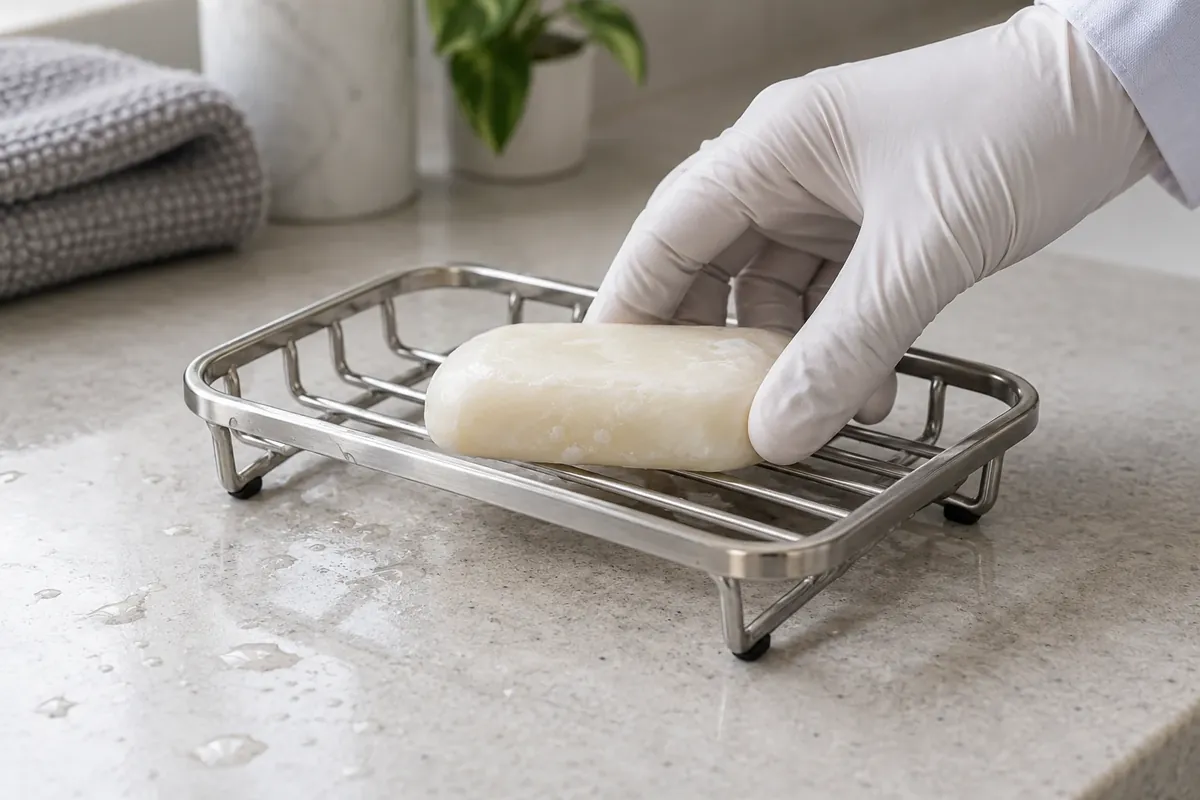
Repeat the placement with the partly used bar. Check whether it can rest without being wedged into a corner and whether a buyer can lift it with wet fingers using the clearance the product is expected to provide. The bar should not require bending the dish, separating wires or scraping against an edge to remove it. If the product relies on a raised rim to retain soap, verify that the rim does not make retrieval difficult for the smallest approved reference.
The buyer should also decide whether accidental movement is in scope. A gentle repositioning during the sample review is different from a defined drop, vibration or misuse test. Do not infer “won’t fall through” from a single centered placement. State the placement and handling conditions that matter to the intended product. If the buyer expects the dish to be moved while it contains a bar, test that exact action and record what happens.
The sampled product architectures in the research pack illustrate different approaches: a raised slotted tray, a wire dish and a commercial soap dish with drainage openings. Their published descriptions show examples of form, not a universal spacing recommendation. A buyer can use them to frame questions but should not copy a competitor’s dimensions or claim that its geometry guarantees a particular user outcome.
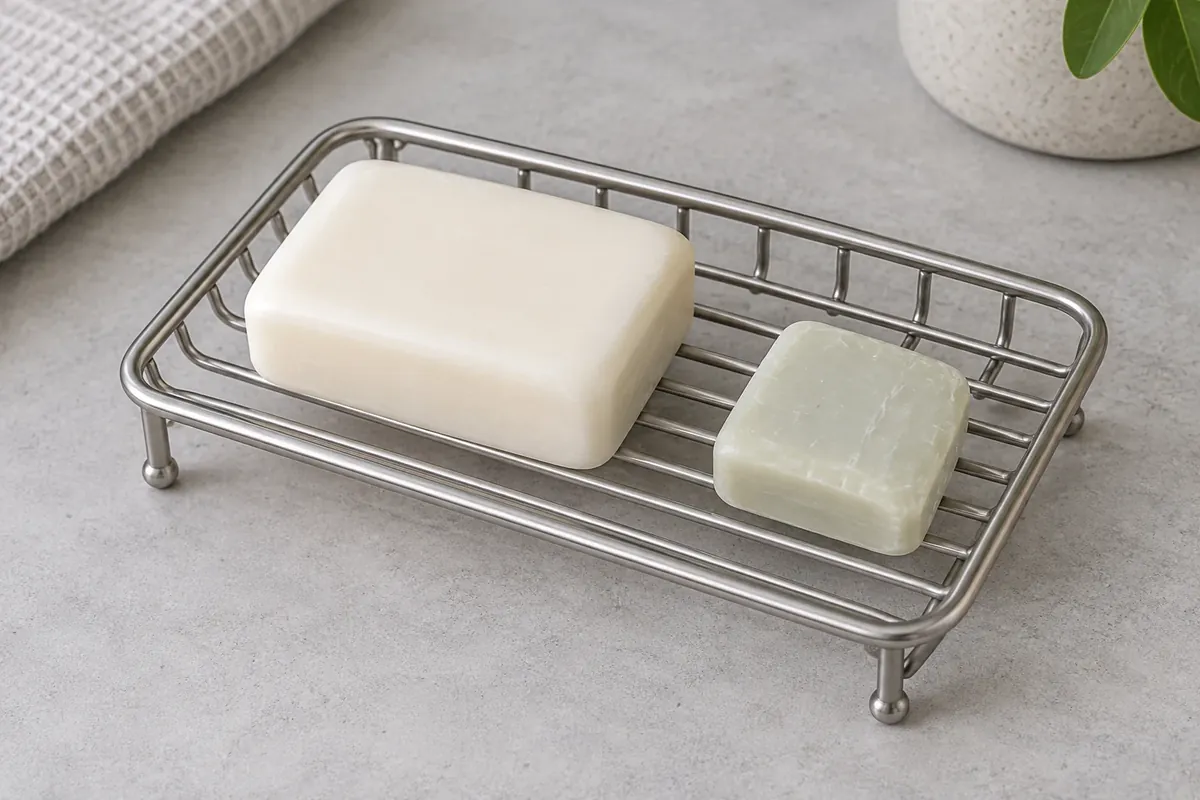
Does drainage require a larger opening?
A drainage path must be evaluated with the whole dish. Water may leave through openings in the base, around the bar, over a sloped tray or through a combination of surfaces. The visible opening is only one part of the system; orientation, support height, side-wall shape, contact areas and where the dish is placed can affect whether liquid has a clear route off the surface.
For a wire form, inspect the direction of the supports and any transverse rails. A cross-member can help connect the structure but may create a local ledge where residue remains. End returns and perimeter wires can also define a boundary. For a punched tray, inspect whether the openings remain unobstructed when the reference bar is centered or positioned toward an edge. These observations can identify questions for a sample review, but they do not measure drainage performance.
Test a representative configuration under controlled conditions only if drainage is part of the product requirement. Decide in advance what liquid is used, how much is applied, how the bar is positioned, how long the sample sits and what the buyer will observe. Keep the procedure consistent across compared samples. If the buyer does not have a defined method or performance threshold, do not turn an informal observation into a quantitative claim.
A useful comparison records at least three separate results:
- Bar support: whether the selected bar rests at the intended contact points and remains supported in the stated positions.
- Liquid path: where visible liquid can exit or collect under the agreed sample setup.
- Cleaning access: whether the buyer can reach the underside, intersections and perimeter for the specified wipe or rinse method.
These should not be collapsed into a single “drains well” pass. A structure may provide open space but still have corners or joints that are difficult to reach. Conversely, a tray with a different base architecture may meet a buyer’s cleaning or package requirements even when its openings look different. The approval record should preserve what was actually evaluated.
User discussions recorded during research described soap falling between supports and residue accumulating on another dish. Those comments help identify failure cases to include in testing; they do not establish how often the problem occurs or which geometry is superior. A product claim about soap longevity or drying time would require evidence for the exact bars, dish and use conditions.
Which product details belong on the drawing and RFQ?
Use a drawing revision that separates the outer size from the soap-supporting area. Show top and side views, wire or sheet sections, key opening dimensions and the relevant edge returns. If there is a formed perimeter, indicate the contact surface and whether the bar is intended to touch it. The drawing should make it possible to compare the approved sample with a later production lot.
Identify material and finish requirements as their own fields. A visual description such as “silver metal” is not enough to establish a substrate or finish process. If the surface, corrosion resistance or cleaning-chemical compatibility matters, specify the requirement and evidence expected for the exact construction. Do not assume that a polished appearance proves material grade, coating adhesion or bathroom durability.
For welded construction, mark cosmetic faces and any joints that could contact the soap or a user’s hand. The buyer can ask the supplier to review access for forming, welding, grinding and finishing, then inspect the actual sample for sharp edges, incomplete finishing, visible distortion or other defects against agreed criteria. Avoid specifying hidden process details the buyer cannot verify unless they are relevant to an approved control plan.
If the product includes a purchased insert, feet, liner or mounting component, name the responsible supplier and part revision. Koitor’s current soap-dish SKU and any exact purchased component are unconfirmed; do not treat a conceptual wire drawing as proof of a finished product capability. A private-label program should track the complete approved configuration so a component substitution does not silently change the contact area or stability.
The pack-out should keep the dish from being bent or scratched and prevent parts from pressing into one another if multiple pieces share a carton. Buyers should review the actual package, not only a product sample outside the box. Record the orientation, protective separation and carton configuration needed for the target channel. Do not claim that a particular package has passed transit testing unless there is a report for that exact pack and method.
How should the buyer run a repeatable sample review?
The objective is to make the decision reproducible across product, quality, sourcing and supplier teams. A short checklist and retained references are usually more useful than a vague statement that the sample “looks fine.” Attach the approved drawing revision, actual soap references, photographs and observation notes to the sample record.
A practical review can follow this order:
- Identify the sample. Record supplier, product code, drawing revision, date, finish and any component supplier or revision.
- Measure the dish. Check outside dimensions and clear supporting area at the points shown on the drawing. Note the measurement method and tolerance where the drawing requires one.
- Inspect the construction. Look for visible sharp edges, loose joints, uneven support spacing, burrs, coating damage or finish variation under the buyer’s documented criteria.
- Place the new reference bar. Use the intended orientation and a normal placement position. Record contact points, tilt and edge clearance.
- Place the partly used reference. Repeat the observation with the smaller bar and test removal without pulling or flexing the structure.
- Check likely alternate placements. If the product will be sold without placement instructions, test the reasonable offsets and crosswise positions buyers expect.
- Review liquid and cleaning access. Follow the defined method, if one exists, and inspect the underside, corners and joints after the sample condition.
- Confirm packaging. Return the product to the intended pack and check that the dish and any components remain protected and correctly identified.
Use the same references for the first article, pre-production sample and any later revision that can affect the supports, perimeter, finish or package. If the production-intent sample differs from the approved drawing, document the difference and decide whether a new review is required. A sample approval applies to the specific configuration and method recorded; it is not a blanket statement about all later versions.
For a small-batch OEM project, the buyer can use this record when discussing a trial order, private-label package or follow-on quantity. Koitor is a family-owned custom metal hardware factory with documented metal forming, wire fabrication, welding, finishing and packaging experience. That background can support a discussion about metal structure and sample review, but it does not establish a current Koitor soap-dish model or verified soap performance. The exact scope should be confirmed from the buyer’s drawing or sample.
What common specification mistakes should importers avoid?
The first mistake is specifying only the soap’s largest new dimensions. The used bar may present a narrower or more rounded footprint, so a dish can appear compatible at launch but behave differently later. Include both the new and reduced reference in the sample record if supporting small bars is part of the buyer decision.
The second is treating a drainage opening as a performance claim. A gap can be visible without proving a specific drying rate, hygiene result or longer soap life. Keep the product description to what the buyer has documented. If the business needs a comparative statement, define the test and compare the exact products under the same conditions.
The third is approving by overall dish width alone. Outside dimensions do not reveal the clear support area, spacing at the edges or contact created by end returns. Ask for a dimensioned drawing and check it against a real bar. For mixed assortments, a single sample bar may not represent all target formats.
The fourth is overlooking finishing at contact points. A wire end, weld or cut edge may become important where a user grips the bar or cleans the dish. Set an acceptance standard for the relevant surface and inspect a production-equivalent sample. Appearance is not a substitute for checking the geometry and edge condition.
The fifth is approving an untracked component substitution. A polymer foot or liner can affect where the dish rests, how it is cleaned or which part of the bar contacts the structure. If a component is part of the approved design, identify its supplier, revision and acceptance evidence. Do not accept “same material” as proof that a substitute is dimensionally interchangeable.
Finally, do not copy another brand’s tray pattern simply because it is visible online. Published pages may show a product’s dimensions or material but do not expose every drawing tolerance, test method or market requirement. Use competitor examples to ask better questions, then build a distinct buyer-specific acceptance plan.
Buyer checklist before approval
Before approving a quote or sample, confirm the following items with the supplier and the internal product owner:
- Target soap formats are named or represented by controlled samples.
- New and partly used bar dimensions are recorded where small-bar retention matters.
- The dish’s outside dimensions and clear support area are shown separately.
- Support pitch, edge openings, perimeter geometry and relevant cross-members are identified.
- Intended bar orientation and placement assumptions are explicit.
- Bar retention, removal, cleaning access and drainage observations are separate checks.
- Any test setup, liquid condition, observation time and acceptance criteria are defined before use.
- Material, finish and cosmetic faces are stated without relying on visual appearance alone.
- Weld, formed edge and contact-surface requirements are visible in the drawing or inspection criteria.
- Purchased feet, liners or other components have a supplier and revision record.
- The approved production-intent sample matches the drawing and reference configuration.
- Packaging protects the part and shows product identification as intended for the sales channel.
- Any product claim is limited to the exact evidence that supports it.
A supplier RFQ can include the product drawing, target bar set, intended mounting or placement scope, target quantity, required finish, logo or private-label needs, package expectations and target market. If the buyer has only a concept, a photo and a short list of desired bars can begin the conversation, but final fit should be settled by a dimensioned sample and written approval.
Häufig gestellte Fragen
How much space should there be between the wires of a soap dish?
There is no universal spacing to apply to every soap bar and wire layout. Choose the buyer’s reference bars, including the reduced size if small-bar retention matters, then evaluate the actual support openings and edge geometry. Record a project-specific acceptance range on the drawing.
Should a wire soap dish use more wires for better support?
More supports may change contact area, drainage openings, cleaning access, part count and production steps. The buyer should compare realistic configurations against the target bars and the product’s cleaning requirement instead of treating wire count as a quality score.
Does an open wire base make soap last longer?
An open base shows space around the soap, but that alone does not prove longer soap life or a specific drying result. Those claims need a defined comparison using the exact bars, products and use conditions.
How do I test a partly used soap bar?
Select a representative reduced bar or prepare a controlled sample, record its dimensions and condition, place it in the approved orientations, and observe its support and removal. Keep the reference and method with the sample record.
Can buyers compare wire and slotted soap dishes?
Yes, as different product architectures. Compare the same bar set, placement, cleaning and package requirements across production-intent samples. Do not assume one architecture will always drain, clean or retain soap better.
What details should be on the wire soap-dish drawing?
Show overall size, usable support area, opening geometry, wire or sheet dimensions, perimeter and joints, material/finish requirements, cosmetic faces, tolerances that matter, component revisions and the approved soap reference. Include a revision identifier.
Can Koitor confirm a current wire soap-dish model?
The project’s documented capabilities support discussion of metal wire forming, welding, finishing and packaging, but an exact current Koitor soap-dish SKU is not confirmed. Buyers should share a drawing or physical sample for a scope review before making a product-specific sourcing claim.
Arbeiten Sie mit Koitor Hardware zusammen
If your assortment needs a wire soap dish or another bathroom storage part, share the target soap references, preferred wire or tray concept, drawing revision, finish, package and required sample checks. A supplier can then clarify which parts and validations belong in the quotation and approval plan. Product scope and any performance claims should be confirmed for the actual design.
Discuss a Bathroom Hardware Drawing or Sample
Share the soap references, wire-dish drawing and finish or packaging requirements with Koitor Hardware to discuss metal structure and sample review. Exact soap-dish product scope must be confirmed.
OEM / EIGENE MARKE
Verwandeln Sie diesen Beschaffungsleitfaden in ein Produktdossier
Teilen Sie uns Ihr Zielprodukt, die Größe, die Oberflächenausführung, die Bestellmenge und Ihre Verpackungsanforderungen mit. Ihr Team erhält vor der Angebotserstellung eine praxisorientierte Prüfung der Herstellbarkeit.

 English
 Español
 Português
 Français
 Deutsch
 العربية