

The right entryway wall organizer assortment is a small, clearly differentiated family, not a stack of near-identical products with arbitrary hook counts. Before an OEM RFQ, an importer should decide which customer jobs need a separate SKU: a compact hook rail, a shelf-and-hook organizer, or a mail-pocket combination. Then the buyer should define the visible functions, footprint range, mounting assumptions, finish options, pack format and sample evidence that distinguish each item. The broad search phrase is consumer-led; this guide focuses on the importer’s assortment and product-development decision, not a consumer shopping list or a claim that Koitor currently makes entryway organizers.
Why Should an Importer Plan the Assortment Before Requesting Quotes?
An assortment decision determines how many distinct product configurations a supplier must quote, sample, document, pack and maintain. If the buyer sends a vague request for an “entryway organizer,” different suppliers may price different combinations of hooks, shelves, pockets, materials and mounting parts. The resulting quotes can look comparable while describing different products.
Start with the buyer’s intended retail range. Is the offer meant to provide a basic place for keys and small hanging items, a landing shelf for everyday carry objects, or a combined mail-and-entry station? Those jobs overlap, but they are not identical. A short hook rail cannot substitute for a shelf when customers need a horizontal drop zone. A pocket may add useful document storage but also changes the product envelope, access, finish visibility, packing protection and assembly details. A more complex SKU should earn its place by solving a distinct use case.
Public product listings illustrate how varied the category can be. Target’s Brightroom example combines a wall-mounted organizer with four hooks and a cubby. Wayfair’s Speight listing describes another configuration with an open shelf, a slatted pocket and three hooks, while a Faire wholesale listing presents an all-in-one arrangement with a shelf, mail holder, keyholder option and coat rack. These are product-specific examples, not evidence of importer demand, category sales, a universal standard, or Koitor’s product range. Use them as reminders to name the actual functions in a brief rather than assuming that two products called “wall organizer” share a specification.
The core commercial task is to decide whether a variation should be a new SKU, a selectable option, or an omitted concept. Consider a variation separately when it changes a meaningful buyer-facing function, fit envelope, assembly, material responsibility, packaging, or approved use. A new color alone may be a finish option if the product body and packing controls stay the same; it may require a separate sellable code or process route, but that is a program decision. A mail pocket, by contrast, changes storage function and may change the silhouette, sheet-metal details and access. Do not multiply SKUs just because a drawing can be altered.
Keep this article at portfolio level. For a single mail-and-key unit, use the detailed metal mail organizer fit, hook and mounting guide to define envelope fit, hook layout and item-level checks. This assortment guide helps a category manager decide which configurations deserve that detailed work.
Which Three Organizer Architectures Belong in the First Comparison?
Use a compact architecture comparison before adding decorative or dimension variants. The names below describe concept families, not fixed engineering specifications.
| Concept family | Buyer job | What changes the SKU decision | Main development questions |
|---|---|---|---|
| Hook rail | Hang a defined set of keys, leashes, light bags or similar items | Number and arrangement of hooks, overall rail length, visual finish, mounting pattern | Which items are in scope? What spacing and projection are needed? Which attachment and mounting details belong in the controlled drawing? |
| Shelf plus hooks | Add a small landing surface above or beside the hanging area | Shelf depth and edge, hook position, wall projection, assembly and protective packaging | What objects should fit on the shelf? Does the shelf create a distinct use case? How will edges, joints, finish and packed shape be reviewed? |
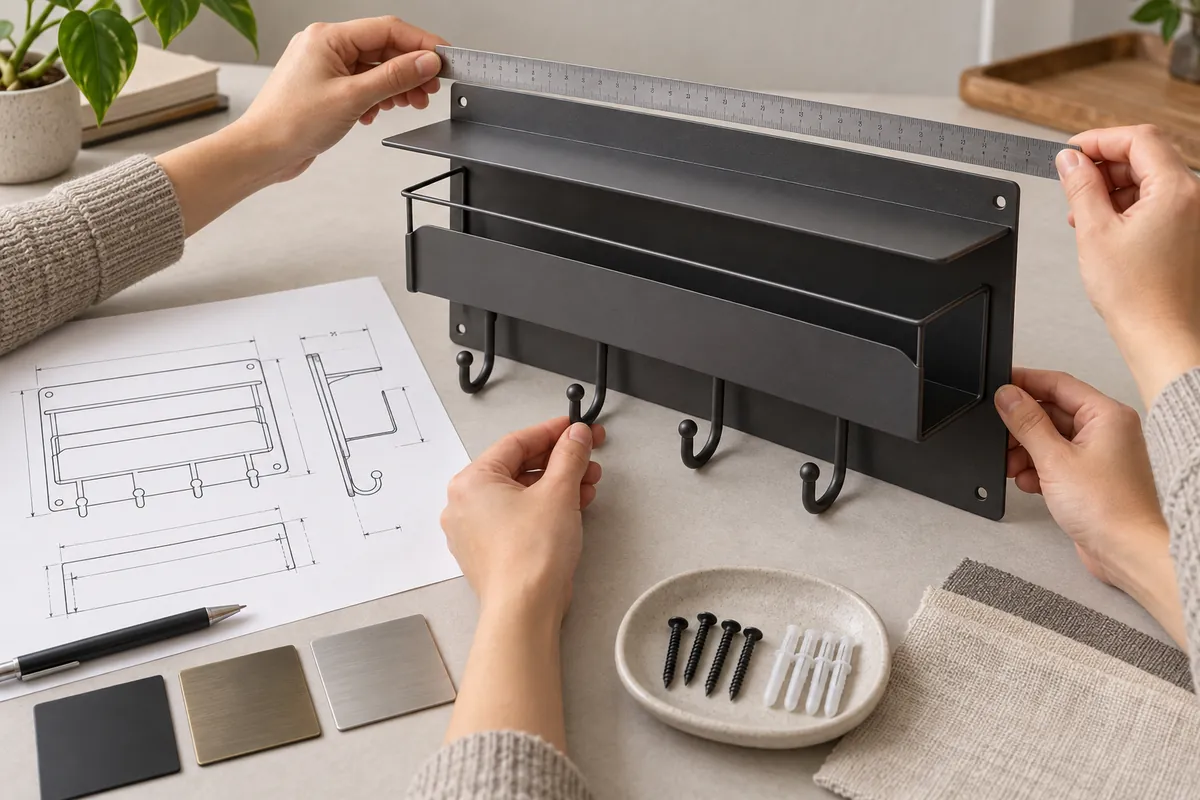
| Shelf, hooks and mail pocket | Combine a surface, hanging points and document storage | Pocket opening and depth, access direction, envelope range, body construction, material mix and assembled footprint | Which documents must fit? Does the pocket obstruct the shelf or hooks? Who supplies each material or bought-in component? |
A hook rail is often the simplest reference concept in a range because it can establish the family’s visual language and mounting interface. That does not mean it is always the lowest-cost or most suitable item; cost depends on material, geometry, finish, packaging and order assumptions. It is simply a useful baseline for comparing what additional functionality changes.
A shelf-and-hook variant deserves separate consideration when the shelf surface provides a distinct job, such as holding a small set of everyday items. The buyer should define the intended objects through representative dimensions or photographs, not an unsupported load promise. Shelf depth, front edge, side stops, attachment detail and wall projection should be reviewed against that brief. If the shelf only changes decoration without changing buyer value or product requirements, it may not justify another SKU.
A mail-pocket version changes the range more substantially. A front lip, pocket opening, side closure or mesh panel may affect the usable document space, appearance, cleanability, cost and carton protection. Decide which document types and use conditions matter before a designer adds several pockets. The precise fit of a pocket belongs in a product-level specification and sample review; it is not established by the category name.
Avoid treating all three concepts as one universal design. The functions compete for space. A deep pocket can obstruct access to a shelf. Long hooks may extend below the organizer and affect nearby furniture or door clearance. A wide rail may suit a broader wall zone but become awkward in a compact retail carton. The comparison must include the assembled envelope and the way a customer uses the unit, not only a list of features.
How Can a Buyer Decide Whether a Variation Is a New SKU?
Use a decision test with four questions. First, does the variation solve a meaningfully different customer task? Second, does it require a different fit, material, assembly or finish specification? Third, does the difference affect buying, installation, merchandising, shipping or service? Fourth, can the importer maintain the extra code and its documentation without creating avoidable complexity? If the answer is “no” to all four, the variation may belong as an option or may not belong in the initial range.
A useful range can contain several configuration families without offering every family in every width, finish and color. Avoid multiplying three architectures by several dimensions and finishes before there is evidence the buyer’s channel needs the complete matrix. Start with the smallest set that represents distinct use cases, then gather feedback from the intended retail, hospitality or e-commerce channel. This is a testable assortment hypothesis, not a claim about how the market will perform.
Separate product architecture from presentation options. Architecture affects shape, function, assembly and packaging. Presentation options might include finish color, label language or retail pack artwork. The two can interact: a finish may require a separate production lot, and a color-specific carton may create inventory exposure. But buyers should not confuse a label option with a new product function. Ask suppliers to state which options share a body, process, hardware set or packaging insert and which require separate controls.
Use a matrix to keep choices visible:
| Range field | Hook rail | Shelf plus hooks | Shelf, hooks and mail pocket |
|---|---|---|---|
| Primary customer task | Hanging | Landing surface and hanging | Mail/document storage plus surface or hanging |
| Distinguishing function | Hook arrangement | Shelf presence and useful surface | Pocket capacity and access arrangement |
| Critical envelope | Rail width and projection | Shelf depth, rail width and projection | Pocket depth/opening, shelf and total projection |
| Separate materials or parts | Identify hooks and backing parts | Identify shelf construction and attachment | Identify pocket material, body parts and responsibility |
| Finish scope | Visible faces and hook finish | Shelf, hooks and joining details | Pocket interior, edges, hooks and shelf faces |
| Retail or transport pack | Protect hook ends and mounting face | Protect shelf edges and keep parts organized | Protect pocket shape, finish and any loose parts |
| Sample approval | Layout and visual reference | Shelf access and assembly review | Document fit, access and interaction among functions |
Do not fill the matrix with invented dimensions or capacities. Mark unknowns as buyer decisions. When the importer has no named cabinet or wall system to fit, say that the unit is designed for the stated application envelope and list what still needs project verification. When exact references exist, identify model, drawing revision, sample date and owner of the approval.
What Should the RFQ and Quote Comparison Include?
An RFQ should make each supplier quote the same item. Include the intended SKU architecture, annotated drawing or reference sample, overall envelope, visible faces, material and finish assumptions, intended configuration, assembly expectations, packaging concept, target market, order quantity and any known labeling or private-label requirements. If some inputs are open, mark them as open questions instead of letting each supplier silently make a different assumption.
For every proposed SKU, ask for an itemized response to these points:
- Which components are included in the quoted product and which are supplied by the buyer or another vendor?
- Which material, thickness, wire form, finish or color assumption is used for the concept?
- Which drawing features control fit, appearance, hook position, shelf projection and mounting-hole location?
- Which changes would affect tooling, fixtures, assembly steps, finish access or pack-out?
- Which dimensions or visible features will be reviewed on the sample?
- What sample version is being quoted, and how will later revisions be identified?
- Does the retail pack ship assembled or with buyer assembly, and are screws, anchors or instructions included?
- What is the carton arrangement, and which surfaces or protrusions need protection?
- Which costs are fixed, variable, or dependent on final quantity, finish and packing assumptions?
The purpose is not to demand a supplier’s proprietary cost model. It is to make the quote’s scope and exclusions comparable. If two suppliers give different prices, first check that they are quoting the same architecture, materials, components, finish, assembly and packaging. A lower quote for a hook-only rail cannot be compared directly with a shelf-and-pocket combination.
A custom metal hardware manufacturer can review drawings or physical samples and discuss forming, bending, welding, finishing, assembly and packaging implications within confirmed capability. Koitor Hardware’s approved company facts support bathroom and home storage hardware OEM, drawing or sample review, and project-based customization. They do not establish that Koitor currently manufactures this entryway organizer, a wood or composite component, a specific mounting system, or a tested load rating. A buyer should request a product-specific capability check rather than infer one from a neighboring category.
For broader supplier context, an importer can review an OEM home storage hardware capability page and compare it with the exact drawing and sourcing scope. A service page is not a substitute for an approved sample or specification.
How Should Samples Validate the Assortment?
Sample approval should test the SKU distinction, not merely confirm that one attractive prototype exists. Give the supplier a separate sample brief for each architecture and mark the shared and unique features. If two samples share a hook rail but differ by shelf or pocket, record those shared and unique requirements so a later change is not mistaken for an unchanged product.
A practical review sequence is:
- Confirm the sample identity, drawing revision, finish reference and included parts.
- Compare the physical sample with the approved envelope and the buyer’s defined use zone.
- Place representative items on the shelf, through the pocket, or on the hooks as applicable; record fit and access observations without turning a visual review into an unverified capacity claim.
- Review edges, joints, surface finish, coating coverage, attachment details and visible alignment against the agreed reference.
- Check the intended mounting pattern on the documented sample panel or wall assembly with the responsible installation party. Do not assume one fastener suits every substrate.
- Fold, disassemble or pack the unit as intended for shipment; inspect contact points, loose components, exposed edges and the retail presentation.
- Record accepted deviations, open points, reference photos and the approval owner.
A sample that looks correct in isolation may still reveal a range problem. For example, a mail pocket can make the combined model visually heavy next to a compact hook rail; a shelf can cause a second model to project much farther from the wall; or three different mounting patterns can confuse replacement and installation instructions. These are reasons to review the family side by side, not to promise that one design change will solve every issue.

If the buyer needs detailed mail opening, hook spacing, mounting and sample checks for one item, use the existing metal mail organizer buyer guide. If the range instead relies on a wall system with interchangeable hooks or rails, the garage wall-storage compatibility matrix addresses a different interface question; entryway products should not borrow its compatibility claims unless the same interface is specified and verified.
What Manufacturing and Packaging Choices Can Change the SKU?
A shelf, pocket, hook rail and mounting plate can use different forming, joining, finishing and assembly routes. The buyer does not need to design the factory process, but the buyer should describe the intended appearance and function clearly enough for the supplier to identify process assumptions. A bend that creates a pocket lip, a welded hook, a folded shelf edge, a separate bracket or a bought-in fastener can change the drawing, finish access, assembly sequence and inspection points.
Visible faces should be identified on the drawing. Tell the supplier which surfaces face the room, which sides are hidden after mounting, and which joining areas may remain visible. Agree the appearance reference for the chosen finish, and ask how a production sample will show color, texture and edge treatment. Do not assume that the same finish will look identical across different materials or part geometries. Any target variation should be defined by the buyer and supplier using an agreed sample or controlled standard.
Packaging must match the architecture. Hooks can protrude into neighboring parts, a shelf edge can contact another product, and a pocket can deform if its unsupported shape is compressed. A buyer should identify whether the product ships assembled, flat-packed, or with loose hardware; which parts touch during transport; and how fasteners and instructions are contained. Ask for a pack sample or review photos of the actual pack-out when packaging is part of the approval. Do not claim that a stronger carton or a particular insert guarantees damage-free transit.
A shared family design can make packaging and replacement easier if the common parts remain genuinely common. It can also create confusion if different variants look alike but use different screws, wall patterns, carton labels or assembly steps. Use the SKU code and revision to connect the product, sample, packaging, label and order record. A product matrix is most useful when it controls how changes are communicated, not just how products are named.
How Can an Importer Keep the First Range Practical?
The first range should be large enough to answer distinct use cases and small enough to validate. Decide a “core” architecture first, then add another configuration only when it changes buyer value or resolves an identified gap. Define whether the extra product is a new item, a finish option, a bundled accessory or a customer-specific variant. Keep unconfirmed concepts in a development backlog instead of presenting them as launched or available products.
When comparing a proposed line, score each concept against a short buyer-oriented set of criteria: role in the assortment, user task, target wall or placement envelope, function, channel fit, manufacturing complexity, packaging risk, expected documentation and service implications. The score is a decision aid, not a market forecast. If sales data is unavailable, use research, channel feedback or a limited validation plan and label it accordingly. Do not invent demand figures or assume that search volume predicts purchases by distributors.
A useful range decision often requires saying “not yet.” A combination model might have more features but also a larger footprint and a more involved pack. A color variant can make a shelf more attractive but may add stock-keeping cost or require separate packaging. A very compact rail may suit a small wall but cannot substitute for a product with a document pocket. Write down the trade-off and the buyer segment for which the choice is intended.
For a home-storage category owner, the custom home storage hardware production page provides a relevant contact path for discussing an OEM project. Koitor is a family-owned custom metal hardware factory; a project-specific review must still confirm whether a proposed organizer construction, bought-in part and order scope fit current capability.
Buyer Checklist Before Requesting a Quotation
- Choose the initial architecture: hook rail, shelf plus hooks, or shelf, hooks and mail pocket.
- State the customer task and channel for each proposed SKU.
- Identify the functions that make one version meaningfully different from another.
- Attach a dimensioned drawing, physical reference sample or clearly scaled concept.
- Mark overall width, height, projection, visible faces, edge details and mounting pattern.
- List the representative items the shelf, hooks or pocket must accommodate.
- State whether dimensions and use assumptions are confirmed, provisional or still open.
- Separate product-body components from buyer-supplied or third-party parts.
- Identify material, finish, color and sample reference requirements without inventing test criteria.
- Specify assembled versus flat-packed presentation and retail-pack needs.
- Identify carton protection and loose-hardware control questions.
- Record target quantity, order mix, target market and sample timing assumptions.
- Ask suppliers to list assumptions, exclusions, tooling or process changes, and packaging responsibilities.
- Link the approved sample to a drawing revision and SKU code before bulk approval.
When an importer evaluates an entryway wall organizer for the first range, use this checklist to keep category-level choices aligned with the detailed drawing and approved sample. Exact dimensions, component fit and mounting checks belong to the specified product revision.
Häufig gestellte Fragen
Does every entryway wall organizer need hooks, a shelf and a mail pocket?
No. A buyer should choose functions based on the intended user task and channel. A hook rail, shelf-and-hook unit and mail-pocket design can serve different use cases. Combining every feature may increase size and complexity without adding value for every SKU.
Should every width and finish become a separate SKU?
Not automatically. Separate a variant when it changes how the product is sold, fitted, assembled, documented, packed or serviced. A finish may be an option within a controlled program, while a different architecture may warrant a separate product code. The buyer and supplier should agree how each variation is identified and controlled.
Can a product photo confirm fit or load capacity?
No. A photo can show an apparent arrangement, but it does not establish the actual dimensional envelope, wall attachment, material, process or performance. Use a drawing and sample for fit review, and define any project-specific performance requirement and appropriate evidence separately.
Does Koitor currently manufacture this entryway organizer?
That capability is not confirmed by the available approved company facts. Koitor supports bathroom and home storage hardware OEM, drawing and sample review, and related metal-manufacturing discussions. Share the proposed construction and product scope for a capability check rather than assuming that a nearby category proves current production.
What should an importer compare when two supplier quotes differ?
Compare quoted architecture, materials, included components, finish, assembly, sample scope, packaging, quantity basis, exclusions and timing assumptions. A quote for a hook rail is not equivalent to a quote for a shelf-and-pocket combination, even if both are called wall organizers.
Arbeiten Sie mit Koitor Hardware zusammen
Plan a Custom Home-Storage Hardware SKU
Share your organizer concept, target assortment, drawing or sample, finish preference, mounting assumptions, packaging needs and trial quantity. Koitor can review whether the proposed metal-hardware scope fits its confirmed OEM capabilities.
OEM / EIGENE MARKE
Verwandeln Sie diesen Beschaffungsleitfaden in ein Produktdossier
Teilen Sie uns Ihr Zielprodukt, die Größe, die Oberflächenausführung, die Bestellmenge und Ihre Verpackungsanforderungen mit. Ihr Team erhält vor der Angebotserstellung eine praxisorientierte Prüfung der Herstellbarkeit.


 English
 Español
 Português
 Français
 Deutsch
 العربية