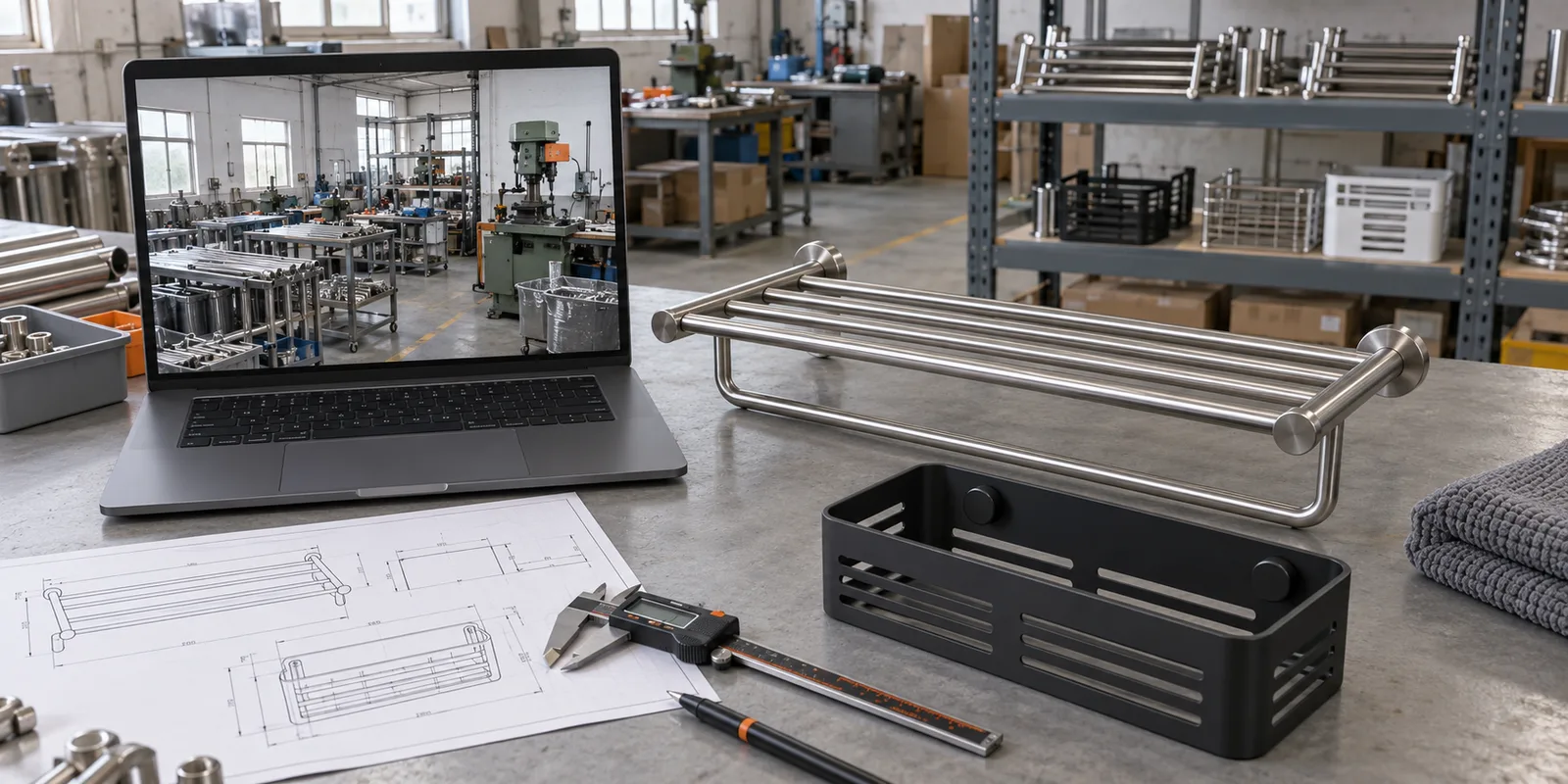
To understand how to audit bathroom hardware supplier capabilities without visiting China, buyers should verify the company identity, inspect production processes by live video, compare technical answers with physical samples, and place a controlled trial order before making a larger commitment. A remote audit is not one document or one video call. It is a structured collection of evidence showing that the supplier can interpret specifications, manufacture the required metal hardware, control visible quality, pack it correctly, and communicate when a problem appears.
What can a remote bathroom hardware supplier audit actually prove?
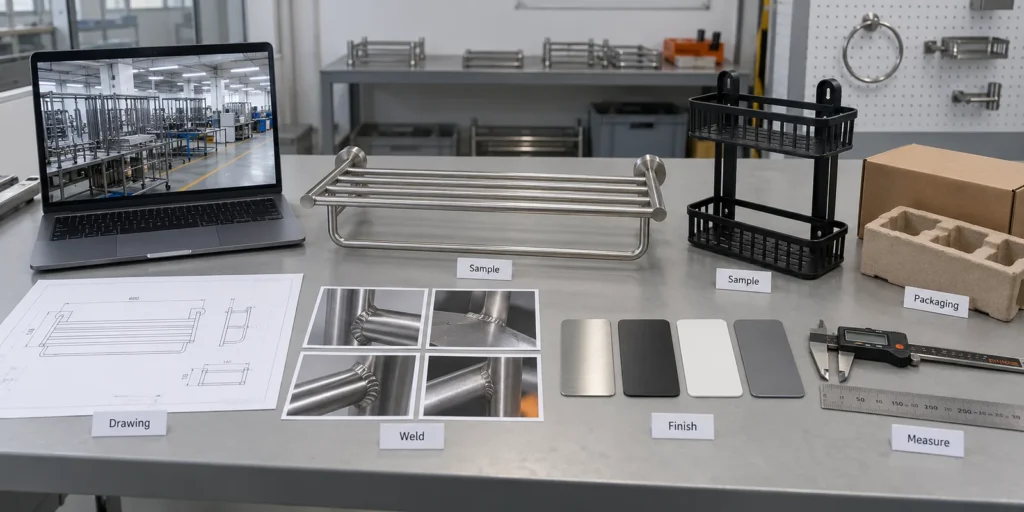
A remote supplier audit can provide useful evidence about identity, production fit, process discipline, communication and order control, but it cannot prove every claim or remove every sourcing risk. Buyers should define the audit as a decision process rather than a pass-or-fail certificate.
The first objective is identity verification. Confirm the legal company name used for quotations, invoices and payments. Compare the business address, website, email domain, bank beneficiary and contact details. Differences do not always indicate a problem, because export, accounting or group-company arrangements may exist, but every difference requires a clear explanation before payment.
The second objective is capability fit. A bathroom hardware factory may be experienced with towel racks, shower caddies, wire baskets or tissue holders, yet be unsuitable for a product requiring a different material, joint method or finish. Ask the supplier to show processes relevant to the proposed item rather than a general factory presentation.
The third objective is operating discipline. A buyer wants to see how drawings are controlled, how samples are identified, how approved finishes are referenced, how nonconforming parts are separated and how packing requirements reach the production team. Simple, consistently followed controls can be more informative than an elaborate presentation.
A remote review cannot independently validate certifications, laboratory results, capacity figures or customer claims unless those items are checked through appropriate evidence. It also cannot replace project-specific testing when load, corrosion, installation or regulatory requirements matter. Treat the audit as one layer alongside samples, inspection and commercial due diligence.
Which supplier identity and business details should buyers verify first?
Buyers should verify who will contract, manufacture, receive payment and manage quality before discussing price in detail. This prevents confusion later when the name on a quotation does not match the bank account or production location.
- Legal identity: request the registered company name, address and business registration information that can be checked through an appropriate source.
- Commercial identity: confirm the company name on the quotation, pro forma invoice and final invoice.
- Payment identity: confirm the bank beneficiary through a known contact, especially after any emailed request to change payment details.
- Production role: ask which operations are performed at the production facility and which are outsourced.
- Responsible contacts: identify who owns quotation, engineering questions, production follow-up and quality issues.
- Export process: clarify which entity appears on export documents and who handles shipment coordination.
Outsourcing is not automatically a negative sign. Surface finishing, special tooling or packaging may involve external partners. The important questions are whether the supplier discloses the arrangement, defines requirements, checks incoming or returned work, and remains accountable for the finished product.
Buyers should also evaluate communication security. Confirm important changes through more than one channel and keep an approved contact list. A believable email that changes a bank account deserves independent confirmation. This control belongs in any supplier verification China workflow because payment fraud can occur even when the real supplier is legitimate.
For general company and manufacturing context, buyers can review Koitor Hardware as a Hersteller von maßgefertigten Badbeschlägen before preparing technical questions for a remote review.
How should buyers run a useful live video factory review?
A useful live video review should follow a buyer-prepared route and show current operations, identifiable locations and relevant processes in real time. A polished prerecorded tour may provide background, but it should not be the only visual evidence.
Send the route in advance so the supplier can protect confidential customer information and follow safety rules. Ask to begin outside or at a neutral identifying area, then move through material storage, forming, welding, grinding or polishing, finishing coordination, assembly, inspection, packing and finished-goods storage as relevant.
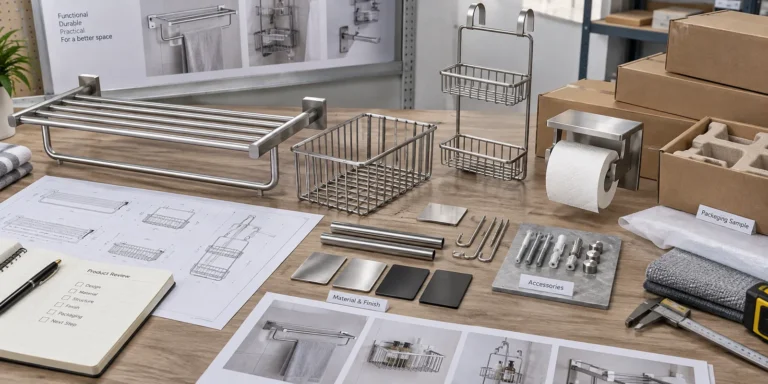
Request close views of product details rather than only wide views of equipment. For a towel rack, examine tube joints, bracket fit, visible weld transitions, screw access and assembled alignment. For a wire shower caddy, examine wire spacing, weld intersections, edge condition, drainage geometry and coating coverage around corners. For a tissue holder, examine spindle movement, mounting plate fit and packaging protection.
Use open questions during the call. Ask the guide to explain what a station is doing, how the job is identified, which drawing revision is being used and what happens when a part does not match. Consistent answers from sales and production personnel are useful evidence that information moves through the organization.
Do not ask workers to interrupt unsafe operations or reveal another customer’s drawings, packaging or brand. Respect for confidentiality is itself a supplier signal. A factory should be able to demonstrate general process control without exposing protected information.
Record observations in a hardware supplier checklist during the call. Note what was clearly seen, what was explained but not demonstrated, and what requires later evidence. The goal is not to collect hours of video; it is to close defined questions.
What evidence should support a factory audit for bathroom accessories?
Evidence should connect the supplier’s claimed process to the buyer’s actual product requirements. A compact evidence pack with traceable drawings, samples and inspection records is more useful than a large folder of unrelated promotional material.
| Audit Area | Useful Remote Evidence | What the Buyer Should Compare | Limitation |
|---|---|---|---|
| Company identity | Registration details, quotation and bank information | Names, addresses and contracting entity | Documents should be checked through suitable independent sources |
| Technical review | Marked drawing, specification sheet and question log | Revision, dimensions, materials, finish and tolerances | A document does not prove production capability by itself |
| Fertigung | Live video of relevant forming, welding and assembly steps | Process shown versus product structure | One call is only a time-limited observation |
| Quality control | Inspection checklist, measuring tools and sample labels | Checks performed versus agreed critical features | Project-specific testing may still be required |
| Surface finish | Approved color or texture reference and finished samples | Appearance under consistent lighting | Screen color is not a reliable master standard |
| Packaging | Packing specification, carton arrangement and packed sample | Protection, parts count, labels and assembly hardware | Transport performance requires appropriate validation |
| Order control | Schedule, milestone updates and issue records | Planned dates versus actual communication | Past examples may not predict every future order |
For drawings, require a visible revision or date. The supplier should confirm which dimensions are critical, which tolerances are realistic and which details remain open. A marked-up drawing showing questions and agreed changes demonstrates more technical engagement than a quick “no problem” response.
For inspection, ask for the proposed checklist before production. It should identify product-specific checks such as overall dimensions, hole spacing, assembly fit, rack stability, visible weld condition, sharp edges, finish appearance, component count and carton labels. Acceptance rules should be agreed for the project; generic inspection photos are not enough.
For packaging, request photographs or video of the complete set: product protection, hardware bag, instructions, inner box or divider, master carton and shipping marks. Buyers developing retail programs may also review Badezimmer-Accessoires unter Eigenmarke requirements when preparing the evidence list.
How do samples reveal more than a remote presentation?
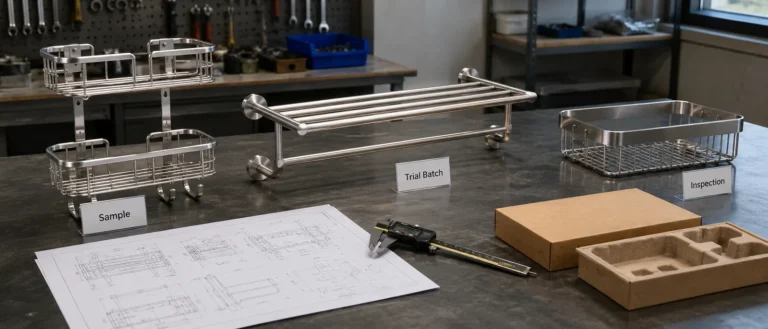
A physical sample reveals whether the supplier can translate discussions into a repeatable product. Buyers should evaluate the sample against a written specification and return a structured approval record instead of relying on general appearance.
Begin with identity and revision. Label the sample with the supplier, product code, drawing revision, sample date, material and finish reference. Without this information, an approved sample can become ambiguous when bulk production starts.
Check dimensions that affect installation, assembly and customer use. These may include mounting-hole spacing, overall width, basket depth, distance from the wall, tube alignment, hook clearance and screw engagement. Use suitable measuring equipment and record results rather than writing “size okay.”
Inspect workmanship in good light and from normal viewing angles. Look for sharp edges, uneven gaps, visible joint inconsistency, rocking, bent wires, trapped polishing marks, coating defects and scratches. Hidden surfaces still matter when they affect corrosion risk, assembly or safe handling.
Assemble the sample using only the supplied components and instructions. A product that requires factory knowledge to assemble may create returns at retail. Count screws, anchors, caps and tools; review whether the hardware bag is labeled and secured so it cannot damage the product.
Use the sample review to test communication. Send numbered photographs and a table containing the issue, required change, responsible party and next revision. Ask the supplier to return an updated drawing or action list. The quality of this correction cycle helps predict how bulk-production issues will be handled.
Koitor Hardware can review bathroom and home storage hardware from buyer drawings or physical samples. Depending on product structure, material, finish and packaging, samples usually take about 5-7 working days after details are confirmed. That timing is a planning reference rather than a guarantee.
Why is a controlled trial order part of supplier verification?
A controlled trial order tests the complete supplier workflow under commercial conditions: order confirmation, material preparation, production communication, inspection, packaging, documentation and shipment coordination. It is often more informative than negotiating a large first order based only on a good sample.
Keep the first order commercially meaningful but limited enough to manage risk. Koitor’s MOQ can start from 100 pieces depending on the product structure, material, finish and packaging, which may suit certain trial programs. Buyers should request a project-specific quotation rather than assume one MOQ applies to every design.
Define milestones before paying the deposit. Typical points include final drawing approval, finish reference approval, packaging artwork approval, pre-production sample confirmation, production update, inspection and shipment authorization. Assign a named owner on both sides.
Do not relax the specification because the quantity is small. A trial order should use the same controlled drawing, bill of materials, finish reference and packing instruction intended for later orders. Otherwise, the buyer learns little about repeatability.
Track supplier behavior as carefully as product quality. Did the supplier identify unclear details before production? Were delays communicated early? Were photos tied to the correct order? Did the team propose practical corrective action? A supplier that reports a manageable problem clearly may be lower risk than one that always says everything is perfect.
Bulk production for custom metal hardware usually takes around 4-6 weeks depending on quantity, complexity, material availability, finish and packaging. During a trial, compare the confirmed schedule with actual milestones and document the causes of any change.
Which warning signs require more investigation before an order?
Warning signs are inconsistencies that remain unexplained, resistance to relevant evidence, vague technical answers and pressure to commit before specifications are clear. One issue may have an innocent explanation, but repeated inconsistencies justify deeper checks or a smaller commitment.
- The quotation company, invoice company and bank beneficiary differ without a documented explanation.
- The supplier will only provide edited videos and repeatedly avoids a reasonable live review.
- Technical answers change between messages or do not match the drawing.
- The supplier agrees to every material, tolerance, finish, price and lead time without asking product-specific questions.
- A sample arrives without a revision, material identification or finish reference.
- Packaging is discussed only after production even though retail presentation or transport protection is important.
- Requested inspection records contain unrelated products or cannot be connected to the order.
- A bank account change arrives unexpectedly and the contact discourages independent confirmation.
A low quotation is not itself a warning sign, but a large unexplained price difference should trigger a scope comparison. Confirm material grade or type, dimensions, wire or tube size, finish, accessories, packaging, inspection scope, tooling and commercial terms. Two quotations may describe different products even when the product name is identical.
Likewise, a factory does not need every process in-house to be suitable. What matters is transparent responsibility and control. Ask how outsourced finishing or special components are approved, identified and checked before final packing.
What should be included in a remote hardware supplier checklist?
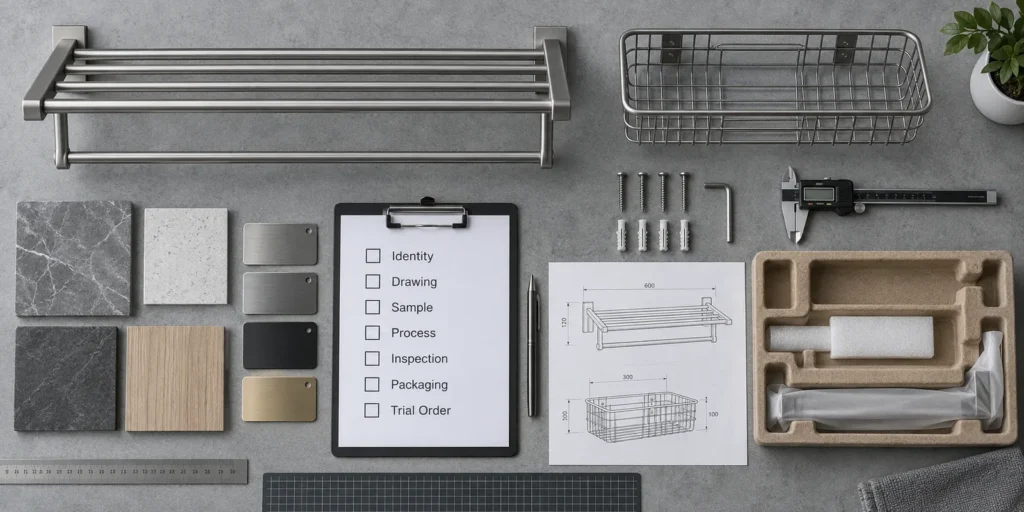
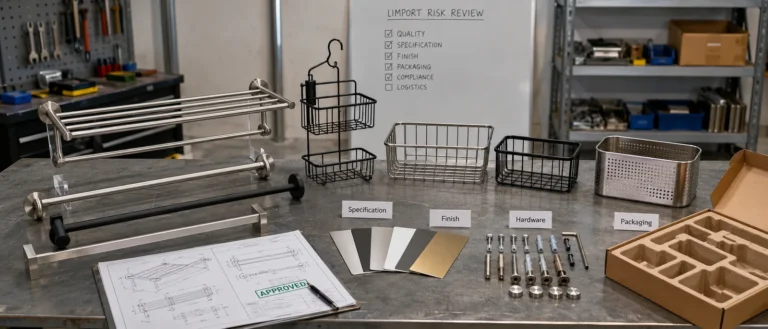
A remote audit checklist should convert buyer expectations into evidence requests, responsible owners and decision points. Use the same checklist for shortlisted suppliers so comparisons remain consistent.
- Legal company name, registered address and contracting entity confirmed.
- Bank beneficiary and payment-change verification procedure confirmed.
- Production location and in-house versus outsourced processes explained.
- Named contacts for commercial, technical, production and quality questions.
- Live video route completed for product-relevant processes.
- Current drawing revision and open technical questions documented.
- Material, dimensions, joint method and surface finish specified.
- Approved sample labeled and reviewed against written criteria.
- Product-specific inspection checklist agreed before production.
- Packaging structure, hardware bag, instructions and labels reviewed.
- MOQ, tooling, sample cost, lead-time assumptions and payment terms compared.
- Trial-order milestones and update frequency agreed.
- Corrective-action and change-approval process understood.
- Independent inspection or testing arranged where project risk requires it.
Keep the final decision record short. Summarize verified facts, open risks, conditions before purchase and the maximum initial exposure the buyer accepts. Additional sourcing guidance is available through bathroom hardware sourcing resources.
Frequently asked questions about remote supplier audits
Can a video call replace an on-site factory audit?
No. A video call is a useful evidence source but has a limited field of view and duration. Use it with company verification, controlled samples, written specifications, trial orders and independent inspection or testing when the project’s risk justifies those steps.
What should I ask a bathroom hardware supplier to show live?
Ask to see product-relevant material storage, forming, welding, surface preparation, assembly, inspection, packing and order identification. Focus on details that affect your towel rack, shower caddy, wire basket or tissue holder rather than requesting a generic tour.
How can I tell whether the supplier understands my drawing?
Ask the supplier to mark critical dimensions, identify unclear details, explain the proposed manufacturing route and return a revision-controlled question list. Technical questions and practical alternatives usually reveal more understanding than a simple confirmation.
Should I request certificates during supplier verification?
Request only documents relevant to your legal, market or customer requirements, then verify them through appropriate sources. Do not treat an emailed image as conclusive evidence, and do not assume a general company document proves that a particular product meets a specific requirement.
How large should the first trial order be?
The quantity should be large enough to test the production and packing workflow but limited enough to control commercial risk. MOQ can start from 100 pieces for some Koitor projects, depending on structure, material, finish and packaging.
How does Koitor Hardware support a remote evaluation?
Koitor Hardware is a family-owned custom metal hardware factory specializing in bathroom and home storage hardware. The team can discuss drawings or physical samples, relevant production steps, sample development, inspection points, packaging and small-batch OEM options through direct factory communication. Buyers can send a drawing or sample to Koitor to begin a project-specific review.
Arbeiten Sie mit Koitor Hardware zusammen
Need Evidence for a Bathroom Hardware Supplier Review?
Send Koitor your drawing, sample, target material, finish, packaging idea and expected order quantity. Our team can clarify the proposed manufacturing steps, sample plan and inspection points before quotation so your remote review is based on the actual product.
OEM / EIGENE MARKE
Verwandeln Sie diesen Beschaffungsleitfaden in ein Produktdossier
Teilen Sie uns Ihr Zielprodukt, die Größe, die Oberflächenausführung, die Bestellmenge und Ihre Verpackungsanforderungen mit. Ihr Team erhält vor der Angebotserstellung eine praxisorientierte Prüfung der Herstellbarkeit.
 English
  Español
  Português
  Français
  Deutsch
  العربية