
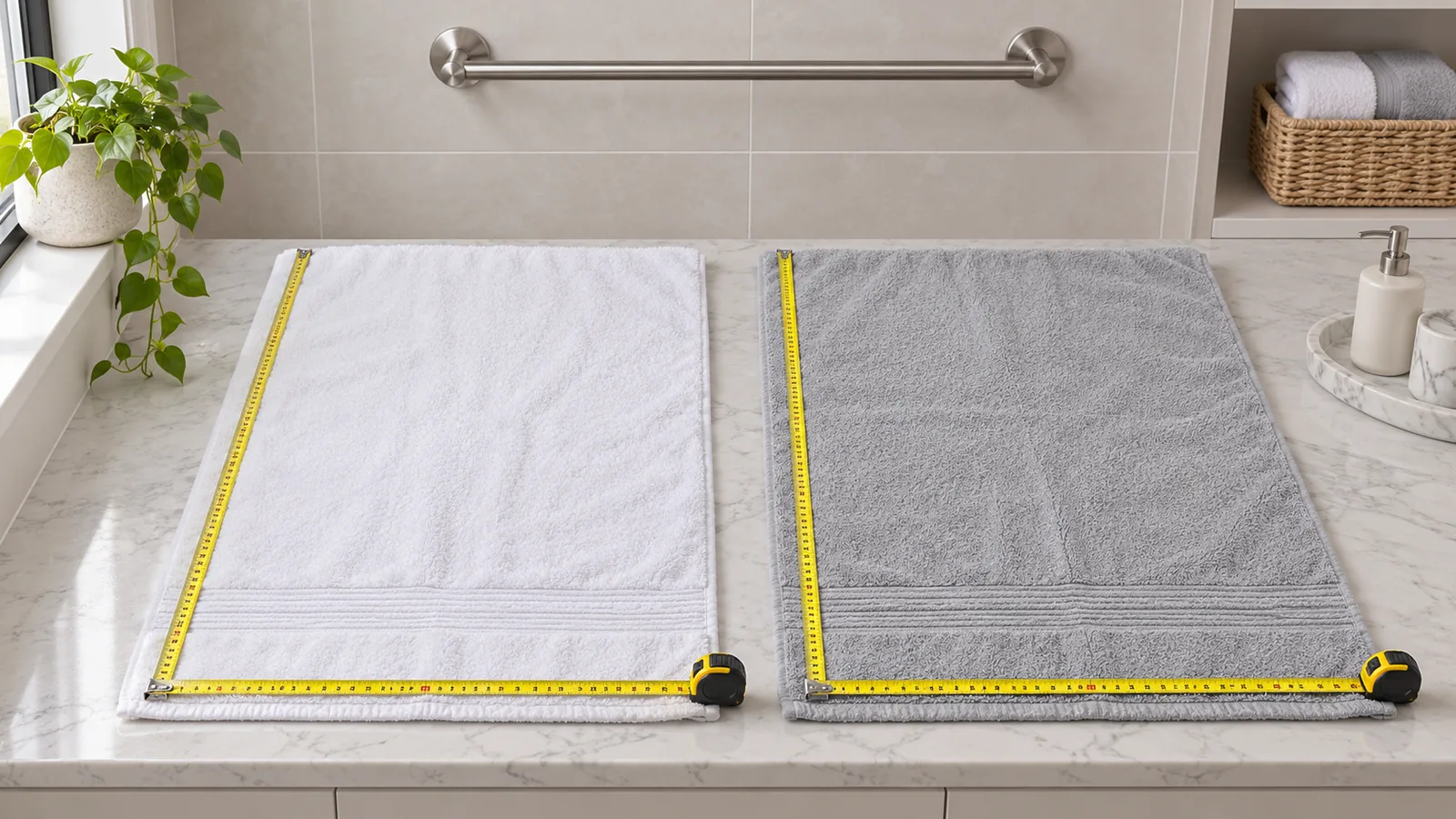
Bath towel sizes are best compared as panel width and length, not as a promise of how a towel will fit on a bar or in a cabinet. Product names such as bath towel, bath sheet, hand towel, and washcloth are useful shopping labels, but exact dimensions vary by supplier. Check the listed measurements and test the actual item in the intended folded, rolled, hanging, or stored condition.
Bath towel sizes: what panel labels tell you
A towel is a flexible textile panel. Its stated dimensions describe the panel before it is folded, rolled, draped, or compressed. Those dimensions do not tell you its finished folded width, thickness, roll diameter, hanging drop, or how much room it occupies in a particular cabinet. These depend on the towel’s construction, how it is folded, and how it is arranged.
Names commonly suggest intended use: bath towels for drying after a bath or shower, larger bath sheets for greater coverage, hand towels for hand drying, and washcloths for smaller tasks. But these names are not a substitute for a measured specification. Retailers and brands can use different dimensions for similarly named products, so compare the actual width and length shown on the label or product page.
Otelia’s catalog, for example, lists a 27-by-54-inch bath towel and a 16-by-27-inch hand towel. These are that supplier’s stated dimensions, not mandatory industry sizes. Converting 27 by 54 inches gives 68.58 by 137.16 centimeters before rounding. If a buyer rounds to whole centimeters, the converted panel is about 69 by 137 centimeters. The original units and the rounding should remain visible so the conversion is reproducible.
A dimension label also does not determine absorbency, drying time, weight, softness, or hotel suitability. Those are separate product characteristics that depend on material, construction, finishing, and the supplier’s own specifications. Avoid inferring them from a larger footprint alone.
Panel size versus usable fit
A towel may fit a storage space in one state but not another. An unfolded panel, a towel folded in half, a towel folded into thirds, and a tightly rolled towel occupy different space. A product page that gives only width and length does not specify which folding method the buyer will use.
Suppose a 27-inch-wide towel is folded once lengthwise. Its nominal folded width is about 13.5 inches before accounting for fabric thickness, hems, drape, or irregular folding. This is a simple geometric example, not proof that it will fit a particular towel bar or shelf. If a towel is folded into thirds, its nominal width becomes about 9 inches, again before thickness and folding variation. A buyer should test the actual towel and actual storage method.
| Measurement or state | What it describes | What it does not describe |
|---|---|---|
| Panel width | One dimension of the unfolded towel | Finished folded width or hanging clearance |
| Panel length | The other unfolded dimension | Hanging drop after a particular fold |
| Folded width | Width after a defined folding method | Thickness or how neatly the towel stays folded |
| Rolled diameter | Approximate outer size when rolled | Exact fit unless the roll and opening are tested |
| Hanging condition | The towel draped over a bar or rail | Required clear span without checking fold and drape |
| Storage depth | Space needed for the actual folded or rolled item | A universal value implied by the product name |
The table is a measurement guide. It does not create a universal tolerance or promise that a textile will retain a precise folded shape. For a product assortment or storage design, the buyer needs the actual panel dimensions and a test using a representative towel.
Compare named supplier examples carefully
Named catalog examples are more useful than pretending there is one required size for each towel name. A comparison record should include the supplier, product name, stated units, panel width, panel length, and any size variation offered. If the listing has multiple sizes or a range, preserve the exact option chosen.
For example, when a catalog lists a 27-by-54-inch bath towel, record it as 27 inches wide by 54 inches long according to that supplier’s listing. Do not silently switch the order of dimensions or describe the value as a universal bath towel standard. If another supplier lists a different dimension, show both entries under their supplier names rather than averaging them into an invented norm.
Conversions should keep enough precision for their use. One inch equals 2.54 centimeters, so 27 inches converts to 68.58 centimeters and 54 inches to 137.16 centimeters. Rounding to 69 by 137 centimeters may be practical for a product overview, but the exact converted values can be retained in a specification file. Do not mix rounded metric values with precise imperial values in a way that suggests greater accuracy than the source provides.
The same practice applies to “bath sheet” and “oversized towel.” These labels may describe larger options, but the buyer should read the individual dimensions. A label that implies a larger panel does not tell you whether the extra length or width suits the intended shelf, bar, or user. Compare the axis that matters: width if the towel must span a rail, length if the drop matters, or both if it must fit folded in a cabinet.
Measure for a towel bar
A towel bar’s clear span and a towel’s panel width are different quantities. When a towel is draped over a bar, it may fold across itself, so the relevant dimension can be the towel’s width and the number of folds used. The bar’s usable span is the open distance available between obstructions or supports, not necessarily its nominal overall length.
First determine how the towel will hang. A towel folded once over the bar creates a hanging loop with two layers. A towel folded lengthwise before hanging may occupy a narrower span but create more layers. The actual arrangement depends on the product and user preference. Measure the physical towel after the intended fold rather than estimating from its product name.
Also consider adjacent obstacles: a wall, shower enclosure, cabinet door, countertop, hook, or neighboring towel may restrict how the textile hangs. The product’s panel length can affect the drop and whether the lower edge interferes with nearby fixtures. A paper dimension alone does not reveal these interactions. Use a representative towel in the intended room or mock up the arrangement with the actual dimensions.
For a related product-sourcing path, see Koitor’s custom bathroom towel rack manufacturer information. It focuses on the bar’s span and room fit. This article focuses on towel panel dimensions and how folding changes the textile footprint. Neither a towel label nor a bar’s advertised overall length should replace checking the exact usable arrangement.
Measure for folded or rolled storage
A cabinet shelf or organizer needs the dimensions of the towel in its storage state. A folded towel can be measured by its finished width, length, and stack height. A rolled towel can be checked by its outer diameter and length. The panel size is the starting point, but folds, hems, fabric thickness, and compression change the occupied space.
For a consistent storage test, use the same folding sequence and the actual towel assortment that will be stored. Lay the folded towel on a flat surface, measure the footprint, and record how many layers are stacked. For rolled storage, roll the towel in the way a user is likely to do it, then measure the outer diameter at more than one point if the roll is uneven. Record whether the roll is loose or compressed; do not assume the user will reproduce a tight factory-style roll.
The existing guide to rolled-towel storage and roll diameter covers how the stored roll relates to an organizer. For a rack with several arms, see the buyer-focused guide to multi-arm swivel towel rack specifications. These are distinct from textile size labels: one concerns the towel’s panel and fold, while the others concern storage hardware and configuration.
If an organizer is being developed for hospitality, poolside, or other commercial use, the intended towel set should be specified. A buyer can provide a representative textile or its dimension sheet to the hardware supplier. Do not claim the organizer accommodates “all bath towels” unless the assortment range and storage arrangement have actually been evaluated.
A simple dimensional example
Consider a hypothetical towel panel that is 27 inches wide and 54 inches long. If folded in half across its width before draping, the nominal width per side is 13.5 inches. If folded into thirds, the nominal width is 9 inches. If instead the towel is folded lengthwise, its width becomes approximately 13.5 inches while its length remains close to 54 inches until another fold is made. These calculations describe geometry only.
If the towel is folded in half along its length for a shelf, its nominal panel footprint could be roughly 27 by 27 inches before taking hems, thickness, and folding tolerances into account. Folded into thirds along the length, the nominal footprint might be about 27 by 18 inches. The actual result depends on the fold direction and how neatly the material is arranged. These hypothetical calculations do not prescribe a storage standard.
This example illustrates why width and length must stay attached to the calculation. A 27-by-54 panel can become a 13.5-by-54 drape, a 27-by-27 square fold, or another footprint depending on the fold. A person choosing a towel bar, shelf, or roll organizer should identify the intended use and test that arrangement rather than assume the original panel dimensions equal the storage footprint.
Build a useful buyer specification
For assortment planning or hardware development, record the textile dimension in a form another person can reproduce:
- Supplier and product reference
- Towel type or catalog name as supplied
- Panel width and length, with units
- Whether measurements are nominal or include a stated tolerance
- Intended fold, roll, or hanging method
- Finished folded footprint or roll diameter if measured
- Sample or revision used for a fit check
- The hardware’s usable opening or clear span being evaluated
- Any obstruction or spacing condition that affects the arrangement
A buyer does not need to over-engineer an ordinary household choice, but a distributor or product manager benefits from the extra context when selecting an accessory or planning a set. If the towel dimensions vary across sizes, record the actual range and decide which option the hardware should accommodate. Avoid converting a single sample into a claim about every item in a textile category.
When a supplier provides dimensions without defining the measurement orientation, ask which edge is width and which is length. If a catalog uses “length” for the longer edge and another uses “width,” preserve each source’s wording and add a diagram or explicit orientation. This prevents confusion when the same numbers are reused in a packaging, storage, or product-fit document.
Häufig gestellte Fragen
Are bath towel sizes standard?
Product names and dimensions vary by supplier. Compare the exact panel width and length on the label or catalog rather than assuming that every bath towel or bath sheet has one fixed size.
What is the difference between a bath towel and a bath sheet?
A bath sheet is commonly positioned as a larger towel option, but the exact difference depends on the supplier’s assortment. Check the stated dimensions of the specific products being compared.
How do I know whether a towel fits a towel bar?
Check the usable bar span and the towel’s actual folded hanging width. Drape the representative towel using the intended fold and confirm that nearby walls or fixtures do not interfere.
Does towel panel width equal its folded storage width?
No. Folding changes the footprint. State the fold and measure the resulting width; fabric thickness and how tightly it is folded also affect the occupied space.
Can a towel’s size tell me its absorbency?
No. Panel dimensions do not establish absorbency, drying time, fabric weight, or performance. Those are separate product properties that need their own product information.
What should I send a hardware supplier when planning towel storage?
Share the towel’s exact dimensions, a representative sample if possible, the intended fold or roll, and the organizer or bar requirements. A product name alone may not define the fit.
Fazit
Bath towel sizes should be read as dimensions of a flexible panel, then translated into the fold, drape, or roll that the buyer actually needs. Catalog names help organize choices, but the measured width and length determine the starting point. Check a real towel against the intended bar or storage hardware, and keep textile dimensions separate from the hardware’s clear span or opening. For a custom metal bathroom or home-storage hardware project, Koitor’s OEM manufacturer information und Kontaktseite are available to discuss drawings, samples, and scope; this does not imply textile manufacturing.
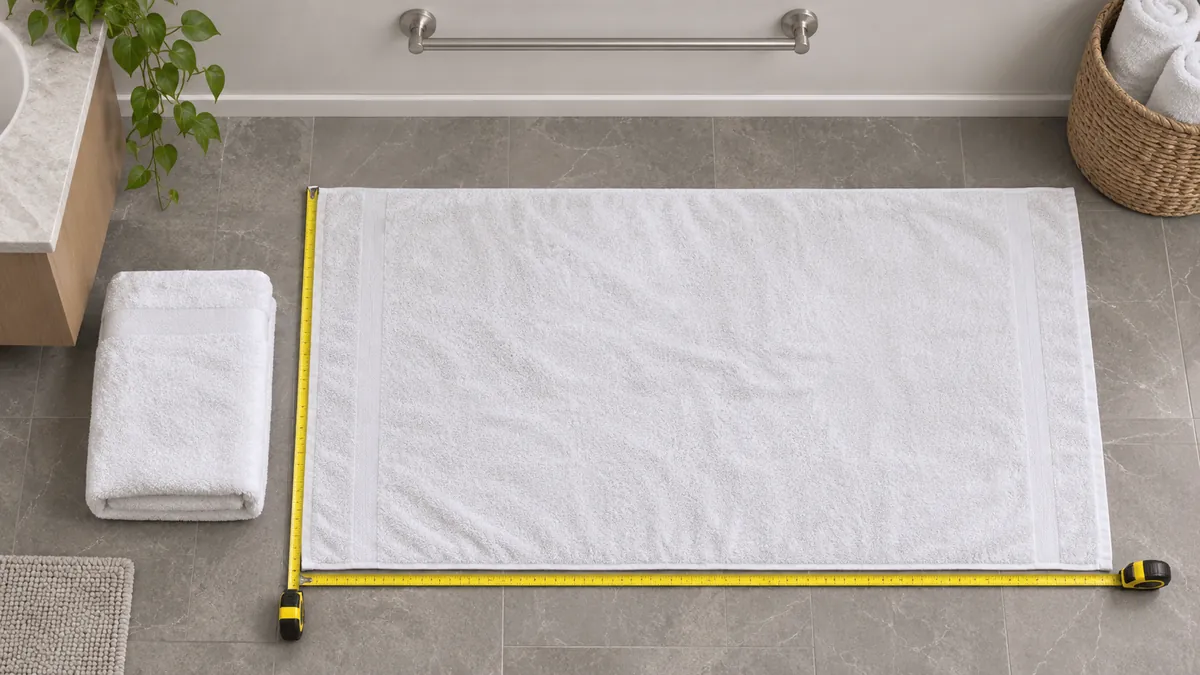

Plan around the user’s actual arrangement
A dimension check becomes more useful when it models the way someone will use the towel. In a shared bathroom, a buyer may need towels to hang separately without overlapping. In a compact guest room, the priority may be a folded stack that fits a shelf. In a poolside setting, quick retrieval and clear separation between clean and used textiles may matter more than the folded footprint. These are different arrangement questions, and none is answered by the label “bath towel” alone.
For a bar, note whether the towel is draped over the rail, folded over it, or attached at another point. Measure the actual clear span between supports or adjacent obstructions. Then place the textile in the intended orientation and observe whether it bunches, overlaps a neighboring item, or hangs into an area that should remain clear. If the lower edge could contact a countertop, floor, or water source, include that in the fit check. This is a practical layout check, not a performance or hygiene claim.
For shelf storage, define a folding pattern before comparing dimensions. One person may fold a towel into quarters while another folds it into thirds. A product designed around a very compact sample fold may frustrate users if it requires unusually careful arrangement. Use a representative sample and a repeatable fold sequence, then measure the resulting footprint. Record the stack height separately if multiple pieces are stored together.
For roll storage, measure the roll in the way the user is likely to form it. A tightly compressed sample may appear smaller than a loosely rolled towel in normal use. If a rack opening is circular or bounded by arms, check both the maximum diameter and how the roll enters and exits. A static fit can still be inconvenient if retrieval requires force or if adjacent rolls shift. These are use observations to test with the actual assembly, not values inferred from a textile label.
Comparing towel options across an assortment
A distributor may carry several panel sizes under similar names. Build a small comparison matrix with one row per actual catalog item rather than combining products into a generic “standard” row. Include the supplier’s label, stated measurements, units, and intended use wording. If the dimensions are described as approximate or subject to variation, preserve that note. A buyer can then identify which textile is the reference for a towel bar, rack, or storage product.
When converting to metric, keep source values and converted values side by side. A 27-by-54-inch panel converts to approximately 68.58 by 137.16 centimeters. If a storefront rounds this to 69 by 137 centimeters, label the values as rounded. Do not reverse the width and length just because another catalog lists the longer edge first. A clear specification can say “panel width × panel length” and show a simple orientation sketch.
If two catalog products differ only slightly in panel dimensions, do not assume the larger one necessarily requires different hardware. Test both in the intended arrangement and note whether the difference changes clear span, drop, fold, or storage depth. Conversely, a small change can matter in a tight cabinet or between closely spaced supports. The correct conclusion depends on the geometry and use case, not the product label alone.
Where towel dimensions are unknown, do not fabricate a typical value. Ask the textile supplier for the chosen SKU’s dimensional sheet or measure a sample. If only a range is available, state the range and test a representative large option when planning capacity. This is especially useful when an assortment includes several suppliers, because suppliers may use different labels and dimension conventions.
A fit-check worksheet for buyers
A concise worksheet can make the review repeatable:
- Write down the exact towel SKU and supplier.
- Record the panel width and length with units and source.
- Identify the intended fold, drape, or roll.
- Measure the textile after that arrangement.
- Record the bar’s usable span, shelf opening, or organizer space.
- Test the actual sample, including adjacent items or obstructions.
- Note what does not fit and which dimension caused the conflict.
- Preserve the result with the product and hardware revisions reviewed.
The worksheet should not claim that one test covers every towel unless the assortment and tolerances are defined. If a buyer checks only one sample, say so. If the hardware is adjustable, record the position tested. If the textile is compressed, folded tightly, or rolled differently from normal user behavior, include that caveat. Honest scope makes the conclusion useful to a product manager who must decide whether more testing is needed.
A report can also distinguish three findings: dimension match (the measured textile can be placed in the specified space), use fit (the arrangement can be performed conveniently in the intended location), and portfolio coverage (the fit applies to the listed towel range). These are related but not equivalent. A single bath towel may pass a dimension check without establishing that a mixed assortment or every user arrangement will fit.
Avoid turning examples into standards
The catalog dimensions in this guide are there to show how a buyer can read and convert a real listing. They should not be copied into a product requirement without confirming the actual SKU. If a supplier changes the towel construction or assortment, request the current size and sample again. A buyer can use the same measurement language across vendors while still preserving each vendor’s own values.
A useful comparison statement might say: “Supplier A lists this panel as 27 by 54 inches; the metric conversion is approximately 68.6 by 137.2 centimeters; fit was checked with the towel folded once over the named bar.” That statement is more informative than “standard bath towel fits,” because it records the source, units, fold, and hardware actually assessed.
Source note
The named towel-dimension examples are from Otelia’s guide to towel types and sizes. Dimensions vary by supplier; the cited catalog is an example, not a universal standard.
Discuss a related hardware project with Koitor
Share the relevant drawing or sample, product revision, finish, order quantity, and packaging scope to clarify the manufacturing discussion. Topic-specific accounting, care, textile, or coating decisions remain with the appropriate buyer and technical owners.
OEM / EIGENE MARKE
Verwandeln Sie diesen Beschaffungsleitfaden in ein Produktdossier
Teilen Sie uns Ihr Zielprodukt, die Größe, die Oberflächenausführung, die Bestellmenge und Ihre Verpackungsanforderungen mit. Ihr Team erhält vor der Angebotserstellung eine praxisorientierte Prüfung der Herstellbarkeit.

 English
 Español
 Português
 Français
 Deutsch
 العربية