
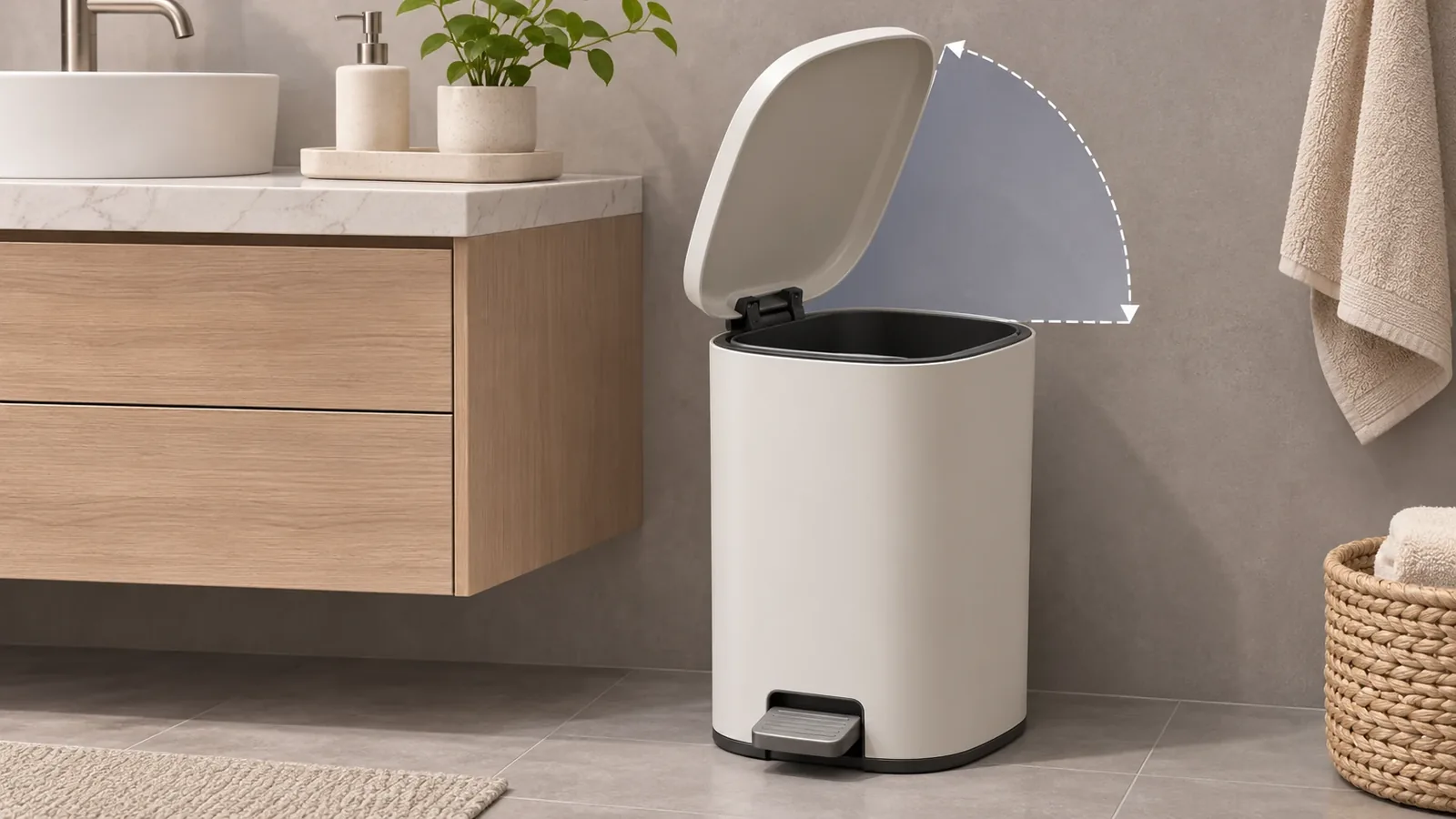
Short answer: A slim bathroom bin must fit when closed and while opening before a buyer approves a placement claim. Record the bin’s rear clearance while closed, the lid’s path as the pedal is operated, the open-lid height, and the available space above and beside the unit. Then compare those observations with the intended position next to a wall, vanity or cabinet. A narrow footprint alone does not establish that the lid will clear the wall or an overhead surface.
This guide concerns the placement envelope of a freestanding pedal bin. It does not recommend a universal wall gap, bathroom capacity, pedal life, liner type, hygiene claim, safety condition or installation method. The buyer’s intended site and the exact model determine the relevant measurements. A sample observation is evidence about the reviewed unit and configuration, not a universal performance claim for a product family.
Manufacturer examples show why the motion architecture should be identified rather than assumed. Simplehuman’s 5L Slim Step Can product page describes an internal hinge intended for wall-side operation on that model. Its 45L Butterfly Step Can page describes a split lid opening from the center for a low-counter application on a different, larger kitchen product. These examples establish distinct designs in specific products; they do not prove every internal hinge or split lid has the same envelope, and the kitchen model’s capacity or details should not be transferred to a bathroom bin.
Define the placement problem before comparing bins
“Bathroom pedal bin” and “slim bin” are broad category descriptions. They do not say whether the unit will stand next to a wall, under a vanity, beside a toilet, within a cabinet recess or in an open corner. The buyer should identify the exact location and the boundary conditions that matter. A freestanding bin placed against a tiled wall presents a different opening question from a bin under a counter with a low underside.
Begin with the usable area, not a product’s marketing silhouette. Record the intended floor position, nearby wall or vanity face, overhead obstruction, user approach side and any door or drawer that may move in the same area. If the product is meant to be moved for cleaning or emptying, state that as a separate task. Do not assume that a narrow body can be pushed fully against every wall or that all users will position it in the same way.
When comparing a slim bathroom bin for a tight location, record the actual wall or vanity boundary rather than relying on the word “slim.”
The buyer should also specify whether the use case is a freestanding bin or a product inside cabinetry. A bin sold as freestanding should not be presented as a built-in unit unless the maker has documented that application. A cabinet recess can constrain both the body and the operating mechanism. If a buyer intends to install the unit inside a cabinet, provide the cabinet’s current opening and door details to the responsible designer and product maker; a product photo does not approve that fit.
Keep product capacity, exterior footprint and lid movement separate in the comparison. They answer different questions. A “slim” description may refer to the body shape, yet the pedal may project forward and the lid may need space behind or above. Request the exact model’s outline drawing or measure the sample under a documented setup. Never borrow a dimension from a similar-looking product or infer an open height from a closed product image.
Check rear lid motion and open height as separate envelopes
The rear envelope describes the space needed behind the body as the lid begins to open and continues through its intended motion. The overhead envelope describes the highest point reached by the lid in the fully opened state. One does not answer the other. A lid could move mainly upward and require overhead room while needing little rear sweep; another design could move backward and need more clearance behind the bin. Buyers should ask the manufacturer which motion applies to the exact model.
Make a simple side-view sketch of the intended position. Mark the wall or vanity boundary, the closed bin outline and the lid’s observed path. Then record the maximum open position relative to the floor or another agreed datum. If the maker provides a drawing, confirm its model and revision before using it. If the buyer measures a physical sample, record the sample identity and the measuring method so that the number is not later mistaken for a maker specification.
The pedal approach is another separate interface. A wall or cabinet may leave room for the lid but restrict a foot’s approach to the pedal. The buyer can review the intended standing position and whether a nearby fixture creates an obstruction. That is a layout review, not an ergonomic certification. If the program needs a specific usability assessment, the responsible product team should define participants and conditions rather than relying on a single buyer’s impression.
The bin’s closed envelope still matters. Check the body, pedal, hinge area, handle or any protrusion against the available floor position. Confirm the intended cleaning and liner replacement task if those actions affect the space. A bin that fits when the lid is closed may still collide with a vanity during operation; conversely, a lid that clears the wall does not mean the closed body fits the selected location.
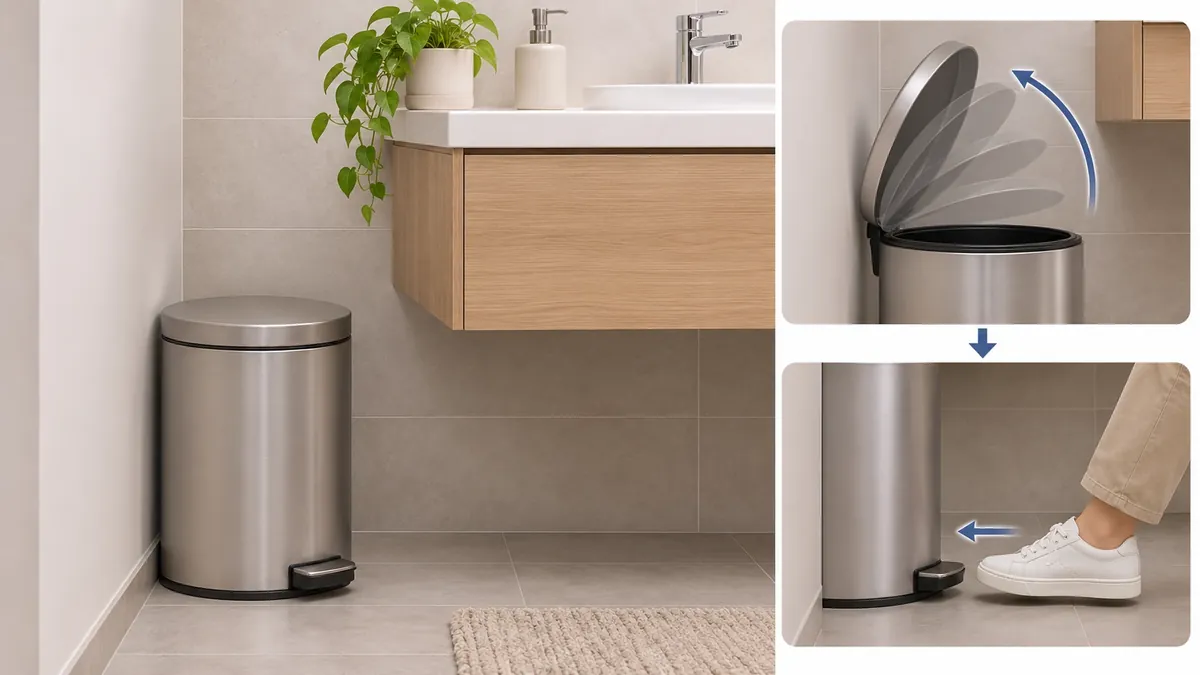
A product may have a hinge or linkage concealed inside its body. A manufacturer’s statement about an internal hinge on one model can help a buyer understand that such an architecture exists. It does not reveal the exact sweep or height for another model. Ask for the applicable technical drawing or examine the selected sample. Do not use an architecture label as a substitute for the envelope evidence.
Compare motion architectures against the site
A conventional pedal bin lid and a split lid do not necessarily share the same opening path. In a split design, sections may move differently from a one-piece lid. A hinge location may shift the highest point or rearward path. These are geometric possibilities to check, not claims that one design always suits small bathrooms better. The buyer should compare the actual opening motion with the actual room boundary.
The Simplehuman 5L Slim Step Can is a specific small product whose page describes an internal hinge for wall-side operation. The same manufacturer’s 45L Butterfly Step Can uses a split lid and is described for low-counter clearance. They serve as examples of model-specific approaches, not a controlled test or direct product comparison. The second product is a larger kitchen can, so it should not be presented as a bathroom equivalent or as evidence that a split lid will fit a particular vanity.
A buyer can assess options with a matrix rather than a universal ranking. For each candidate, identify the lid type, stated hinge arrangement, rear movement evidence, open height evidence, pedal side and supplied liner or bucket if relevant. Mark unknowns explicitly. If a maker supplies no envelope drawing, keep the dimension as a sample-review item or request a supplier confirmation. Do not estimate a missing value from a website photograph.
| Placement question | Evidence to gather | Why it is separate | Boundary to preserve |
|---|---|---|---|
| Will the closed body fit? | Current outline or sample against floor footprint | Does not include lid motion | Check model and revision |
| How much rear movement occurs? | Side-view drawing or observed sweep | Differs from open height | Do not infer from a closed photo |
| What is the open height? | Maker drawing or measured sample state | Does not show rear clearance | State the datum and sample identity |
| Can a user reach the pedal? | Layout sketch and approach-side review | Does not establish ergonomic suitability | Use the intended location |
| Can nearby doors move? | Combined fixture and bin layout | Another component may overlap the bin zone | Review both closed and moving positions |
| What parts are included? | BOM and packaging list | Images may show optional items | Name liner, bucket and accessories |
A split lid may be worth investigating when overhead space is limited, but the split alone is not proof of a fit. The opening height, lid path and bin body still need to be checked. An internal hinge may help a named model operate nearer a wall, but a buyer should not generalize that description into a guaranteed zero-gap installation. Leave a placement decision open when a relevant envelope is undocumented.
Conduct a repeatable sample and layout review
A review can be made repeatable without turning it into a lab test. Identify the exact bin model and sample condition. Place it at the intended orientation with the agreed wall, counter or cabinet boundary. Photograph the closed position, beginning of motion, intermediate sweep and fully open state. Note whether the pedal approach is clear and whether nearby doors or drawers are expected to move.
Use the same setup for each candidate model. If one bin is tested away from the wall and another is tested beside a vanity, the results are not comparable. Mark the relevant boundary on a floor plan or use a physical mock-up with the dimensions specified by the project team. This guide does not prescribe a clearance value; the buyer’s site drawing or the responsible designer supplies that requirement.
If the product has a removable inner bucket or liner, check whether those parts affect the task only if the program cares about them. Keep emptying, liner replacement and cleaning separate from lid clearance. A buyer might choose to assess all of them in one visit, but each result should have its own observation. Do not infer hygiene, odor control, sealing or ease-of-cleaning performance from a sample demonstration alone.
Record any uncertainty. If the sample lid does not reach the full open position, say that the open height was not confirmed. If a vanity drawing is preliminary, label the placement check provisional. If the supplier demonstrates a different finish or model revision, preserve that difference in the record. An honest “not assessed” status is more useful than an unsupported pass.
After selection, connect the review record to the SKU, drawing, quotation and approved product image. If the supplier changes the hinge, lid form, body shape, pedal position or supplied bucket, ask whether the placement check should be repeated. A new component can alter the envelope even when the product name remains the same.
When several bathroom layouts are in scope, make a small location matrix. Each row can identify a different installation condition: beside a wall, beside a vanity, inside a cabinet opening or in an unobstructed corner. For each location, enter the same model reference, boundary drawing, closed footprint status, rear motion status, open-height status and pedal-approach status. Mark “not assessed” when the evidence is missing. This makes it clear whether one bin has been reviewed for all locations or only for the particular sample setting used in the meeting.
Do not treat a successful fit at one address as a universal fit claim. A vanity overhang, skirting board, door swing or adjacent fixture can change the available envelope. If a distributor wants to publish placement guidance, it should state the exact product model and the boundary condition used for that guidance. A diagram can communicate the measured configuration, but it should not hide the fact that a different cabinet or wall arrangement may require a separate check.
Consider the position of the user as well as the lid. The pedal may be accessible when the bin is set away from the wall but crowded when it is pushed into a recess. A person may approach from a different side because of the toilet, vanity or room entry. The buyer can document the intended approach and ask the responsible product team to review the layout. This is not a substitute for a formal usability or accessibility evaluation where a project requires one.
If the bin is shown in lifestyle photography, use the same opening architecture and placement condition as the approved sample. An image with the lid held at a manually chosen angle does not show the full opening range. An image with the bin removed from its wall does not establish the rear clearance needed when it is operating. Product images should illustrate the selected reference honestly, and any dimensions should come from the maker’s current documentation or the buyer’s verified layout record.
The product file can preserve the evidence without turning every observation into a claim. Keep the source of each measurement, the date, the model and the setup. A manufacturer drawing, a buyer’s site plan and a physical sample observation are different sources. If they disagree, pause the placement statement and ask the responsible party to resolve the discrepancy. A transparent unresolved field is more useful than an estimate that later appears to be a certified fit value.
For a marketplace or distributor catalog, keep the closed footprint, rear lid motion and fully open height in separate fields. Combining them into one short description such as “fits tight spaces” removes the condition the buyer needs to evaluate. If dimensions are published, identify the exact model and whether the number comes from the maker’s current specification or a buyer’s verified sample record. Never fill a missing open-height field by measuring an image on a screen.
If two bin variants share a body but use different lids, keep their placement evidence separate until the maker confirms that the motion is the same. A component change can alter the open envelope without changing the general product name. The buyer can use one record for each variant and reference the lid part number, body part number and sample label. This is particularly useful when a supplier offers a split lid as an option, because the option’s presence alone does not tell the buyer how it moves in a specific space.
A buyer may also need to coordinate cleaning or emptying with the room layout. If a bin is lifted or moved before emptying, record that as a distinct task from pedal operation. If it remains in place, make sure the operating and liner-replacement positions are not conflated. The product maker may document the inner bucket or liner arrangement, while the buyer’s site owner defines where the bin can stand. Assign each question to its source rather than asking one product measurement to answer every placement concern.
Put the two clearances and accessory scope in the RFQ
An RFQ should describe where the bin will stand and what must move around it. Attach the location sketch or cabinet detail, state the floor footprint, identify the rear and overhead boundaries, and describe the user’s pedal approach. Ask the supplier to provide the exact model and revision, its current outline or operating drawing, and any documented open-lid dimensions. If the buyer is comparing a one-piece lid with a split or internal-hinge architecture, request a response for each specific model rather than a generic family claim.
Ask the supplier to distinguish its product data from the buyer’s installation assumption. A statement that an internal hinge permits wall-side use is a model-specific description; a project still needs the relevant clearance and site check. Record which values are maker-provided, which are measured from the submitted sample and which are supplied by the buyer’s own layout. Keep units and measurement datums consistent, and flag any drawing value that needs confirmation.
List the body, lid, pedal, inner bucket, liner, fasteners and packaging accessories separately where applicable. State whether an inner bucket or liner is included, optional or supplied by another party. A photo that shows a liner does not establish that the liner is part of the ordered product. For private-label listings, tie the front, side and open-lid images to the exact approved model and state only features supported by its documentation.
If a supplier proposes an alternative model, compare the closed footprint and operating envelope again. Do not transfer approval based on the word “slim,” similar capacity or appearance. Keep an unresolved rear or overhead dimension as an open condition and avoid approving a room-fit claim until the appropriate party has answered it. If the buyer’s requirement is a precise installation envelope, the product maker and site designer should confirm it against their respective current information.
At receiving or launch, verify that the product reference matches the reviewed sample and that the included components align with the BOM. This does not require a buyer to repeat every measurement on every unit. It does require the commercial team to avoid using an unreviewed substitute in product copy. A change to the body, hinge, lid or pedal should be routed through the product owner before the old placement material is reused.
Buyer checklist before approval
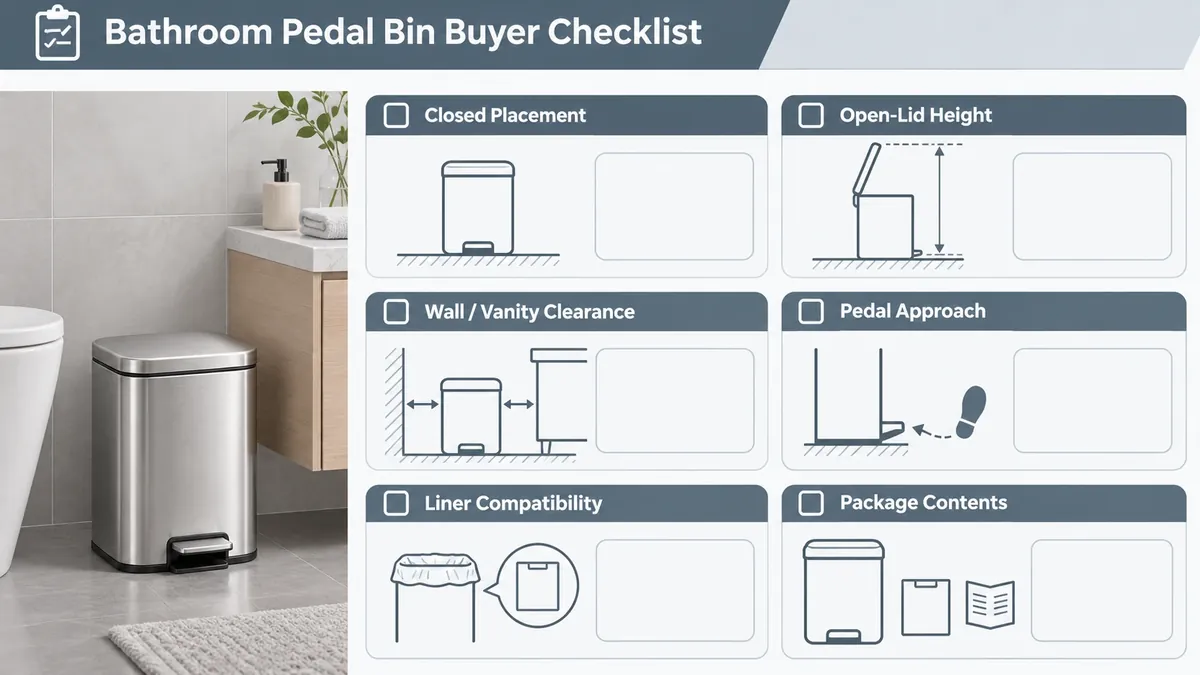
- Identify the exact bin model, SKU and drawing revision.
- Record the closed body footprint separately from opening movement.
- Check rear lid motion and fully open height as different envelopes.
- Confirm the wall, vanity, cabinet or other boundary used in the review.
- Assess the pedal approach and nearby moving doors separately.
- State whether the item is freestanding or intended for a cabinet opening.
- List the lid architecture, inner bucket, liner and accessories in the BOM.
- Use the same setup to compare candidate models.
- Label sample observations, maker dimensions and buyer site values by source.
- Reopen the review if the body, hinge, lid or pedal changes.
Does a slim bathroom bin mean the unit can sit directly against a wall?
No. It is not a universal clearance specification. Check the selected model’s lid motion and the buyer’s actual wall boundary.
Is open-lid height the same as rear lid clearance?
No. Open height describes the upper extent in an open state; rear clearance describes movement behind the bin. Request evidence for both where the site requires them.
Does an internal hinge prove that every unit fits under a vanity?
No. The cited maker describes an internal hinge on a specific product. A different size, model or cabinet may have a different envelope. Verify the selected reference against the location.
Is a split lid always best for a low counter?
No universal conclusion follows from the architecture. A named split-lid model may be designed for a low-counter application, but the buyer still needs the exact model’s motion and dimensions.
Does Koitor manufacture the cited pedal bins?
This article makes no such claim. Koitor’s relevant commercial link is its approved metal home-storage scope, and buyers should confirm actual product and component capability before requesting a quotation.
For project context, see Koitor’s OEM home-storage hardware scope. Buyers can share a placement drawing and selected hardware scope for review.
Review a Defined Home-Storage Hardware Scope
Share the intended placement drawing, selected model references, metal components, finish and packaging needs. Koitor can first confirm whether the defined metal scope fits its current capabilities before quotation.
OEM / EIGENE MARKE
Verwandeln Sie diesen Beschaffungsleitfaden in ein Produktdossier
Teilen Sie uns Ihr Zielprodukt, die Größe, die Oberflächenausführung, die Bestellmenge und Ihre Verpackungsanforderungen mit. Ihr Team erhält vor der Angebotserstellung eine praxisorientierte Prüfung der Herstellbarkeit.


 English
 Español
 Português
 Français
 Deutsch
 العربية