
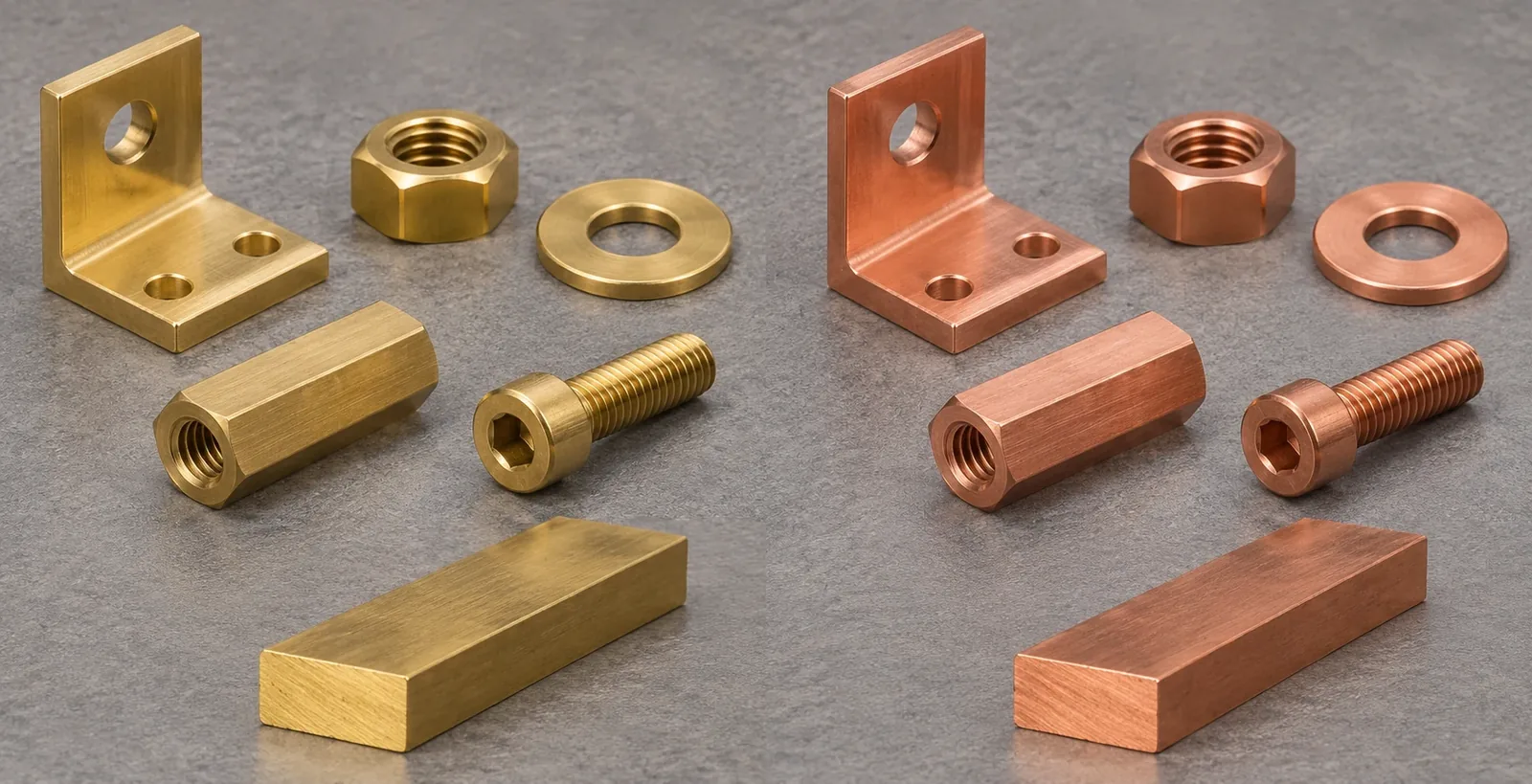
Brass vs copper is a comparison between a copper material and a family of copper-zinc alloys, not between two single grades with fixed properties. Their useful differences depend on the actual alloy designation, product form, condition, manufacturing route, finish and intended part. A buyer selecting hardware should compare complete proposed components against the same function and interface. Color or a general property table can help begin the discussion, but neither establishes the grade, fit or suitability of a finished product.
What is the basic difference in brass vs copper?
Copper is a metallic element used in different commercial grades and product forms. Brass is a family of copper-zinc alloys; the proportions and any additional alloying elements vary among grades. Therefore, “copper” and “brass” are broad names rather than complete engineering specifications. A buyer needs the material designation that corresponds to the supplier’s product and the form in which it will be made.
The Copper Development Association’s discussion of copper alloys describes copper alloy families, while its wrought brass datasheet collection ties properties to named materials. These sources support the distinction between a base metal and alloy families. They do not identify the composition of an unmarked part or prove that one grade is right for a particular bathroom or storage component.
For sourcing, the first question should be: what exact material does the quotation describe? “Brass-colored” may refer to an appearance; “brass” may mean a substrate, a finish family or a product label. Copper-colored plating likewise does not establish a copper substrate. Record material and surface treatment separately. If exact substrate identity matters, request the appropriate supplier documentation or agreed verification rather than inferring it from color.
The Copper Development Association’s brass and copper product resources provide useful family context. Commercial supplier and industry pages may focus on different product forms or uses; preserve those boundaries. A value reported for one alloy, temper or shape cannot automatically be applied to another. This article uses no single material property as a universal winner.
Why do the exact grade and product form matter?
A material family includes variations that are selected for different forming, machining, joining, appearance or service requirements. The grade and condition matter, as does whether the supplier is providing sheet, strip, rod, tube, a machined item, a cast item or another form. The buyer should not treat those routes as interchangeable simply because the finished parts share a color or outline.
When a quotation identifies only “copper” or “brass,” ask the supplier to state its controlled designation and form. If the material is purchased through a component supplier, ask which documentation accompanies the delivered item and which part number it covers. If the supplier proposes a substitute, compare the named material and process route with the approved drawing. Do not silently translate a general family name into a specific grade.
| Buyer question | Evidence to request or record | Warum das wichtig ist |
|---|---|---|
| Which material is supplied? | Exact supplier designation and applicable material record | Broad names include different alloys and conditions |
| What form is being processed? | Sheet, rod, tube, machined or other form as stated | Form influences how the part is made and what dimensions are practical |
| Which condition applies? | Temper or supplier condition when specified | Properties can depend on the supplied condition and processing history |
| What is the manufacturing route? | Forming, machining, joining, casting or secondary steps | A route change can change geometry, tooling and acceptance points |
| What is the surface? | Finish description and approved appearance sample | Finish and substrate are different attributes |
| What is the component’s job? | Drawing, mating features and environment | Material choice should answer the real part requirement |
| What is the approval reference? | Part number, revision and representative sample | Repeat orders need traceable identity, not a remembered color |
This record is more useful than asking which material is “better.” A material comparison is meaningful only against a function. A decorative cap may prioritize appearance, dimensional fit and surface consistency. A threaded fitting may require a carefully defined thread and mating part. A component subject to a specified load needs an engineering requirement and appropriate evidence. Those are different decisions, even when the same buyer is choosing between copper and brass.
How should a buyer compare the finished hardware component?
Compare the actual part geometry and assembly, not only raw-material descriptions. Two alternatives may have different section dimensions, wall thicknesses, interfaces or finishing routes. If one part is redesigned to serve the same function, compare the complete assembly rather than assuming equal dimensions mean equal behavior. Record which facts are known and which remain open.
Start by identifying the product function, mating parts, exposed faces, installation context and environment. Add the part drawing and revision, then mark critical dimensions and any threads, holes, bends, joints or contact areas. The supplier should identify the material and process it proposes for that geometry. If the part changes shape or route, have the responsible product engineer review the new interface and required acceptance evidence.

Finish must remain a separate comparison field. Polished, brushed, plated, lacquered or otherwise treated surfaces can differ in appearance and in maintenance requirements. A color match under one lighting setup does not prove that two parts use the same substrate or process. Approve a representative finished sample against a stated visual reference and specify which faces, edges and recesses are included in the review.
If the application depends on electrical or thermal properties, those may be relevant to a named component requirement. They should not be treated as automatic reasons to choose copper for a decorative bathroom fitting. If the part is structural, a generic conductivity or color comparison does not establish the design’s capacity. Keep each property attached to the requirement and supplier evidence that actually support it.
The full assembly also includes interfaces and other materials. A copper or brass component may contact stainless steel, aluminum, a coating, a polymer or a fastener. If a project has a corrosion or compatibility concern, evaluate the actual material pair, environment and design. The broad alloy name is not enough to settle how that joint behaves. The existing mixed-metal corrosion guide and brass versus stainless steel comparison address distinct neighboring questions; use them where they match the project rather than importing a blanket conclusion.
When supplier documents provide a property value, read the heading, condition and test context before putting it into a comparison table. Confirm whether the value describes a particular alloy, product form, temper or sample direction. Ask whether it applies to raw stock or to a finished part after forming, joining and coating. A number without its unit and conditions is not a useful approval basis. Two suppliers may report different values because their material designations or test conditions differ, not necessarily because one finished component is better.
The buyer can make a comparison useful by recording the claim next to its evidence and intended decision. For example, if mass matters for a moving component, define whether the comparison holds volume constant or compares two functionally equivalent designs. If finish appearance matters, use the approved finished sample under agreed review conditions. If a performance property matters, state the complete part and evidence required. This prevents a raw-material fact from being presented as a finished-product guarantee.
Keep supplier marketing language out of the specification unless it is translated into a verifiable requirement. Words such as “premium,” “solid,” “heavy-duty” or “weatherproof” may describe positioning but do not identify the alloy, form or acceptance method. Ask the supplier to clarify what the phrase refers to, and replace it in controlled documents with a designation, drawing, sample or evidence requirement. If the supplier cannot support a claim, keep it out of product copy rather than turning an assumption into an approval.
A useful handoff also records what did not change. If the material changes but the finish target stays the same, say so explicitly and review the appearance again. If the supplier and process stay fixed while the part geometry changes, identify the affected dimensions and sample checks. Clear change notes help prevent a later reviewer from assuming that an unchanged product title means every underlying specification remained unchanged.
Does color or weight identify copper versus brass?
Color and weight can be clues, but they are not reliable complete identification methods for a finished component. Finishes, coatings, lighting and product geometry can change visual appearance. Weight depends on both material and volume, and two components with different shapes cannot be compared by hand feel alone. A visual impression or a scale reading does not establish exact grade, processing condition or performance.
For purchasing records, identify the part by supplier designation and controlled drawing. If the buyer needs verified substrate information, state what supplier declaration or test record is acceptable. A casual magnet check, color chart or comparison to a household object should not be presented as definitive across all copper alloys, finishes and assemblies. The appropriate verification depends on the question and on whether the exposed surface is representative of the substrate.
Do not use a brass-colored sample to approve a copper or brass material callout unless substrate identity is independently supported. Conversely, if the requirement is only an agreed decorative finish, make that clear and avoid claiming a specific base metal that the supplier has not documented. Product listings and packaging should describe the verified material and finish accurately.
What should buyers consider before changing materials?
A copper-to-brass or brass-to-copper substitution can affect the material record, manufacturing process, dimensions, finish, supplier and assembly. Treat it as a controlled design or sourcing change. The change should be reviewed against the same use, interface and acceptance requirements as the original part.
- Record the approved component’s part number, supplier, material designation and drawing revision.
- Request the proposed material’s exact designation, product form and condition.
- Compare the manufacturing route and any tooling or secondary operation changes.
- Review the part drawing, dimensions, interfaces and visible surfaces.
- Identify the proposed finish and compare it with an approved appearance sample.
- Name the intended environment and product function.
- Identify required material records or test evidence and the responsible supplier.
- Build or obtain a representative sample using the proposed route.
- Have the product or engineering owner approve the changes and documented limits.
- Update the BOM, purchase description and incoming review before repeat production.
Keep unresolved information explicit. If a supplier has not stated the grade, write “not confirmed.” If an appearance sample is not tied to a revision, do not treat it as the final finish standard. If the part has changed geometry, mark the affected interfaces for review. A comparison worksheet should capture gaps as well as the selected answer.
Sample approval has a limited scope. It documents the part reviewed, the revision, the conditions and the criteria used. It does not automatically verify hidden composition, a long-term corrosion claim, load rating or production-lot consistency. For any statement that matters commercially or legally, agree the evidence and responsible party before the product is represented to customers.
What sourcing mistakes cause confusion?
Treating brass as one grade. Brass includes multiple copper-zinc alloys. Request the actual supplier designation and condition where relevant.
Treating “copper” as a complete specification. Commercial copper products also vary by grade and form. Match the record to the supplier’s offered product.
Equating finish with substrate. Copper-colored or brass-colored surfaces do not prove a solid copper or brass base. Record them separately.
Comparing raw material without the component. A part’s geometry and manufacturing route affect the actual product. Compare the complete proposed alternatives and mating parts.
Assuming one family is always stronger or more durable. Material labels alone do not establish the performance of a designed component. Ask for application-specific requirements and evidence.
Using a property chart as a product approval. A table may report a selected alloy and condition. It does not approve a different grade, shape, finish or assembled product.
Changing materials without notifying the buyer. A revised source or process can affect appearance and fit even if the listing name remains unchanged. Tie production to a controlled revision.
Comparing cost without matching scope. Material, route, finishing, machining, tooling, quantity and packaging can differ. State common assumptions before comparing quotations.
How can Koitor help clarify an OEM project?
Koitor Hardware is a family-owned custom metal hardware factory focused on bathroom and home-storage products. In a confirmed OEM project, Koitor can discuss the relationship between metal component drawings, assembly interfaces, sample review, surface finish and packaging scope. The specific supplier and material route for a purchased copper or brass part must be confirmed in that project; this guide does not represent Koitor as a copper smelter, brass foundry, material testing laboratory or supplier of every named alloy.
Provide a drawing or physical sample, the proposed material designation, the part’s function, mating components, desired appearance and unresolved questions. If a third-party component maker controls the material or finishing process, identify that supplier’s documentation responsibility. The product owner should set the performance requirement and decide what evidence is sufficient. A factory discussion helps coordinate the scope but does not create an unverified test result.
For private-label development or a trial order, retain the approved part identity and finish reference so the next sample or reorder can be compared against the same decision. Any material substitution should trigger review of the drawing, supplier record and sample. MOQ, sampling time and production lead time depend on the exact product and order and must be confirmed by quotation.
Learn about the confirmed scope on the Koitor OEM home-storage hardware page. To share a project question, use the Koitor contact page with the drawing or sample reference.
What should the RFQ and sample checklist include?
A useful RFQ lets suppliers quote the same component under the same assumptions. It identifies material, form, finish, geometry and interfaces separately. It also names which fields are buyer requirements and which supplier proposals still need approval. A brass vs copper quotation should identify the actual grade and form rather than leave the material family as the whole specification.

Before requesting a quote or approving a sample, document:
- Component function, product drawing and revision.
- Current and proposed supplier part numbers.
- Exact copper or brass designation and product form.
- Temper or condition, if the supplier specification makes it relevant.
- Manufacturing route and any secondary operations.
- Critical dimensions, mating parts, threads and installation features.
- Surface finish, appearance reference, and faces included in approval.
- Intended exposure, cleaning assumptions and use environment.
- Material records or other evidence required, with the responsible supplier named.
- Sample identity, review date, acceptance questions and unresolved items.
- Quote basis, including quantity, tooling, finish, inspection and packaging.
- Change-notification process for material, process, supplier or drawing revisions.
Do not use an open-ended phrase such as “premium copper,” “solid brass look” or “best for bathrooms” as a technical requirement. Translate the desired outcome into a named material or appearance specification and the evidence needed to verify it. If that information is not yet available, preserve it as a design decision with an owner and date.
How should material evidence be tied to the delivered item?
Ask the supplier which document identifies the material and whether it maps to a specific part number, lot or production revision. A generic brochure can explain a family, while a certificate or declaration may describe a narrower supplied item. The buyer should not assume that every document in a supplier’s catalog applies to the component being quoted. Record the document title, issuing party, date and scope so a future reviewer can locate the evidence used in approval.
If a material designation changes, check whether that change affects the form, processing condition, finish or assembly. A supplier may use a new source while keeping a familiar product name. Ask which changes require notification and whether the approved sample still represents the next shipment. If evidence is not available for a claim the buyer plans to make, change the claim or request a verification route before approving the copy.
The same control applies to outsourced finishing. The component maker may provide a substrate declaration, while a separate finishing supplier controls a coating or plating step. Keep each responsibility attached to the correct record. Do not attribute the finisher’s process to the assembly factory without confirmation. If the finished appearance is critical, retain an approved sample or controlled visual reference and note any lighting or viewing conditions used to judge it.
This documentation discipline is useful even for decorative parts that do not need an extensive test program. It helps buyers distinguish an appearance decision from a material decision, and it prevents a descriptive phrase from becoming an unsupported technical claim. When no special evidence is required, state that the review is limited to the listed drawing, sample and finish criteria.
Häufig gestellte Fragen
Is brass just another name for copper?
No. Brass is a family of copper-zinc alloys. Copper is an element and is also supplied in different commercial grades and product forms. The actual designation should come from the supplier.
Is brass stronger than copper?
There is no universal answer from the family names alone. Grade, condition, part shape, manufacturing route and joint design influence the finished component. Compare the actual alternatives against a defined requirement.
Can a brass-colored part be made from another material?
Yes. A surface treatment can create a brass-like appearance on another substrate. Specify surface appearance and base material separately.
Can weight tell me whether a part is brass or copper?
Weight alone is not a definitive material test. It depends on the part’s geometry and volume as well as the material. Use the product identity and suitable supplier evidence.
Which should a bathroom hardware buyer choose?
Choose based on the actual component, required appearance, environment, manufacturing route and evidence. Neither broad family name is automatically right for every bathroom product.
Does a sample prove the material is correct?
A sample supports review of the identified item, but visual appearance does not prove hidden substrate composition. Request the agreed material record or verification method when composition matters.
Sources and further reading
- Copper Development Association: Copper alloys
- Copper Development Association: Wrought brass datasheets
- Brass vs stainless steel hardware comparison
- Brass dezincification in bathroom hardware
- C260 and C360 brass grade guide
Work with Koitor Hardware
Compare the real part before selecting its material
Share the component drawing or sample, material designation, finish reference and mating parts so the OEM discussion can focus on the actual product requirement.
OEM / EIGENE MARKE
Verwandeln Sie diesen Beschaffungsleitfaden in ein Produktdossier
Teilen Sie uns Ihr Zielprodukt, die Größe, die Oberflächenausführung, die Bestellmenge und Ihre Verpackungsanforderungen mit. Ihr Team erhält vor der Angebotserstellung eine praxisorientierte Prüfung der Herstellbarkeit.


 English
 Español
 Português
 Français
 Deutsch
 العربية